Best JD/MBA Programs in North Carolina
Compare 6 accredited JD/MBA programs in North Carolina, with graduate earnings, cost, debt, and completion data from IPEDS and the U.S. College Scorecard.

Choosing a North Carolina JD/MBA means weighing price against prestige, and the spread is wide. Average net price runs from about $11,655 at the University of North Carolina at Chapel Hill to $41,555 at Elon University, though those are institution-wide figures, not JD/MBA quotes.nnThe payoff is one dual degree that qualifies graduates for the bar and for business leadership roles, including MBA in Finance roles, in Charlotte's banking sector and the Research Triangle's corporate and tech employers.nnMost programs take four years, a year less than earning both degrees separately.
Key Points
- Most North Carolina JD/MBAs take 4 years, versus about 5 separately.
- UNC-Chapel Hill has the lowest net price, roughly $11,655 institution-wide.
- None of the schools here publishes a GMAT or GRE waiver for the JD/MBA.
Best JD/MBA Schools in North Carolina, Ranked
This list weighs cost, graduate outcomes, and program format together, and every figure shown is institution-wide rather than specific to the JD/MBA. Graduation rates describe the whole school, and tuition figures are published graduate rates that may differ from what dual-degree students pay. Confirm current ABA and AACSB status with each school before you apply, since we could not independently verify it for every program.
Duke University
#1Durham, NC · ~$67,000/yr (est.)
Best for: Students wanting flexible sequencing across both schools
Duke pairs Duke Law and the Fuqua School of Business in Durham. The school has a graduation rate of 97%, and published graduate tuition is about $65,120 for both in-state and out-of-state students. The program runs four years instead of the five that separate degrees would take, with an accelerated 3.5-year option and three summers for internships. Duke Law and Fuqua are expected to hold ABA and AACSB accreditation, but we could not independently confirm current status, so verify it directly.
- Four years versus five for separate degrees
- Accelerated completion in 3.5 years is available
- Three summers for internships and employment
- Flexible order for the first two years
- Separate admission decisions from Duke Law and Fuqua
- Blended Law and Fuqua tuition rate each semester
- Current Duke JD students may add the MBA in year two or three
University of North Carolina at Chapel Hill
#2Chapel Hill, NC · ~$13,000/yr (est.)
Best for: North Carolina residents prioritizing lower tuition
UNC-Chapel Hill offers a JD/MBA through its School of Law and Kenan-Flagler Business School, a full-time, campus-based path. The school has a graduation rate of 91%, and published graduate tuition is about $10,764 in-state and $29,421 out-of-state, the widest in-state advantage on this list. Students complete each school's first-year core, then study jointly with up to 12 hours cross-credited. Verify current ABA and AACSB accreditation with the school, as our research could not confirm it.
- Minimum of four academic years
- Separate applications to the law school and Kenan-Flagler
- At least 74 law credits and 63 MBA credits
- Up to 12 hours cross-credited toward each degree
- Full first year enrolled in each program
- One-year admission deferment available
- Two years of joint study
Elon University
#3Elon, NC · ~$22,000/yr (est.)
Best for: LSAT takers avoiding the GMAT or GRE
Elon Law and the Love School of Business jointly offer a JD/MBA in Elon, with a focus on experiential learning. The school has a graduation rate of 84%, and published graduate tuition is about $22,086 for all students. Students apply to the MBA after their first year of law school, and the LSAT is accepted for MBA admission. ABA and AACSB status could not be independently confirmed in our research, so check with the school.
- Apply to the MBA after the first year of law school
- LSAT accepted for MBA admission, no GRE or GMAT needed
- Earn both degrees in less time than separately
- Residency-in-practice experiential law program
- Mentoring and leadership cultivation programs
Campbell University
#4Buies Creek, NC · ~$16,000/yr (est.)
Campbell Law offers a Juris Doctor/MBA through a cooperative arrangement with a partner business school, delivered in a hybrid format that suits working professionals. The school has a graduation rate of 61%, and published graduate tuition is about $15,156 for in-state and out-of-state students alike. Available details on this program are limited, so confirm curriculum, timeline, and current ABA and AACSB status with the school directly.
- Hybrid format for added scheduling flexibility
- Cooperative arrangement between law school and business school
- Aimed at administrative and executive roles
- Combines core JD courses with MBA coursework
North Carolina Central University
#5Durham, NC · $5,000 – $10,000/yr (est.)
North Carolina Central University offers a JD/MBA exclusively to NCCU School of Law Day Program students, completed in four years. The school has a graduation rate of 42%, and published graduate tuition is about $4,740 in-state and $18,048 out-of-state, the lowest on this list. Students need separate admission to the School of Business, which accepts the LSAT in place of the GMAT or GRE. Verify current ABA and AACSB accreditation directly, as we could not confirm it independently.
- Open only to NCCU Law Day Program students
- Four-year completion
- Separate admission to the School of Business
- LSAT accepted in lieu of the GMAT or GRE
- Business school entry after the first year of law
- MBA credits range from 33 to 60 depending on preparation
- Fall applications due June 1, reviewed on a rolling basis
Cost & outcomes by school
Federal data for the highest-earning JD/MBA programs, independent of the ranking above. Earnings are this field's master's graduates four years after completing, where the Scorecard reports them.
| School | Earnings | Tuition / yr | Debt | Grads/yr | Format |
|---|---|---|---|---|---|
| North Carolina Central University NC | — | $7,638 | — | — | Campus |
| University of North Carolina at Chapel Hill NC | — | $12,751 | — | — | Campus |
| Campbell University NC | — | $16,347 | — | — | Hybrid |
| Elon University NC | — | $22,086 | — | — | Campus |
| Wake Forest University NC | — | $39,141 | — | — | Campus |
| Duke University NC | — | $66,523 | — | — | Campus |
Sources: U.S. Department of Education. Tuition and graduates: IPEDS. Earnings and debt: College Scorecard, this field's master's graduates; a dash means no figure is reported.
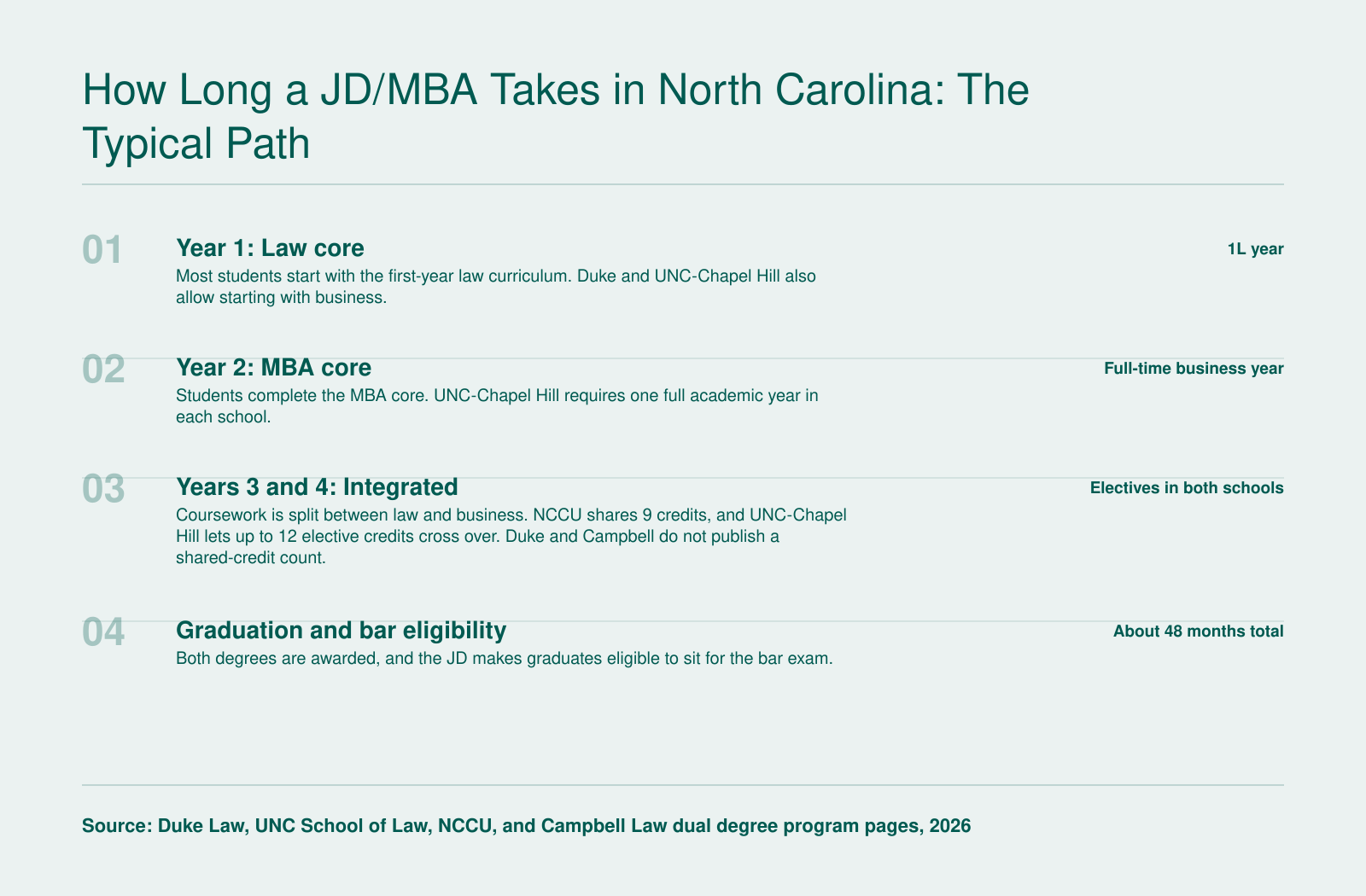
How Long a JD/MBA Takes in North Carolina: The Typical Path
Most North Carolina JD/MBAs take 4 years, compared with about 5 years for the two degrees earned separately. Duke describes a 3.5-year route that depends on careful course scheduling. UNC-Chapel Hill, North Carolina Central University and Campbell do not publish an accelerated or 3-year track, and Elon's pages do not state a program length.
Online and Hybrid JD/MBA Options in North Carolina
Among master's programs in North Carolina, Campbell University is the only school here listed as hybrid, while Duke University, the University of North Carolina at Chapel Hill, Elon University, and North Carolina Central University are listed as campus programs. Even Campbell's hybrid label deserves caution. Its dual degree requires four years of full-time study, and the published schedule does not say which MBA courses, if any, are online.
The reason is the JD. American Bar Association rules cap how many law credits can be earned through distance education, so the law half is typically taught in person. At NCCU, the JD is daytime and on campus, and the dual degree is open only to Day Program students. UNC describes both degrees as full-time, with the MBA on campus.1 Duke and Elon do not publish an online or evening MBA path for dual-degree students that we could confirm.
Can you earn a JD/MBA dual degree program fully online in North Carolina? No: none of these programs offers one, and the most flexibility you can expect is hybrid MBA coursework alongside in-person law classes.
JD/MBA Programs That Waive the GMAT or GRE
Based on the admissions pages reviewed, none of the schools here publishes a GMAT or GRE waiver for the JD/MBA, and none clearly states that an LSAT score can replace the GMAT on the business side. Duke accepts the LSAT or GRE for law admission, and North Carolina Central requires the LSAT, but those rules cover the law application only. Campbell University is left out of the table because its requirements could not be confirmed, so check with its admissions office directly. Always confirm current policies and deadlines with each school before applying.
| School | MBA Test Policy (GMAT/GRE) | Law School Test Policy (LSAT/GRE) | Application Deadline |
|---|---|---|---|
| Duke University | No published waiver policy for the JD/MBA (LSAT may replace the GRE only for the separate JD/MA) | LSAT or GRE required; either gets equal consideration | February 15, 2027 |
| University of North Carolina at Chapel Hill | No published waiver policy | No minimum LSAT stated; recent median LSAT was 167 | March 1 |
| Elon University | No published waiver policy (the MBA admissions page does not address GMAT or GRE requirements) | Not confirmed in available research | July 15 |
| North Carolina Central University | No published waiver policy | LSAT required, with an LSAT writing sample; each component is applied for and accepted separately | October 1 through April 30 |
Related Articles
Cost of a JD/MBA in North Carolina and Employer Demand for MBA Graduates
The University of North Carolina at Chapel Hill carries the lowest net price among the ranked best business schools in north carolina at roughly $11,655, but that is an institution-wide average after financial aid, not a quote for a JD/MBA.
Public vs. private tuition
In-state graduate tuition among these schools shows a clear public advantage: North Carolina Central lists about $7,638, UNC-Chapel Hill about $12,751, while Campbell ($16,347), Elon ($22,086), and Duke ($66,523) charge the same for all students. Out-of-state students at UNC face $31,408, still below Duke's price.
At UNC-Chapel Hill, the UNC School of Law tuition and fees page lists annual resident tuition and mandatory fees of $33,116, so a four-year JD/MBA could exceed $130,000 in law tuition alone before adding the MBA portion and living costs. Private schools run higher, with Duke's annual tuition figure alone making a four-year program a six-figure investment.
Where North Carolina employers hire
Charlotte's banking and finance headquarters and the Research Triangle's corporate, tech, and life-sciences employers consistently seek dual degree holders for in-house counsel, compliance, and strategy consulting roles. A JD/MBA is especially valuable in roles where legal risk and business decisions intersect, from contract negotiation to regulatory strategy.
Debt and payoff
Median graduate debt among these programs ranges from $13,000 at Duke to $28,250 at North Carolina Central, though those figures cover all graduate borrowers, not only dual-degree students. Duke's low debt pairs with institution-wide median earnings near $97,800 ten years after entry, while NCCU's higher debt sits against institution-wide median earnings of about $42,968. The payoff varies across best MBA schools, but lower debt at a high-earning school can offset a larger tuition bill.
Choosing the Right JD/MBA Program for Your Career Goals
Choose the program that lines up with the legal market you want. Duke's JD/MBA, with Fuqua access and structured internship summers, fits students aiming for national corporate law and large-firm recruiting. UNC is the strongest in-state public value: its most recent ABA summary reports 189 of 205 graduates in bar-required roles, and a separate Class of 2025 summary reports 90.2% full-time, long-term, bar-passage-required employment. Elon's three-year JD/MBA feeds small and mid-size Southeast and mid-Atlantic firms; Campbell prepares graduates for administrative and executive roles across corporate, government, and nonprofit settings. NCCU, an HBCU, offers a four-year day program path with broad employment across private, government, judicial, and corporate sectors.
Is a JD/MBA worth it for corporate law? The extra year and tuition can pay off for deal work, finance, or in-house roles where business literacy is valued. For pure litigation, a standalone JD may be enough, so weigh the added cost against whether you actually need a General MBA credential for your target practice.
Frequently Asked Questions About JD/MBA Programs in North Carolina
What is the cheapest JD/MBA program in North Carolina?
Do you need to take the GMAT for a JD/MBA in North Carolina?
Can you apply to a JD/MBA after starting law school?
Do JD/MBA students in North Carolina qualify for scholarships from both schools?
Compare JD/MBA programs on the data that matters
Explore more MBA specializations or browse every graduate field.
All MBA programs