Best JD/MBA Programs in South Carolina
Compare 5 accredited JD/MBA programs in South Carolina at 3 schools, with graduate earnings, cost, debt, and completion data from IPEDS and the U.S. College Scorecard.

Earning a JD and an MBA separately can run five or six years; the dual-degree path in South Carolina compresses that to roughly three and a half, with University of South Carolina students starting the sequence each July. The tradeoff is choice: the state offers only a handful of combined tracks, and none runs fully online.
All of them share one structure, two years of law first, then MBA coursework in year three. Tuition, admissions testing rules, and graduate earnings diverge enough that the cheaper nameplate is not always the stronger return.
Key Points
- USC's JD/MBA lists lower in-state tuition than Charleston's.
- No South Carolina JD/MBA can be finished entirely online.
- USC's law school reports a 90.05% first-time bar pass rate.
Ranked: South Carolina JD/MBA Programs for 2027
South Carolina's JD/MBA options cluster around three distinct paths: a Columbia university pathway with multiple MBA tracks, a Charleston campus MBA paired with JD study, and a law-school-led dual degree with the College of Charleston MBA. The order below weighs cost, completion time, and format, with added emphasis on career outcomes and graduation success.
University of South Carolina
#1Columbia, SC · ~$14,000/yr (est.)
Best for: Future corporate counsel and business leaders
University of South Carolina combines the School of Law and Darla Moore School of Business for JD/MBA options that take about three and a half years through a one-year MBA or four years through an International MBA. Students build corporate law, negotiation, and strategic decision-making skills, with an optional business analytics certificate and access to both alumni networks.
- Complete in three and a half years
- Finance, marketing, supply chain, or strategic management specializations
- Business Analytics graduate certificate option
- LSAT required
- Four-year program
- 3.0 GPA minimum
- In-country immersion experience
- LSAT accepted for MBA admission
- French, German, or Spanish language options
- Corporate internship included
- Priority deadline March 1
- LSAT accepted for GMAT waiver
College of Charleston
#2Charleston, SC · $16,000 – $21,000/yr (est.)
Best for: Charleston-based law students wanting full-time MBA
College of Charleston pairs a one-year, full-time MBA with Charleston School of Law's JD for law students who typically apply after two years of law school. The AACSB-accredited, cohort-based program uses case studies, team projects, executive mentors, and a global immersion trip, with emphasis areas in finance, marketing, business analytics, and hospitality and tourism development.
- Law students typically apply after two years of law school
- Full-time, on-campus program
- AACSB accredited
- Cohort-based learning environment
- Emphasis areas: finance, marketing, business analytics, or hospitality and tourism development
- Case-based team projects and global immersion trip
Charleston School of Law
#3Charleston, SC · ~$48,000/yr (est.)
Best for: Current Charleston Law students after two years
Charleston School of Law offers a dual JD/MBA through the College of Charleston MBA for current JD students who complete two years of full-time study, including Contracts I and II plus a business associations or business organizations course, while in good academic standing. The program is not open to transfer students and requires satisfying each school's degree requirements separately.
- Requires two years of full-time law study before applying
- Complete Contracts I and II plus Business Associations or Business Organizations
- Must remain in good academic standing
- Transfer students not eligible
- Partner with College of Charleston MBA
- ABA-accredited law school
Cost & outcomes by school
Federal data for the highest-earning JD/MBA programs, independent of the ranking above. Earnings are this field's master's graduates four years after completing, where the Scorecard reports them.
| School | Earnings | Tuition / yr | Debt | Grads/yr | Format |
|---|---|---|---|---|---|
| College of Charleston SC | — | $16,300 | — | — | Campus |
| University of South Carolina SC | — | $14,134 | — | 35 | Campus |
| Charleston School of Law SC | — | $48,234 | — | — | Campus |
Sources: U.S. Department of Education. Tuition and graduates: IPEDS. Earnings and debt: College Scorecard, this field's master's graduates; a dash means no figure is reported.
USC vs. Charleston: How the JD/MBA Paths Compare
All three tracks run the same way: two years of law first, then MBA coursework starting in year three.
- USC One-Year MBA/JD: 90-hour JD plus 41 MBA hours, about 3.5 years. Starts each July.
- USC International MBA/JD: 90-hour JD plus a 68-hour International MBA, about four years.
- Charleston JD/MBA: Charleston School of Law JD plus a 40-credit College of Charleston MBA (30 core, 9 emphasis, 1 experiential), 3.5 years full-time, finishing with a final semester back at the law school. Each school accepts up to 9 approved credits from the other, and you must be admitted to both.
Which USC credit total is current?
Use the academic bulletin's 68 hours. The Moore School page cites 74 hours beyond the JD and gives conflicting overlap savings (12 hours in one place, 18 in another), so confirm with the school before you plan around it.
Is the International MBA worth the extra time?
The MBA in International Business adds roughly six months and 27 more MBA hours than the One-Year. That pays off for students targeting cross-border transactions, trade work, or international employers. Language and overseas requirements are best confirmed with the Moore School. For domestic practice, the One-Year or Charleston path gets you earning sooner.
How long does a JD/MBA take in South Carolina? About 3.5 years on the One-Year and Charleston paths, and about four years on USC's International track.
Online and Hybrid JD/MBA Options in South Carolina
No JD/MBA among master's programs in South Carolina can be finished entirely online. USC's law school allows no more than 6 distance credits per term and 12 total toward the 90-credit JD, and a student cannot take any distance coursework until 28 JD credits are complete. That cap reflects the ABA framework that limits remote credit in accredited JD programs nationally, which is why some students compare Best Online JD/MBA Programs elsewhere.
The listings for University of South Carolina, College of Charleston and Charleston School of Law are all flagged campus-based, and the schools' own pages describe full-time, in-person sequences. USC Aiken does run a separate 100% online MBA (30 credits, about $13,948, as few as 10 months)1, but published materials do not show those courses count toward the law school's dual-degree plan.
Practical tip for working professionals: the MBA year at USC is structured as full-time study, so ask admissions directly which individual courses have evening, weekend or hybrid sections before assuming you can keep a job through it.
Related Articles
Which South Carolina JD/MBA Programs Waive the GMAT or GRE?
South Carolina's testing policies for JD/MBA programs with no GMAT or GRE required leave room for interpretation, and the clearest guidance comes from the University of South Carolina. USC's Darla Moore School of Business publishes no fixed GMAT or GRE waiver cutoff, a policy also seen in master's programs with no GRE required. Instead, JD/MBA applicants may be eligible to use the LSAT in place of a business-school test if their score is "above average," but the school does not define that threshold numerically. The policy is discretionary, and wording differs between pages, so treat the LSAT substitution as a possibility rather than a guarantee.
The broader JD/MBA application at USC still requires a bachelor's degree, separate law and business applications, a resume, essays, and the law school acceptance letter. Qualified applicants complete a required interview, maintain at least a 3.0 law GPA through the end of the second year, and file an approved plan of study before MBA coursework.
For Charleston-area options, official materials do not publish a distinct JD/MBA test-waiver policy or GMAT/GRE waiver criteria. To confirm a waiver before applying, contact the Darla Moore admissions office for USC or the relevant Charleston admissions office directly.
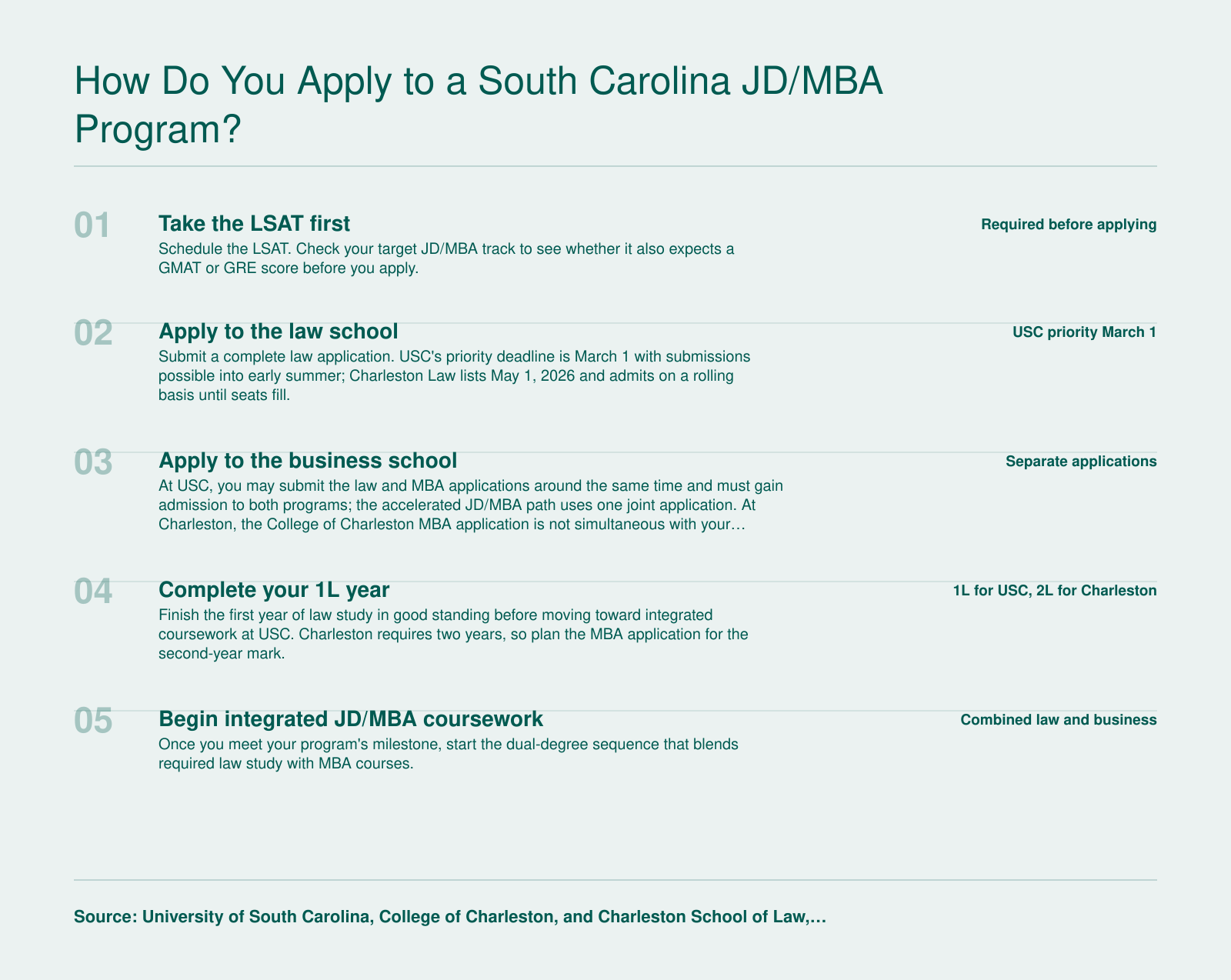
How Do You Apply to a South Carolina JD/MBA Program?
Applying to a South Carolina JD/MBA means coordinating law and business admissions. The timing differs by campus: USC allows applying to both fairly early, while the Charleston path begins with law school and adds the MBA later.
Cost and South Carolina Employer Demand for MBA Graduates
Which program is cheaper?
On the published annual figures in our data, the College of Charleston JD/MBA lists in-state tuition of $16,300 and out-of-state tuition of $21,412. The University of South Carolina JD/MBA lists $14,134 in-state and $30,160 out-of-state. If you qualify for South Carolina residency, USC is the cheaper starting point; if you pay nonresident rates, Charleston comes in lower, so compare both against the most affordable JD/MBA programs.
What the full dual degree runs
USC's institution-wide average net price lands near $22,811, and Charleston's near $18,960; treat both as rough, campus-wide averages rather than JD/MBA-specific totals. For USC, the MBA portion carries a whole-program fee of $16,320 for residents and $23,040 for nonresidents in 2026-27, with School of Law tuition charged separately. Add Columbia or Charleston living costs across three-plus years and the full dual degree runs well into six figures, so model your own residency status and housing before committing.
Who hires these graduates
South Carolina's financial-manager roles are projected to grow at double-digit rates through 2032, according to a South Carolina Commission on Higher Education financial services program review. JD/MBA graduates here feed law firms, manufacturing, healthcare systems, banking, and the Port of Charleston logistics economy, with hiring concentrated around Columbia, Charleston, and Greenville.
In its latest ABA Standard 509 bar passage disclosure for 2025 graduates, the University of South Carolina School of Law reported a 90.05% first-time pass rate across all jurisdictions, well above the 81.13% pass rate for all South Carolina Council-accredited law schools.
Career Outcomes and Earnings for JD/MBA Graduates
Dual-degree holders increasingly land in roles that did not exist as distinct job titles a decade ago, particularly in regulatory compliance and data privacy. Neither South Carolina JD/MBA program publishes combined-degree salary figures of its own, so the closest signal comes from the business side: Best MBA Programs. At USC's Darla Moore School, the full-time MBA Class of 2025 reported 93 percent employed within three months of graduation, with average base salary of $87,927.1 Moore's International MBA cohort, one of the MBA in international business South Carolina options, reported 96 percent domestic employment at three months, with average compensation of $87,098 domestically and $92,669 for those placed abroad.1
Where graduates land
Common destinations include corporate and transactional law, compliance, in-house counsel roles, management consulting, real estate and finance, and startup or family-business leadership. The JD/IMBA route takes about four years, so you reach that market a year or more ahead of sequential degrees.
The ROI picture
Median graduate debt at the University of South Carolina sits at $21,500, below Moore's reported average MBA starting compensation by a comfortable margin. Bear in mind that law school borrowing stacks on top of that figure.
South Carolina JD/MBA FAQs
How long does a JD/MBA take in South Carolina?
Is the USC International MBA worth the extra time compared with the One-Year MBA?
Do I need to pass the bar in South Carolina if I plan a business career after a JD/MBA?
Can I switch into the JD/MBA after starting law school?
Compare JD/MBA programs on the data that matters
Explore more MBA specializations or browse every graduate field.
All MBA programs