Accelerated JD/MBA Programs
Compare 200+ accredited fastest JD/MBA programs at 180+ schools, with graduate earnings, cost, debt, and completion data from IPEDS and the U.S. College Scorecard.

Law schools and business schools have spent the past decade shortening the path to a joint degree, and the gap between the standard and compressed routes is now large. Pursued separately, a JD and an MBA take five years. Accelerated tracks finish in three or four by letting each school count a share of the other's credits and by running coursework through summers.
For affordable JD/MBA programs, the tradeoff is intensity against cost: a shorter timeline means fewer terms of tuition and a year of earlier salary, but little room for internships, and some programs still bill at law school rates. The rankings weigh speed, price, and graduate outcomes.
Key Points
- Several programs below finish a JD and MBA in just three years.
- At Wisconsin-Madison, median earnings five years after entry reach $160,846.
- JD/MBA grads split into law firm and business payoff tracks.
Best Accelerated JD/MBA Programs Ranked: 10 Schools That Finish Fastest
This list favors programs that cut the most time off a dual degree, then balances net price, graduate debt, and federal completion and earnings data against prestige. Not every school below labels itself a three-year track, but each saves at least a year compared with earning the two degrees separately. Cards show institution-wide tuition and net price after aid so you can compare the real cost of speed.
Lewis & Clark College
#1Portland, OR · $15,000 – $20,000/yr (est.)
Best for: Pacific Northwest professionals wanting dual flexibility
Lewis & Clark's joint JD/MBA with Portland State University is designed for law students who want a four-year dual degree rather than five. The timeline stacks three years of law study on campus with one year of PSU MBA coursework, and approved business law credits count toward the MBA core. It is a practical fit for applicants who prefer to skip the GMAT and instead show math proficiency for MBA admission.
- 4-year program
- No GMAT required for law students
- Math proficiency required for MBA admission
- Enter MBA during first or second JD year
- One year at Portland State University
- Business law credits fulfill MBA core requirements
- 2.8 GPA minimum
- Financial aid available
University of Pennsylvania
#2Philadelphia, PA · ~$48,000/yr (est.)
Best for: Aspiring corporate attorneys needing Wharton network
Penn's Carey JD/MBA is a true three-year accelerated track, with the first year in the law school, a joint summer, and years two and three blending Wharton core work with law electives. A required capstone and pro bono legal work push students to integrate both degrees rather than just collect credits. It is built for students targeting corporate law, investment banking, or entrepreneurship where both credentials carry immediate weight.
- 3-year program
- Accelerated three-year curriculum
- Capstone course in final year
- Pro bono legal work required
- Combination of law and business courses
- Earn both JD and MBA degrees
- Prepares for careers at intersection of law and business
Yale University
#3New Haven, CT · ~$50,000/yr (est.)
Best for: Government-bound leaders wanting policy and management
Yale's MBA/JD is a four-year dual degree that keeps two years with Yale Law School, one year in Yale SOM's integrated MBA curriculum, and a final year of electives across both schools. The program requires independent admission to both schools, so the cohort is genuinely dual-credentialed from the start. It suits students aiming for government, policy, or private-sector leadership where legal and managerial training overlap.
- 4-year program
- Two years at Yale Law School
- One year at Yale SOM
- Electives at both schools
- Admitted to both schools independently
- Apply to both programs simultaneously
Duke University
#4Durham, NC · ~$67,000/yr (est.)
Duke's JD/MBA between Duke Law and Fuqua can be finished in four years or accelerated to 3.5 years, with flexibility to begin at either school. Three summers leave room for internships in both law and business, and students draw on dedicated career centers from each side. The program is a strong fit for people who want finance or legal practice with a shorter runway than two separate degrees.
- 4-year program
- Accelerated completion in 3.5 years
- Collaboration with Fuqua School of Business
- Three summers for internships and employment
- Flexible order of first two years
Washington University in St Louis
#5St. Louis, MO · ~$65,000/yr (est.)
WashU's JD/MBA combines WashU Law and Olin Business School over four years, saving one year versus pursuing the degrees separately. The curriculum mixes corporate law, transactional practice, and business management, with access to career services from both schools. It is aimed at students who want a competitive edge in corporate law, investment banking, or regulatory roles.
- 4-year program
- Combines legal and business training
- Financial aid available
- Prepares for corporate law and entrepreneurship
- Access to dual career centers
- Top-ranked WashU Law and Olin
- Outstanding placement rates
- Extensive alumni networks
University of North Carolina at Chapel Hill
#6Chapel Hill, NC · ~$13,000/yr (est.)
UNC-Chapel Hill's JD/MBA requires separate admission to the School of Law and Kenan-Flagler Business School, but cross-credits up to 12 hours between the two. The first-year core of each program is completed before two years of joint study, so the integration happens late and deliberately. It suits students who want a campus-based, full-time dual degree in the Research Triangle.
- 4-year program
- Minimum of four academic years
- Separate applications to each program
- Cross-credit up to 12 hours each
- One-year admission deferment available
- Two years of joint study
University of Wisconsin-Madison
#7Madison, WI · ~$12,000/yr (est.)
Wisconsin's dual degree in law and business lets students share up to 15 credits between the Law School and Wisconsin School of Business. Applicants are encouraged to apply to both programs in the same year, and admitted MBA students defer enrollment for one year while finishing the first year of law school. It is a practical option for students who want legal and management training without losing a full year to separate admissions cycles.
- 15 shared credits maximum
- Apply to both programs in same year
- MBA admission deferred one year
University of Maryland-College Park
#8College Park, MD · ~$18,000/yr (est.)
Maryland's joint MBA/JD from Smith and Maryland Carey Law is a four-year integrated program with no entrance exam requirement beyond what the schools ask. Core business and law courses are sequenced so students gain finance, marketing, contracts, and constitutional law together. The Baltimore-Washington location and personalized career services are the main draw for students targeting corporate or government roles.
- No entrance exam required
- Test optional
- 4-year program
- Joint MBA and JD degrees
- Four-year accelerated program
- Separate applications to both schools
- Located in DC-Baltimore corridor
- Career services and recruitment support
University of California-Davis
#9Davis, CA · $15,000 – $20,000/yr (est.)
UC Davis offers a four-year JD/MBA concurrent degree with the Graduate School of Management and either UC Davis School of Law or UC Law San Francisco. Up to 12 units of JD coursework count toward the MBA, and students must be admitted to both schools. It is a flexible, campus-based path for students who want legal and business training in Northern California.
- 4-year program
- As few as four years
- Partnership with UC Davis School of Law
- Partnership with UC Law San Francisco
- 12 units of JD coursework accepted
- Separate admissions to both schools
- Custom paths available
Rutgers University
#10New Brunswick, NJ · ~$23,000/yr (est.)
Rutgers' JD/MBA on the Newark campus joins Rutgers Business School and Rutgers Law School in a four-year sequence: first-year JD, second-year MBA core, then two years combining both. Admission requires separate applications and the LSAT, with some credits recognized between schools. It fits students who want a public-university dual degree and a clear structure from law to business leadership.
- Entrance exam required
- Exams: LSAT
- 4-year program
- Complete in just four years
- Offered on Rutgers Newark campus
- First year focuses on JD curriculum
- Second year focuses on full-time MBA core
- Third and fourth years combine both disciplines
None of the ranked JD/MBA programs match the fastest lens yet. The full ranking is at the link above.
Cost, debt & payoff
Median earnings of this field's master's graduates (4 yrs after completing) vs. their median federal loan debt · U.S. College Scorecard
Across these programs the median graduate earns about $142,843 and finishes with roughly $47,552 in debt — a ratio that clears a common rule of thumb (keep debt below first-year salary). Tuition and debt vary widely school to school, so check the per-school figures in the table above before you shortlist.
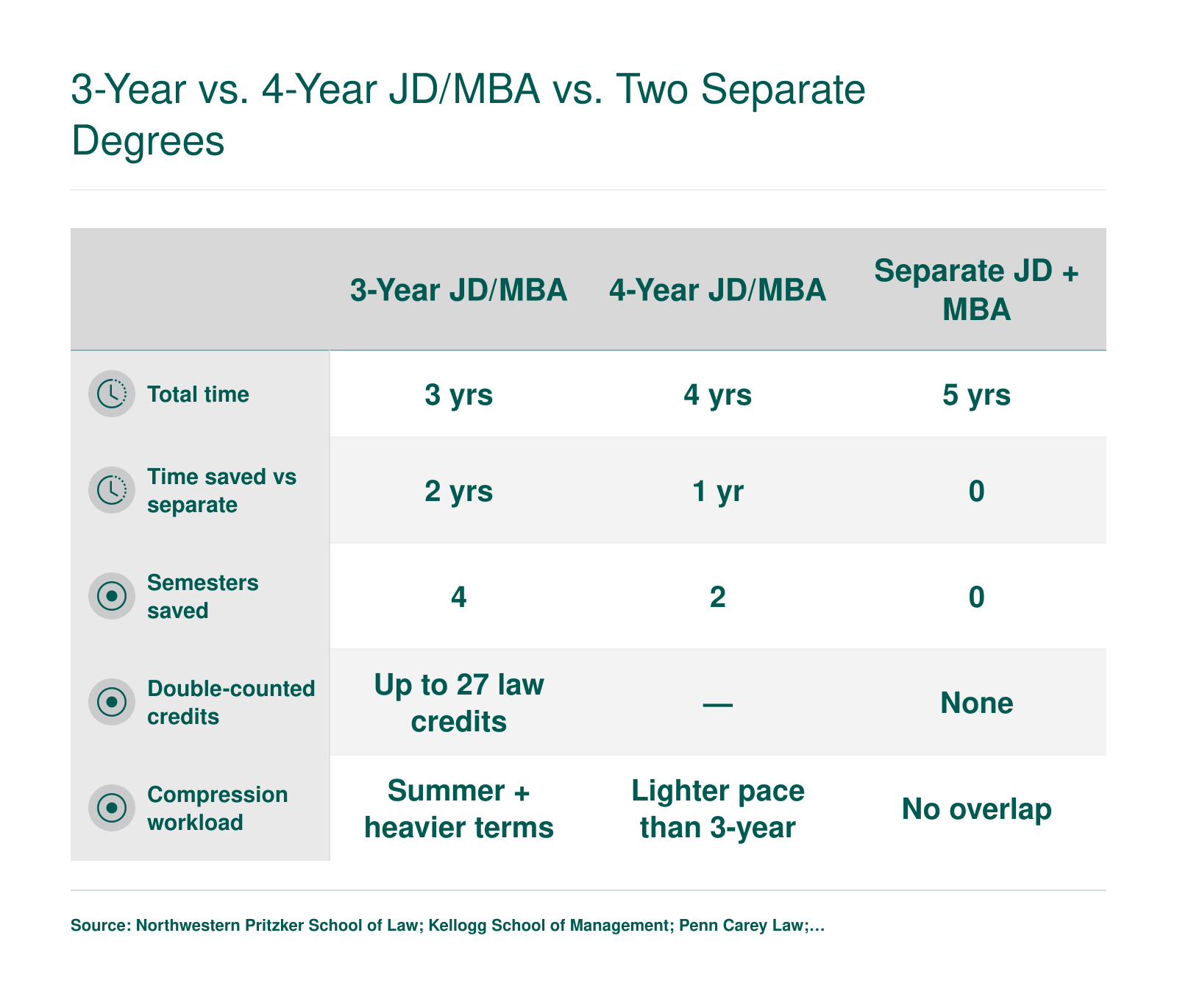
3-Year vs. 4-Year JD/MBA vs. Two Separate Degrees
A JD/MBA takes three years in the most accelerated programs, four years in a standard integrated track, and five years when the JD and MBA are pursued separately. The time saved comes from credit sharing and compressed scheduling, but it requires summer terms and heavier semesters.
What Does an Accelerated JD/MBA Cost? Lowest-Priced Options Compared
The lowest-priced options below show published graduate tuition and institution-wide net price after aid, the latter being an average across all aided students rather than a personalized JD/MBA quote. Because JD/MBA students often pay law school rates in some terms and business school rates in others, per-credit billing varies; for context, USC Gould lists a $3,815 per-unit rate for 2026-27 and a three-year total of $384,936, while Columbia's three-year tuition is $359,616 before future increases. A three-year track roughly multiplies annual tuition by three and a four-year track by four, compared with five or more years for two separate degrees, so the shortened schedule removes one to two years of tuition.
| School | Location | In-State Graduate Tuition | Out-of-State Graduate Tuition | Net Price |
|---|---|---|---|---|
| University of North Carolina at Chapel Hill | Chapel Hill, NC | $12,751 | $31,408 | $11,655 |
| University of Missouri-Kansas City | Kansas City, MO | $13,726 | $32,298 | $13,310 |
| University of Houston | Houston, TX | $10,051 | $19,231 | $14,276 |
Related Articles
Accelerated JD/MBA Admissions: LSAT, GMAT, GRE, and Deadlines
- Test policiesColumbia and Penn require GMAT or GRE; Columbia also requires LSAT if submitted, Penn treats LSAT optional; Northwestern waives LSAT.
- Other testsUSC requires GRE only; Chicago accepts GRE, GMAT, or LSAT; Indiana requires both LSAT and GMAT or GRE. JD-Next is not confirmed.
- Application method and timingMost schools use joint or integrated applications; Indiana requires separate approval from both schools. Adding the MBA after 1L is not confirmed by published materials.
- Median scoresBroad top-program ranges often cited: 170–174 LSAT and 675–695 GMAT; no verified per-school GPA medians are published here.
- Work experienceMany three-year tracks prefer 2+ years; Indiana requires at least two years; Penn seeks professional maturity.
- DeadlinesColumbia ED Nov. 2, 2026; Penn R1 Sept. 8, 2026; Northwestern R1 Sept. 9, 2026; USC final Apr. 1, 2027.
Top Graduate Earnings Among Ranked Schools
Among the schools in this ranking, the highest median earnings figure is $160,846 for University of Wisconsin-Madison's JD/MBA program, five years after entry.
JD/MBA Employment Outcomes: Earnings, Debt, and Bar Passage
A JD/MBA dual degree program can point toward two different payoff models: a law-firm track measured by bar passage and JD-required employment, or a business track measured by post-MBA hiring and compensation.
Bar passage and employment at a glance
- USC Gould: 94% first-time bar passage across all jurisdictions, 93% first-time on the July 2025 California bar, 96% full-time long-term bar-required or JD-advantage employment, and 100% employed within 10 months. - Suffolk: 88% full-time long-term JD-required or JD-advantage employment for 2025, and 91.37% ultimate bar admission for 2023-2025, not first-time bar passage.1 - Boston College: for the Class of 2025, 95.8% full-time long-term bar-required or JD-advantage employment and 96.7% employed at 10 months; supplementary figures are not ABA-audited.2 These are overall JD outcomes, not separated for accelerated JD/MBA students.
Where the combined degree pays off
Corporate law, consulting, investment banking/private equity, and in-house or executive leadership tend to value both credentials. Corporate law and in-house roles use the JD and MBA daily; consulting and banking rely more on the business toolkit and treat the JD as a differentiator.
Do JD/MBAs out-earn single-degree peers?
Published salary comparisons do not separate JD/MBA graduates from JD-only or MBA-only peers, so no definitive advantage can be claimed. Business-side roles may pay at the market rates reported for Best MBA Programs, but law-firm associate pay is generally lockstep and not raised by an MBA. Program-level median debt and 10-year monthly payments are not separated for JD/MBA students; request joint-degree figures from each school.
JD/MBA programs by state
Accelerated JD/MBA Questions Applicants Still Ask
These are the questions applicants ask most when comparing accelerated JD/MBA formats, timelines, and eligibility. The answers below reflect program-level details and current bar-admission guidance, but always verify requirements with the law school and your state bar.
Which schools offer a 3-year JD/MBA?
Can you complete an accelerated JD/MBA online, hybrid, or part-time?
Do JD/MBA graduates earn more than JD-only or MBA-only graduates?
Can you sit for the bar exam on the same timeline as JD-only classmates?
Compare JD/MBA programs on the data that matters
Explore more MBA specializations or browse every graduate field.
All MBA programs