Best JD/MBA Programs in California
Compare 22 accredited JD/MBA programs in California at 20 schools, with graduate earnings, cost, debt, and completion data from IPEDS and the U.S. College Scorecard.

A JD/MBA combines a law degree with a graduate business degree in a single enrollment, usually finished in four years instead of the five or six that earning both separately would take. Shared credits that count toward both degrees are what compress the timeline.
The tradeoff is front-loaded cost against a widened career path: corporate law, private equity, general counsel roles, and management positions that reward fluency in contracts and balance sheets alike. Tuition across California programs runs from roughly $9,500 to over $70,000 a year, a spread that matters when comparing affordable MBA programs, and admission requires clearing two separate bars, the law school and the business school, each with its own exam and standards.
Key Points
- Berkeley requires the GMAT, while California Western offers the clearest waiver.
- Statewide first-time bar passage was 69.7% on the July 2025 exam.
- California State University-Sacramento is the lowest-cost program among those ranked here.
Best JD/MBA Schools in California: 2027 Ranking
These ten California programs combine a Juris Doctor with an MBA, and every one is campus-based. Tuition and net price appear on each card. Net price is an institution-wide average after aid, not a JD/MBA-specific figure, and graduation rates describe the whole school, not this program alone.
Stanford University
#1Stanford, CA · $60,000 – $65,000/yr (est.)
Best for: Applicants seeking full funding pathways
Stanford's joint program starts with a year at the law school, then a year at the business school, followed by combined coursework that integrates both fields. Joint degree students can apply to the Knight-Hennessy Scholars program, which offers full funding and cross-disciplinary leadership training. Schools offering this program graduate 92% of their students, and applicants must be admitted to both schools.
- First year at the law school, second year at the business school
- Combined coursework in later years integrates both disciplines
- Knight-Hennessy Scholars funding available to joint degree students
- Admission to both law and business schools is required
- Flexible sequencing allowed, including two law years before business school
- Aid is administered by whichever school you attend that year
University of California-Berkeley
#2Berkeley, CA · ~$16,000/yr (est.)
Best for: Applicants wanting two law school options
UC Berkeley's concurrent degree pairs the Haas School of Business with a law school partner, so students leave with a Berkeley MBA and a JD. The structure is four years: two in law school, one in business school, and a final year of electives at both. Schools offering this program graduate 93% of their students.
- Four-year program leading to a Berkeley MBA and a JD
- Two law school partners available
- First two years in law school
- Third year in business school
- Fourth year takes electives at both schools
- Berkeley Law and Haas track requires 118 units
- Alternate law partner and Haas track requires 117 units
- Separate admission processes for law and business
University of California-Los Angeles
#3Los Angeles, CA · ~$14,000/yr (est.)
Best for: Aspiring consultants and public service leaders
UCLA Law and the Anderson School of Management offer a four-year J.D./M.B.A. with concentrations in corporate law and finance, international trade, industrial relations, public service, and management consulting. Small cohorts and a large alumni network support careers in corporate law, consulting, and public policy. Schools offering this program graduate 93% of their students.
- Four-year joint degree with the Anderson School of Management
- Five concentration options, including international trade and industrial relations
- Corporate law and finance concentration available
- Financial aid available
- Public service concentration within the joint degree
- Requires 73 law units and 80 management units
- Apply separately to the law and management schools
- Management consulting concentration within the joint degree
- 73 law semester units and 80 management quarter units required
- Separate applications to each school
University of California-Irvine
#4Irvine, CA · ~$15,000/yr (est.)
UC Irvine's four-year dual degree combines UCI Law with the Paul Merage School of Business and takes less time than earning each degree separately. Coursework spans taxation, corporate governance, and intellectual property, with an emphasis on negotiation and policy analysis. Schools offering this program graduate 87% of their students.
- Four-year concurrent JD and MBA
- Coursework in taxation, corporate governance, and intellectual property
- Separate applications to both schools
- Eligible for financial support from both schools
- Administered through the Program in Law and Graduate Studies
University of California-Davis
#5Davis, CA · $15,000 – $20,000/yr (est.)
UC Davis pairs its Graduate School of Management with a law school partner, and students can finish both degrees in as few as four years. Up to 12 units of JD coursework count toward the MBA, and custom paths are available. Schools offering this program graduate 86% of their students.
- Complete both degrees in as few as four years, saving up to a year
- Up to 12 units of JD coursework count toward the MBA
- Two law school partners available
- Separate admission to each school required
- Custom paths available
- Full-time, campus-based
University of Southern California
#6Los Angeles, CA · ~$72,000/yr (est.)
USC offers a JD/MBA through the Gould School of Law and Marshall School of Business, with law courses in year one and MBA coursework in year two. Years three and four combine advanced law and business electives. Schools offering this program graduate 92% of their students.
- First year is 33 units of required law courses
- MBA portion requires 48 units
- JD portion requires 35 graded law units
- GMAT or GRE and the LSAT are required
- Separate applications to each school
Santa Clara University
#7Santa Clara, CA · ~$32,000/yr (est.)
Santa Clara University's combined degree begins with the first year of law school, then moves into coursework at the Leavey School of Business. Students work with faculty advisors to design a personalized course of study. A GMAT waiver is available for qualified candidates. Schools offering this program graduate 88% of their students.
- Up to 12 quarter units of business and 8 semester units of law count toward both degrees
- First year completed in law school
- GMAT waiver available for qualified candidates
- Rolling admissions with separate law and MBA applications
- Starts fall, winter, or spring
- Minimum of two letters of recommendation
- Faculty advisors plan a specific course of study
University of San Diego
#8San Diego, CA · ~$31,000/yr (est.)
The University of San Diego's concurrent program takes about four years and 120 credit hours. Year one is law only, year two is business only, and years three and four are split across both schools. Students prepare for the bar exam and complete a capstone. Schools offering this program graduate 84% of their students.
- About four years and 120 total credit hours
- Year one at law school only, year two at business school only
- Years three and four taken at both schools
- Up to 6 units cross-count toward each program, with a minimum B grade
- Capstone and a January intersession course required
- Prepares students for the bar exam
- Scholarships and financial aid available
- Entrance exam required
Loyola Marymount University
#9Los Angeles, CA · ~$23,000/yr (est.)
Loyola Marymount's J.D./MBA is a four-year, full-time dual degree between Loyola Law School and the LMU MBA program. Applicants do not need to submit GMAT or GRE scores, and current law students can apply right after their first year. Schools offering this program graduate 79% of their students.
- Four-year, full-time dual degree
- JD from Loyola Law School and MBA from LMU
- No GMAT or GRE required
- Apply to both programs separately
- Application opens to current law students after the first year
Chapman University
#10Orange, CA · ~$40,000/yr (est.)
Chapman's joint program runs through the Fowler School of Law and the Argyros College of Business and Economics, saving a year and 20 credits versus separate degrees. It is full-time, 118 credits, and draws on strong ties to Orange County organizations. Schools offering this program graduate 82% of their students.
- Four years of full-time study, 118 total credit hours
- Saves one year and 20 credits over separate degrees
- Minimum 2.6 law GPA for current students, C+ minimum in all coursework
- Acceptance to both schools required
- Fall 2027 deadlines: Nov. 1, 2026, Feb. 1, 2027, June 1, 2027
- Career services from both schools
Cost & outcomes by school
Federal data for the highest-earning JD/MBA programs, independent of the ranking above. Earnings are this field's master's graduates four years after completing, where the Scorecard reports them.
| School | Earnings | Tuition / yr | Debt | Grads/yr | Format |
|---|---|---|---|---|---|
| Loyola Marymount University CA | $140,532 | $23,172 | $99,813 | 59 | Campus |
| Thomas Jefferson School of Law CA | — | $3,692 | — | — | Hybrid |
| California State University-Sacramento CA | — | $9,542 | — | — | Campus |
| University of California-Los Angeles CA | — | $14,476 | — | — | Campus |
| University of California-Irvine CA | — | $14,827 | — | — | Campus |
| University of California-Davis CA | — | $15,141 | — | — | Campus |
| University of La Verne CA | — | $15,318 | — | — | Campus |
| University of California-Berkeley CA | — | $15,866 | — | — | Campus |
| Golden Gate University CA | — | $17,070 | — | — | Hybrid |
| Southwestern Law School CA | — | $20,240 | — | — | Hybrid |
| University of San Francisco CA | — | $29,960 | — | — | Campus |
| University of San Diego CA | — | $31,240 | — | — | Campus |
Sources: U.S. Department of Education. Tuition and graduates: IPEDS. Earnings and debt: College Scorecard, this field's master's graduates; a dash means no figure is reported.
How We Ranked California JD/MBA Programs
Graduate outcomes and cost shaped this ranking of Master's Programs in California, not prestige. These signals determine where each program lands.
- Money in and out: Graduate earnings, median debt, and net price from College Scorecard show what a degree costs and what it tends to pay back.
- Access and follow-through: Admissions selectivity and completion rates show how competitive a school is and how reliably its students finish.
- Why we combine signals: Federal data rarely separates students in JD/MBA dual degree programs from everyone else, so several of these measures describe the whole university or a broader degree level. No single number decides a school's place. We read the signals together.
- Trust baseline: Each business school paired with a program here is listed among AACSB accredited general MBA programs, and each partner law school holds ABA approval. Accreditation status can change, so check the ABA and AACSB directories before you apply.
Online and Hybrid JD/MBA Options in California
The American Bar Association is still debating how much of a law degree can be taught remotely, and that debate shapes every JD/MBA program here. Current standards let a school deliver up to 50% of JD credits through distance education, but they also call for at least 64 of the 83 required credits in regularly scheduled classroom sessions or direct faculty instruction.1 A recommendation to lower that 64 to 48 is under review and is not yet a requirement.2
No program here is confirmed as a fully online MBA. The schools with campus-listed formats, including Stanford,3 Chapman (a daytime cohort) and the University of San Francisco (four full-time residence years),4 describe in-person study. Claremont Graduate University's Drucker MBA with Southwestern Law School lists in-person, online and hybrid formats, but it does not say which component is remote or what attendance is required.
Ask admissions: - Which JD and MBA courses can be taken online? - Are there residency minimums? - Do evening or weekend sections exist?
Related Articles
Which Ranked JD/MBA Programs Waive the GMAT or GRE
Test flexibility is uneven among the programs here, and a full waiver is rare. Berkeley keeps a GMAT requirement for the business side but lets concurrent-degree applicants use that score for law admission. California Western offers the clearest waiver, and Chapman states none.
- UC Berkeley (Berkeley Law / Haas): Law accepts the LSAT or GRE.1 Haas requires the GMAT.2 Concurrent-degree applicants may submit a valid GMAT to Berkeley Law in place of the LSAT or GRE, per Berkeley Law's concurrent degree page. No Haas waiver is published. Median LSAT: 171.3
- California Western School of Law / San Diego State: Law accepts the LSAT, GRE, or JD-Next. The business side accepts the GMAT or GRE, and these scores may be waived. They are recommended for applicants with an undergraduate GPA below 3.2.
- Chapman University (Fowler / Argyros): The MBA requires an official GMAT or GRE score, and the LSAT is not accepted. Law-school tests and waivers: No published policy.
Test policies for the remaining schools are not confirmed here, so check each admissions page before you apply.
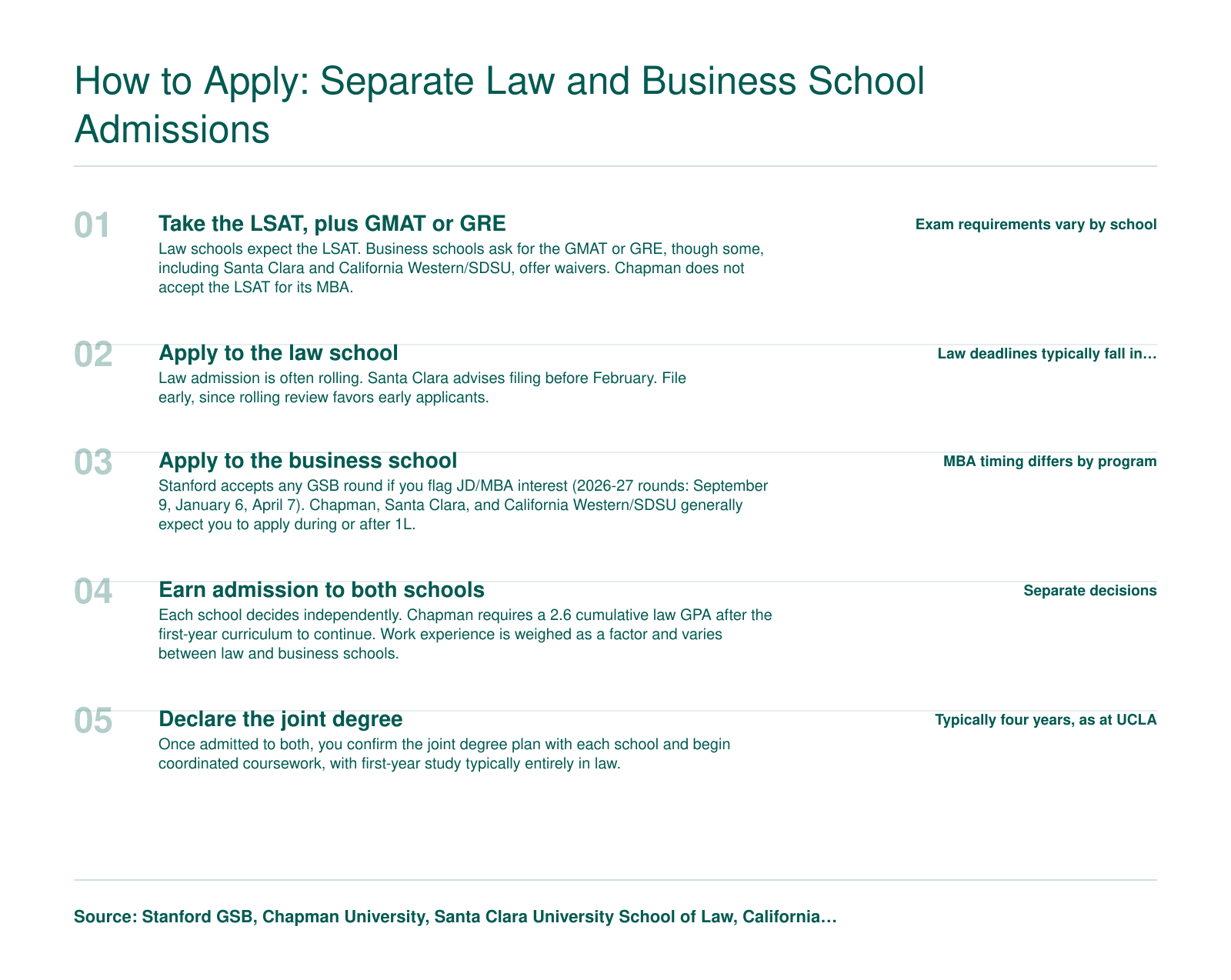
How to Apply: Separate Law and Business School Admissions
Most JD/MBA programs here ask you to win admission to the law school and the business school separately. Timing varies: some schools let you apply to the MBA during 1L, while others accept applicants in any round. Confirm current dates on each school's admissions page.
JD/MBA Program Cost and California Employer Demand for MBA Graduates
Cost spreads wider than prestige suggests, and California employers pay well for MBA graduates from several of the schools here.
What the programs cost
California State University-Sacramento is the lowest-cost option, with graduate program tuition of about $9,500 for residents and $19,600 for non-residents. USC sits at the top for total program cost. USC's 2026-27 accelerated schedule works out to about $385,000 in tuition over three years (approximate, before living costs). Berkeley's Haas MBA tuition for 2026-27 is $80,430 for residents and $92,675 for non-residents, and its JD/MBA runs four years.1 Claremont Graduate University charges $2,070 per unit regardless of residency. Chapman's four-year format saves one year compared with earning the degrees separately. Program-level median debt and monthly payment figures are not published for these degrees, so budget from tuition plus each school's living estimate.
Employer demand
UCLA Anderson's Class of 2025 reported a median base salary of $160,096, with technology (28.3%), consulting (25.6%) and financial services (19.4%) leading.2 At Haas, consulting and financial services drew about 35% of the 2025 class.1 At Stanford, 90% of job seekers had offers within three months.3 Reporting years and definitions differ, so treat these as directional, not like-for-like.
Career Outcomes and Bar Passage for California JD/MBA Graduates
Bar passage is the single outcome that decides whether JD/MBA dual degree programs pay off, and in California the margin between schools matters less than most applicants assume. On the July 2025 exam, first-time takers passed at 69.7% statewide, while first-time takers from ABA-approved California law schools passed at 84.4%. The February 2026 administration was far harsher: 43.9% statewide in the initial report (revised to 44.0%), and 62.9% for graduates of ABA-approved California schools. Winter sittings consistently run lower, so compare like with like when you read a school's number.
Read These Figures as School-Wide
Pass rates and American Bar Association employment disclosures, including full-time, long-term, bar-passage-required placement measured roughly ten months after graduation, are reported for an entire graduating law class. Schools almost never break out joint-degree students separately, so no published figure describes JD/MBA graduates on their own. Treat the law school's overall record as your best available proxy and ask admissions directly about dual-degree placement.
Federal earnings data specific to these JD/MBA programs has not yet been published, so starting salaries should come from each school's own employment report.
California JD/MBA FAQs
How long does it take to complete a JD/MBA in California?
Are there 3-year or accelerated JD/MBA programs in California?
Can I add the MBA after starting law school?
Do JD/MBA programs require both the LSAT and GMAT?
Compare JD/MBA programs on the data that matters
Explore more MBA specializations or browse every graduate field.
All MBA programs