Master's in Geography Programs With No GRE Required
Compare 190+ accredited no-gre Geography programs at 110+ schools, with graduate earnings, cost, debt, and completion data from IPEDS and the U.S. College Scorecard.

Skipping the GRE saves a $220 test fee and weeks of prep, but a waiver does not mean every program treats your application the same way. Many geography departments, including Virginia Tech, UNC Charlotte, and the University of Nevada-Reno, now list scores as optional. Others state outright that scores are not considered, and a few still weigh them in funding decisions.
That difference matters most for students targeting GIS, human geography, or environmental planning tracks with assistantships, where competition for funded seats can quietly favor applicants who submit more materials.
Key Points
- In 2027 University of Idaho teaching assistants get $18,985 plus tuition waiver.
- Idaho, Western Michigan, and UNC Charlotte have the lowest net prices here.
- Assistantships make campus programs nearly free; online programs pay out of pocket.
Top Geography Master's Programs With No GRE Required
These geography master's programs have GRE waivers or test-optional admissions. The list is ordered by a mix of retention, completion, institutional quality, and moderate cost and earnings factors, not by a single metric.
Virginia Polytechnic Institute and State University
#1Blacksburg, VA · ~$19,000/yr (est.)
Best for: Research-driven students seeking funded fieldwork
Virginia Tech's Master of Science in Geography is a 31-credit, STEM-designated program with thesis and non-thesis options. The department does not require the GRE for admission, though submitted scores may be considered. Students can pursue graduate assistantships and the Sidman P. Poole Endowment for field research.
- 31-credit, two-year STEM-designated program
- Thesis or non-thesis option
- Teaching and research assistantships available
- Sidman P. Poole Endowment funding for field research
- Accelerated option for Virginia Tech undergraduates
University of North Carolina at Charlotte
#2Charlotte, NC · $5,000 – $10,000/yr (est.)
Best for: Urban GIS and planning career changers
UNC Charlotte's Master of Arts in Geography emphasizes research methods, GIS, urban planning, and human-environment relationships. The GRE is optional as of Fall 2025, and the university identifies the GRE as not required for the non-thesis project option. Small cohorts and the Charlotte metro provide applied learning opportunities.
- Emphasis on GIS, urban planning, and research methods
- Small classes with close faculty contact
- Early entry option for eligible UNC Charlotte seniors
- GRE optional for admission
- Funding through assistantships and scholarships
University of Nebraska-Lincoln
#3Lincoln, NE · $5,000 – $10,000/yr (est.)
Best for: Midwestern students prioritizing teaching assistantships
The University of Nebraska-Lincoln offers a flexible 30-credit Geography MA with thesis and non-thesis options plus multiple specialization areas. The GRE is optional for admission. Teaching assistantships with tuition remission and an accelerated master's option are available.
- 30-credit program with thesis and non-thesis options
- Specializations include GIS, human-environment, urban, and cultural geography
- Priority deadline January 1 for funding consideration
- Teaching assistantships with tuition remission available
- Accelerated master's option
- Concentration in GIS and geovisualization
- Interdisciplinary focus with anthropology and global studies
- Paid teaching assistantships available
- Prepares for GIS specialist roles
- Concentration in human-environment relations
- Interdisciplinary work encouraged
- Close faculty mentorship
- Dual degree programs offered
University of Nevada-Reno
#4Reno, NV · ~$7,000/yr (est.)
The University of Nevada, Reno offers a Master of Science in Geography with research strengths in climatology, water resources, GIS, and conservation. GRE scores are optional for admission. Students can choose thesis or non-thesis paths and use paleoclimate and geospatial analysis labs.
- Thesis and non-thesis degree plans
- Research areas include climate, water, GIS, and conservation
- GRE scores optional for admission
- Access to paleoclimate and geospatial labs
- Climatology research focus
- State-of-the-art lab facilities
- Nevada State Climate Office affiliation
- Field study equipment available
Texas State University
#5San Marcos, TX · ~$9,000/yr (est.)
Texas State offers two geography master's tracks: a 30-credit M.S. with thesis and a 33-credit M.A.Geo. with an applied research paper. The M.A.Geo. can be completed online, and the GRE is not required. Faculty mentorship and research opportunities are central.
- M.S. thesis track and M.A.Geo. applied research track
- 30-credit M.S. or 33-credit M.A.Geo.
- Online option for M.A.Geo. allows up to 100% coursework online
- GRE not required for admission
- Priority deadlines for funding consideration
South Dakota State University
#6Brookings, SD · $5,000 – $10,000/yr (est.)
South Dakota State offers a Geography M.S. with a Geographic Information Sciences specialization, covering GIS, remote sensing, and geospatial modeling. No GRE is required for admission, and students can pursue thesis or non-thesis tracks. A cooperative internship with the EROS Data Center is a distinctive option.
- Geographic Information Sciences specialization
- Thesis or non-thesis track with portfolio and oral defense
- Internship opportunities with EROS Data Center
- No GRE required for admission
- Accelerated option for eligible undergraduates
- Two letters of recommendation required
University of Hawaii at Manoa
#7Honolulu, HI · $15,000 – $20,000/yr (est.)
The University of Hawaii at Manoa offers a research-based Master of Arts in Geography with individualized study. The GRE is not required, and the program admits for fall only. Students explore physical geography, human-environment interactions, and geospatial technologies.
- Research-based MA with individualized study
- Fall admission only; January 15 deadline
- No GRE required
- Three letters of recommendation and statement of objectives required
- Environmental geography focus
- World-class geographic research setting
- Writing sample optional
Western Michigan University
#8Kalamazoo, MI · $20,000 – $25,000/yr (est.)
Western Michigan University's Master of Science in Geography offers GIS and environmental/resource analysis concentrations. The program does not require the GRE, and students gain hands-on lab experience with current GIS software. Assistantships and accelerated options are available.
- GIS focus with state-of-the-art software
- About 30 hours lecture and 30 hours lab per techniques course
- Professional internships and independent study options
- GRE not required
- Environmental and resource analysis concentration
- Accelerated option for WMU undergraduates
- Assistantships competitively available
- No GRE required
University of Idaho
#9Moscow, ID · $10,000 – $15,000/yr (est.)
The University of Idaho offers a Master of Science in Geography with thesis and non-thesis tracks available on campus and online. No GRE is required, and teaching assistantships can cover tuition and provide stipends. Research areas include polar meteorology and climate adaptation.
- 30-credit program with thesis and non-thesis tracks
- Offered on campus and online
- Research in polar meteorology and climate change
- Teaching assistantships with full tuition coverage
- No GRE required; 3.0 GPA minimum
Liberty University
#10Lynchburg, VA · ~$9,000/yr (est.)
Liberty University's online Master of Arts in Geography includes a Disaster Management concentration with asynchronous 8-week courses and year-round starts. No standardized test is required for admission. Military students may qualify for a reduced per-credit tuition rate.
- Disaster Management concentration
- 100% online with 8-week asynchronous courses
- Eight start dates per year
- Transfer up to 50% of credits
- Military tuition discount available
- No standardized test required
Cost & outcomes by school
Federal data for the highest-earning Geography programs, independent of the ranking above. Earnings are this field's master's graduates four years after completing, where the Scorecard reports them.
| School | Earnings | Tuition / yr | Debt | Grads/yr | Format |
|---|---|---|---|---|---|
| George Mason University VA | $114,744 | $17,964 | — | 18 | Campus |
| University of Wisconsin-Madison WI | $111,616 | $12,325 | $27,416 | 34 | Campus |
| Fort Hays State University KS | — | $4,949 | — | — | Campus |
| Montana State University MT | — | $7,661 | — | — | Campus |
| Texas State University TX | — | $8,997 | — | 14 | Campus |
| University of New Mexico NM | — | $9,860 | — | 9 | Campus |
| University of Nevada-Reno NV | — | $7,032 | — | 5 | Campus |
| South Dakota State University SD | — | $9,384 | — | 8 | Campus |
| Liberty University VA | — | $8,730 | — | 6 | Online |
| University of North Carolina at Charlotte NC | — | $8,037 | — | 4 | Campus |
Sources: U.S. Department of Education. Tuition and graduates: IPEDS. Earnings and debt: College Scorecard, this field's master's graduates; a dash means no figure is reported.
Cost, debt & payoff
Median earnings of this field's master's graduates (4 yrs after completing) vs. their median federal loan debt · U.S. College Scorecard
Across these programs the median graduate earns about $80,622 and finishes with roughly $30,093 in debt — a ratio that clears a common rule of thumb (keep debt below first-year salary). Tuition and debt vary widely school to school, so check the per-school figures in the table above before you shortlist.
Lowest Net Price Among No-GRE Geography Master's Programs
The schools with the lowest published average net price after aid here are the University of Idaho, Western Michigan University, and UNC Charlotte. These net price figures are institution-wide averages after grant and scholarship aid, not a quote for the geography degree itself. In-state and out-of-state tuition differs sharply at Idaho and Charlotte, but the gap is much smaller at Western Michigan; several online no-GRE geography programs charge a flat per-credit rate regardless of residency, including LSU at $725 for 31 credits ($22,475 total), Oregon State at $609 per quarter credit for 45 quarter credits, and Penn State at $1,048 per credit for 33 to 36 credits ($34,584 to $37,728).
| School | Average net price after aid | In-state graduate tuition and fees | Out-of-state graduate tuition and fees | Median graduate debt |
|---|---|---|---|---|
| University of Idaho | $14,831 | $9,084 | $28,320 | $21,982 |
| Western Michigan University | $15,273 | $15,252 | $19,034 | $26,188 |
| University of North Carolina at Charlotte | $15,435 | $7,239 | $22,492 | $21,500 |
Paying for It: Assistantships, Tuition Waivers, and Scholarships
At the University of Idaho, thesis-option students appointed as teaching assistants receive a package worth roughly $18,985 for Fall 2026 plus a full tuition waiver, with summer support of up to $8,000 depending on available funding.1 The University of Denver listed a 2025-26 assistantship stipend of about $23,232 over a nine-month appointment.2 These awards typically cover tuition and pay a living stipend, so fully funded campus students often leave with far less debt than their tuition sticker price suggests.
The Online and Non-Thesis Blind Spot
Assistantships are usually tied to on-campus research or teaching work, so students in an online master's in geography program and non-thesis students are frequently ineligible. Louisiana State University, for example, excludes online students from departmental funding entirely.3 If you enroll online or choose an accelerated master's in geography to finish faster, budget to pay more out of pocket. That gap can erase the apparent savings of a cheaper online program.
Scholarships and Priority Deadlines
San Diego State lists several named department scholarships, including the Ned H. Greenwood Award for physical geography and the William and Vivian Finch award for remote sensing, each requiring a separate application.4 Application deadlines vary: UNC Charlotte sets February 15 for fall and October 15 for spring5, and Northern Arizona uses February 15.6
One practical move: email the graduate coordinator about funding before you apply. Many assistantships hinge on specific faculty research grants, and a short message can tell you whether money exists for your interests.
Related Articles
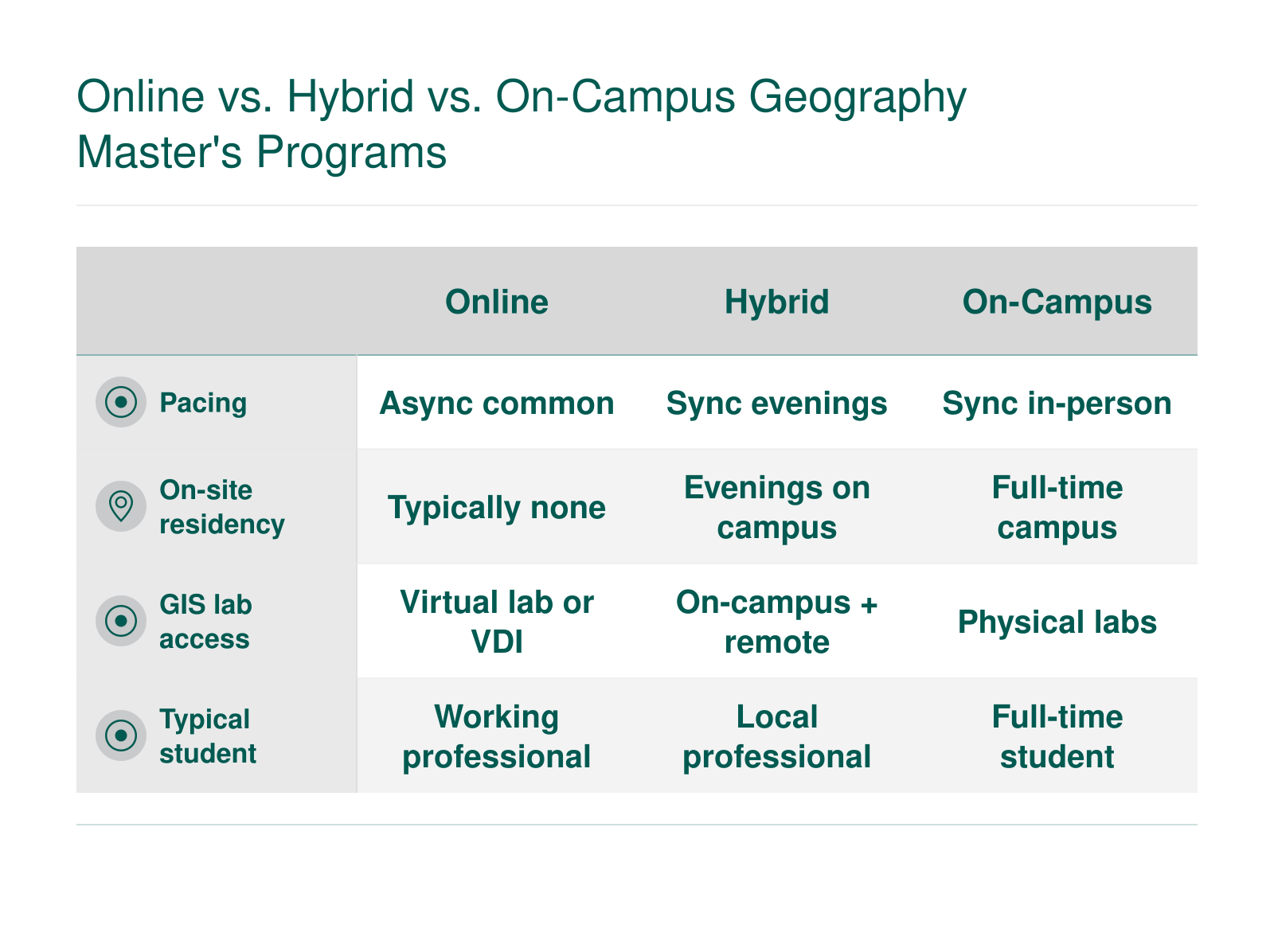
Online vs. Hybrid vs. On-Campus Geography Master's Programs
Geography master's programs come in three delivery formats, each with distinct tradeoffs for scheduling, residency, and GIS lab work. Online programs are often asynchronous and built for working professionals, while hybrid programs pair evening campus sessions with remote access. On-campus programs offer the most direct access to faculty and physical labs for full-time students.
Specializations and Thesis vs. Non-Thesis Tracks
Common Concentrations
GIS and geospatial analysis is the most common focus in master's in geography programs. The University of North Dakota covers GIS, remote sensing, cartography, and spatial analysis.1 The University of Nebraska at Omaha adds cartographic visualization and human geography.2 The University of Montana offers General Geography, GIS & Cartography, and Community and Environmental Planning options.3 Oklahoma splits its program into Environmental Systems and Geospatial Technologies4, while Northern Iowa lists Human Spatial Systems and Planning and Development.5 Some schools skip formal concentrations and let your electives define the focus, so check the course catalog.
Thesis vs. Non-Thesis
A thesis track fits students heading toward a PhD or working on faculty-funded research. Non-thesis tracks, which end in a capstone, project, or portfolio, suit working professionals and are common in online master's in geography programs. They often skip the research phase, but many add coursework to make up for it:
- Omaha: 30 credits with a thesis, 36 without.2
- Montana (Cartography & GIS): 34 with a thesis, 40 without.3
- Oklahoma: 30 with a thesis, 33 without.4
- North Dakota: 30 credits either way.1
Tying It to Careers
GIS and remote sensing coursework points toward GIS analyst and mapping roles. Planning-oriented options lead toward urban and community planning, and environmental systems work toward environmental consulting. Pick the track that matches the job you want, not just the shortest credit count.
What You'll Need to Apply (Without GRE Scores)
Policies vary by program, so confirm current instructions before applying.
- Bachelor's degreeAn accredited bachelor's is required. Many programs admit non-geography majors, sometimes with prerequisite GIS or statistics coursework; UW–Madison states it regularly does.
- Minimum GPAA 3.0/4.0 floor is typical. UW–Madison lists 3.00; some programs don't publish a number, but admitted students generally exceed it.
- GRE statusOptional means scores are reviewed if sent; not considered means ignored. Penn State, UW–Madison, and UIUC do not use scores. A strong score may help only at optional-score programs.
- Supporting materialsStatement of purpose, letters of recommendation, and resume are standard. Thesis applicants should identify a faculty advisor.
- DeadlinesFall priority deadlines range from Dec. 1 (Penn State, UCSB) to Jan. 15 (Kentucky). Delaware and Denver have later finals; rolling or multi-start options include Texas State and Liberty.
Geography programs by state
Frequently Asked Questions About Geography Master's Programs and the GRE
Admissions policies, accreditation, and career paths can shift by program. These answers focus on what applicants need to verify before enrolling.
Is the GRE required for a master's in geography?
Can I get a master's in geography without a geography bachelor's degree?
Are online geography master's programs without the GRE accredited and respected by employers?
What can you do with a master's in geography?
Compare Geography programs on the data that matters
Explore more Science & Engineering specializations or browse every graduate field.
All Science & Engineering programs