Best Master's in Geography Programs in Florida
Compare 11 accredited Geography programs in Florida at 4 schools, with graduate earnings, cost, debt, and completion data from IPEDS and the U.S. College Scorecard.

Which Florida geography master's programs actually pay off for students targeting GIS, coastal resilience, or urban planning roles?
Florida's hurricane exposure, sea-level rise, and rapid urban growth keep state and local agencies hiring spatial analysts. The ranking combines campus and online options and weighs graduate earnings, net price, debt, and completion rates.
The core financial tension is residency: Florida residents can pay roughly $6,400 a year at Florida's flagship, while out-of-state students at the same school pay close to $28,700. Assistantships and in-state tuition matter more than a school's name.
Key Points
- The University of Florida does not require the GRE for its MA/MS in Geography.
- Public in-state graduate tuition runs from the mid-$5,000s to roughly $6,400 a year.
- University of Florida offers an online geomatics option through IFAS; other schools here are mostly campus-based.
Best Master's in Geography Schools in Florida: Ranked List
Florida's geography master's programs are mostly campus-based, and the biggest differences are in funding, thesis requirements, and cost for non-residents. The four schools below span two large public research universities, one mid-sized public, and one private university with much higher tuition. Program-level earnings appear only where federal data reports them.
University of Florida
#1Gainesville, FL · ~$13,000/yr (est.)
Best for: Research-focused students seeking assistantships
The University of Florida's Department of Geography offers thesis-based M.A. and M.S. degrees organized around seven focus areas, including Earth System Science, Medical Geography in Global Health, Geopolitics and the Global Economy, and GeoSpatial Analysis. Its distinctive strength is funding: teaching assistantships carry a tuition waiver and health insurance, though the department does not offer stand-alone waivers, and fall applicants should aim for the January 31 assistantship deadline. Listed graduate tuition is about $10,770 for Florida residents and $27,335 for non-residents, and the school graduates 91% of its students institution-wide. Program-level earnings are not yet available for geography here.
- Seven research focus areas, including Earth System Science and Medical Geography
- Thesis required, working with an assigned faculty advisor
- Fall admission only, one start date per year
- Teaching assistantships with tuition waiver; research assistantships available
- Deficiency coursework allowed for applicants from other fields
- Thesis-based degree sharing the department's seven concentration options
- No spring admission; fall start only
- Interdisciplinary research on topics like climate change and infectious disease
- Competitive teaching assistantships with tuition waivers
- Five concentration options, with GIS and Climate Science available
- Optional second concentration in Climate Science
- Master's thesis research option
- Geography colloquium series and independent study available
Florida State University
#2Tallahassee, FL · ~$11,000/yr (est.)
Best for: Career-focused students wanting a non-thesis option
Florida State University's geography master's is a 30-credit, two-year degree with a thesis track that leads toward doctoral study and a non-thesis track aimed at the workforce. It is the only school on this list with program-level earnings in federal data: graduates reported median earnings of $53,587 one year after finishing and $69,641 four years after finishing, with 96% employed at the one-year mark. The school graduates 86% of its students institution-wide, and listed graduate tuition is about $8,684 for residents and $24,116 for non-residents. Funded students are advised to begin establishing Florida residency before classes start to qualify for the in-state rate.
- Two-year program of 30 total credit hours
- Thesis or non-thesis track; non-thesis leads to the workforce
- Core courses in geographic thought and research methods
- Electives allowed from departments like urban planning and statistics
- Optional M.A. path requires foreign language proficiency
- Full funding reported for two years
- Six thesis credit hours required
- Thesis committee of three faculty members
- Proposal meeting, public presentation, and oral defense required
University of South Florida
#3Tampa, FL · ~$10,000/yr (est.)
Best for: GIS-minded students weighing human or environmental tracks
The University of South Florida's M.A. in Geography lets students choose among human geography, environmental geography, and geographic information systems and spatial analysis. Coursework covers GIS, remote sensing, Web GIS, programming, spatial data science, and environmental justice. A thesis track suits students aiming for a PhD, while a professional track uses internships, projects, or exams. Listed graduate tuition is about $8,350 for residents and $19,048 for non-residents, the lowest out-of-state figure among the four schools, and the school graduates 77% of its students institution-wide.
- Three concentrations: human, environmental, and GIS with spatial analysis
- Thesis track involves proposing, executing, and publishing original research
- Professional track uses internships, projects, or exams
- Coursework includes Web GIS, databases, programming, and spatial data science
- Topics include political geography, nature and society, and environmental justice
University of Miami
#4Coral Gables, FL · ~$47,000/yr (est.)
The University of Miami is the private option here, with a flat graduate tuition of about $45,540 for residents and non-residents alike. Its M.A. in Geography is a 30-credit degree with tracks in development studies, environmental analysis, and globalization and urban change, plus an optional concurrent Graduate Geospatial Certificate. Small classes and a focus on urban and sustainability topics set it apart. The school graduates 84% of its students institution-wide, and the program listings for the urban and conservation concentrations note that the GRE is required.
- 30 total credit hours
- Thesis or advanced independent study option
- Training in GIS, remote sensing, digital cartography, and spatial statistics
- Optional concurrent Graduate Geospatial Certificate
- Smart Cities and Global Urbanization and Infrastructure emphases
- Sustainable development focus
- GRE listed as an entrance exam
- Minimum of two letters of recommendation
- Areas include climate change and biogeography
- Focus on the interplay of society and nature
- Thesis required
- GRE listed as an entrance exam
Cost & outcomes by school
Federal data for the highest-earning Geography programs, independent of the ranking above. Earnings are this field's master's graduates four years after completing, where the Scorecard reports them.
| School | Earnings | Tuition / yr | Debt | Grads/yr | Format |
|---|---|---|---|---|---|
| Florida State University FL | $69,641 | $10,553 | $25,125 | 14 | Campus |
| University of South Florida FL | — | $10,428 | — | 5 | Campus |
| University of Florida FL | — | $12,737 | — | 6 | Campus |
| University of Miami FL | — | $46,870 | — | — | Campus |
Sources: U.S. Department of Education. Tuition and graduates: IPEDS. Earnings and debt: College Scorecard, this field's master's graduates; a dash means no figure is reported.
Highest published program-level figure among the geography master's programs here.
Cost, Funding, and Florida Licensure or Certification for Geography Master's Graduates
What You Pay Before Aid
Sticker tuition varies widely across these Master's Programs in Florida. In-state graduate rates at the public programs run from the mid-$5,000s to roughly $6,400 a year, while out-of-state students pay from around $17,000 to nearly $29,000. University of Miami, a private program, charges the same rate regardless of residency, closer to $47,000. Keep in mind that net price (what students actually pay after aid) is an approximate institution-wide average, not a geography-specific figure. Institution-wide median graduate debt at the public institutions clusters around $15,000 to $18,000; Florida State also reports a roughly $286 median monthly payment on a standard 10-year plan.
The Real Cost Lever: Assistantships
Tuition waivers almost never stand alone. At University of Florida, they come tied to a teaching or research assistantship, each of which pairs a stipend with a waiver and health insurance. Appointments generally run 20 hours a week and are competitive. UF offers no standalone waivers, and hourly OPS jobs carry no waiver or insurance. External awards from NSF, NASA, and the Ford Foundation are encouraged.
Credentials: GISP and the PSM License
Florida licenses no geographers, so no state credential is required to practice. Separately, Florida's Professional Surveyor and Mapper License applies only to specific mapping and surveying roles. A master's in geography or GIS alone does not qualify you; that path requires a surveying and mapping degree, supervised experience, and board exams, and GISP does not substitute for it.1
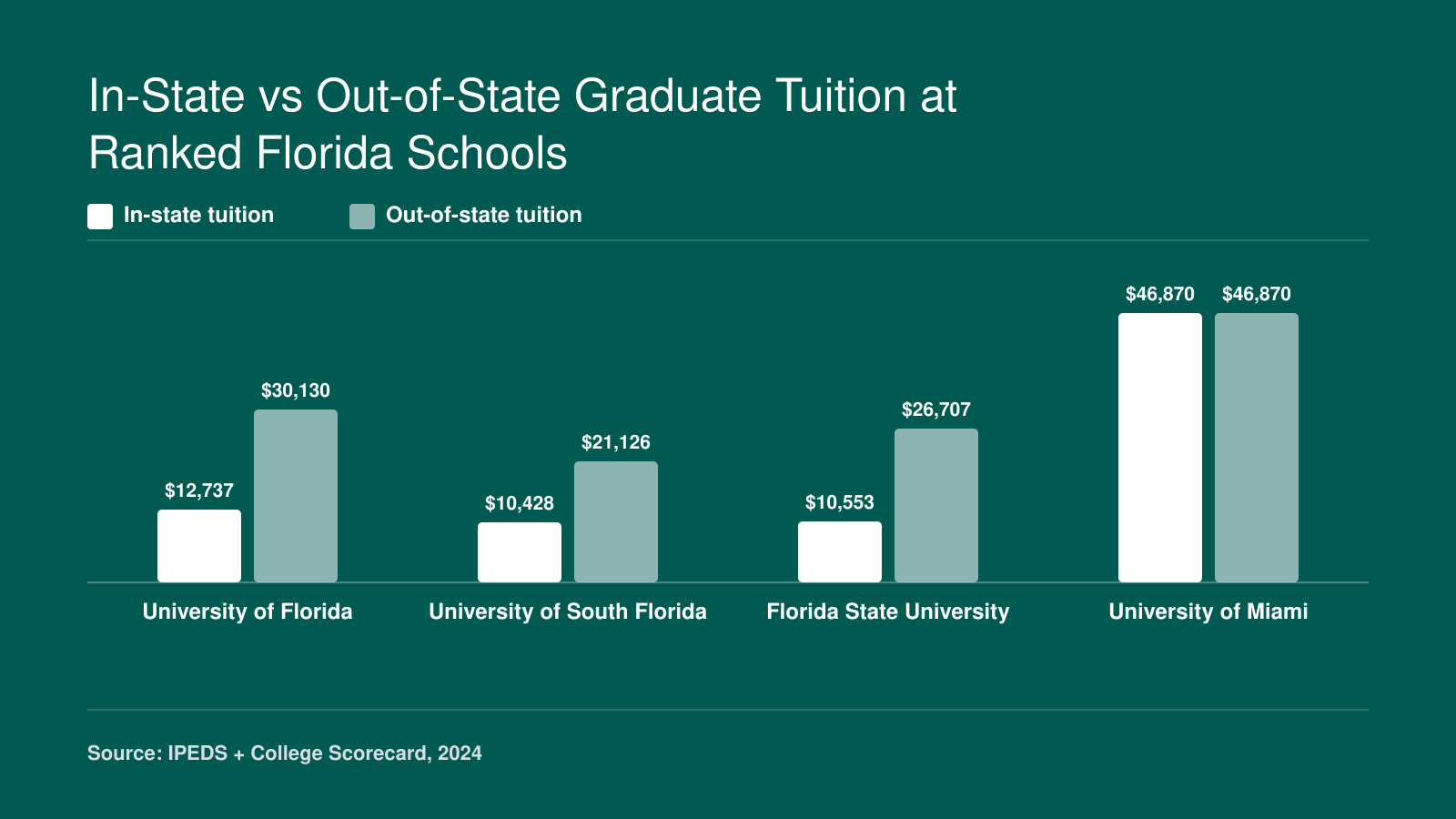
In-State vs Out-of-State Graduate Tuition at Ranked Florida Schools
The public universities here charge out-of-state students roughly double the in-state rate, with the gap widest at University of Florida ($17,393). University of Miami is private and charges one rate to everyone. Funded assistantships, such as the teaching assistantships with tuition waivers that University of Florida lists, can offset most of this tuition, so confirm funding with each department before comparing sticker prices.
Related Articles
Online and Hybrid Master's in Geography Options in Florida
Online delivery is rare across these programs, so confirm it before you start searching.
The clearest option is at the University of Florida, through its IFAS Geomatics program. The M.S. with a concentration in Geomatics and Geographic Information Sciences offers an online non-thesis route, approved in Fall 2011. Confirm with the program whether the thesis route can be done remotely, whether any campus visits are required, and how the degree is titled, since it may read geomatics rather than geography. UF's M.A. and M.S. in Geography itself is not documented as online or hybrid. Only thesis defenses may be held by video or in person.
Florida State University, the University of South Florida, and the University of Miami are campus-based. None documents an online or hybrid version of its geography master's, so don't spend time hunting for one.
Online tracks tend to be non-thesis and GIS-focused. They also offer fewer assistantship opportunities than the on-campus thesis programs, which can matter for funding.
Which Florida Geography Master's Programs Waive or Make the GRE Optional?
The University of Florida is among the graduate programs that don't require GRE or GMAT and does not require the GRE for its MA/MS in Geography. The department says scores are not required for master's or PhD applicants, and any scores you do submit are removed before faculty review.
The University of South Florida also does not require the GRE for its M.A. in Geography. One wrinkle: a GRE Verbal score of 153 can still be used to satisfy the English-proficiency requirement, but that is an alternative proof of language skills, not an admissions-test requirement.
Florida State University is less clear. No geography-specific GRE policy turned up.1 The university says that from the Spring 2026 cycle it has no university-wide standardized-test requirement for master's programs, though individual units may set one.1 It also describes the GRE as temporarily waived for most master's programs through Fall 2026.2 Confirm with the geography department whether its master's is covered.
For the University of Miami's M.A. in Geography, we did not find a published GRE policy. Contact the department directly before you apply.
Admissions Requirements and Deadlines for Florida Geography Master's Programs
Only the University of Florida's published geography admissions details are confirmed here. Check Florida State University, University of South Florida, and University of Miami department pages directly for current terms and dates.
- Degree and GPAA bachelor's degree is required, not necessarily in geography. UF sets a 3.0 minimum undergraduate GPA.
- Statement of purposeUF caps it at 500 words: subfield interests, faculty fit, funding plans, preparation, and post-degree goals.
- Recommendations and CVThree letters plus a CV. Letters submitted by December 5 still receive review for December 1 applications.
- Faculty contactFor thesis tracks, contacting a prospective advisor before applying helps demonstrate faculty fit, which UF's statement prompt asks about.
- Fall funding deadlineUF's December 1, 2026 date is for full consideration for departmental funding. Later applications are not eligible for assistantships.
- Final deadline and springUF's final deadline is April 15, 2027. Admission is Fall only; spring starts are not accepted.
- Exam and English proficiencyUF does not require the GRE. English scores apply only if required; third-party sources cite TOEFL 80 or IELTS 6.
How Long Does a Master's in Geography Take?
Flexible track options have made the two-year master's less uniform than it once was, with research timelines and part-time pacing stretching completion in different directions.
Full-time students should plan on roughly two years. The University of Florida sets its M.A./M.S. minimum at 30 credit hours, at least 21 of them in geography coursework, and the 2026 handbook frames the degree as a two-year, thesis-only path. (An earlier handbook listed two to three years, so posted guidance has shifted.)
Thesis vs. Non-Thesis Pacing
At UF, every student completes a thesis, a poster at the departmental colloquium, and a public defense, and original research can push finish dates toward the longer end. The University of South Florida offers a choice: a thesis track built around proposing and publishing a supervised research project, or a professional track using internships, projects, or exams. Professional tracks typically move faster because they skip the open-ended research timeline.
Where programs allow part-time enrollment, expect the clock to extend accordingly.
Frequently Asked Questions About Florida Geography Master's Programs
Is a master's in geography worth it?
What can you do with a master's in geography?
Can you study human geography at the master's level in Florida?
Compare Geography programs on the data that matters
Explore more Science & Engineering specializations or browse every graduate field.
All Science & Engineering programs