Most Affordable Master's in Geography Programs
Compare 190+ accredited most affordable Geography programs at 110+ schools, with graduate earnings, cost, debt, and completion data from IPEDS and the U.S. College Scorecard.

At a public university, the resident or nonresident checkbox can move a geography master's bill by thousands of dollars a year. Annual in-state graduate tuition across the programs ranked here runs from $6,605 at New Mexico State University to $14,476 at UCLA.
Government agencies, planning offices, and environmental firms still hire for GIS, remote sensing, and spatial analysis. Those skills are taught at regional publics as well as flagships, so cheaper programs, including affordable geography masters programs without gre, can deliver the same toolkit.
Key Points
- Oregon State's online geography M.S. costs $609 per credit, no out-of-state surcharge.
- Hunter College and Cal State LA keep out-of-state gaps close to $10,000.
- Cal State Long Beach geography M.A. median earnings: $87,165 after four years.
The 10 Most Affordable Master's in Geography Programs for 2027
This list ranks programs by net price and financial aid metrics, not by name recognition. We highlight schools where in-state and out-of-state graduate tuition, concentrated study options, and flexible delivery formats line up with strong value. Full methodology follows the list.
CUNY Hunter College
#1New York, NY · ~$11,000/yr (est.)
Best for: Working professionals needing evening geography classes
In-state graduate tuition is $7,382 and out-of-state $15,332. The campus-based Master of Arts in Geography offers four concentration options, including Environmental Studies, Geographic Information Science, and Urban Geography Studies. Evening classes accommodate working professionals, and students can finish full-time in as few as three semesters. Financial aid, scholarships, and teaching or research assistantships support the degree, with pathways into government, NGOs, and PhD-level work.
- Four concentration options: Environmental Studies, GIS, Urban Geography Studies
- Full-time completion possible in as few as three semesters
- Evening classes for working or part-time students
- Thesis or comprehensive exam capstone
- Financial aid and scholarships available
- Research and teaching assistantships available
- Located on Manhattan's Upper East Side
- Prepares for government, NGO, or PhD-level roles
California State University-Los Angeles
#2Los Angeles, CA · ~$9,000/yr (est.)
Best for: Aspiring community college geography instructors
In-state graduate tuition is $7,160 and out-of-state $19,760. This campus-based Master of Arts in Geography requires 30 credit hours, with seminars in physical, urban, human geography, and geographic thought. Admission calls for a 2.8 GPA, two recommendation letters, and a statement of intent. Graduates pursue teaching at secondary or community college levels as well as government and private industry roles.
- 30 total credit hours
- 2.8 GPA minimum for admission
- Two letters of recommendation required
- Statement of intent required
- Thesis or comprehensive exam option
- Required seminars cover physical, urban, and human geography
- Prepares for secondary and community college teaching
- Careers in government and private industry
California State University-Northridge
#3Northridge, CA · ~$9,000/yr (est.)
Best for: Learners wanting flexible geography course selection
In-state graduate tuition is $7,458 and out-of-state $20,058. The campus MA in Geography is a 30-unit program with flexible course selection across geomorphology, climatology, biogeography, cultural and urban geography, and GIS. A thesis or graduate project is required, and students may gain competence in a foreign language or statistics. Graduates are prepared for doctoral study, community college teaching, or professional roles in business, government, and industry.
- 30 total credit hours
- 3.0 GPA minimum
- Two letters of recommendation required
- Thesis or graduate project capstone
- Flexible course selection across broad subfields
- Optional competence in foreign language or statistics
- Prepares for PhD, teaching, or industry
- Curriculum includes GIS and cartography
California State University-Long Beach
#4Long Beach, CA · $9,000 – $19,000/yr (est.)
In-state graduate tuition is $7,350 and out-of-state $19,950. The campus MA in Geography is built around 30 units with core courses, advanced methods, two topical seminars, and a thesis. Applicants need a bachelor's degree in geography or a related field, a 3.0 GPA, and GRE scores. The university graduates about 69% of students institution-wide, and required work includes GIS and remote sensing methods.
- 30 total credit hours
- 3.0 GPA minimum
- GRE scores required
- Thesis required
- Two topical seminars required
- Minimum B in core courses
- Advanced GIS and remote sensing courses
- Field methods in landscape analysis
New Mexico State University
#5Las Cruces, NM · $7,000 – $19,000/yr (est.)
In-state graduate tuition is $8,183 and out-of-state $25,307. The campus-based Master of Applied Geography blends theory with hands-on training, with six concentration options including GIS and remote sensing, urban geography, and environmental planning. Students work with a faculty advisor and have access to geospatial software, field equipment, and research laboratories. Partnerships with agencies like the Bureau of Land Management and National Park Service support applied work, and the Master's Accelerated Program lets undergraduates earn dual credit.
- Six concentration options, including GIS and remote sensing
- Environmental planning and urban geography tracks
- Access to GIS and remote sensing software
- Field equipment, GPS, and research laboratory available
- Interdisciplinary partnerships with BLM and NPS
- Master's Accelerated Program for dual credit
- Faculty advisor and committee guidance
- Prepares for government, private sector, or PhD
University of Florida
#6Gainesville, FL · ~$13,000/yr (est.)
In-state graduate tuition is $6,381 and out-of-state $28,659. The on-campus Geography MA and MS programs offer seven focus areas, including GeoSpatial Analysis, Earth System Science, and Medical Geography in Global Health. Both degrees require a thesis and admit only for fall, with teaching or research assistantships that can include tuition waivers and health insurance. The university graduates about 91% of students institution-wide.
- Seven research focus areas
- Includes Earth System Science and Medical Geography in Global Health
- Optional concentration in Climate Science
- Thesis required
- Fall admission only
- Teaching assistantships with tuition waiver
- Deficiency coursework allowed
- Interdisciplinary research projects
- Master of Science in Geography degree track
- Research assistantship opportunities
- Competitive teaching assistantships
- Faculty advisor assigned
- World-renowned research faculty
- No spring admission
San Jose State University
#7San Jose, CA · ~$10,000/yr (est.)
In-state graduate tuition is $8,410 and out-of-state $21,010. The hybrid MA in Geography offers late afternoon, evening, and online classes, with emphases in GIS, Urban Geography, and physical geography options. A 30-credit thesis is required, and internships with NASA Ames and USGS give real-world experience. Graduates often land roles at Silicon Valley tech firms, and the university graduates about 69% of students institution-wide.
- 30 total credit hours
- Thesis required
- Emphasis in GIS and Urban Geography
- Physical Geography option available
- Late afternoon, evening, and online class formats
- Internships with NASA Ames and USGS
- Silicon Valley career opportunities
- Plan A or Plan B degree paths
University of South Florida
#8Tampa, FL · ~$10,000/yr (est.)
In-state graduate tuition is $6,410 and out-of-state $17,324. The campus M.A. in Geography has thesis and professional tracks with three concentrations: human geography, environmental geography, and GIS and spatial analysis. The professional track uses internships, projects, or exams, while the thesis track involves publishable research under faculty supervision. The university graduates about 77% of students institution-wide, and coursework spans GIS, remote sensing, spatial data science, and environmental justice.
- Thesis and professional tracks
- Three concentrations: human, environmental, GIS
- Thesis track includes publishable research
- Professional track uses internships, projects, or exams
- Coursework covers GIS, remote sensing, spatial data science
- Web GIS, programming, and databases
- Environmental justice and physical geography
- Prepares for doctoral study or government, industry, NGOs
San Francisco State University
#9San Francisco, CA · $5,000 – $10,000/yr (est.)
In-state graduate tuition is $7,950 and out-of-state $20,550. The campus Master of Arts in Geography, Resource Management, and Environmental Planning requires at least 30 units. Core coursework totals 12 units covering environmental research methods, environmental management, and physical and human geography seminars. Admission requires a related undergraduate major with a 3.25 GPA in the major, a statement of purpose, and two recommendation letters; the culminating experience is a research project or thesis.
- 30 total credit hours minimum
- 3.25 GPA in major for admission
- Two letters of recommendation required
- Statement of Purpose required
- Thesis or research project capstone
- Core coursework in environmental research and management
- Electives in resource management and environmental planning
- Prepares for environmental management, planning, and PhD
University of California-Los Angeles
#10Los Angeles, CA · ~$14,000/yr (est.)
In-state graduate tuition is $15,203 and out-of-state $49,403. The campus Master of Arts in Geography is research-focused and designed for students aiming toward a PhD. The department is ranked top 10 by the National Research Council, and the program includes 36 credit hours, nine courses, and a thesis or capstone. Applications for fall admission are due December 15, and the university graduates about 93% of students institution-wide.
- Rated top 10 by National Research Council
- 36 total credit hours
- Nine total courses
- Thesis or capstone option
- Research seminar required every enrolled term
- Fall application deadline: December 15
- 13 concentration options
- PhD-oriented foundation
Cost & outcomes by school
Federal data for the highest-earning Geography programs, independent of the ranking above. Earnings are this field's master's graduates four years after completing, where the Scorecard reports them.
| School | Earnings | Tuition / yr | Debt | Grads/yr | Format |
|---|---|---|---|---|---|
| George Mason University VA | $114,744 | $17,964 | — | 18 | Campus |
| University of Wisconsin-Madison WI | $111,616 | $12,325 | $27,416 | 34 | Campus |
| Pennsylvania State University PA | $102,798 | $26,034 | — | — | Campus |
| California State University-Long Beach CA | $87,165 | $8,898 | $20,500 | 29 | Campus |
| Fort Hays State University KS | — | $4,949 | — | — | Campus |
| Northeastern State University OK | — | $5,771 | — | — | Online |
| New Mexico State University NM | — | $6,605 | — | 7 | Campus |
| Georgia Southern University GA | — | $6,646 | — | 5 | Campus |
| University of Nevada-Reno NV | — | $7,032 | — | 5 | Campus |
| East Carolina University NC | — | $7,658 | — | 3 | Campus |
| Montana State University MT | — | $7,661 | — | — | Campus |
| University of North Carolina at Charlotte NC | — | $8,037 | — | 4 | Campus |
Sources: U.S. Department of Education. Tuition and graduates: IPEDS. Earnings and debt: College Scorecard, this field's master's graduates; a dash means no figure is reported.
Cost, debt & payoff
Median earnings of this field's master's graduates (4 yrs after completing) vs. their median federal loan debt · U.S. College Scorecard
Across these programs the median graduate earns about $80,622 and finishes with roughly $30,093 in debt — a ratio that clears a common rule of thumb (keep debt below first-year salary). Tuition and debt vary widely school to school, so check the per-school figures in the table above before you shortlist.
How We Ranked These Programs and Why Accreditation Matters
Unlike nursing or social work, geography has no specialized accrediting board, so the credential that counts belongs to the university itself.
What accreditation should a geography master's program have? A master's in geography program should be offered by a regionally (institutionally) accredited university, because no programmatic accreditor exists for geography or GIS degrees.1
Regional accreditation is what makes a school eligible for federal financial aid, and employers and doctoral programs expect it. U.S. public universities are covered by HLC, SACSCOC, MSCHE, NWCCU, WSCUC, or NECHE, depending on region.2 Check a school's status on its accreditor's website before you apply.
Markers That Are Not Accreditation
- GISCI: Certifies individuals, not schools. The GISP credential requires four years of professional experience, a portfolio, an exam, and at least 60 points, 30 of them for education. A master's adds education points but does not confer the credential, and no degree is required.4
- UCGIS: A university consortium, not an accreditor.1
- URISA: A directory of GIS programs, not an accreditor.3
The True Cost of a Geography Master's: Fees Beyond Per-Credit Tuition
Per-credit tuition is only the starting number; the total cost of a master's degree also includes mandatory fees that can push the final bill noticeably higher. At the University of Maryland, the GIS M.S. runs $939 per credit for 2025-2026, so 30 credits comes to roughly $28,170 in tuition. Campus fees add $727 per term for students taking nine or more credits, or $376.50 for eight or fewer. Winter and summer terms carry separate campus-services and distance-learning fees, such as $54.25 and $108.70 for distance learning. Arizona's online GIS master's program charges $850 per credit for all states, about $25,500 for 30 credits, plus mandatory fees of $51.50 to $228 per term depending on units.
Other programs publish all-in figures. Oklahoma's Geospatial Technologies M.S. lists $33,495 in total tuition and fees at $1,015 per credit, excluding books and materials. Penn State World Campus requires 33 credits at $1,048 per credit for 2026-2027. Fee itemization varies, so confirm the current schedule with each bursar.
Sticker price is not always what you pay. Many on-campus geography departments offer graduate assistantships and tuition waivers, which can cut the bill sharply. Also budget for fieldwork, conference travel, and thesis costs where your program requires them.
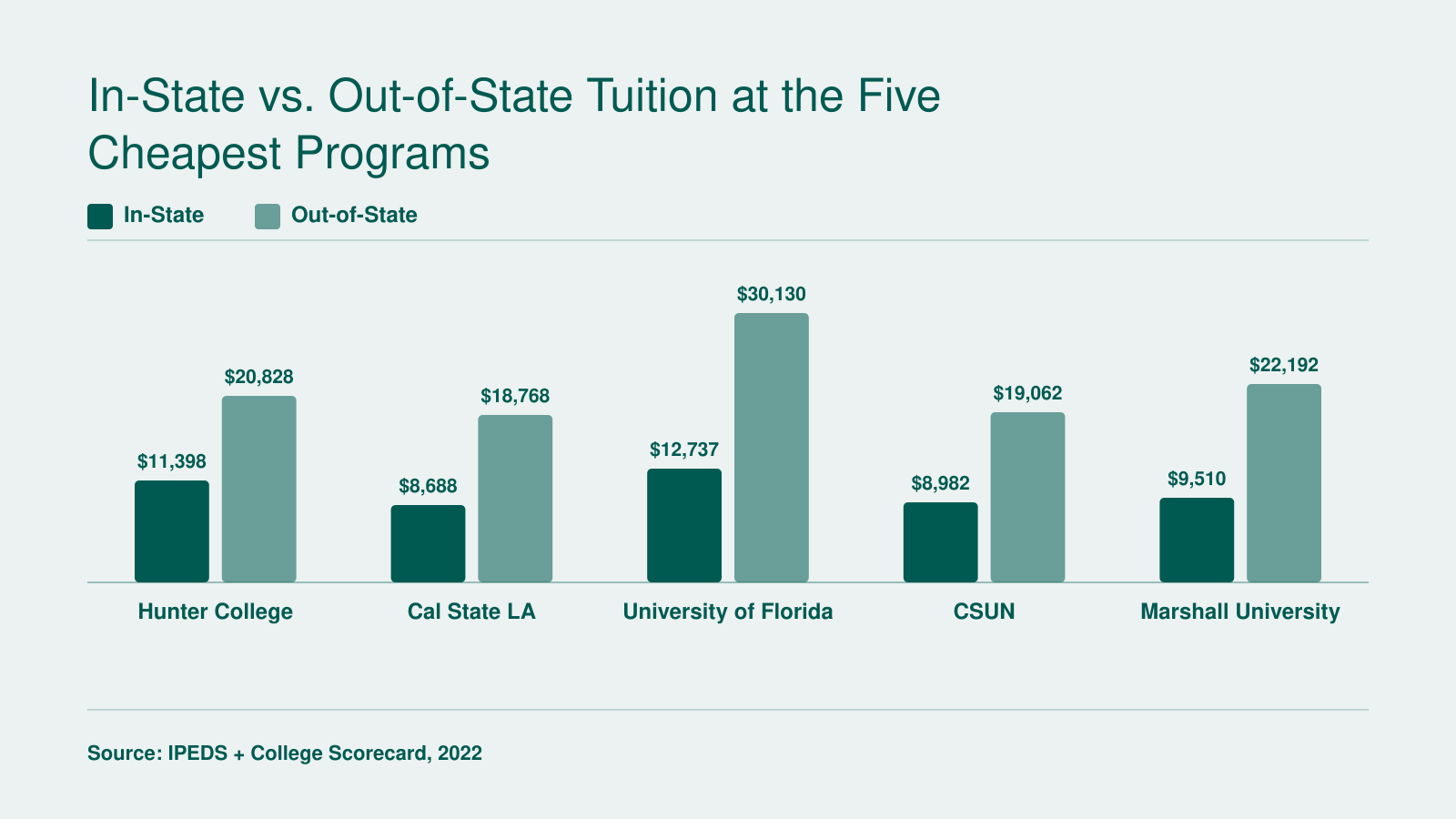
In-State vs. Out-of-State Tuition at the Five Cheapest Programs
At public universities, tuition depends heavily on residency. Hunter College and Cal State LA keep the gap between in-state and out-of-state rates close to $9,400-$10,100, while the University of Florida spans more than $17,000.
Online vs. On-Campus Geography Master's: Where You Save More
Oregon State charges $609 per credit for its online M.S. in Geography and Geospatial Science with no nonresident surcharge, and the University of Illinois Urbana-Champaign sets its online CyberGIS M.S. at $798 per credit for 2026-27, the same for in-state, out-of-state, and international students. Penn State World Campus lists $1,048 per credit for 11 or fewer credits in its 33-credit GIS master's. Flat pricing is not universal, though. Idaho's online M.S. in GIS is residency-based, at $11,796 in-state and $31,272 out-of-state per academic year for 2026-27, plus a $35 per-credit web fee.
Campus Programs and Assistantships
Nearly every school ranked here is campus-based, and San Jose State is the lone hybrid. None is online-only. Out-of-state students on campus pay more. The University of Florida lists $12,737 in-state against $30,130 out-of-state, but its teaching assistantships come with tuition waivers that can close most of that gap for funded students.
International Students
Expect nonresident rates on campus. Among online options, Illinois is the clearest on equal pricing. Oregon State drops the nonresident surcharge, but confirm directly how it treats international applicants before you budget.
What Geography Master's Graduates Earn and Owe
Geography graduate outcomes increasingly track geospatial skills more than the degree title. The program-level numbers show that pattern where federal data exists.
Cal State Long Beach's M.A. in Geography reports median earnings of $87,165 four years after finishing, with median debt of $20,500. That works out to about $233 a month on a 10-year repayment plan. Florida State reports $69,641 four years after finishing, against median debt of $25,125 and a payment near $286 a month.
UCLA, UC Davis, and San Jose State have no program-level earnings or debt figures to quote. Their published tuition is still worth weighing, but it can't be paired with outcomes the way the first two can.
Is a master's in geography worth it?
For most students, yes, with a condition. Debt in the low-to-mid $20,000s and payments under $300 a month leave room for a GIS-related salary to do real work. The affordable options here offer strong value when you pick an accelerated master's in geography with technical, employer-facing training. The value shrinks if you borrow heavily for a program with no clear career path.
Related Articles
Geography programs by state
Frequently Asked Questions About Affordable Geography Master's Programs
Geography master's costs vary with credit load, transfer policies, and thesis or capstone tracks. These answers focus on budget details students ask about most.
What is the most affordable master's in geography program?
How long does a master's in geography take?
Can I transfer graduate credits into a geography master's program?
Compare Geography programs on the data that matters
Explore more Science & Engineering specializations or browse every graduate field.
All Science & Engineering programs