Best Master's in Geography Programs in Arizona
Compare 7 accredited Geography programs in Arizona at 4 schools, with graduate earnings, cost, debt, and completion data from IPEDS and the U.S. College Scorecard.
Geospatial skills now show up in climate, planning, and natural resource job postings, skills central to many environmental science master's programs, not just in geography departments. Arizona's master's options are few: the University of Arizona in Tucson, Arizona State University's hybrid and online route, and Northern Arizona University in Flagstaff.
Campus and online formats are compared side by side here, and in-state graduate tuition runs from $10,843 to $14,856 a year, placing them among the Most Affordable Master's in Geography Programs. With so few choices, format, GRE policy and funding separate these programs more than reputation does.
An assistantship with a tuition waiver can outweigh any sticker-price gap between them.
Key Points
- The University of Arizona's Geography MA states it does not request or consider GRE scores.
- Out-of-state tuition adds about $19,300 at Arizona and $6,300 at Northern Arizona.
- Arizona issues no geographer license, but the GISP credential requires a 150-point portfolio.
Best Master's in Geography Schools in Arizona, Ranked
Arizona has three public universities with master's programs in geography, and they split cleanly by focus: research-heavy campus study in Tucson, a flexible hybrid option anchored in the Phoenix area, and a GIS and planning pathway in Flagstaff. Earnings figures below are program-level medians from federal data, and graduation rates and net price are institution-wide averages, not geography-specific.
University of Arizona
#1Tucson, AZ · ~$15,000/yr (est.)
Best for: Aspiring researchers pursuing thesis-based study
The University of Arizona in Tucson houses the School of Geography, Development & Environment, which has led the field for over 50 years. Its geography master's draws 50 completions in the federal data, the largest cohort among Arizona programs, and graduates earned a median of about $56,800 one year after finishing and about $80,600 four years out. Graduate tuition runs about $14,738 in state and $33,992 out of state, institution-wide net price after aid averages roughly $16,700, and the institution-wide graduation rate is about 68%.
- Six concentration options, including human-environment, GIS and remote sensing, physical geography
- Two-year program with thesis or professional non-thesis pathway
- Requires 33 graduate units per the department handbook
- Fall-only entry; January 5 application deadline
- Many full-time students work as graduate assistants while enrolled
- Prepares graduates for academia, NGOs, and the private sector
Arizona State University
#2Scottsdale, AZ · ~$11,000/yr (est.)
Best for: Working professionals needing flexible online delivery
Arizona State University offers a 30-credit Geography, MA through the College of Liberal Arts and Sciences, delivered at the Tempe campus or fully online. Coursework spans computational spatial science, earth systems and climate, place and culture, and sustainability, with strengths in urban heat island research. Graduates earned a median of about $55,300 one year after finishing, and graduate tuition is about $10,368 for both residents and non-residents, the lowest out-of-state rate in the state.
- 30 total credit hours with thesis or capstone course GPH 597
- Four concentration options across spatial science, climate, culture, sustainability
- Fully online option available; also offered on campus
- Starts fall, spring, or summer
- 3.0 GPA in the last 60 hours and one recommendation letter
- Spatial Analysis and Urban Climate research centers
- Accelerated bachelor's plus master's option
- Not eligible for the STEM-OPT extension
Northern Arizona University
#3Flagstaff, AZ · ~$13,000/yr (est.)
Best for: GIS and planning focused career builders
Northern Arizona University's Master of Science in Geography sits in the Department of Geography, Planning and Recreation in Flagstaff. Students pair core coursework with a GIS or Community Planning graduate certificate and finish with a thesis or applied practicum, which suits those aiming at planning and natural resource careers. Graduate tuition is about $12,135 in state and $18,588 out of state, institution-wide net price after aid averages roughly $14,200, and the institution-wide graduation rate is about 61%.
- 30 total units with 3.0 GPA minimum
- Thesis (GSP 699) or professional practicum (GSP 689), plus oral defense
- Graduate certificate in GIS (16 units) or Community Planning (15 units)
- GIS and geodesign coursework
- Some online or blended coursework
- Accelerated bachelor's to master's plan shares 12 units
- Six-year completion limit
Cost & outcomes by school
Federal data for the highest-earning Geography programs, independent of the ranking above. Earnings are this field's master's graduates four years after completing, where the Scorecard reports them.
| School | Earnings | Tuition / yr | Debt | Grads/yr | Format |
|---|---|---|---|---|---|
| University of Arizona AZ | $80,622 | $14,856 | $33,662 | 40 | Campus |
| Arizona State University AZ | $69,050 | $13,587 | $30,093 | 24 | Campus |
| Arizona State University AZ | $69,050 | $10,843 | $30,093 | 5 | Hybrid |
| Northern Arizona University AZ | — | $13,023 | — | 14 | Campus |
Sources: U.S. Department of Education. Tuition and graduates: IPEDS. Earnings and debt: College Scorecard, this field's master's graduates; a dash means no figure is reported.
Cost, debt & payoff
Median earnings of this field's master's graduates (4 yrs after completing) vs. their median federal loan debt · U.S. College Scorecard
Across these programs the median graduate earns about $69,050 and finishes with roughly $30,093 in debt — a ratio that clears a common rule of thumb (keep debt below first-year salary). Tuition and debt vary widely school to school, so check the per-school figures in the table above before you shortlist.
Online and Hybrid Master's in Geography Options in Arizona
The online and campus-only master's in geography programs in Arizona differ more in focus than in format, so choose the degree first and the delivery method second.
Where online delivery exists
Arizona State University is the ranked school listed as hybrid among the Best Online Master's in Geography Programs. Its online MA in Geography is delivered entirely through ASU Online with no campus residency stated, and it ends in a capstone or thesis. The coursework is broad (research methods, spatial statistics, urban planning, climatology), and its GIS content is introductory. ASU's separate MAS in GIS is on-campus only, runs 12 months and 30 credits, and requires an internship.1 The two are not interchangeable. ASU says diplomas and transcripts do not distinguish online from in-person study.
The University of Arizona lists its MA in Geography as campus-based in Tucson. Its online route is the 30-credit MS in Geographic Information Systems Technology, offered in person or online as the same degree pathway, with no residency requirement stated. Online courses run in 7.5-week sessions, and the Geospatial Data Science emphasis admits for fall only.
Northern Arizona University is listed as campus-based, though its MS in Geography includes some online or blended coursework.
What to confirm before applying
Published materials do not establish whether online students can hold assistantships, so ask each department directly. Also confirm thesis or capstone options and whether any in-person fieldwork or capstone presentation applies.
Which Arizona Geography Master's Programs Waive the GRE or Make It Optional
Funding consideration often depends on applying by the earliest priority deadline, so check each program's date before you plan your timeline. The University of Arizona's Geography MA states that it does not request or consider GRE scores. For the other programs, the pages we reviewed do not list the GRE as a requirement, and Northern Arizona University publishes no GRE policy at all. International applicants must show English proficiency at all three schools, though the pages cited here do not give TOEFL or IELTS minimums, so confirm those scores with each graduate admissions office.
| Program | GRE Policy | Fall Deadline | Required Materials |
|---|---|---|---|
| Arizona State University, Geography, MA | Not listed as a required material in the application instructions | Fall A 2026: July 23, 2026 | Application and fee; official transcripts; personal statement; resume; one letter of recommendation; English proficiency proof; minimum 3.00 GPA |
| Arizona State University, Geographic Information Systems, MAS | Not listed as a required material on the application requirements page | Rolling admission until the program is full | Graduate Admissions application; personal statement (two pages maximum); official transcripts; two letters of recommendation; English proficiency for non-native speakers; minimum 3.00 GPA in last 60 hours |
| University of Arizona, Geography, MA | Not requested or considered | January 5 (domestic and international) | Transcripts from all institutions attended; English proficiency proof for international students; minimum 3.0 GPA |
| University of Arizona, Geographic Information Systems Technology, MS | Not listed as a required material on the program page | Not stated on the program page | Four-year bachelor's or comparable international degree; statement of purpose; at least one letter of recommendation; English proficiency when required; minimum 3.0 GPA |
| Northern Arizona University, Geographic Information Science with Remote Sensing, Master's | No published policy | N/A | Transcripts; essay, letter of intent, or personal statement; recommendation(s) or reference(s); minimum 3.0 GPA |
Related Articles
Cost of a Master's in Geography in Arizona: Tuition, Net Price, and Assistantships
How much does a master's in geography cost in Arizona? For a 30-credit degree, base tuition starts around $18,000 online, and the final bill depends on residency, fees, and funding across master's programs in Arizona.
Tuition and credit hours
ASU's online graduate rate is $605 per credit for 2026-27, according to ASU Tuition and Costs. The 30-credit M.A.S. in GIS costs $18,150 before fees. Fees include $15 per credit for student support, a $200 technology fee, and a $90 student-initiated fee for 7 or more credits in fall and spring. Resident online tuition is capped at 11 credits in Fall 2026, while nonresident students pay per credit, per the Fall 2026 Graduate Online Tuition Schedule.
On campus, ASU's base graduate tuition is $13,327 resident and $29,196 nonresident at 9 credits per semester, excluding program tuition and separate fees, according to ASU 2026-27 Tuition and Fees. NAU's M.S. in Geography requires 30 credit hours. UA's current per-credit rate is not confirmed here, so check its bursar page.
Net price and debt
Institution-wide average net price is only a rough guide: about $14,158 at NAU and $16,674 at UA, not geography-specific. At UA, median debt for geography master's graduates is $33,662, which works out to roughly $383 a month over 10 years.
Assistantships
ASU's M.A. in Geography offers no department funding, and assistantships are case-by-case and rare. The GIS M.A.S. has no guaranteed funding. Stipend amounts, remission percentages, and named scholarships for 2026 were not confirmed, so ask each department directly. Online students are generally not eligible for assistantships, so compare online sticker price against campus cost after any funding. NAU lists scholarships and financial aid for its program.
In-State vs. Out-of-State Graduate Tuition at Arizona Geography Programs
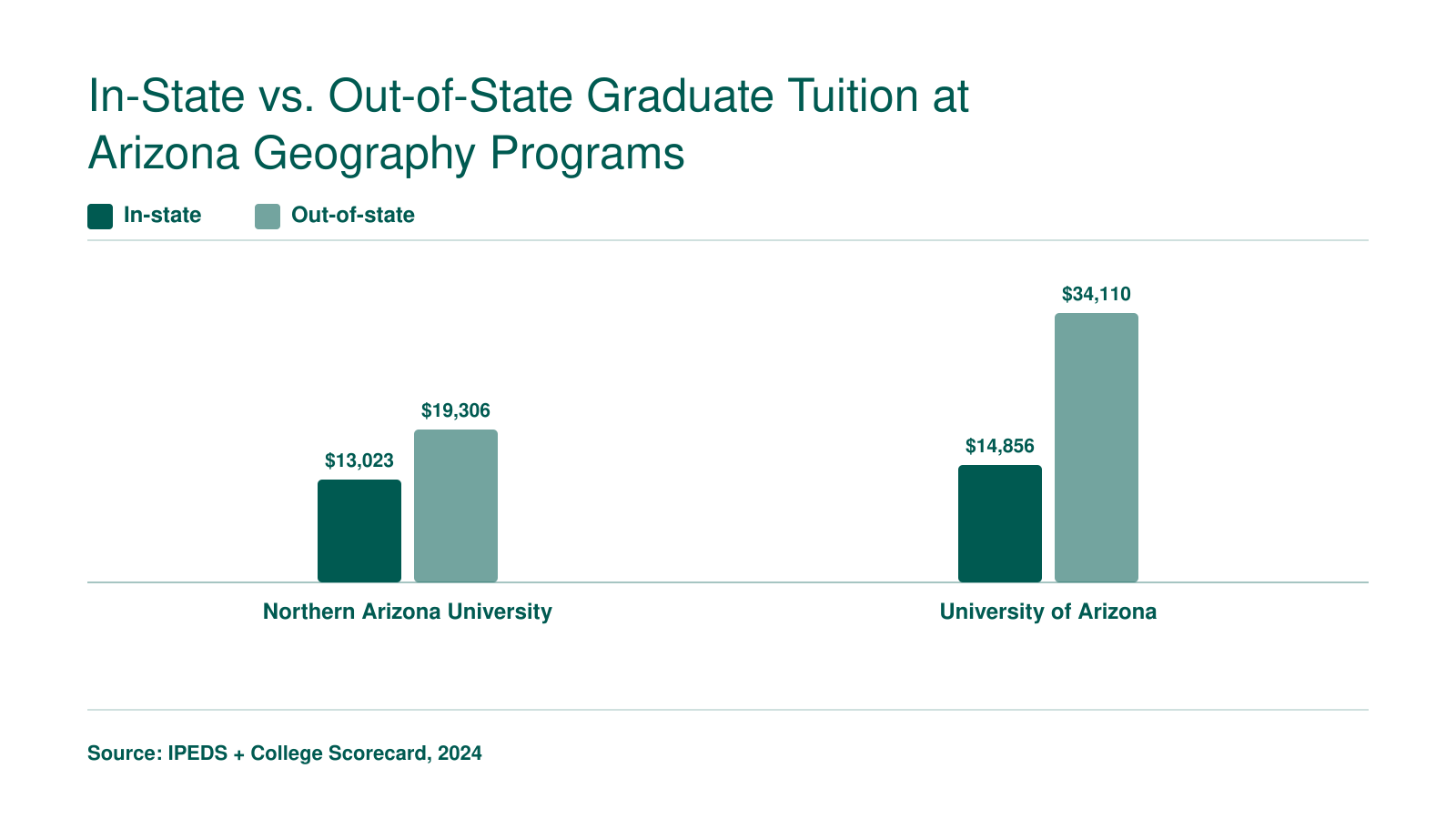
Residency changes the bill more than the choice of school. At Northern Arizona University, out-of-state graduate tuition and fees run about $6,300 above the in-state rate. At the University of Arizona, the gap is roughly $19,300. A research or teaching assistantship that includes tuition remission can erase most of that difference, so ask each department what its funding packages cover.
Arizona Geography Licensure and Certification: What to Know
Geography vs. GIS vs. Urban Planning: Choosing the Right Master's Focus in Arizona
Geospatial work has split into distinct professional tracks, and the degree label you pick now shapes which job postings you qualify for.
What each degree actually covers
- Geography: The broadest of the three. Coursework spans geographic theory, spatial statistics, GIS, urban planning, and climate change, and programs typically close with a thesis, capstone, or practicum. Graduates land in roles like environmental planner, GIS analyst, city planner, or intelligence analyst, working for environmental agencies, city governments, consulting firms, and nonprofits.
- GIS: The most technical path, built around geodatabases, GIS programming, remote sensing, and web mapping.1 Typical titles include GIS analyst, GIS developer, remote-sensing analyst, and geospatial programmer, with employers concentrated in local government, utilities, transportation agencies, and geospatial firms.
- Urban planning: The policy and place track, covering land use, zoning, housing, transportation, and environmental planning. Graduates become city planners, regional planners, transportation planners, and zoning administrators in municipal planning departments, regional commissions, consulting firms, and nonprofits.
Where to find each in Arizona
For geography, ASU offers an MA in person and online, UA offers an MA, and NAU offers a 30-credit NAU MS in Geography. On the GIS side, ASU runs a Master of Advanced Study in GIS, UA offers a 30-credit degree typically finished across five semesters online or in person, and NAU offers an MS in Geographic Information Science with Remote Sensing. For planning, ASU's two-year Master of Urban and Environmental Planning is the standalone option.
Rule of thumb: research and teaching lean geography, technical mapping careers lean GIS, municipal policy work leans planning.
Compare Geography programs on the data that matters
Explore more Science & Engineering specializations or browse every graduate field.
All Science & Engineering programs