Best Master's in Environmental Science Programs in Arizona
Compare 6 accredited Environmental Science programs in Arizona at 3 schools, with graduate earnings, cost, debt, and completion data from IPEDS and the U.S. College Scorecard.

What does a master's in environmental science actually cost in Arizona among the most affordable master's in environmental science programs, and does it pay back? The University of Arizona's online MS runs 30 credits at $850 per credit. Arizona State's environmental and resource management graduates post median earnings of $74,674 four years out against $39,313 in median debt.
Groundwater depletion, Colorado River shortages, extreme heat, and copper mine reclamation keep steady demand for hydrologists, compliance specialists, and remediation staff. The harder call is fit. Arizona's programs split sharply by focus, from water science to sustainability policy, and that choice shapes which employers call back more than the name on the diploma does.
Key Points
- University of Arizona offers a 30-credit online master's in environmental science, finishable in about two years.
- Arizona State University graduates show median earnings of $74,674 against median debt of $39,313.
- Check each school's admissions page for GRE policy, since some publish none.
Best Master's in Environmental Science Programs in Arizona, Ranked
This list favors programs with strong graduate earnings, solid institution-wide graduation rates, and a reasonable price, then looks at how well each program fits working students through campus, hybrid, or online delivery. Arizona has five schools with a relevant master's degree, and they differ a lot in cost and format. The accreditation notes below separate institutional accreditation from programmatic accreditation, because no dedicated accreditor for environmental science master's programs was identified in the research.
University of Arizona
#1Tucson, AZ · ~$15,000/yr (est.)
Best for: Students wanting thesis or non-thesis options
The University of Arizona offers an M.S. in Environmental Science on the Tucson campus, in a hybrid format, and fully online through Arizona Online. All versions require at least 30 graduate units, and the program offers thesis and non-thesis paths with coursework in areas such as soil and water science, environmental microbiology, and data analysis. The university graduates about 68% of its students overall. It is accredited institutionally by the WASC Senior College and University Commission (WSCUC), not the Higher Learning Commission. No programmatic accreditation was identified for the environmental science degree itself. The separate M.S. in Environmental Health Sciences carries CEPH accreditation.
- 30 credits required
- $850 per credit for the online format
- Prerequisites in math, chemistry, biology, and physics
- Core courses in environmental physics, microbiology, and soil chemistry
- Thesis or report option
- At least 30 units with thesis and non-thesis tracks
- Hybrid or online options through Arizona Online
- Final exam and oral presentation assessment
- Six-year completion limit
- Master's report option available
- Tucson campus format
- Research-intensive curriculum with hands-on learning
- Bachelor's degree and transcripts required for admission
- Tuition varies by residency
Northern Arizona University
#2Flagstaff, AZ · ~$13,000/yr (est.)
Best for: Aspiring researchers bridging science and policy
Northern Arizona University in Flagstaff offers a two-year, thesis-based M.S. in Environmental Sciences and Policy built around two emphasis areas. It suits students who want to join natural science research with policy and communication skills, whether for government, industry, or a PhD. Students from participating Western states may qualify for reduced nonresident tuition, and eligible government and nonprofit employees can receive a 10% discount. The university graduates about 61% of its students overall. The research lists the Higher Learning Commission as NAU's accreditor, though the 2026 action found was a program approval, not a reaffirmation. No programmatic accreditation was identified for this degree.
- Science and Policy concentration
- 34 to 36 units with mandatory thesis and oral defense
- 3.0 GPA admission requirement
- Focus on the science-policy interface
- Paleoenvironmental Sciences concentration
- Focus on paleoclimatology
- Quantitative data analysis emphasis
- Thesis and oral defense required
- Two emphasis areas available
- Letters of recommendation, resume, and writing sample required
- Integrates natural and social sciences
- Prepares students for PhD programs
Arizona State University
#3Scottsdale, AZ · ~$11,000/yr (est.)
Best for: Working professionals in resource management
Arizona State University offers three online master's options in the Ira A. Fulton Schools: Environmental and Resource Management, the Water Management version, and Environmental Engineering. The Environmental and Resource Management degree has the strongest outcomes data on this list, with the largest graduate group and published earnings. It requires 30 credit hours with thesis or project paths and uses rolling admissions. ASU has been accredited by the Higher Learning Commission since 1931, was reaffirmed in 2023, and is next reviewed in 2032 to 2033. No programmatic accreditation for these degrees was identified.
- 30 credit hours, thesis or project options
- Online format, STEM-OPT extension eligible
- 3.0 GPA and related bachelor's degree required
- Applied project course ERM 593
- Rolling admissions
- Water Management concentration
- Online format
- Bachelor's degree required for admission
- 30 credit hours with thesis or project options
- Core courses in treatment, focus on water quality
- Minimum 3.0 GPA
- STEM-OPT eligible
Prescott College
#4Prescott, AZ · ~$19,000/yr (est.)
Prescott College offers an online M.S. in Environmental Studies and Sustainability with a bioregional, field-based approach that lets students apply coursework to their local environment. The 36-credit program ends in a capstone portfolio and is designed for working professionals, with concentrations in Conservation Biology and in Resilience Planning and Climate Solutions. The college graduates about 56% of its students overall. It is accredited by the Higher Learning Commission, and no programmatic accreditation exists for this field. It is the highest-priced option on this list.
- Conservation Biology concentration
- 36 credits, fully online
- Aimed at wildlife biology and conservation careers
- Resilience Planning and Climate Solutions concentration
- Systems thinking and environmental policy included
- Prepares for agency and nonprofit roles
- 36 credits with core courses in climate science
- Capstone portfolio required
- Two-year completion time
- No on-campus requirement
Grand Canyon University
#5Phoenix, AZ · ~$10,000/yr (est.)
Grand Canyon University's online M.S. in Sustainability is the most affordable per-credit option here, at $600 per credit for 38 credits. It covers climate change, sustainable business, and renewable energy within a Christian worldview framework, and it ends in a capstone project. The university graduates about 43% of its students overall, the lowest rate on this list, and the program has no published earnings data. GCU is regionally accredited by the Higher Learning Commission, and no programmatic accreditation was identified for this field.
- 38 credits at $600 per credit
- Online with 8-week courses
- 2.8+ GPA required, GRE or GMAT optional
- Transfer up to 12 credits
- Capstone project included
Cost & outcomes by school
Federal data for the highest-earning Environmental Science programs, independent of the ranking above. Earnings are this field's master's graduates four years after completing, where the Scorecard reports them.
| School | Earnings | Tuition / yr | Debt | Grads/yr | Format |
|---|---|---|---|---|---|
| Arizona State University AZ | $74,674 | $10,843 | $39,313 | 68 | Campus |
| University of Arizona AZ | $70,131 | $14,856 | — | 37 | Online or campus |
| Prescott College AZ | — | $18,630 | — | 11 | Online |
Sources: U.S. Department of Education. Tuition and graduates: IPEDS. Earnings and debt: College Scorecard, this field's master's graduates; a dash means no figure is reported.
Online and Hybrid Master's in Environmental Science Options in Arizona
University of Arizona's Online Master's in Environmental Science is fully online and asynchronous, with 7.5-week or 16-week courses. The 30-credit degree can be finished in about two years, or two to three semesters through the Accelerated Master's pathway.
Which programs are online, campus, or both
- Online: University of Arizona, Arizona State University's Environmental and Resource Management MS, Prescott College, and Grand Canyon University.
- Campus: Northern Arizona University's Environmental Sciences and Policy MS.
- Both: University of Arizona's Professional Science Master's in Resilience Practice is offered online and in person.
Structure, accreditation, and completion
University of Arizona describes its online environmental science master's program as fully equivalent to the Main Campus program, so students earn the same institutional accreditation. The curriculum requires a 6-credit thesis or 3-credit report and a final defense. The available handbook does not identify required in-person fieldwork or lab work, though the final presentation or defense is part of the milestone. The Resilience Practice option uses virtual field trips and an 8-credit capstone with a real-world partner.
ASU's Executive Master of Sustainability Leadership starts in the fall only, with an August 1 deadline1, while ASU's online Environmental and Resource Management MS lists rolling admissions and a thesis or project option.
Which Arizona Environmental Science Master's Programs Waive or Make the GRE Optional?
The table below reflects GRE policies and fall deadlines published on official graduate admissions pages for the programs where that information was available. Where a school's page is silent on the GRE, the table says so instead of guessing. When the GRE is not required, applicants are typically evaluated on a statement of purpose, letters of recommendation, transcripts and a minimum GPA, so confirm those requirements on each program's admissions page.
| School | Program | GRE Policy | Application Deadline |
|---|---|---|---|
| Arizona State University | Civil, Environmental and Sustainable Engineering, MS | Not required (no longer required for any SSEBE MS or MSE program) | March 1 for fall |
| University of Arizona | Environmental Science, MS | Not required (scores are requested but not required) | Domestic: June 1 for fall; international: December 1 for fall |
| University of Arizona | Natural Resources, MS (Natural Resources Studies emphasis) | Optional | January 15 for fall |
| University of Arizona | Natural Resources, MS (Watershed Management and Ecohydrology emphasis) | Optional | January 15 for fall |
| Northern Arizona University | Civil-Environmental Engineering, MS | Required for applicants whose undergraduate degree is from another institution; competitive scores expected | June 15 (Fall 2027) |
| Northern Arizona University | Environmental Sciences and Policy, MS | No published policy | January 10 |
Related Articles
What a Master's in Environmental Science Costs in Arizona, and the Credentials That Follow
Across Master's Programs in Arizona at public universities, most graduate environmental science pricing is now flat per-credit online, so the resident/nonresident gap matters far less for distance learners.
The tuition spread
Among the ranked public programs, Northern Arizona University carries the lowest published graduate tuition, roughly $13,000 for residents against about $29,900 for nonresidents, with the University of Arizona close behind for residents (around $13,900) but considerably steeper out of state (about $42,300). Grand Canyon University charges the same rate regardless of residency. The net price figures are institution-wide averages after aid, not quotes for any single master's program.
Per-credit math and fees
For 2026-27, ASU Online Tuition and Costs lists an online graduate rate of $605 per credit, though it says final pricing varies by program and some programs add differential tuition. Arizona's online MS in Environmental Science publishes $850 per credit across 30 credits, about $25,500 in tuition before mandatory and program fees. NAU's published online totals sit near $13,100 to $14,100 annually including fees, though its own pages do not fully agree23. Campus students should budget separately for mandatory charges: NAU lists about $1,625 a year in Flagstaff2, and ASU's schedule includes a tuition surcharge, technology fee, graduate support fee, and student-initiated fees that together add well over $1,0001.
Credentials after graduation
Arizona does not license "environmental scientists" as a category. The closest state credential is professional geologist registration through the Arizona Board of Technical Registration. Nationally, graduates pursue the Certified Professional Soil Scientist, AIH Professional Hydrologist, and CHMM designations. Each sets its own coursework and experience standards, so verify them directly before choosing between hydrology, geology, and soil science electives.
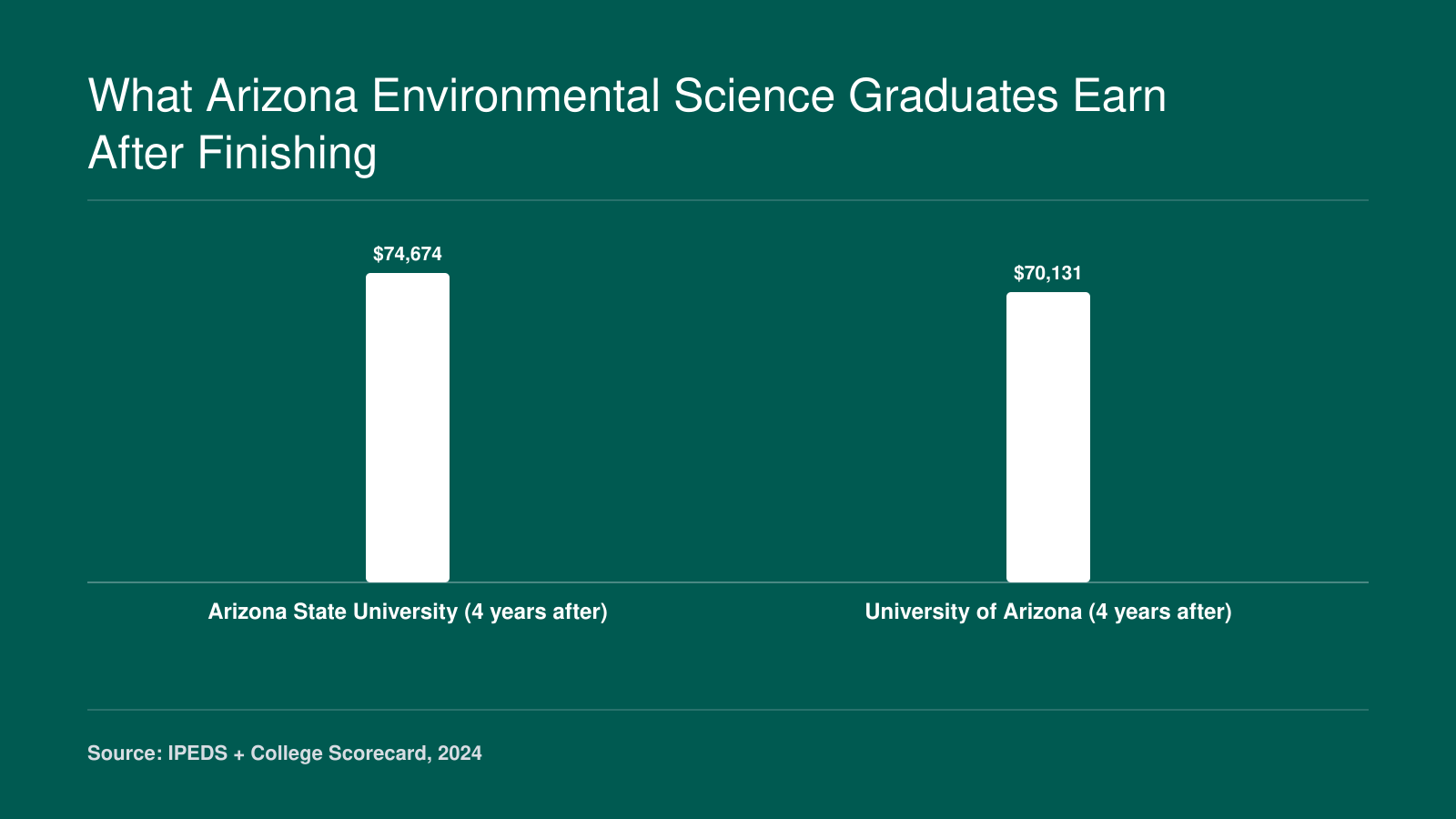
What Arizona Environmental Science Graduates Earn After Finishing
Program-level earnings are reported for only two schools here, so the chart covers just those, each measured four years after completion. Arizona State University graduates have a median debt of $39,313 against median earnings of $74,674, a manageable ratio for a master's degree. The University of Arizona shows $70,131 four years out, but no program debt figure is reported, so a debt comparison isn't possible. Northern Arizona University, Prescott College and Grand Canyon University are left out because no program-level earnings are reported for them.
Master's in Environmental Science in Arizona: Common Questions
Is University of Arizona the only school with an environmental science master's in Arizona?
How long does it take to get a master's in environmental science in Arizona?
Should I choose a thesis or non-thesis track?
What can I do with a master's in environmental science in Arizona?
Compare Environmental Science programs on the data that matters
Explore more Science & Engineering specializations or browse every graduate field.
All Science & Engineering programs