Most Affordable Master's in Environmental Science Programs
Compare 400+ accredited most affordable Environmental Science programs at 230+ schools, with graduate earnings, cost, debt, and completion data from IPEDS and the U.S. College Scorecard.

Florida Atlantic University posts $4,879 in-state tuition, while UTEP's out-of-state rate is $25,502. In-state tuition across the ranked programs runs from $4,879 to $9,987, and few students pay sticker price once aid lands. Affordability here is measured by net price and aid, not a school's name. Before comparing the list, weigh what changes your final bill: true total cost, net price after grants and assistantships, graduate earnings, and thesis or fieldwork obligations. The cheapest listed tuition is rarely the cheapest total degree.
Key Points
- Per-credit tuition, not annual price, drives the real total cost.
- UC Santa Barbara reports $90,082 median earnings, $32,485 median debt.
- University of Toronto Scarborough offers $21,500 stipends tied to teaching assistant hours.
Top 10 Affordable Environmental Science Master's Programs
These 10 programs stand out for combining lower tuition with solid environmental science training. We compare campus and online options, credit requirements, concentrations, and institution-wide graduation rates so you can weigh cost against fit. Affordability here is measured mainly by tuition and net price, not name recognition.
CUNY Brooklyn College
#1Brooklyn, NY · $10,000 – $15,000/yr (est.)
Best for: New York City residents wanting campus research
CUNY Brooklyn College offers a campus-based Master of Science in Earth and Environmental Sciences that emphasizes research skills, analytical methodologies, and effective communication. Students build expertise in quantitative and geo-referencing techniques to address environmental challenges. The program is designed to strengthen competitiveness for doctoral studies and advanced careers while aligning with CUNY's affordable tuition structure. Institution-wide, the school graduates 54% of students.
- Campus-based program in Brooklyn
- Focus on research methodologies and analytical skills
- Prepares students for doctoral study
- Emphasizes quantitative and geo-referencing techniques
- Affordable CUNY tuition structure
California State University-Los Angeles
#2Los Angeles, CA · ~$9,000/yr (est.)
Best for: Concentration-focused scientists comparing environmental tracks
Cal State LA's Master of Science in Environmental Science is campus-based and offers concentrations in Environmental Biology, Environmental Engineering Science, and Environmental Hydrology. The curriculum requires 46 units and a minimum 2.75 GPA for admission, with options for professional internships or research preparation. Students take courses in conservation biology, population genetics, global change, toxicology, hydrology, and geochemistry. Institution-wide, the school graduates 53% of students.
- 46-unit curriculum with core and electives
- Minimum 2.75 GPA for admission
- Professional Experience option includes internships
- Research Experience option prepares for doctoral study
- Courses span conservation biology, population genetics, global change, and toxicology
- Oral exam and seminar presentations required
- Environmental Engineering Science concentration
- Hands-on internship or research component
- Focus on pollution solutions and civil engineering courses
- Thesis or project option available
- Prepares for doctoral study
- Environmental Hydrology concentration
- Professional or research tracks available
- Courses cover hydrology and geochemistry
- Fall and spring admission cycles
- Hands-on internship options offered
The University of Texas Rio Grande Valley
#3Edinburg, TX · $5,000 – $10,000/yr (est.)
Best for: South Texas professionals targeting agriculture and coast
UTRGV offers campus-based master's programs in Agricultural, Environmental, and Sustainability Sciences and in Ocean, Coastal, and Earth Sciences. The agricultural track integrates sustainable agriculture, natural resources, and ecosystem services, while the ocean and coastal track emphasizes marine coastal sciences and environmental impacts. Both prepare graduates for roles in academia, private industry, and public organizations. Institution-wide, the school graduates 51% of students.
- Focus on sustainable agriculture and environmental stewardship
- Prepares for academia, private industry, and public organizations
- Multidisciplinary degree structure
- Integrative education approach
- Addresses food systems, natural resources, and ecosystem services
- Focus on marine and coastal sciences
- Emphasizes environmental impacts
- Multidisciplinary theoretical and applied training
- Prepares for science careers
- Scholarship opportunities available
California State University-Fullerton
#4Fullerton, CA · $9,000 – $19,000/yr (est.)
Cal State Fullerton's Master of Science in Environmental Studies uses small class sizes and a cohort structure to support collaboration on sustainability challenges. Students can pursue a general track or concentrations in Environmental Planning and Environmental Research. The program prepares graduates for roles in air quality management, environmental consulting, environmental planning, and advocacy. Institution-wide, the school graduates 70% of students.
- Campus-based program with small class sizes
- Cohort structure fosters collaboration
- Flexible course options and multidisciplinary approach
- Focus on global sustainability
- Prepares for air quality management and environmental consulting
- Concentration in environmental planning
- Focus on research and advocacy
- Community collaboration emphasis
- Prepares for environmental planning careers
- Concentration in environmental research
- Interdisciplinary curriculum includes biology, ecology, and geology
- Skills in education and planning
- Focus on environmental research and advocacy
- Career paths in science, education, and planning
California State University-Fresno
#5Fresno, CA · ~$9,000/yr (est.)
Cal State Fresno offers a fully online Master of Science in Water Resource Management that uses GIS and geospatial technologies. The 30-unit program covers water economics, politics, and environmental policy while preparing students for urban, industrial, and agricultural sectors. Admission requires a bachelor's degree, minimum GPA, GRE scores, and GIS proficiency. Institution-wide, the school graduates 57% of students.
- 30-unit graduate program
- Fully online with no on-campus meetings
- $551 per unit and $16,530 total cost
- Part-time over five semesters
- Minimum 3.0 GPA and GRE scores required
- GIS proficiency prerequisite
- Focus on water economics, politics, and environmental policy
- Internship and final project required
Florida International University
#6Miami, FL · ~$11,000/yr (est.)
FIU's Master of Science in Environmental Studies is campus-based and emphasizes environmental policy, natural resource science, and sustainable development. Students can focus on the regional geology of South Florida, the Caribbean, or Latin America, with cultural and political contexts woven through the curriculum. The program prepares graduates for careers in geosciences, meteorology, and agriculture. Institution-wide, the school graduates 74% of students.
- Campus-based program in Miami
- Focus on environmental policy and sustainable development
- Natural resource science emphasis
- Cultural and political contexts covered
- Prepares for careers in geosciences, meteorology, and agriculture
- Bachelor's degree required
- Financial aid available
- Concentration in regional geology of South Florida
- Focus on South Florida environmental policy
- Natural resource management emphasis
- Prepares for geosciences careers
- Caribbean concentration
- Emphasis on cultural contexts and sustainable development
- Environmental policy studies and natural resource science
- Geoscience career pathways
- Latin America concentration
- Addresses environmental policy and natural resource management
- Sustainable development emphasis with cultural and political contexts
- Career preparation in environmental science
- Access to Agroecology Program resources
American Public University System
#7Charles Town, WV · $5,000 – $10,000/yr (est.)
American Public University System offers an online Master of Science in Environmental Policy and Management designed for working adults and career changers. The 36-credit program costs $455 per credit and does not require GRE or GMAT scores, with monthly course starts and 8 to 16 week courses. Concentrations include ecosystems management, landscape ecology, and renewable energy. Institution-wide, the school graduates 57% of students.
- 36 total credits required
- Online delivery for working adults
- $455 per credit
- No GRE or GMAT required
- Monthly course starts with 8 to 16 week courses
- Transfer up to 15 credits
- No application fee
- Taught by industry professionals
- Concentration in ecosystems management
- Capstone project included
- Focus on environmental policy and sustainable practices
- Monthly course start options
- Concentration in landscape ecology
- Includes environmental risk assessment
- Covers environmental ethics
- Capstone project required
- Concentration in renewable energy
- Focus on energy policy and environmental economics
- Sustainable strategies covered
- Up to 15 transfer credits accepted
California State University-Sacramento
#8Sacramento, CA · $10,000 – $20,000/yr (est.)
Sacramento State's Master of Science in Environmental Studies is a 30-unit interdisciplinary program with hybrid delivery and evening courses. The curriculum combines environmental science and policy, with a thesis or project option, and prepares students for natural resource agencies, consulting, nonprofits, and doctoral study. Institution-wide, the school graduates 56% of students.
- 30-unit interdisciplinary curriculum
- Hybrid delivery with evening course offerings
- Thesis or project required
- Focus on environmental science and policy
- Prepares for natural resource agencies, consulting, and nonprofits
- Prerequisite environmental courses with B- or better
- Two recommendation letters and statement of purpose required
- Graduate writing intensive course
The University of Texas at El Paso
#9El Paso, TX · $5,000 – $10,000/yr (est.)
UTEP's Environmental Science M.S. offers campus-based concentrations in biology, chemistry, and geosciences. Students gain multidisciplinary research experience in locations from El Paso to the Himalayas and complete internships that connect classroom work to real-world problem-solving. The program prepares graduates for agencies such as the EPA and TCEQ. Institution-wide, the school graduates 50% of students.
- Concentration in biology
- Multidisciplinary curriculum with research opportunities
- Research locations from El Paso to the Himalayas
- Internships for real-world problem-solving
- Focus on biodiversity, climate change, and pollution
- Preparation for careers with EPA and TCEQ
- Concentration in chemistry
- Multidisciplinary environmental science
- Research in international locations
- Hands-on internship experience
- Study of biodiversity and climate change
- Concentration in geosciences
- Multidisciplinary curriculum including environmental policy
- Research opportunities and internships
- Studies biodiversity, climate change, and pollution
- International research locations
Florida Atlantic University
#10Boca Raton, FL · $7,000 – $18,000/yr (est.)
Florida Atlantic University's Master of Science in Environmental Science offers both thesis and non-thesis options, with a flexible curriculum tailored to individual subdisciplines. Students can pursue hands-on research in environmental restoration and prepare for careers in research, management, and regulation. Institution-wide, the school graduates 63% of students.
- Campus-based program in Boca Raton
- Thesis and non-thesis options
- Flexible curriculum tailored to subdisciplines
- Hands-on research in environmental restoration
- Prepares for research, management, and regulation careers
Cost & outcomes by school
Federal data for the highest-earning Environmental Science programs, independent of the ranking above. Earnings are this field's master's graduates four years after completing, where the Scorecard reports them.
| School | Earnings | Tuition / yr | Debt | Grads/yr | Format |
|---|---|---|---|---|---|
| American University DC | $104,878 | $36,754 | $26,500 | 51 | Campus |
| Yale University CT | $100,347 | $49,500 | $41,000 | 158 | Campus |
| Duke University NC | $96,411 | $66,523 | $48,310 | 150 | Campus |
| University of Houston-Clear Lake TX | $94,092 | $9,762 | — | 5 | Online or campus |
| University of Idaho ID | $92,396 | $10,816 | — | 56 | Online or campus |
| California State University-Fullerton CA | $91,697 | $8,994 | — | 12 | Campus |
| Webster University MO | $89,701 | $13,736 | — | 15 | Online or campus |
| University of California-Santa Barbara CA | $88,781 | $15,124 | $32,485 | 72 | Campus |
| University of Michigan MI | $87,988 | $28,886 | $35,377 | 217 | Campus |
| California State Polytechnic University-Humboldt CA | $77,785 | $9,921 | $24,185 | 33 | Campus |
| Georgia Southern University GA | — | $6,646 | — | — | Campus |
| Sul Ross State University TX | — | $6,661 | — | — | Online |
Sources: U.S. Department of Education. Tuition and graduates: IPEDS. Earnings and debt: College Scorecard, this field's master's graduates; a dash means no figure is reported.
Cost, debt & payoff
Median earnings of this field's master's graduates (4 yrs after completing) vs. their median federal loan debt · U.S. College Scorecard
Across these programs the median graduate earns about $74,899 and finishes with roughly $41,000 in debt — a ratio that clears a common rule of thumb (keep debt below first-year salary). Tuition and debt vary widely school to school, so check the per-school figures in the table above before you shortlist.
Tuition and Total Cost: What You'll Actually Pay
Graduate tuition is increasingly quoted per credit rather than per academic year, which means two environmental science master's programs with similar annual prices can finish at very different totals.
Start with credits, not years
Multiply the required credits by the per-credit rate, then add mandatory fees each term. Cal State LA's environmental science master's requires 46 units; Cal State Dominguez Hills requires 30.1 At the same rate, that gap alone runs into thousands of dollars. Fresno State's online water resource management master's lists 30 units at $551 per unit, about $16,530 in tuition, taken part-time across five semesters.1
Residency drives the biggest gap
On campus, where you live still matters most. Florida Atlantic lists roughly $4,879 in-state against $17,324 out-of-state; CUNY Brooklyn College about $7,452 versus $15,402; UT Rio Grande Valley about $9,987 versus $19,827.1 Some fully online master's in environmental science programs publish a single per-credit rate with no residency distinction, which can make an out-of-state student's bill surprisingly competitive. Confirm it on the bursar page, since rates shift year to year and quoted tuition often excludes fees.
Budget the line items nobody advertises
Technology, online course, and program fees are billed on top of tuition. So are books, lab or field kits, and travel for required campus residencies or field courses.
A workable estimate: (credits x per-credit rate) + (fees x number of terms) + books and field gear + travel.
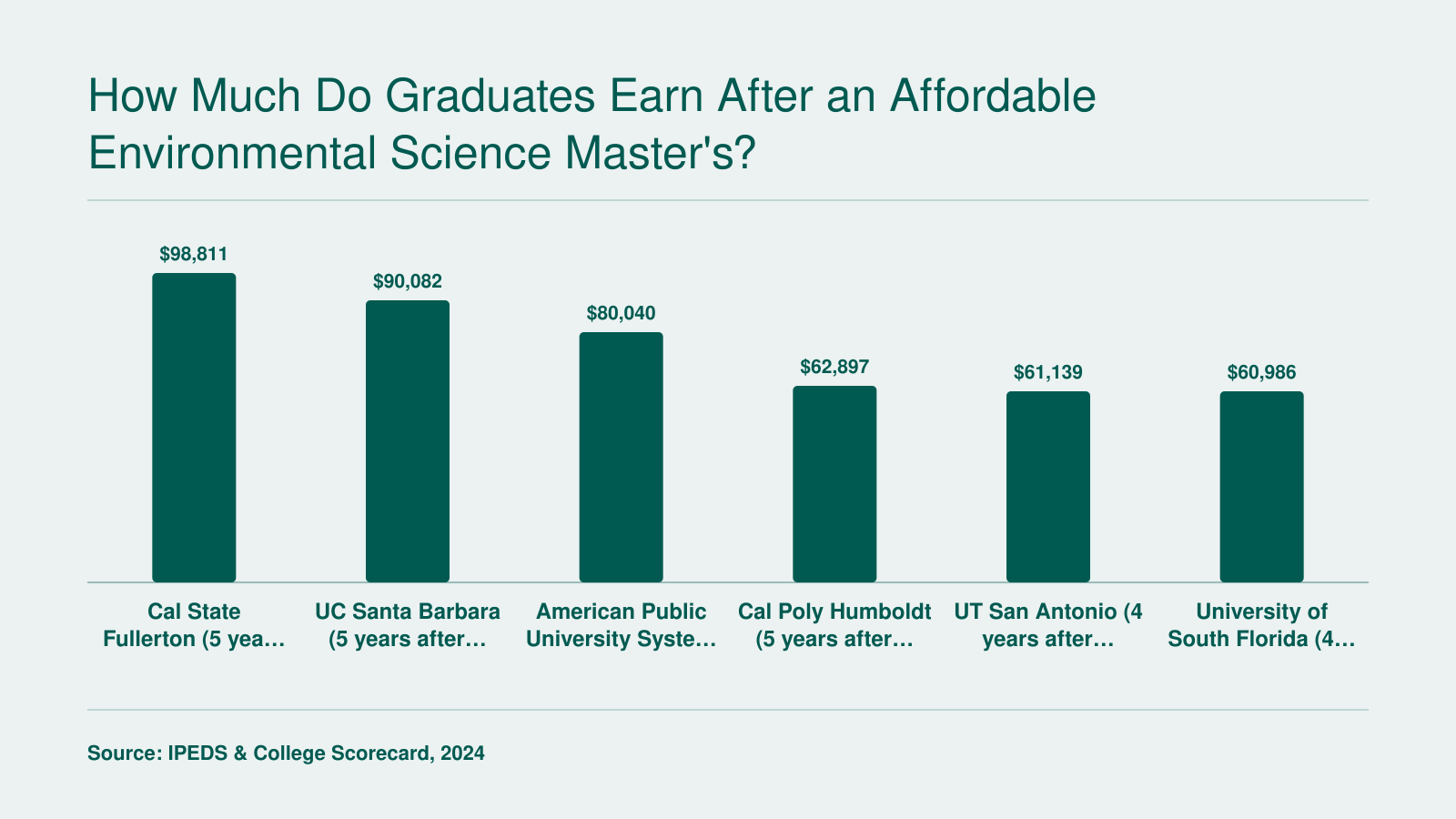
How Much Do Graduates Earn After an Affordable Environmental Science Master's?
The schools below report median earnings that range from roughly $61,000 to just under $99,000 after finishing. Where median program debt is available, the return looks strong: UC Santa Barbara shows median debt of $32,485 against median earnings of $90,082, while Cal Poly Humboldt shows $24,185 in debt against $62,897 in earnings.
Related Articles
Net Price After Aid: Scholarships, Grants, and Assistantships
According to University of Toronto Scarborough's application information, admitted MSc students receive a 2026-2027 stipend of $21,500 tied to 130 teaching assistant hours, as part of a minimum 12-month funding package inside a 16-month program. Assistantships like this are the biggest lever on net cost in affordable environmental science masters programs.
Ohio University's environmental studies assistantships carry a stipend and a full tuition waiver, but they are competitive.3 According to University of Montana's environmental studies funding page, a full-year teaching assistantship waives tuition but not roughly $1,000 per semester in fees, and health insurance is required (about $1,746.50). Don't read "full waiver" as "free." At the University of West Florida, most on-campus applicants who apply for an assistantship receive one, though deadlines matter: Feb 15 for fall, Oct 1 for spring.1 Wayne State lists a single graduate teaching assistantship, so many students there self-fund.2
The published detail on named scholarships is thin. Ohio mentions partial awards based on academic ability, with no amounts or online rules.3 Ask each department directly.
Online students and the fine print
Funding detail skews toward on-campus students, and some assistantships may favor thesis-track students. Online learners should confirm eligibility before counting on one. West Florida's waiver of up to 90% of the nonresident portion for online students is not automatic and must be requested each semester.4
Also, the net price figure on a school's profile is an institution-wide average, so it only approximates what a graduate student will pay.
Apply by the priority deadline. UMass Lowell, for example, sets January 15 for assistantship consideration.5
What Environmental Scientists Earn Nationally
Thesis, Capstone, and Fieldwork: Requirements That Affect Cost and Time
In online environmental science programs, the capstone is now the standard final project, and the thesis is a deliberate research track.
Thesis or capstone
A thesis suits anyone heading toward research or a PhD, and it is often the path that comes with funded assistantships. The University of Idaho's M.S. in Environmental Science thesis route splits 30 credits into at least 24 of coursework and 6 of thesis work, while the non-thesis version shifts that balance toward coursework for working professionals. Bemidji State runs a 30-credit thesis track against a 32-credit non-thesis track1. Youngstown State's non-thesis students complete a two-semester, 3-credit capstone ending in a 20-minute oral presentation2. SUNY ESF, by contrast, requires a thesis plus a synthesis experience worth 3 to 6 credits3.
Fieldwork, labs, and travel
Hands-on requirements are where budgets break. South Alabama's M.S. in Environmental Sciences non-thesis path includes a roughly 480-hour internship and two consecutive full-time semesters in residence, so it is not a remote degree. Villanova's M.S. in Environmental Science builds at least 8 lab credits into its 30-credit curriculum. Harvard Extension's Sustainability Graduate Program is hybrid: at least one course must be taken on campus, which means airfare and lodging. Johns Hopkins offers optional weekend labs; Colorado State runs fully online; Purdue expects on-campus lab time.
Before you deposit, ask in writing whether labs, field courses, or internship hours can be completed near you.
Environmental Science programs by state
Admissions and Timeline FAQs
Admissions requirements and timelines vary by school. The answers below cover GRE policies, typical completion times, prerequisite coursework, and application deadlines based on current program information.
Do affordable environmental science master's programs require the GRE?
How long does an online environmental science master's take part-time?
What prerequisite courses do I need?
When are application deadlines?
Compare Environmental Science programs on the data that matters
Explore more Science & Engineering specializations or browse every graduate field.
All Science & Engineering programs