Best Master's in Environmental Science Programs in Washington
Compare 6 accredited Environmental Science programs in Washington at 4 schools, with graduate earnings, cost, debt, and completion data from IPEDS and the U.S. College Scorecard.

Washington offers a rare mix of study sites: Puget Sound restoration, salmon recovery, working forests, and a state climate policy agenda that keeps agencies and consultancies hiring. The tradeoff is fit against cost. A research thesis at the University of Washington-Seattle Campus carries in-state tuition of $23,202, while Western Washington University, Washington State University, Central Washington University, and The Evergreen State College charge less for graduate study.
The campus programs here sit on one page, ranked by graduate outcomes rather than prestige.
Most public-sector environmental roles value a thesis and field skills over a school's name.
Key Points
- Washington State University waives GRE 2027; advisor support and 3.0 GPA required.
- Western Washington University lists quarterly stipends up to $6,328.
- All programs ranked here are taught in person.
Ranked: Best Environmental Science Master's Programs in Washington
Washington's environmental science master's options range from a 21-month research thesis at the University of Washington to an interdisciplinary evening program at The Evergreen State College. The ranked list below compares graduate earnings and completion outcomes alongside program structure, concentrations, and deadlines. Use the cards to quickly spot in-state and out-of-state tuition, delivery format, and best-fit strengths.
University of Washington-Seattle Campus
#1Seattle, WA · ~$19,000/yr (est.)
Best for: Research-focused environmental health scientists
The University of Washington offers two graduate paths in environmental health sciences: a 21-month, 62-credit thesis-based MS and a 24-month MPH with a 160-hour practicum. Both draw on the department's partnerships with Washington and Northwest agencies, farmworker communities, and policymakers, and the MS may offer Western regional tuition reciprocity for qualifying residents. Students can focus on climate and health, environmental toxicology, or occupational hygiene.
- 21-month, 62-credit thesis-based curriculum
- Areas of emphasis include climate and health, environmental toxicology, and occupational hygiene
- Funding support available through traineeships and assistantships
- Career advising and research-focused training
- 24-month campus-based program with 160-hour practicum
- Thesis or capstone project required
- Core courses cover ethics, risk assessment, and toxicology
- Internship support and funding opportunities available
Western Washington University
#2Bellingham, WA · $14,000 – $27,000/yr (est.)
Best for: Concentration-focused environmental science students
Western Washington University's thesis-based MS in Environmental Science offers three concentrations: energy-environmental systems, environmental toxicology, and freshwater and terrestrial ecology. Applications are due February 1 for fall quarter, and the program no longer requires the GRE. Students work with a faculty advisor and complete a public thesis presentation.
- Specialization in energy systems
- Courses in energy science, energy policy, life cycle analysis, and renewable energy
- Annual progress review and public thesis presentation
- Teaching practicum elective available
- Concentration in environmental toxicology
- 15 credits of required courses plus 30 credits for specialization
- Advanced toxicology courses with laboratory work and risk assessment training
- Teaching assistantship opportunities available
- Specialization in freshwater and terrestrial ecology
- Graduate teaching assistantships available
- Up to 10 credits of 400-level courses; no more than 4 practicum credits
Washington State University
#3Pullman, WA · ~$15,000/yr (est.)
Best for: Students wanting thesis and non-thesis options
Washington State University's Environmental Science program offers MS and PhD pathways with interdisciplinary coursework and research. Students can choose a thesis or non-thesis MS, and admission requires a B average in a related bachelor's degree plus faculty advisor support. Application dates vary by campus and track, so confirm details with the university.
- MS and PhD pathways
- Thesis or non-thesis MS options
- B average GPA and related bachelor's degree required
- Faculty advisor required before admission
- Interdisciplinary coursework and research
- English proficiency required for international applicants
Central Washington University
#4Ellensburg, WA · ~$13,000/yr (est.)
Central Washington University offers a Cultural and Environmental Resource Management graduate program with concentrations in natural resources, cultural resources, and economic resources. Students can complete a 45-credit Master of Applied Science or a 60-credit Master of Science, with thesis or project-based options. The program prepares graduates for federal, state, Tribal, and private-sector resource management roles.
- Focus on natural resources
- Careers in federal, state, and Tribal resource management
- Upper-level electives and research projects available
- Focus on cultural resources
- Environmental law and resource economics courses
- Conflict resolution and methodology training
- Focus on economic resource management
- Resource economics and policy emphasis
- Prepares for management careers in public and private sectors
The Evergreen State College
#5Olympia, WA · ~$13,000/yr (est.)
The Evergreen State College's Master of Environmental Studies blends natural and social sciences with traditional ecological knowledge, with full-time or part-time evening classes and a required thesis.
- 72-credit interdisciplinary curriculum
- Evening class schedule supports working students
- Full-time or part-time enrollment options
- Thesis required
- Internship opportunities available
- Field trips and hands-on labs
- Research design and quantitative analysis training
Cost & outcomes by school
Federal data for the highest-earning Environmental Science programs, independent of the ranking above. Earnings are this field's master's graduates four years after completing, where the Scorecard reports them.
| School | Earnings | Tuition / yr | Debt | Grads/yr | Format |
|---|---|---|---|---|---|
| Washington State University WA | $77,903 | $14,845 | — | 7 | Campus |
| The Evergreen State College WA | — | $13,458 | — | 27 | Campus |
| Western Washington University WA | — | $13,878 | — | 25 | Campus |
| University of Washington-Seattle Campus WA | — | $18,792 | — | 40 | Campus |
Sources: U.S. Department of Education. Tuition and graduates: IPEDS. Earnings and debt: College Scorecard, this field's master's graduates; a dash means no figure is reported.
Online and Hybrid Master's in Environmental Science Options in Washington
All environmental science master's programs on this list are campus-based. UW-Seattle's thesis-based MS in Environmental Health Sciences, Western Washington's thesis MS in Environmental Science, Washington State's MS, Central Washington's resource management degrees, and Evergreen's Master of Environmental Studies are all taught in person. We found no fully online or low-residency option among them, so confirm any hybrid claim with the school directly.
Part-time and evening study
Evergreen is the clearest fit for working professionals. It lists evening classes and both full-time and part-time enrollment, though its field trips and labs still require you on site. Washington State describes a thesis or non-thesis MS, which may give working students more flexibility. Western Washington admits for fall quarter only and expects a faculty advisor agreement, which makes a part-time path harder to plan.
Residents and tuition
None of these programs is online, so Washington residents pay the on-campus resident rate rather than a separate online rate. Resident tuition applies on campus for these Master's Programs in Washington, and it is well below the nonresident rate at each school.
Which Washington Environmental Science Master's Programs Waive the GRE?
Washington State University currently waives the GRE "until further notice" for its M.S. in Environmental and Natural Resource Sciences, placing the program among No-GRE master's programs.1 Applicants still need a potential faculty advisor's support and a 3.0 GPA equivalent, but no GRE score is required.
Among environmental science master's programs no GRE, the University of Washington's Master of Science in Environmental Health Sciences lists the GRE as "not considered": scores are not required and, if submitted, are not used.2 Western Washington University has not required the GRE for its M.S. in Environmental Science since 2020, and its M.A. in Environmental Studies and Marine and Estuarine Science track are also optional. Submitting scores at Western can support a holistic review, with no penalty for omitting them.
Central Washington University and The Evergreen State College have no published GRE policy in the program pages reviewed. Because requirements can change each cycle, confirm the current policy with the department before registering for the test.
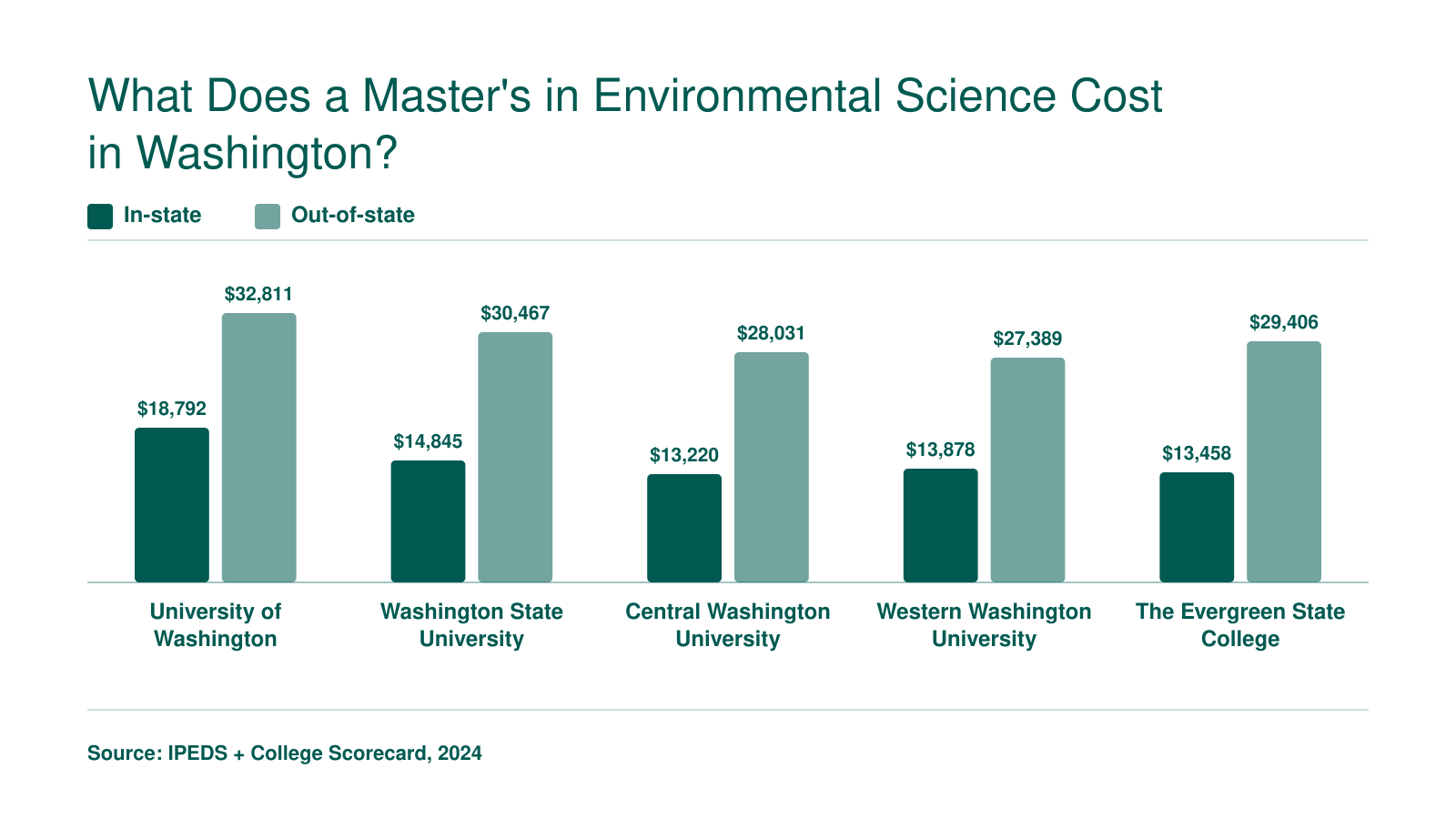
What Does a Master's in Environmental Science Cost in Washington?
The chart shows each school's published graduate tuition and fees before aid; individual programs may bill different rates. Published net price after aid is an institution-wide average, not a quote for any single master's student. Total program cost estimates are not published for most programs because required credits and mandatory fees are not consistently itemized.
Related Articles
Funded Environmental Science Master's Programs in Washington: Assistantships and Tuition Waivers
Western Washington University's College of the Environment lists stipends of up to $6,328 per quarter as of Fall 2026, with full or partial tuition waivers and health insurance. Selection is competitive, and the published information does not say whether that amount is guaranteed or how many quarters it covers.
At Washington State University, a 20-hour weekly appointment earns a full tuition waiver and a 10-hour appointment a half waiver.1 The standard waiver requires Washington residency. Nonresidents can waive the out-of-state portion in their first year, while international students receive that waiver throughout. Since Aug. 16, 2026, the new Graduate School Commitment waiver code applies only to 50% FTE assistantships.1
At the University of Washington, assistantships are department-specific. Employment of at least 20 hours a week can waive the nonresident differential, but benefits depend on the hiring department's offer letter.
Evergreen State College publishes no assistantship or waiver details that I could confirm, so plan on self-funding there unless the program tells you otherwise.
Thesis-track students generally have better odds at research funding than coursework-only students at affordable environmental science master's programs. Email potential advisors before you apply, because funding often follows their grants.
Washington Licensure and Certification for Environmental Scientists
Thesis vs. Non-Thesis Tracks and Specializations in Washington
Washington State University is the one program here where the thesis choice is explicit: its M.S. in Environmental & Natural Resource Sciences offers thesis and non-thesis (Directed Studies Plan) routes. Thesis suits research or PhD paths. Non-thesis, with a smaller project and more coursework, fits agency or consulting roles. Listed specializations include wildlife and habitat ecology, ecohydrology and biogeochemistry, and quantitative modeling with spatial ecology.1
The others lean toward research:
- University of Washington: The Environmental Health Sciences M.S. is a 62-credit thesis degree. Electives can steer toward toxicology, occupational health, or climate change. No non-thesis option is established.
- Western Washington University: Thesis only (45 credits including 12 for the thesis). The catalog points to energy-environmental systems.
- Central Washington University: A 60-credit M.S. and a 45-credit MAS, thesis or project-based, centered on natural resource management.
- The Evergreen State College: Its Master of Environmental Studies lists a thesis component.
STEM designation is not established for any of these programs, so international students should confirm OPT eligibility with each school.
Career and Salary Outcomes for Washington Environmental Science Master's Graduates
The table below shows median earnings for environmental science master's graduates from Washington programs, using College Scorecard data reported one year and four years after program completion. These are program-level outcomes, not university-wide figures, and they offer a practical way to compare the income payoff of each degree.
| Program | Median earnings one year after completion | Median earnings four years after finishing |
|---|---|---|
| Washington State University | $56,115 | $77,903 |
| Central Washington University | $59,067 | $62,984 |
| Western Washington University | $56,460 | N/A |
Common Questions About Environmental Science Master's Programs in Washington
How do University of Washington, Washington State University, and Western Washington University compare for an environmental science master's?
Can I get a funded environmental science master's in Washington?
Does in-state tuition apply if I move to Washington for grad school?
Compare Environmental Science programs on the data that matters
Explore more Science & Engineering specializations or browse every graduate field.
All Science & Engineering programs