Master's in Environmental Science Programs With No GRE Required
Compare 400+ accredited no-gre Environmental Science programs at 230+ schools, with graduate earnings, cost, debt, and completion data from IPEDS and the U.S. College Scorecard.

Sitting for the GRE General Test costs about $220, and many applicants spend weeks or months preparing before paying that fee. For a master's in environmental science, the effort increasingly buys little: many programs have dropped the exam outright.
Policies are not uniform, though. Columbia lists the GRE as optional for its Earth and Environmental Engineering MS, and UCF says the test is generally not required for its online environmental engineering degree. Without a score, committees lean harder on transcripts, prerequisite science coursework, and recommendations.
Key Points
- No GRE is required; admissions focus on transcripts, experience, and English tests.
- Fall 2027 deadlines cluster from December through March at many programs.
- In-state tuition starts near $8,700 and reaches almost $26,000.
Top 10 No-GRE Master's in Environmental Science Programs
This list focuses on the admission criterion that matters most here: programs that waive, do not require, or make optional the GRE. The order is a practical balance of institution-wide completion and retention, moderate cost and earnings signals, and overall institutional quality, drawing on IPEDS and College Scorecard rather than advertising. Not every school on the page is test-free in every track; where official 2025-2026 policy was available, we noted it.
Columbia University in the City of New York
#1New York, NY · ~$58,000/yr (est.)
Best for: Engineering students seeking Ivy research
This Ivy League research university offers a 30-credit master's in Earth and Environmental Engineering with specializations in sustainable energy, sustainable mining and materials, and water resources and climate risks. Applicants need a bachelor's degree in engineering or a related field, and the published listing describes GRE scores as not required or optional. The school reports an institution-wide graduation rate of 96%.
- 30-credit program, typically completed in 1 to 1.5 years
- Concentrations in sustainable energy, sustainable mining and materials, and water resources and climate risks
- Bachelor's degree in engineering or a related field required
- Requires transcripts, three recommendation letters, personal statement, and resume
- Published listing describes GRE as not required or optional
- Thesis or research course options plus research opportunities
- $85 application fee and financial aid available
University of Notre Dame
#2Notre Dame, IN · ~$65,000/yr (est.)
Best for: Working engineers focused on water treatment
This private research university offers a nine-month professional master's in civil and environmental engineering with concentrations in water quality, treatment, and recovery or fluid dynamics and modeling. The published listings state no GRE is required, and applicants need an engineering or physical sciences background. The school reports an institution-wide graduation rate of 95%.
- Nine-month, full-time professional master's program
- Concentration in water quality, treatment, and recovery
- Undergraduate degree in engineering or physical sciences required
- No GRE required according to published listing
- Requires statement of intent, three recommendation letters, and essay
- Nine-month professional master's with campus delivery
- Concentration in fluid dynamics and modeling
- Engineering or physical sciences bachelor's degree required
- Published listing states no GRE is required
- Requires statement of intent, three recommendation letters, and a 1,000-word essay
Johns Hopkins University
#3Baltimore, MD · ~$65,000/yr (est.)
Best for: Environmental policy professionals needing hybrid flexibility
This university offers a hybrid master's in environmental sciences and policy with an international environmental policy focus. The 10-course program includes an on-site residency and takes 12 to 24 months, and the published listing does not mention a GRE requirement. The school reports an institution-wide graduation rate of 94%.
- 10 courses plus an on-site residency required
- 12 to 24 months to complete, with fall, spring, and summer entry
- International environmental policy concentration
- Hybrid mode combines online and on-campus learning
- Published listing does not mention a GRE requirement
- Interdisciplinary coursework with access to Washington, D.C. agencies
- Evening classes and immersive experiences available
University of Illinois Urbana-Champaign
#4Champaign, IL · ~$19,000/yr (est.)
This public research university offers an online, 32-credit master's in natural resources and environmental sciences with concentrations in aquatic chemistry and conservation ecology. The program is designed for working professionals and includes a capstone, internship, or group research experience, with a 3.0 GPA expectation. Published listings state no GRE is required, and the school reports an institution-wide graduation rate of 85%.
- 32-credit online program with a non-thesis capstone
- Concentration in aquatic chemistry
- 3.0 GPA required for admission
- No GRE required according to published listing
- Part-time study available for working professionals
- Capstone, internship, or group research experience options
- Water resources management and ecological conservation focus
- 32 credits required, with the online track offered as non-thesis only
- Conservation ecology concentration
- 3.0 GPA admission expectation
- Published listing states no GRE is required
- Professional orientation course included
- Minimum 12 hours at the 500 level required
- Focus on ecosystem science and human dimensions
Northeastern University
#5Boston, MA · ~$29,000/yr (est.)
This private research university offers a joint, 36-credit master's in environmental science and policy through its College of Science and School of Public Policy and Urban Affairs. Students choose concentrations in climate change, ecosystem function, or the general policy track, with an optional co-op. The graduate admissions page states the GRE is not required or considered, and the school reports an institution-wide graduation rate of 91%.
- 36 credit hours, full-time or part-time over 1.5 years
- Optional co-op experience available
- Jointly offered by two colleges
- Requires transcripts, personal statement, resume, and two recommendation letters
- Published listing states the GRE is not required or considered
- Interdisciplinary courses across environmental policy, sustainability, and marine science
- Climate change concentration within the 36-credit program
- Full-time or part-time study with fall and spring entry
- Focus on climate policy, sustainability, and faculty expertise
- Transcripts, personal statement, resume, and two recommendation letters required
- No GRE requirement per published materials
- Optional co-op and financial aid available
- Ecosystem function concentration within the 36-credit program
- Full-time or part-time study with an optional co-op
- Covers environmental management, water resources, and marine systems
- Application requires transcripts, personal statement, resume, and two recommendation letters
- GRE scores neither required nor considered
- Online application and English proficiency for international applicants
Clemson University
#6Clemson, SC · $10,000 – $15,000/yr (est.)
This public research university offers an online environmental engineering and science master's and a separate hydrogeology master's. The online program includes an environmental health physics concentration, thesis and non-thesis tracks, and no application fee, while the hydrogeology program offers research and teaching assistantships. Published listings state no GRE is required, and the school reports an institution-wide graduation rate of 87%.
- Online delivery with no application fee
- No GRE requirement according to published listing
- Minimum 3.0 GPA and engineering or science degree required
- Core courses in environmental principles
- Thesis and non-thesis options available
- B.S. to M.S. pathway option
- Online program with environmental health physics concentration
- No GRE required and no application fee
- 3.0 GPA admission requirement
- 30 credit hours for non-thesis or 24 credit hours for thesis
- Focus on radiation detection, risk assessment, and radioactive waste management
- ABET-accredited by ASAC
- Campus-based interdisciplinary hydrogeology program
- No GRE scores required according to published listing
- No application fee and financial aid available
- Research and teaching assistantships offered
- Field camp experience included
- Requires statement of purpose and letters of recommendation
- Reduced tuition for assistants
Florida State University
#7Tallahassee, FL · ~$11,000/yr (est.)
This public university offers an on-campus master's in aquatic environmental science with thesis and non-thesis tracks, plus a professional master's option focused on applied training. The program expects a 3.0 GPA and does not set a GRE minimum, with 33 to 36 credit hours depending on the track. The school reports an institution-wide graduation rate of 86%.
- 33 to 36 credit hours, with thesis and non-thesis tracks
- 3.0 GPA required for admission
- No GRE minimum according to published listing
- Full-time or part-time attendance available
- Capstone project for non-thesis students
- Professional Science Master's option and joint JD/MS pathway
- Focus on aquatic environmental science
- 36 credit hours, non-thesis professional degree
- Requires a 3.0 undergraduate GPA
- No GRE requirement according to published listing
- Professional development focus with capstone project
- Internship opportunities available
- Full-time or part-time attendance
University of Minnesota-Twin Cities
#8Minneapolis, MN · ~$22,000/yr (est.)
This public research university offers a campus-based, STEM-designated master's in environmental health. The program does not require the GRE and offers emphasis areas plus scholarships and applied practice experiences through a top-ranked public health school. The school reports an institution-wide graduation rate of 85%.
- Campus-based, STEM-designated graduate degree
- No GRE required according to published listing
- Multiple emphasis areas available
- Scholarship opportunities and applied practice experiences
- Professional mentorship and research focus
- Top-ranked public health school setting
- Priority application deadline December 1, final June 15
University of Central Florida
#9Orlando, FL · ~$9,000/yr (est.)
This public university offers a fully online, 30-credit master's in environmental engineering with an environmental engineering science concentration. The program is designed for working professionals and covers water treatment, waste management, and environmental modeling. The school reports an institution-wide graduation rate of 78%, and although the GRE is not required, UCF recommends it for applicants who plan to pursue a thesis.
- 30 credit hours, fully online format
- Concentration in environmental engineering science
- Thesis and non-thesis options available
- GRE not required generally; highly recommended for thesis track
- Focus on pollution control, water treatment, waste management, and environmental modeling
- Bachelor's degree in a related field required
- Three recommendation letters and statement of objectives required
- Distinct residency-based tuition rates apply
North Carolina State University at Raleigh
#10Raleigh, NC · $12,000 – $33,000/yr (est.)
This public land-grant university offers an online, 30-credit master of environmental assessment for working professionals. The program expects a 3.0 GPA in related fields and includes a professional project, with the published listing stating no GRE is required. The school reports an institution-wide graduation rate of 85%.
- 30-credit, fully online program
- No GRE required according to published listing
- 3.0 GPA in related fields expected
- Professional project required for completion
- Interdisciplinary focus on environmental and health risk assessment
- Flexible for full-time working professionals
- Graduate certificate option available
Cost & outcomes by school
Federal data for the highest-earning Environmental Science programs, independent of the ranking above. Earnings are this field's master's graduates four years after completing, where the Scorecard reports them.
| School | Earnings | Tuition / yr | Debt | Grads/yr | Format |
|---|---|---|---|---|---|
| American University DC | $104,878 | $36,754 | $26,500 | 51 | Campus |
| University of Houston-Clear Lake TX | $94,092 | $9,762 | — | 5 | Online or campus |
| University of Idaho ID | $92,396 | $10,816 | — | 56 | Online or campus |
| University of Central Florida FL | — | $8,872 | — | — | Online |
| Florida State University FL | — | $10,553 | — | — | Campus |
| Eastern Kentucky University KY | — | $10,794 | — | — | Online |
| University of Kansas KS | — | $11,971 | — | — | Campus |
| Clemson University SC | — | $12,646 | — | — | Online or campus |
Sources: U.S. Department of Education. Tuition and graduates: IPEDS. Earnings and debt: College Scorecard, this field's master's graduates; a dash means no figure is reported.
Cost, debt & payoff
Median earnings of this field's master's graduates (4 yrs after completing) vs. their median federal loan debt · U.S. College Scorecard
Across these programs the median graduate earns about $74,899 and finishes with roughly $41,000 in debt — a ratio that clears a common rule of thumb (keep debt below first-year salary). Tuition and debt vary widely school to school, so check the per-school figures in the table above before you shortlist.
What No-GRE Programs Ask for Instead of Test Scores
No-GRE admission shifts the focus to academic preparation and evidence you can handle graduate-level environmental science.
- Bachelor's degreeA completed bachelor's degree is the baseline; several programs admit students with science deficiencies and let them remedy gaps.
- Minimum GPAGPA minimums in the programs below generally fall between 2.7 and 3.0, with conditional or provisional routes below those thresholds.
- Prerequisite courseworkCommon prerequisites include college chemistry with lab, biology, calculus or statistics, and earth or environmental science credit; Oklahoma State requires a B or better in algebra, biology, and general chemistry.
- Statement of purpose, recommendations, and resumeApplications typically ask for a written statement, letters of recommendation, and a resume or CV to show experience and fit.
- Conditional and deficiency routesYoungstown State allows provisional admission for up to three deficiencies or a GPA below 2.7; Towson uses 2.75 conditional admission; Cal Poly admits conditionally classified students with a small number of unmet prerequisites; Arizona asks students to finish deficiencies in the first two semesters.
Application Deadlines and Start Terms to Plan Around
When do you need to apply to start one of the no-GRE environmental science master's programs in fall 2027? At many campus programs, the answer is this winter. Fall entry dominates, and the key dates cluster between December and March:
- CU Boulder: Fall 2027 entry only, with deadlines of December 1, 2026 for international applicants and December 15, 2026 for domestic applicants.1
- Penn: A December 15, 2026 priority deadline and a March 15, 2027 final deadline for fall 2027. Spring entry is also offered.2
- Stanford: Earth and Planetary Sciences graduate applications for autumn 2027 are due December 4, 2026.3
- KU Edwards: Fall, spring, and summer starts, with a May 1 fall priority date and an August 1 final deadline.4
Professional and online-friendly programs like KU Edwards tend to offer more start terms, which gives working applicants more room to plan.
Holding out for the final deadline can cost you money. Scholarship and assistantship consideration is often tied to the earlier date. At UTSC's MEnvSc, for example, international applicants must apply by February 1, 2027, while domestic applicants can apply until May 1.5 Dates shift every cycle, so confirm them on the program page before you build your timeline.
Related Articles
Earnings After an Environmental Science Master's
The highest reported median earnings in this group belongs to Columbia University.
Cost, Funding, and Assistantships at No-GRE Programs
What will a no-GRE environmental science master's actually cost after assistantships, residency pricing, and online fees?
Tuition and posted prices
Published graduate tuition across the affordable environmental science master's programs below starts around $8,700 and reaches nearly $26,000 for in-state students. Out-of-state rates are more variable: several campus programs fall between about $16,400 and $34,500, while American Public University System charges the same $8,700 regardless of residency. North Carolina State University and the University of Massachusetts Lowell, for example, list out-of-state tuition near $32,900 and $29,100.
Assistantships and waivers
Funding beyond sticker price often depends on the track. The University of Illinois Urbana-Champaign's Natural Resources and Environmental Sciences M.S. ties assistantships to full-time, on-campus, thesis students, the setting most likely to include tuition remission and a stipend.1 UMass Lowell lists a January 15 application deadline. DePaul University's thesis-based assistantship pays $6,300 per academic year for 10 hours weekly, covering 48 of 52 required credit hours2. Students in Online Master's in Environmental Science programs usually have fewer assistantship options, but the University of West Florida's online M.S. in Environmental Science offers a 90% nonresident tuition waiver, requested each semester and not retroactive, with other fees still owed3.
Program-level median debt is not widely published. Where it is available, one program here lists median debt near $31,700, about $360 a month on the standard 10-year plan. Because funding is competitive and contingent, contact departments directly before assuming eligibility.
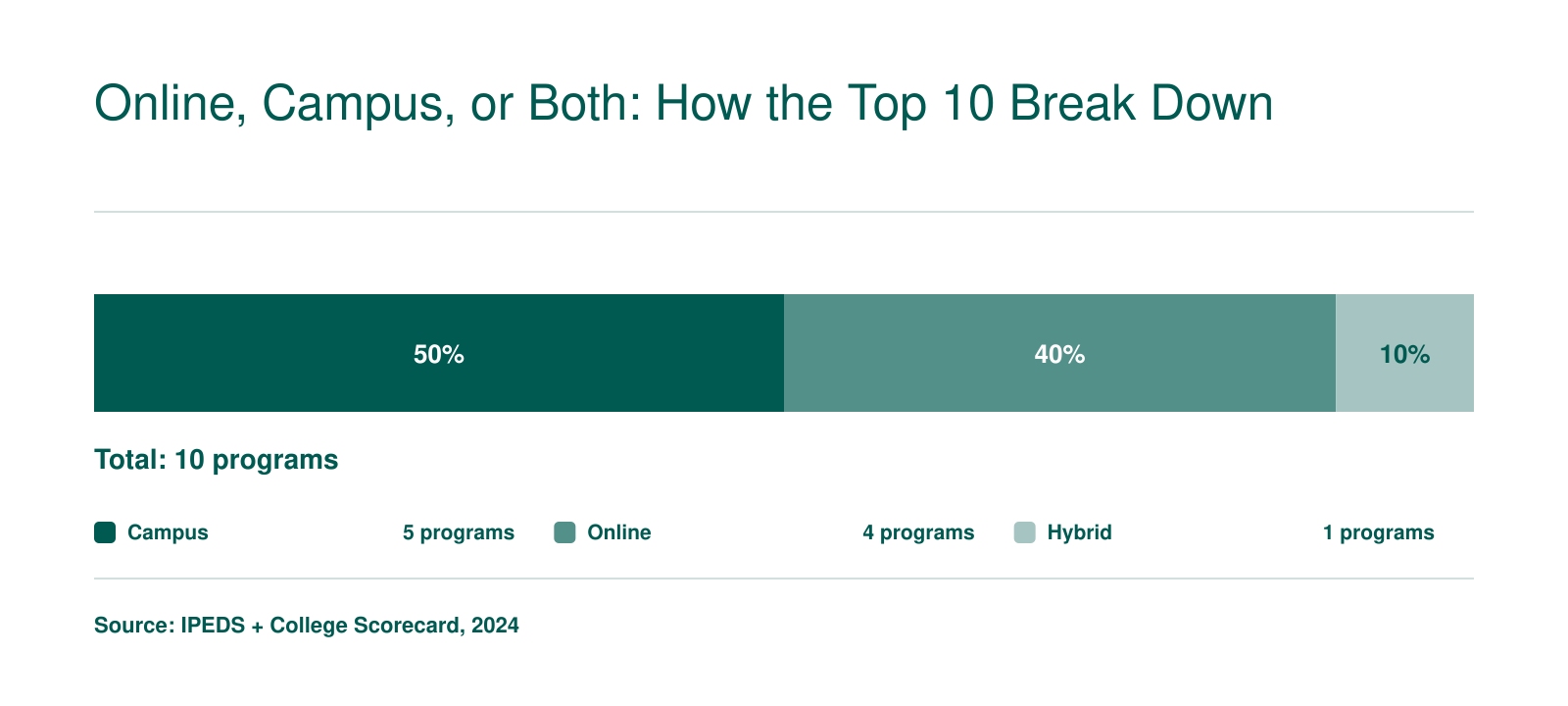
Online, Campus, or Both: How the Top 10 Break Down
Online and hybrid formats fit working professionals in environmental agencies or consulting, while campus programs often provide easier access to labs, fieldwork, and assistantships.
International Applicants: English Tests and STEM OPT Eligibility
English proficiency scores are the main extra hurdle for international applicants, and published minimums cluster in a narrow band. UMass Lowell lists TOEFL iBT 79, IELTS 6.5, and Duolingo 115. New Haven asks for TOEFL 80, IELTS 6.5, and Duolingo 105.2 Toledo posts Duolingo 110. Idaho's TOEFL figure appears as 4.5, which is not a standard iBT score, so confirm it with the university.3 RIT sits at TOEFL 79, IELTS 6.5, and Duolingo 120, but requires the GRE from applicants with international degrees.4 Requirements vary by program, so check each page.
STEM designation matters because Environmental Science (CIP 03.0104) is on the DHS STEM list, which opens the 24-month OPT extension for F-1 graduates.1 Eligibility follows the CIP code on your I-20, not the program title, so ask the school's DSO to confirm it.
Fully online programs generally cannot sponsor F-1 visas, so choose a campus or hybrid option. Some schools may also ask for a credential evaluation, such as WES, of your foreign degree.
Environmental Science programs by state
Frequently Asked Questions About No-GRE Environmental Science Master's Programs
Do you need the GRE for a master's in environmental science?
Are there online environmental science master's programs with no GRE?
What can I do with a master's in environmental science?
Can I get into an environmental science master's with a non-science bachelor's degree?
Compare Environmental Science programs on the data that matters
Explore more Science & Engineering specializations or browse every graduate field.
All Science & Engineering programs