Best Master's in Environmental Science Programs in Utah
Compare 4 accredited Environmental Science programs in Utah at 3 schools, with graduate earnings, cost, debt, and completion data from IPEDS and the U.S. College Scorecard.

Which Utah master's programs actually train scientists for a shrinking Great Salt Lake, Wasatch Front inversions, and a tightening Colorado River allocation? The state's public universities charge roughly $7,800 to $8,700 a year in resident graduate tuition, while out-of-state rates pass $24,000, so residency often moves the math more than prestige does.
Campus and online master's in environmental science formats both appear here. The sharper decision is thesis versus applied project: one feeds doctoral work and agency research, the other feeds consulting and permitting jobs that hire on technical skills, not publications.
Key Points
- Utah State's Master of Natural Resources is the fully online option here.
- In-state tuition is about $7,828 at Utah State, $8,724 at Utah.
- Professional Geologist licensure covers groundwater, soil, and site assessment work in Utah.
Best Master's in Environmental Science Programs in Utah, Ranked
Utah's environmental science master's programs differ more in focus than in location. This list weighs graduate earnings, graduation rates, net price, and campus accessibility, while also highlighting the research and agency connections that shape your experience. Use the program bullets below to compare concentrations, deadlines, and applied work.
Brigham Young University
#1Provo, UT · $5,000 – $10,000/yr (est.)
Best for: Environmental remediation and toxicology students
BYU's master's program centers on environmental protection, remediation, soil science, and stewardship. Students complete 30 credits with thesis and seminar work and can pursue research in environmental toxicology or bioremediation. The institution reports an 81% graduation rate overall. No specific Utah agency partnership was identified in the materials reviewed, and current regional accreditation should be verified directly.
- 30 credit hours required.
- Includes thesis and seminar components.
- Focus on environmental protection research.
- Prepares for state and federal jobs.
- Courses in soil science and biology.
- Research in environmental toxicology.
- Research in bioremediation techniques.
- Part of College of Life Sciences.
University of Utah
#2Salt Lake City, UT · $9,000 – $28,000/yr (est.)
Best for: Agency-focused environmental science professionals
The University of Utah offers a professional science master's in environmental science alongside research-focused geography master's options in GIS and geography. The environmental science track includes 36 credits, a professional project, and core work in climate systems, urban ecology, and environmental chemistry. Kevin Perry's atmospheric science research on Great Salt Lake dust links students to Utah DEQ, Utah DWR, Utah Geological Survey, and USGS. The institution reports a 65% graduation rate overall, and current regional accreditation should be verified directly.
- 36 credits required.
- Full-time in two years.
- GPA above 3.0 needed.
- Includes professional project.
- Core climate, urban ecology, and environmental chemistry.
- Electives in hydrology, GIS, and remote sensing.
- R coding and project management emphasized.
- Cohort-based classes.
- Research-based degree.
- Geographic Information Science concentration.
- Focus on GIS and remote sensing.
- Collaboration with faculty.
- Funding opportunities available.
- Requires a bachelor's degree.
- Admissions based on fit.
- Part of School of ESS.
- Research-focused degree.
- Geography concentration.
- Prepares for PhD or professional careers.
- Requires letters of recommendation and transcripts.
- Student research opportunities available.
- Faculty consultation encouraged before applying.
- Part of School of Environment, Society & Sustainability.
Utah State University
#3Logan, UT · $8,000 – $25,000/yr (est.)
Best for: Applied climate adaptation internship seekers
Utah State's Environment and Society master's offers a Climate Adaptation Science concentration that pairs an internship with a two-semester research studio. Most students receive assistantships tied to faculty grants, and the curriculum includes data management, modeling, and science communication. The institution reports a 59% graduation rate overall, and current regional accreditation should be verified directly.
- Climate Adaptation Science concentration.
- Interdisciplinary research opportunities.
- Internships with agencies and NGOs.
- Requires 3.2 GPA for admission.
- $55 application fee.
- Funding through assistantships.
- Plan A thesis or Plan B project options.
Cost & outcomes by school
Federal data for the highest-earning Environmental Science programs, independent of the ranking above. Earnings are this field's master's graduates four years after completing, where the Scorecard reports them.
| School | Earnings | Tuition / yr | Debt | Grads/yr | Format |
|---|---|---|---|---|---|
| University of Utah UT | — | $8,724 | — | — | Campus |
| Utah State University UT | — | $7,828 | — | 19 | Campus |
| Brigham Young University UT | — | $8,416 | — | 5 | Campus |
Sources: U.S. Department of Education. Tuition and graduates: IPEDS. Earnings and debt: College Scorecard, this field's master's graduates; a dash means no figure is reported.
Online and Hybrid Master's in Environmental Science Options in Utah
Utah State University's Master of Natural Resources (MNR) is the only fully online environmental graduate degree among the schools ranked in Master's Programs in Utah, built for working natural-resource professionals with no required on-campus residency or in-person session.
The University of Utah Is Campus-Based
The University of Utah does not offer its Environmental Science Professional Master's online.1 The 36-credit program, including its 3-credit Professional Experience Project, is delivered on campus in Salt Lake City.2 Its official page does not advertise an online or hybrid track, so treat any site that labels it "online" as inaccurate.
Correcting the Delivery Labels
BYU's Environmental Science and Sustainability MS is also campus-based in Provo: 30 credit hours, two semesters of required seminar, and an oral thesis defense that must happen in person.3 USU's other environmental science master's programs, including Applied Environmental Geoscience, Climate Sciences, and Environment and Society, are taught on campus in Logan, not online, despite conflicting labels elsewhere.
A Tip for Working Professionals
Even a fully online degree rarely removes the practical side of this field. Research typically requires a faculty advisor, and many environmental careers depend on local fieldwork, lab access, or site data you cannot gather from a laptop. Confirm advisor availability and any field or capstone requirements before you enroll, especially if you plan to keep working while studying.
Which Utah Master's Programs Waive or Make the GRE Optional
Admissions policies for environmental science master's programs vary widely, so confirm the latest terms with each graduate school. GRE-optional does not mean there are no other gates: prerequisite science and math coursework, minimum GPA, and for thesis tracks a faculty advisor match often carry more weight. The table below summarizes the published policies for the programs on this page.
| School | Program | GRE Policy | Application Deadline | Key Prerequisites |
|---|---|---|---|---|
| University of Utah | Environmental Science MS / PSM | Strongly recommended, but not required | Feb 1 priority; Apr 1 regular; Jul 1 late/final | Four-year bachelor's with quantitative or scientific coursework; minimum GPA 3.0; prepared for graduate-level science and math |
| Utah State University | Applied Environmental Geoscience MS | GRE score at or above the 40th percentile required | January 7 | Bachelor's in geology, earth science, or related science; possible prerequisite courses for transcript deficiencies; GPA 3.0 or higher in last 60 credits |
| Brigham Young University | Environmental Science and Sustainability MS | Required | February 1 (US and international) | Four-year baccalaureate in applicable field or equivalent; minimum cumulative GPA 3.2 |
Related Articles
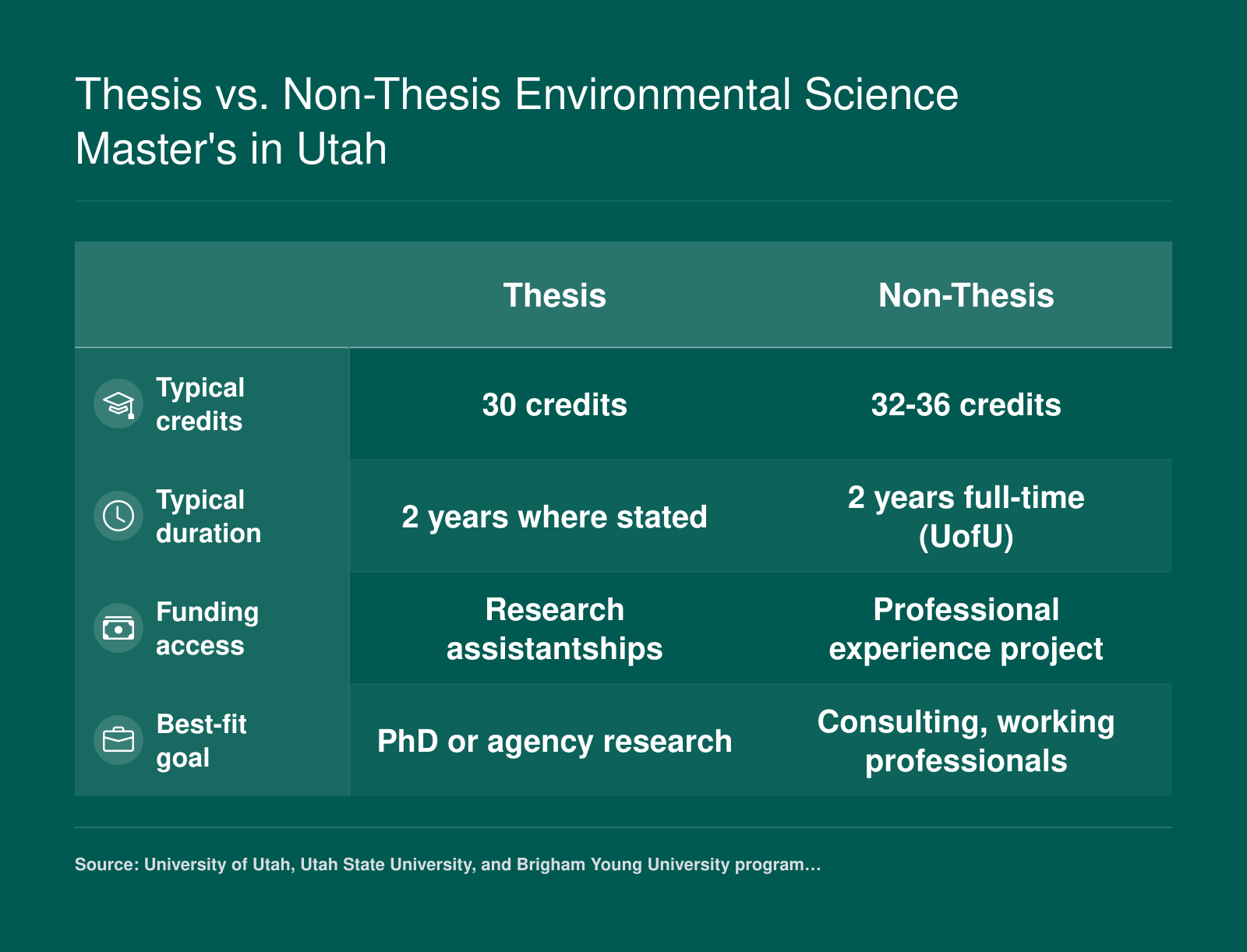
Thesis vs. Non-Thesis Environmental Science Master's in Utah
Thesis tracks emphasize original research and fit students aiming for PhDs or agency research roles. Non-thesis and professional science master's (PSM) tracks use applied projects instead and are built for consultants and working professionals. At the schools ranked here, Brigham Young University's Environmental Science and Sustainability MS and Utah State's Environment and Society Plan A are thesis; University of Utah's PSM and Utah State's PSM, Plan B, and Applied Environmental Geoscience are non-thesis.
Cost of a Utah Environmental Science Master's and Licensure or Certification Paths
Tuition and Net Price
Utah State University carries the lowest in-state graduate tuition here, at about $7,828 per year, compared with $8,724 at the University of Utah. Out-of-state students face a much steeper climb: roughly $24,773 at USU and $27,983 at the U. Brigham Young University lists graduate tuition at $8,936 per two semesters for Latter-day Saint students and $17,872 per two semesters for others, so church membership, not residency, sets the rate.1
Average net price after aid runs from about $14,936 at USU to $15,564 at BYU and $16,200 at the U. Treat these as institution-wide averages, not quotes for a specific environmental science program. Confirm program fees directly with each school, since the environmental science master's total cost varies by program.
How Assistantships Change the Math
For thesis students, funding, including fully funded environmental master's programs, can matter more than the sticker price. The University of Utah ties graduate assistantships to a $25,000 stipend, health insurance, and a tuition waiver for qualifying programs, though stipends vary by department.2 Ask whether your program qualifies. At USU, a half-time (20-hour) assistantship carries a $6,400 per-semester stipend minimum and typically includes tuition support. Nonresident tuition is waived for only the first 12 months, so out-of-state students should establish Utah residency during year one. Course fees are generally not covered. A funded research slot is usually tied to a thesis track, so contact faculty early.
Licensure and Certification
Utah has no single "environmental scientist" license. Your credentials depend on your specialty, and the next section covers the certifications worth knowing.
Utah Environmental Credentials to Know
Career Outcomes for Utah Environmental Science Master's Graduates
Who actually hires an environmental science master's graduate in Utah, and what are the environmental science master's salary and career outcomes? The short answer is a mix of state agencies, federal land managers, water utilities, and private consulting firms clustered along the Wasatch Front.
Where graduates land
The Utah Department of Environmental Quality runs air, water, and hazardous waste programs that depend on monitoring, permitting, remediation, and enforcement staff, and the Utah Division of Water Resources handles supply planning (though several of its recent postings have been engineering-oriented rather than open to any environmental science background). Bureau of Land Management and Forest Service offices across the state hire for NEPA analysis and natural resource work. On the private side, Salt Lake City consultancies including SWCA Environmental Consultants, Terracon, and SOCOTEC staff environmental planning, Phase I and II site assessments, and contamination investigations.123
What the market asks for
Environmental Science Jobs in Utah have recently included environmental field scientist, environmental scientist, wetland scientist and ecologist, and staff scientist roles. Worth knowing: many consulting positions set a bachelor's as the minimum, so a master's is less a gate than a way to specialize and compete for analytical, research-heavy, and program-level work. GIS, field sampling, technical writing, permitting, and data analysis show up repeatedly, and some senior consulting tracks prefer a PE or PG.4
Looking ahead, Great Salt Lake water levels, Wasatch Front air quality, and ongoing water rights disputes are the issues most likely to keep shaping Utah hiring.
Compare Environmental Science programs on the data that matters
Explore more Science & Engineering specializations or browse every graduate field.
All Science & Engineering programs