Best Online Master's in Environmental Science Programs
Compare 60+ accredited online Environmental Science programs, with graduate earnings, cost, debt, and completion data from IPEDS and the U.S. College Scorecard.

Fully online environmental science master's tuition runs from $455 per credit at American Public University to $1,037 at Penn State, across degrees of 30 to 45 credits. Price, more than curriculum, often separates the options.
Every program here is 100% online, with no hybrid terms or required campus residencies, so working professionals and recent graduates can study without relocating.
Degree titles range from environmental engineering to hydrology to policy, and the right fit depends on whether the target job is technical or managerial.
Key Points
- In 2027, Webster University leads first-year earnings among ranked online programs.
- American Public University System posts one flat rate regardless of residency.
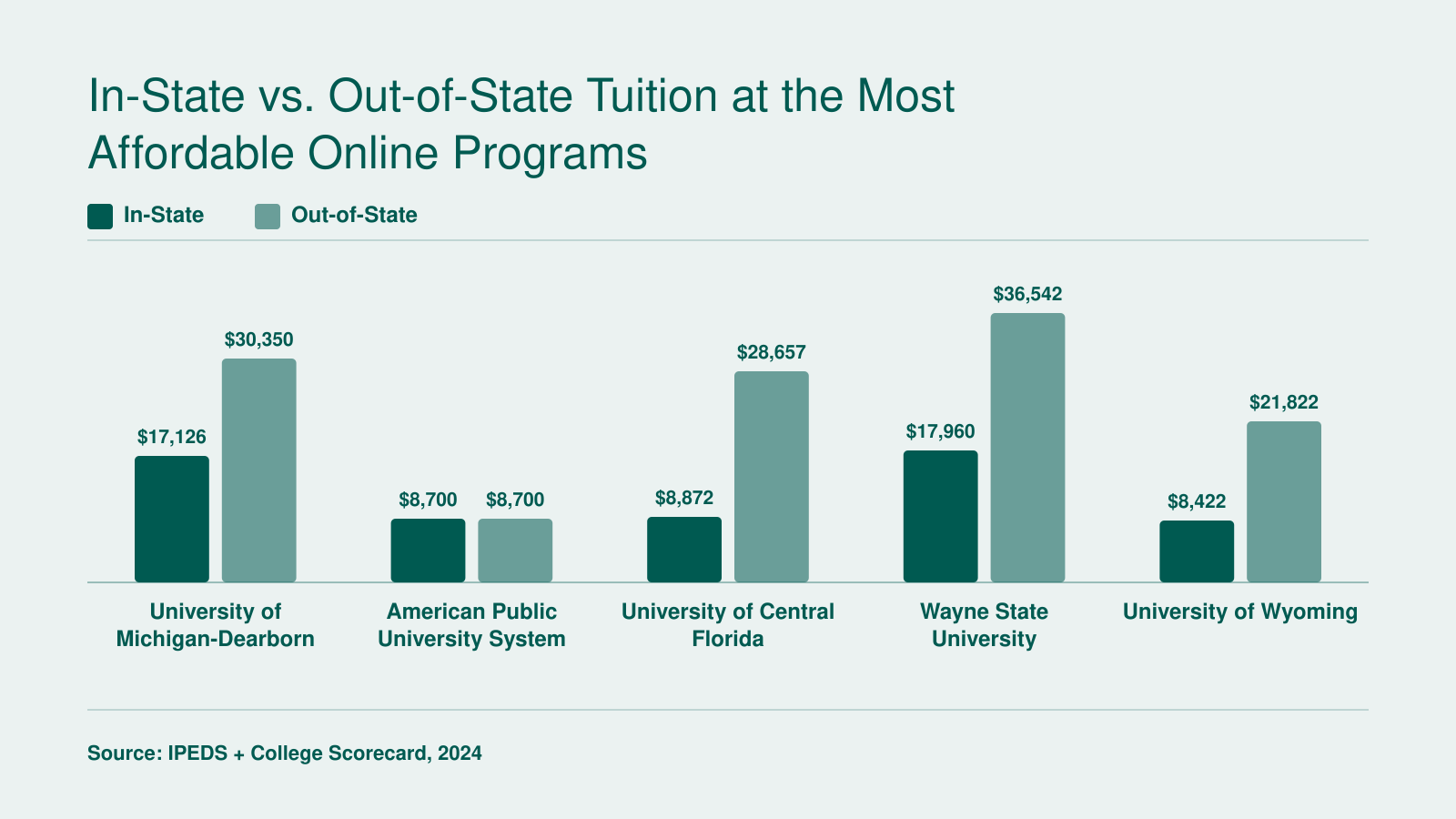
- Out-of-state tuition runs higher at UM-Dearborn, Central Florida, Wayne State, and Wyoming.
Top 10 Best Fully Online Master's in Environmental Science Programs for 2027
These 10 schools stand out for fully online environmental science master's programs, with coursework that students complete remotely. The list is ordered using a mixed quality composite rather than one metric, so the top program is not decided by price or graduation rate alone. Each card below highlights concentration options, tuition, net price, and the institution-wide graduation rate.
Harvard University
#1Cambridge, MA · $55,000 – $60,000/yr (est.)
Best for: Sustainability-focused career changers
Harvard Extension School's sustainability master's combines environmental science with policy and management skills for professionals moving into climate or corporate sustainability roles. The 12-course program uses performance-based admissions and ends in a thesis or capstone, with most coursework available online. The school's graduation rate is 98%.
- Online program format
- 12 courses total
- Tuition $3,440 per course
- Performance-based admissions
- Thesis or capstone project
- Focus on sustainability skills
- Part-time study option
- Harvard University degree
University of Illinois Urbana-Champaign
#2Champaign, IL · ~$19,000/yr (est.)
Best for: Natural resources professionals seeking concentrations
Illinois offers a fully online Master of Science in Natural Resources and Environmental Sciences with concentrations in agronomy/agroecology, aquatic chemistry, and conservation ecology. The non-thesis path requires 32 credits and a 3.0 GPA for admission, with a capstone project and no GRE. The school's graduation rate is 85%.
- Online program option
- 32 credit hours required
- Non-thesis capstone project
- 3.0 GPA admissions requirement
- Financial aid available
- Agronomy/agroecology concentration
- Part-time study possible
- Professional orientation course
- 32 credit hours
- Concentration in aquatic chemistry
- Non-thesis capstone experience
- 3.0 GPA requirement
- Part-time study available
- Graduate level courses
- Professional orientation included
- Online program available
- 3.0 GPA for admission
- No GRE required
- Capstone project option
- Internship experience available
- Concentration in conservation ecology
- Human dimensions covered
- Non-thesis option only online
University of Central Florida
#3Orlando, FL · ~$9,000/yr (est.)
Best for: Budget-conscious online engineering students
UCF's online environmental engineering master's emphasizes environmental systems engineering and practical pollution-control skills. In-state tuition is $369.65 per credit, and the 30-credit program includes thesis and non-thesis options for working students. The school's graduation rate is 78%.
- Online program format
- In-state tuition $369.65 per credit
- Out-of-state tuition $1,276.48 per credit
- Environmental Systems Engineering concentration
- Science or math background needed
- Undergraduate engineering courses required
- Prepares for environmental engineering careers
- Flexible for working students
- Fully online program
- Bachelor's degree prerequisite
- Official transcripts needed
- Resume submission required
- Statement of objectives
- Three recommendation letters
- Thesis or nonthesis options
- Focus on pollution control
- Online program available
- Bachelor's in engineering required
- Water treatment courses
- Waste management topics
- Environmental modeling skills
- Sustainable communities focus
- Prepares for government careers
- Prepares for consulting careers
Clemson University
#4Clemson, SC · $10,000 – $15,000/yr (est.)
Clemson's online Environmental Engineering and Science M.S. combines engineering and science with focus areas in environmental process engineering, sustainable systems, and environmental health physics. Admission requires a 3.0 GPA in an engineering or science background, but no GRE or application fee. The school's graduation rate is 87%.
- Online program delivery
- No application fee required
- No GRE requirement
- Minimum 3.0 GPA admission
- Engineering or science degree prerequisite
- Core courses in environmental principles
- Thesis and non-thesis options
- Specialized focus areas available
- Online program format
- Environmental Health Physics concentration
- No GRE required
- No application fee
- 3.0 GPA admission requirement
- 30 credit hours non-thesis
- 24 credit hours thesis
- Focus on radiation detection
North Carolina State University at Raleigh
#5Raleigh, NC · $12,000 – $33,000/yr (est.)
North Carolina State's online Master of Environmental Assessment is a 30-credit, interdisciplinary degree built for working professionals in environmental science and risk assessment. No GRE is required for admission, and students complete a professional project rather than a thesis. The school's graduation rate is 85%.
- 30 credit hours
- Online delivery
- No GRE required
- 3.0 GPA admission
- Professional project included
- Graduate certificate option
- Interdisciplinary focus
- Flexible for full-time work
American Public University System
#6Charles Town, WV · $5,000 – $10,000/yr (est.)
American Public University's environmental policy and management master's is designed for working adults, with 36 credits, monthly start dates, and $455 per credit. Students can choose concentrations in ecosystems management, landscape ecology, or renewable energy, and no GRE or GMAT is required. The school's graduation rate is 57%.
- 36 total credits required
- Cost per credit $455
- No GRE/GMAT required
- Transfer up to 15 credits
- Courses start monthly
- 8 to 16 week courses
- Taught by industry professionals
- Covers environmental policy and law
- Ecosystems management concentration
- Bachelor's degree admission requirement
- Monthly course starts
- Includes capstone project
- Open educational resources used
- Military tuition discounts available
- Accredited by HLC
- Landscape Ecology concentration
- Includes risk assessment
- Covers environmental ethics
- Internship opportunities available
- No application fee
- Focus on environmental policy
- Concentration in renewable energy
- Focus on energy policy
- Environmental economics included
- Sustainable strategies covered
- Taught by industry experts
- Military discounts available
University of Oklahoma – Hudson College of Public Health
#7Norman, OK · ~$9,000/yr (est.)
Oklahoma's online Master of Environmental Science in Hydrology and Water Security is a 30-credit program focused on water systems, policy, and hydrologic sciences. The program can be completed in about 21 months and includes a hydrology and water security concentration. The school's graduation rate is 75%.
- 30 credit hours
- 100% online format
- 21+ months to complete
- $30,450 total cost
- Bachelor's degree required
- 3.0 GPA minimum
- Focus on Hydrology and Water Security
- Includes core and concentration courses
- $1,015 per credit hour
- Rolling admissions process
- Fall and spring start dates
- Concentration in Hydrologic Sciences
- Focus on water policy
- Core courses include hydrology
- Covers water law
- Includes hydroclimatology
Pennsylvania State University
#8University Park, PA · ~$26,000/yr (est.)
Penn State's online Master of Professional Studies in Ecosystem Management and Administration prepares students for leadership roles in natural resources. The 30-credit program covers statistics, GIS, environmental law, and project management, and requires a bachelor's degree with a 2.75 minimum GPA. The school's graduation rate is 86%.
- 30 credits total
- 100% online format
- $1,037 per credit cost
- Minimum 2.75 GPA
- GRE scores needed
- Three references required
- Includes capstone experience
- Covers statistics and GIS
University of Arizona
#9Tucson, AZ · ~$15,000/yr (est.)
Arizona's online Master of Science in Environmental Science is a 30-credit, interdisciplinary degree with $850 per credit tuition. The program emphasizes data analysis, scientific writing, and applied environmental science, with a thesis or report option. The school's graduation rate is 68%.
- 30 credits required
- $850 per credit cost
- Online program format
- Prerequisites in sciences
- Interdisciplinary curriculum
- Focus on data analysis
- Thesis or report option
- Career skills development
Mississippi State University
#10Mississippi State, MS · ~$10,000/yr (est.)
Mississippi State's online M.S. in Geosciences with an Environmental Geosciences concentration is a 30-credit, non-thesis program covering ocean science, climatology, and GIS. All online students pay in-state tuition of $581 per credit plus a $25 instructional fee, and no GRE is required. The school's graduation rate is 67%.
- 30 credit hours
- Non-thesis program
- Fully online delivery
- 10 courses total
- Tuition $581 per credit
- Instructional fee $25 per credit
- In-state tuition for all
- No GRE requirement
Cost & outcomes by school
Federal data for the highest-earning Environmental Science programs, independent of the ranking above. Earnings are this field's master's graduates four years after completing, where the Scorecard reports them.
| School | Earnings | Tuition / yr | Debt | Grads/yr | Format |
|---|---|---|---|---|---|
| University of Houston-Clear Lake TX | $94,092 | $9,762 | — | 5 | Online or campus |
| University of Idaho ID | $92,396 | $10,816 | — | 56 | Online or campus |
| Webster University MO | $89,701 | $13,736 | — | 15 | Online or campus |
| Sul Ross State University TX | — | $6,661 | — | — | Online |
| Troy University AL | — | $8,550 | — | — | Online or campus |
| University of Central Florida FL | — | $8,872 | — | — | Online |
| Eastern Kentucky University KY | — | $10,794 | — | — | Online |
| Frostburg State University MD | — | $11,498 | — | — | Online |
| University of Florida FL | — | $12,737 | — | — | Online |
| Clemson University SC | — | $12,646 | — | — | Online or campus |
Sources: U.S. Department of Education. Tuition and graduates: IPEDS. Earnings and debt: College Scorecard, this field's master's graduates; a dash means no figure is reported.
Cost, debt & payoff
Median earnings of this field's master's graduates (4 yrs after completing) vs. their median federal loan debt · U.S. College Scorecard
Across these programs the median graduate earns about $74,899 and finishes with roughly $41,000 in debt — a ratio that clears a common rule of thumb (keep debt below first-year salary). Tuition and debt vary widely school to school, so check the per-school figures in the table above before you shortlist.
How We Rank Fully Online Environmental Science Master's Programs
As more universities move graduate science coursework online, the word "online" now covers everything from fully remote degrees to programs with required campus field sessions. This list includes only environmental science master's programs you can complete entirely online. Hybrid formats with mandatory residencies are excluded.
What the Order Reflects
Programs are ordered by a composite of cost, institution-wide graduation rate, and program-level graduate outcomes where federal data reports them. Keep two caveats in mind. Graduation rates describe the whole university, not the environmental science program itself. Net price is an average after grants and scholarships, not a quote for you. Your actual environmental science master's total cost depends on your aid and residency.
Why Institutional Accreditation Comes First
Institutional accreditation (often still called regional accreditation) from an agency recognized by the U.S. Department of Education is the baseline. It determines whether you can use federal student aid, whether other universities will accept your credits, and whether employers and government agencies will take your degree seriously. Accreditation belongs to the institution, so confirm that it covers distance education at the specific campus granting your degree.
Programmatic Recognition Is a Bonus
No single programmatic accreditor is required for environmental science master's degrees, and programmatic accreditation is not universally required.1 Some programs are reviewed by ABET's Applied and Natural Science Accreditation Commission.2 Its 2025-2026 criteria for environmental science and similarly named programs call for at least one year of study beyond the bachelor's and an applied project or research report.3 ABET status comes through formal review, not a program's title, so treat it as an added signal rather than a requirement.
To verify any school, search the Department of Education's accreditation database or CHEA's directory, and check ABET's accredited-program search4 for specialized status.
What an Online Environmental Science Master's Really Costs
Two online environmental science master's programs can both be fully asynchronous and still land thousands of dollars apart once you separate resident tuition, nonresident fees, and mandatory distance-learning charges. The programs below show exactly that split. Residency status alone can shift the bill by more than $18,000 at several public universities here.
At the low end of the listed tuition range, Dickinson State University's online environmental science master's records the same in-state and out-of-state figure, $6,576. At the high end, Wayne State University's online M.A. in Environmental Science lists $17,960 in-state and $36,542 out-of-state. That is roughly a $29,966 spread before aid. Net price narrows the gap. University of Michigan-Dearborn's average net price is about $9,492, while Troy University's is about $16,527, a spread near $7,000 after estimated grant and scholarship aid.
Public University Per-Credit Build-Ups
- University of Florida: Its 30-credit M.S. in Soil, Water, and Ecosystem Sciences lists a resident per-credit rate of $448.73 and an online base rate of $484.48.1 Nonresidents add $873.11 per credit, so a 30-credit nonresident build-up approaches $40,700 before any SWES distance-learning fee. Florida residents avoid that nonresident charge.
- Oregon State University: The online M.S. in Environmental Sciences requires 45 quarter credits at $609 per credit, about $27,405 in tuition. Oregon State publishes no separate nonresident charge or mandatory online fee, though course materials and related expenses are extra.
- University of West Florida: The non-thesis online M.S. in Environmental Science requires 30 semester credits. At $385.85 per credit, in-state tuition is about $11,576; a separate waiver-adjusted out-of-state rate of $494.22 puts it near $14,827. Published pages conflict, and one source shows $1,144.43 as the full out-of-state rate, so verify the current figure.
Calculating Your Total
Use this formula: per-credit rate × total credits, plus any per-term technology or distance fee × the number of terms, plus one-time costs. For example, a 30-credit program at $400 per credit with a $50 distance fee across six terms comes to $12,000 + $300, or $12,300.
How Net Price Fits In
Net price, an institution-wide average after grant and scholarship aid, is not a program-specific quote. It is a useful screen for affordability, but you should still confirm the actual per-credit and per-term charges before comparing offers.
In-State vs. Out-of-State Tuition at the Most Affordable Online Programs
At UM-Dearborn, Central Florida, Wayne State, and Wyoming, out-of-state tuition runs well above the in-state rate. American Public University System posts one flat rate for all online students, a signal that some programs set tuition without a residency differential. See the next section for how out-of-state students may qualify for in-state rates.
Can Out-of-State Students Get In-State Rates Online?
Residency can still shape what you pay for an online degree, but it often matters less than it does on campus. Whether it matters for you depends on how each school prices distance students and where you live.
Flat Online Rates
Many public universities charge online students one rate no matter where they live. The University of Idaho's online M.S. in Environmental Science is $649 per credit for 2026-27 plus a $35 per-credit web fee, or $684 per credit, for every online student.1 Oregon State Ecampus lists $609 per credit with no nonresident surcharge, though fees and materials are extra. Wayne State gives online students its in-state tuition rate regardless of home state. The University of Arizona's online M.S. runs $850 per credit.
Regional Tuition Exchanges
WICHE's Western Regional Graduate Program (WRGP) lets residents of participating western states pay up to 150% of resident tuition at approved programs, and most schools charge resident tuition. WICHE reports average savings of $15,179 per year for 2025-26, but only newly admitted students in approved programs qualify.2 Colorado State's online Ecosystem Science and Sustainability program accepts WICHE-state residents, but WRGP does not automatically cover every online course sequence, and a $1,250 per-semester graduate differential fee applies. WICHE notes that most eligible programs are campus-based, so confirm that yours is 100% online and covered. The Midwest Student Exchange Program is a similar regional arrangement, so ask whether your target program participates.
State Authorization
Some programs cannot enroll residents of certain states or territories. Arizona's online program, for example, restricts some U.S. territories. Most states are covered under SARA reciprocity, which is separate from accreditation, so check the school's state authorization page before you apply.3
Quick Checklist
- Does the school charge a flat online rate?
- Is your state on its authorized list?
Related Articles
M.S. vs. PSM vs. M.A.: Which Online Environmental Science Degree Fits Your Goals
An online environmental science master's can carry one of three labels, and the letters signal different priorities: the Master of Science (M.S.) leans technical and research-driven, the Professional Science Master's (PSM) blends science with management training, and the Master of Arts (M.A.) or policy-focused track emphasizes writing, analysis, and advocacy. One caution up front: the label is a signal, not a guarantee. An M.S. may be non-thesis, a PSM may still involve real research, and an M.A. may require a thesis. Always read the specific curriculum before you decide.
How They Compare
- Focus: M.S. targets science and methods; PSM pairs science with business, policy, and communication; M.A. centers on policy, planning, and advocacy.
- Credits: Totals are program-specific. Among the M.S. programs we reviewed, requirements run from 30 credits at the University of Idaho1 and Wayne State2 to 45 quarter credits at Oregon State3. Reliable universal totals for PSM and M.A. degrees are not published, so check each program.
- Culminating work: M.S. programs vary between a thesis and a non-thesis project. Idaho, for example, offers a 6- to 10-credit thesis or a 3-credit research project paired with coursework.1 Wayne State's thesis runs 8 credits.2 PSM programs typically use an applied capstone, client project, or internship instead of a thesis, while M.A. options range across thesis, portfolio, practicum, or internship.
- Internships: Not required by every program. PSM degrees most often build in applied or industry experience.
Best-Fit Careers
- M.S.: Research, technical analysis, lab and field roles, and a path toward a PhD.
- PSM: Consulting, sustainability management, and compliance, often tied to the National Professional Science Master's Association.
- M.A. or policy degree: Environmental policy, planning, advocacy, and science communication.
Unsure which to pick? Choose the M.S. for technical or research careers, the PSM for industry management, and the M.A. for policy and communication work, then confirm the fit against the actual course list.
Admissions Requirements for Online Environmental Science Master's Programs
Requirements vary, but verified program examples show what to prepare.
- Bachelor's degreeJohns Hopkins requires a bachelor's from a regionally accredited four-year college, and Oregon State requires a bachelor's degree for its online M.S. in Environmental Sciences.
- GPAOregon State sets a 3.0 minimum cumulative GPA for regular admission, calculated on the last 90 quarter or 60 semester credits of graded undergraduate work.
- Science and math preparationJohns Hopkins requires one year of college-level calculus with a B- or better; physics, chemistry, biology, geology, statistics, and differential equations are strongly recommended. Oregon State does not publish a fixed prerequisite course list.
- Non-science backgroundsJohns Hopkins' Environmental Science and Policy M.S. is open to applicants with limited scientific background, so a non-science major is often acceptable when prerequisites are met.
- GREOregon State does not require the GRE for program admission, though some funding opportunities may request scores.
- Letters and statementJohns Hopkins requires two recommendation letters, a one-page statement of purpose, and a resume. Oregon State recommends three references on your qualifications to succeed.
- Work experienceOregon State prefers relevant work or volunteer experience but sets no mandatory minimum. Johns Hopkins considers professional background without requiring work experience.
- Conditional admissionJohns Hopkins offers provisional admission for applicants missing prerequisites; students can complete them through JHU Engineering or another regionally accredited institution and then move to full admission.
Top First-Year Earnings Among Online Environmental Science Graduates
Among the programs ranked here, Webster University leads on first-year earnings.
Environmental Science programs by state
Frequently Asked Questions About Online Environmental Science Master's Degrees
Choosing an online environmental science master's means weighing format, timeline, and specialization. These answers cover the questions prospective students ask most before applying, from prerequisites and thesis options to lab requirements and how earth science differs.
Do I need a bachelor's in environmental science to apply?
Can I complete a thesis online for an environmental science master's?
How long does an online master's in environmental science take?
Do online environmental science programs require lab work or fieldwork, and how is it handled remotely?
Is an earth science master's online the same as an environmental science master's?
Compare Environmental Science programs on the data that matters
Explore more Science & Engineering specializations or browse every graduate field.
All Science & Engineering programs