Best Master's in Environmental Science Programs in North Dakota
Compare 6 accredited Environmental Science programs in North Dakota at 3 schools, with graduate earnings, cost, debt, and completion data from IPEDS and the U.S. College Scorecard.
North Dakota's oil and gas development, row-crop agriculture, Missouri River water quality, and tribal land stewardship all depend on graduate-trained environmental scientists. The state's master's options span campus research tracks and online policy degrees, with annual graduate tuition running from roughly $4,010 to $15,764 depending on the school and your residency.
No state license governs environmental science work here. That puts the weight on the degree itself, the research you produce, and the debt behind it.
Key Points
- UND's Earth System Science and Policy M.S. is fully online in 2027.
- Sitting Bull College does not require GRE scores in 2027 admissions.
- NDSU resident tuition in 2027 is $473.44 per credit before fees.
Ranked: Master's in Environmental Science Schools in North Dakota
North Dakota's environmental science master's options include a flexible online policy degree, a research-based conservation science track, and a tribal college program built around field research. The four schools below show how students can choose between applied management, conservation biology, and natural-resource leadership.
University of North Dakota
#1Grand Forks, ND · ~$14,000/yr (est.)
Best for: Working professionals wanting flexible environmental management
University of North Dakota offers two closely related master's paths in environmental fields: a 30-credit, non-thesis Master of Environmental Management and a 30-to-36-credit Master of Science in Earth System Science and Policy. Both can be pursued on campus or online, with asynchronous online options, and emphasize environmental policy, sustainability science, geospatial analysis, and resource economics. UND is regionally accredited by the Higher Learning Commission; the available materials do not identify a separate programmatic accreditor for these graduate programs.
- 30 credit hours, non-thesis
- On-campus or online format
- 2 to 2.5 years to complete
- Focus on environmental policy, sustainability science, and resource economics
- Internship or applied project required
- Professional science master's approved
- No thesis defense needed
- 30 to 36 credit hours
- Thesis required for M.S. degree
- On campus or online format
- Interdisciplinary sustainability science curriculum
- Earth systems modeling and ArcGIS and remote sensing skills
- R1 research institution
North Dakota State University
#2Fargo, ND · ~$9,000/yr (est.)
Best for: Research-minded applicants needing a faculty advisor
North Dakota State University's Environmental and Conservation Sciences master's program is a research-oriented, on-campus degree with concentrations in Environmental Science, Conservation Biology, and Environmental Social Sciences. Students complete at least 30 graduate credits, including a graduate seminar and 6 to 10 thesis research credits, and must secure a faculty advisor for lab placement and funding. NDSU is regionally accredited by the Higher Learning Commission; no separate programmatic accreditor is identified for the environmental science master's.
- 30 graduate credits minimum
- Environmental Science concentration
- 6 to 10 thesis research credits
- Requires faculty advisor for lab placement and funding
- Graduate seminar and cross-disciplinary course
- Conservation Biology concentration
- Thesis research required
- Scientific integrity course included
- Faculty advisor must be secured
- On-campus M.S. format
- Environmental Social Sciences concentration
- Research credits and thesis or research option
- English proficiency required for international students
- Cross-disciplinary exposure required
- Domestic applications flexible
Sitting Bull College
#3Fort Yates, ND · ~$7,000/yr (est.)
Best for: Tribal natural-resource leaders pursuing environmental science
Sitting Bull College offers a Master of Science in Environmental Science that integrates Western science with Lakota/Dakota cultural values and prepares graduates for leadership roles in wildlife and natural-resource management. The program requires at least 38 credit hours, uses a competitive cohort model, and includes water-quality field research, with daytime and evening courses and an anticipated two-to-three-year timeline. Sitting Bull College is regionally accredited by the Higher Learning Commission; no separate programmatic accreditor is identified for this graduate program.
- Campus-based M.S. program
- Integrates Lakota/Dakota cultural values
- 38 credit-hour minimum
- Competitive cohort model
- First cohort focused on water-quality field research
- Daytime and evening courses
- 2 to 3 year anticipated duration
- Career paths in tribal, state, and federal agencies
Dickinson State University
#4Dickinson, ND · ~$7,000/yr (est.)
Dickinson State University appears with an online environmental science option, but the available program materials do not clearly establish a master's-level curriculum, so applicants should confirm the graduate degree structure and admission requirements directly. The listing emphasizes online flexibility and an affordable published tuition figure. Dickinson State is regionally accredited by the Higher Learning Commission.
- Online format
- Published tuition $9,118 per year
- High school diploma listed as admission requirement
- Scholarships based on GPA
- Comprehensive environmental curriculum
Cost & outcomes by school
Federal data for the highest-earning Environmental Science programs, independent of the ranking above. Earnings are this field's master's graduates four years after completing, where the Scorecard reports them.
| School | Earnings | Tuition / yr | Debt | Grads/yr | Format |
|---|---|---|---|---|---|
| Sitting Bull College ND | — | $6,710 | — | — | Campus |
| North Dakota State University ND | — | $8,786 | — | 2 | Campus |
| University of North Dakota ND | — | $13,677 | — | 3 | Online or campus |
Sources: U.S. Department of Education. Tuition and graduates: IPEDS. Earnings and debt: College Scorecard, this field's master's graduates; a dash means no figure is reported.
Online and Hybrid Master's in Environmental Science in North Dakota
An online master's in environmental science or hybrid program lets you complete most coursework without relocating to campus. North Dakota has few fully online choices, and the University of North Dakota is the clearest. Its Earth System Science and Policy M.S. and M.E.M. can be taken on campus or online. Online classes are asynchronous but not self-paced, so you still work to deadlines. No campus residency is stated, but the ESSP 501L course lists full-day field trips, sometimes on weekends.1 Ask whether online students must attend or can substitute.
North Dakota State University and Sitting Bull College are listed as campus-based, and NDSU expects students to be in residence and matched with a faculty lab. Those suit students who want a research assistantship and lab access. Dickinson State is listed as online, but confirm the details with the school. UND's online route fits working professionals in energy and agriculture. Remote students should compare UND's online and on-campus scheduling before committing.
Which North Dakota Master's Programs Waive or Skip the GRE
A stated no-GRE policy and simple silence on the subject are not the same thing, and North Dakota offers both within its Master's in Environmental Science With No GRE Required programs.
- Sitting Bull College: The graduate handbook is explicit that its programs do not require the GRE, so there is no waiver to chase.1 Admission turns on a bachelor's degree, a cumulative GPA of at least 2.75, a personal statement, recommendations, a résumé, and a background check.
- NDSU, Environmental and Conservation Sciences: The future-students page lists a bachelor's degree, a 3.0 GPA, transcripts, three references, and a faculty lab placement, but publishes no GRE requirement, optional policy, or waiver criteria.
- UND, Earth System Science and Policy: Requirements cover coursework in algebra and statistics or calculus, 12 science credits, a 3.00 upper-division GPA, and a personal statement, with no GRE policy stated.
Where nothing is published, email the graduate program coordinator rather than assume, and ask whether the Graduate School's general requirements differ from the department's; North Dakota departments often set their own terms. One practical note: when you are competing for a funded assistantship, a strong score can still strengthen an application nobody required it for.
Application Deadlines and Prerequisites at a Glance
- NDSU deadlinesFall: May 1 (international) and one month before start (domestic). Spring: Aug. 1 (international) and one month before start (domestic).
- UND deadlinesFall Aug. 1; spring Dec. 1. The official page does not separate domestic and international deadlines.
- Sitting Bull deadline2026 cycle: opened April 1 with a May 31 deadline; the catalog also lists July 1 for fall. Spring is not consistently published.
- Advisor matchNDSU requires an ECS-affiliated faculty advisor to agree to admit you to a lab and arrange research funding before admission.
- GPA and science prerequisitesSitting Bull lists 2.75 in general policies and 3.0 in program materials; NDSU notes a 3.0 overall GPA must be maintained. No fixed chemistry, biology, or statistics sequence is specified; Sitting Bull expects a bachelor's in environmental science or a related field.
- Application materials and English proficiencySitting Bull requires three recommendation letters, GRE combined 300, CV, and letter of intent. NDSU lists TOEFL iBT 81, IELTS 7, Duolingo 115.
Related Articles
Master's in Environmental Science Cost in North Dakota: Tuition, Fees, and Assistantships
Paying by the credit and earning a funded assistantship can lead to very different bills for the same degree. At North Dakota State University, the documented resident rate is $473.44 per credit plus $69.54 in mandatory fees, or $542.98 per credit. Over the 30-credit minimum for its Environmental and Conservation Sciences M.S., the master's in environmental science cost comes to roughly $16,300. That figure applies only to the resident case, so nonresident and online students should confirm their own rate.
Sitting Bull College charges $350 per credit.1 Full-time students add $150 per credit in technology fees, for $500 per credit, plus $25 registration and $30 activity fees each semester.2 The college estimates direct annual master's costs at $7,920.2
Assistantships change the math most. NDSU says assistantships typically include a tuition waiver and a stipend, and waived students are billed at the resident rate. Not every program funds every student, so a thesis M.S. can come close to free only if you land a position. Ask the University of North Dakota and NDSU about regional discounts such as the Midwest Student Exchange Program or Minnesota reciprocity.
Treat each school's net price as an institution-wide average, not a quote for you, even when comparing Most Affordable Master's in Environmental Science programs.
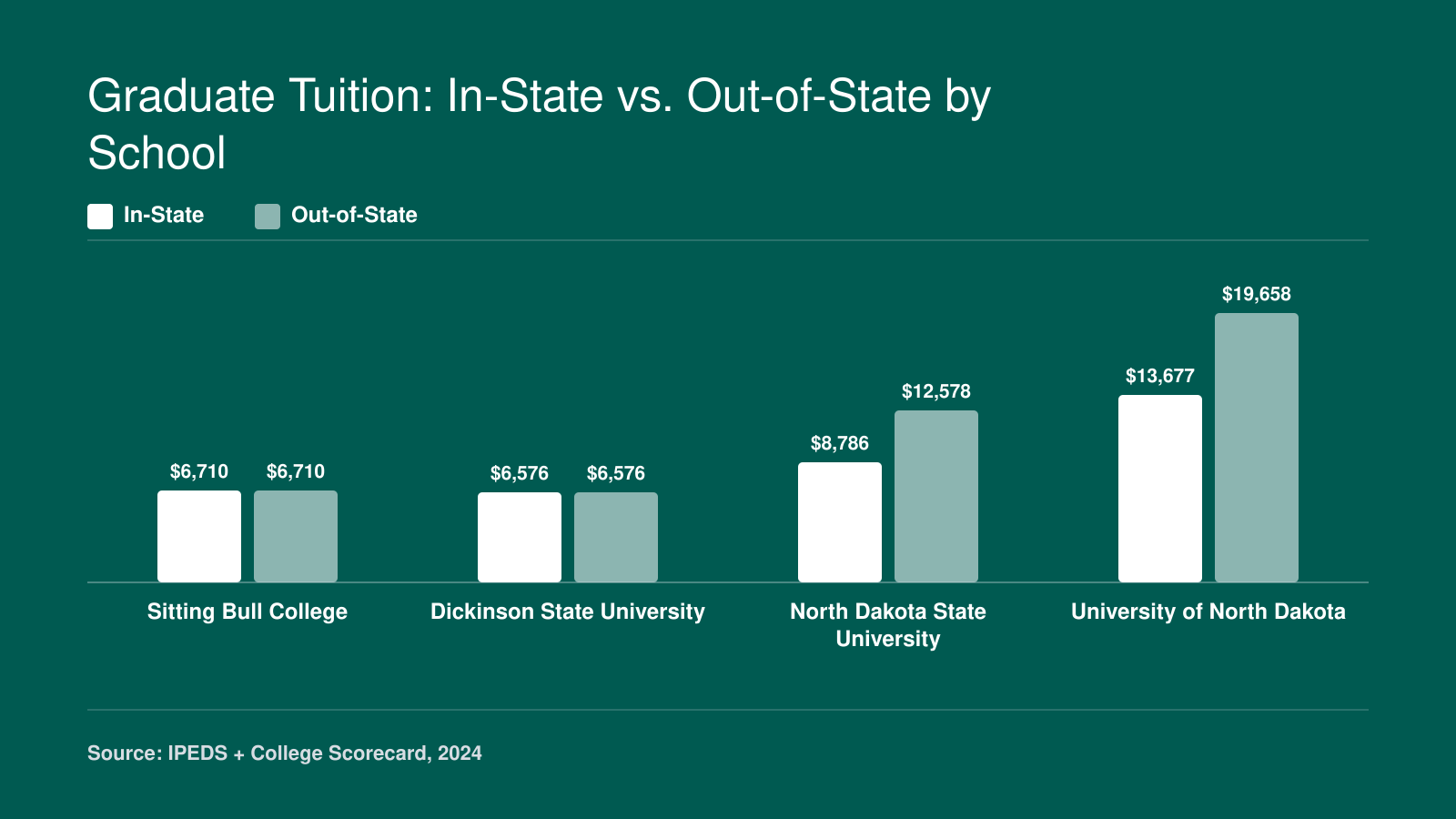
Graduate Tuition: In-State vs. Out-of-State by School
Annual graduate tuition at each school below. Dickinson State and Sitting Bull College charge the same rate for in-state and out-of-state students, while North Dakota State and UND add a substantial out-of-state premium. Figures are from IPEDS and College Scorecard (2024).
North Dakota Licensure and Certification for Environmental Scientists
Is a Master's in Environmental Science Worth It in North Dakota?
The worth of this degree comes down to comparing environmental science master's salary and career outcomes against what they borrow to finish. The schools ranked here do not currently publish program-level earnings for their environmental science master's, so we lean on the other number we do have: median debt at graduation.
What the debt looks like
The University of North Dakota reports about $22,057 in median graduate debt, North Dakota State University roughly $23,199, and Dickinson State University around $18,442. Picture that as a monthly payment: on a standard ten-year plan, those balances run near $200 to $250 a month after finishing. Sitting Bull College does not publish a debt figure for the program.
The verdict
Return on investment is strongest when you avoid that payment entirely. Pursue a thesis-track assistantship that covers tuition, or let an employer fund the degree. Pay full freight out of pocket and the math gets harder to justify.
Thesis vs. Non-Thesis Master's Tracks: How to Choose
The real choice among Master's Programs by Degree and Field is between research depth and funding, and speed back to work. In North Dakota, most paths are thesis-based, a pattern common in Science & Engineering Master's Programs. NDSU's Environmental and Conservation Sciences M.S. requires 30 credits, including 6 to 10 thesis credits. Sitting Bull College's M.S. is also thesis-based, at 38 or more credits. Its first cohort focuses on water-quality field research.1 UND offers both routes: a 36-credit thesis M.S. (proposal due by the end of the third semester, followed by an oral defense) or a 30-credit non-thesis M.E.M. Environmental Policy & Science is UND's named concentration.
Choose a thesis if you plan to pursue a PhD, an agency research role or a funded assistantship, and expect it to take longer. The UND M.E.M. suits working professionals heading into consulting, compliance or tribal resource management. Rule of thumb: if you want funding, contact a faculty advisor before you apply.
FAQ: Master's in Environmental Science in North Dakota
Prospective students often ask how North Dakota's environmental science master's programs compare for flexibility, online delivery, and career paths. Here are practical answers based on published program details.
Which North Dakota school has the best master's in environmental science?
Are there online environmental science master's programs in North Dakota?
Can I work full time while earning an environmental science master's in North Dakota?
What jobs do environmental science master's graduates get in North Dakota?
Compare Environmental Science programs on the data that matters
Explore more Science & Engineering specializations or browse every graduate field.
All Science & Engineering programs