Best Master's in Environmental Science Programs in New Jersey
Compare 9 accredited Environmental Science programs in New Jersey at 5 schools, with graduate earnings, cost, debt, and completion data from IPEDS and the U.S. College Scorecard.

New Jersey runs one of the most demanding environmental regulatory regimes in the country, with thousands of contaminated sites on the state's known contaminated site list and an entire Licensed Site Remediation Professional system built to clean them up. That work, plus coastal resilience projects and a dense consulting sector, keeps demand for trained environmental scientists steady.
The programs ranked here come from New Jersey public universities and span campus and online formats. Graduate tuition at these schools sits well below private rates, and residency drives the real price difference.
The tension most applicants weigh is cost against the field experience and licensure-track preparation that remediation and consulting employers expect.
Key Points
- Out-of-state students pay $14,448 more at Rutgers and $11,280 more at NJIT.
- Rutgers no longer requires GRE scores, while other schools set their own policies.
- New Jersey's LSRP license requires a science degree plus at least 8 years of experience.
Top Master's in Environmental Science Programs in New Jersey
Every school below is a New Jersey institution offering a master's-level environmental science program, in campus, online, or both formats. Net price and graduation rate figures shown with each school are institution-wide, not specific to the environmental science program. Regional accreditation (Middle States) and current deadlines were not fully verified for every school, so confirm both on each graduate admissions page before you apply.
Rutgers University
#1New Brunswick, NJ · ~$23,000/yr (est.)
Best for: Research-driven students focused on soil science
Rutgers offers the broadest research-oriented environmental sciences graduate program in the state, with M.S. and Ph.D. tracks built on an interdisciplinary science foundation. Concentrations in soil science, environmental chemistry and microbiology, and environmental engineering let students specialize, and the program draws on off-campus research stations tied to New Jersey community and industry needs. Published highlights say GRE scores are not required. Master's funding is generally not guaranteed, so budget accordingly. Confirm Middle States accreditation and your start term on the program page.
- Soil Science concentration on the New Brunswick campus
- Undergraduate degree in science or engineering expected
- No GRE scores required, per program highlights
- U.S. applicants: June 1 deadline; international: March 1
- December 15 deadline for merit-aid consideration
- TOEFL or IELTS required for international applicants
- Environmental Chemistry concentration with a microbiology focus
- Campus-based in New Brunswick
- Interdisciplinary study across science fields
- Program length varies by degree
- Environmental Engineering concentration
- Interdisciplinary curriculum for diverse career paths
- Campus-based in New Brunswick
New Jersey Institute of Technology
#2Newark, NJ · $27,000 – $38,000/yr (est.)
Best for: Working professionals studying near Newark
NJIT's M.S. in Environmental Science is a joint effort with Rutgers-Newark units, which makes it distinctive in New Jersey. The curriculum leans toward hazardous and toxic materials, covering identification, management, treatment, and environmental effects, with options for coursework or a thesis. Study can be full time or part time, which suits professionals in the Newark and New York region. The program is on campus; the sources we reviewed do not establish an online option. Confirm accreditation and current deadlines with NJIT, since its published dates have varied between pages.
- 30 credits, with coursework or thesis track
- Campus-based; no online option confirmed
- Minimum 3.0 GPA; advisor consultation required
- Courses drawn from NJIT and Rutgers-Newark
- Rolling admissions, reviewed once an application is complete
- Fall: international May 1, domestic June 1; spring: November 15
- Entry in September (fall) or January (spring), per international admissions page
Rowan University
#3Glassboro, NJ · ~$19,000/yr (est.)
Best for: Aspiring consultants and policy-track professionals
Rowan's M.S. in Applied Environmental Science is a campus-based program aimed at employment rather than pure research. It emphasizes climate change, pollution, and hands-on field experience, with electives in energy transitions and risk assessment. Applications opened for fall 2025, so the program is relatively new. Check Rowan's graduate admissions page for current deadlines and accreditation details.
- Campus-based program in Glassboro
- Hands-on field experiences included
- Electives in energy transitions and risk assessment
- Positioned for government, nonprofit, and consulting roles
- Bachelor's degree required; costs vary by residency
- Applications first opened for fall 2025
Montclair State University
#4Montclair, NJ · ~$16,000/yr (est.)
Montclair State's graduate offering is the Earth and Environmental Science M.S., which leans toward geology rather than a general environmental science curriculum. Concentrations include environmental geology, metamorphic and igneous geology, and sedimentology, stratigraphy, and paleobiology. The degree is STEM-designated and uses rolling admissions. Verify that the program is currently enrolling, along with accreditation and start terms, on Montclair's graduate page.
- 32 semester hours, on campus
- STEM-designated degree
- Two recommendation letters and a personal statement
- Rolling admission policy
- Flexible electives, including oceanography options
- Focus on metamorphic and igneous geology
- Transcripts from all colleges attended
- Supplemental materials required
- Info provided on non-US degree equivalency
- Sedimentology, stratigraphy, and paleobiology emphasis
- Non-refundable $60 application fee
- International applicants supported
Stockton University
#5Galloway, NJ · ~$17,000/yr (est.)
Stockton stands out for its Professional Science Master's in Environmental Science, a 36-credit program built for working professionals. It includes a fully online option with evening and weekend scheduling and a capstone project, plus a campus-based Coastal Zone Management concentration and a five-year accelerated BS/PSM track. Admissions look for a related bachelor's degree and a 3.0 GPA. This is the most flexible option here for students who cannot relocate or attend daytime classes.
- 36 credits, offered online
- Flexible evening courses; about two years to finish
- Capstone project; professional writing and project management courses
- 3.0 GPA, essay, resume, and three recommendation letters
- $50 application fee
- Coastal Zone Management concentration, 36 credit hours
- Campus-based, non-thesis option
- GRE optional
- Includes policy and law courses and applied GIS training
- Five-year dual degree, campus-based
- Hands-on fieldwork and research
- Internship or independent study required
- Minimum 3.5 GPA for transfers
- Concentrations such as forestry available
Cost & outcomes by school
Federal data for the highest-earning Environmental Science programs, independent of the ranking above. Earnings are this field's master's graduates four years after completing, where the Scorecard reports them.
| School | Earnings | Tuition / yr | Debt | Grads/yr | Format |
|---|---|---|---|---|---|
| Montclair State University NJ | — | $16,056 | — | — | Campus |
| Stockton University NJ | — | $17,262 | — | 7 | Campus |
| Rowan University NJ | — | $18,607 | — | 1 | Campus |
| Rutgers University NJ | — | $23,241 | — | 7 | Campus |
| New Jersey Institute of Technology NJ | — | $27,156 | — | 4 | Campus |
Sources: U.S. Department of Education. Tuition and graduates: IPEDS. Earnings and debt: College Scorecard, this field's master's graduates; a dash means no figure is reported.
How We Rank New Jersey's Environmental Science Master's Programs
The ranking is a side-by-side comparison of New Jersey's environmental science master's programs built on federal data, not prestige or advertising. We draw on IPEDS and College Scorecard figures for graduate tuition, net price, and graduation rate, and we add program-level outcomes wherever they are published.
One caution matters when you read the numbers. Net price and graduation rate describe the whole institution, not the environmental science program alone. A university with a strong overall graduation rate may still run a small or newer environmental program, so treat those figures as context rather than a verdict on one degree.
Some programs have no published program-level earnings data, usually because the cohort is small. That gap does not lower a program's place in the order. We simply rely on the measures that are available for it.
Online and Hybrid Master's in Environmental Science Options in New Jersey
Fully remote study versus evening classes on campus: among masters programs in New Jersey, the second option is far more common. Environmental science is a field-heavy discipline, and the programs here reflect that.
The master's programs at Rutgers, NJIT, Rowan, and Montclair State are campus-based. Rutgers lists its M.S. in Environmental Science at a minimum of 30 credits with part-time enrollment permitted.1 The Environmental Geosciences option at Rutgers Newark also totals 30 credits (27 coursework plus 3 research) with an internship, and normally runs about 18 months full-time or two to three years part-time.2 The Earth and Environmental Science M.S. at Rutgers schedules core courses and most electives at night, which makes part-time study realistic for working scientists.3
Stockton's Professional Science Master's is the one listed as an online option in our Best Online Master's in Environmental Science Programs guide, but read the fine print: the 36-credit curriculum (24 core, 12 elective) is structured over two years and includes weekend and summer field work plus a capstone project.4 Evening scheduling helps, but you should plan on being in New Jersey for the hands-on components.
Which New Jersey Master's in Environmental Science Programs Waive the GRE?
Do New Jersey's environmental science master's programs require the GRE? At Rutgers, no: it is one of the master's in environmental science programs with no GRE required. The program page says scores are no longer required.2 The Newark department treats submission as optional.1 If you do send scores, the department looks for above 152 on both verbal and quantitative reasoning, and scores older than five years are not accepted.1
NJIT's program page does not state a GRE policy, so do not assume either way. We also found no GRE policy confirmed for Rowan, Montclair State or Stockton, so treat those as unconfirmed rather than waived.
What replaces the test
- Rutgers: a 3.0 GPA (the department may advocate for exceptions), three recommendation letters, and a science or engineering background with a year of college chemistry and math through calculus.1
- Montclair State: a bachelor's degree, two recommendation letters and a personal statement.
- Stockton: a bachelor's degree, a 3.0 minimum GPA, three letters, an essay and a resume.
- Rowan: a bachelor's degree.
- NJIT: the program page lists 30 required credits but no complete admissions checklist.
Because No-GRE master's programs change requirements from cycle to cycle, email each admissions office to confirm the current policy before you apply.
Related Articles
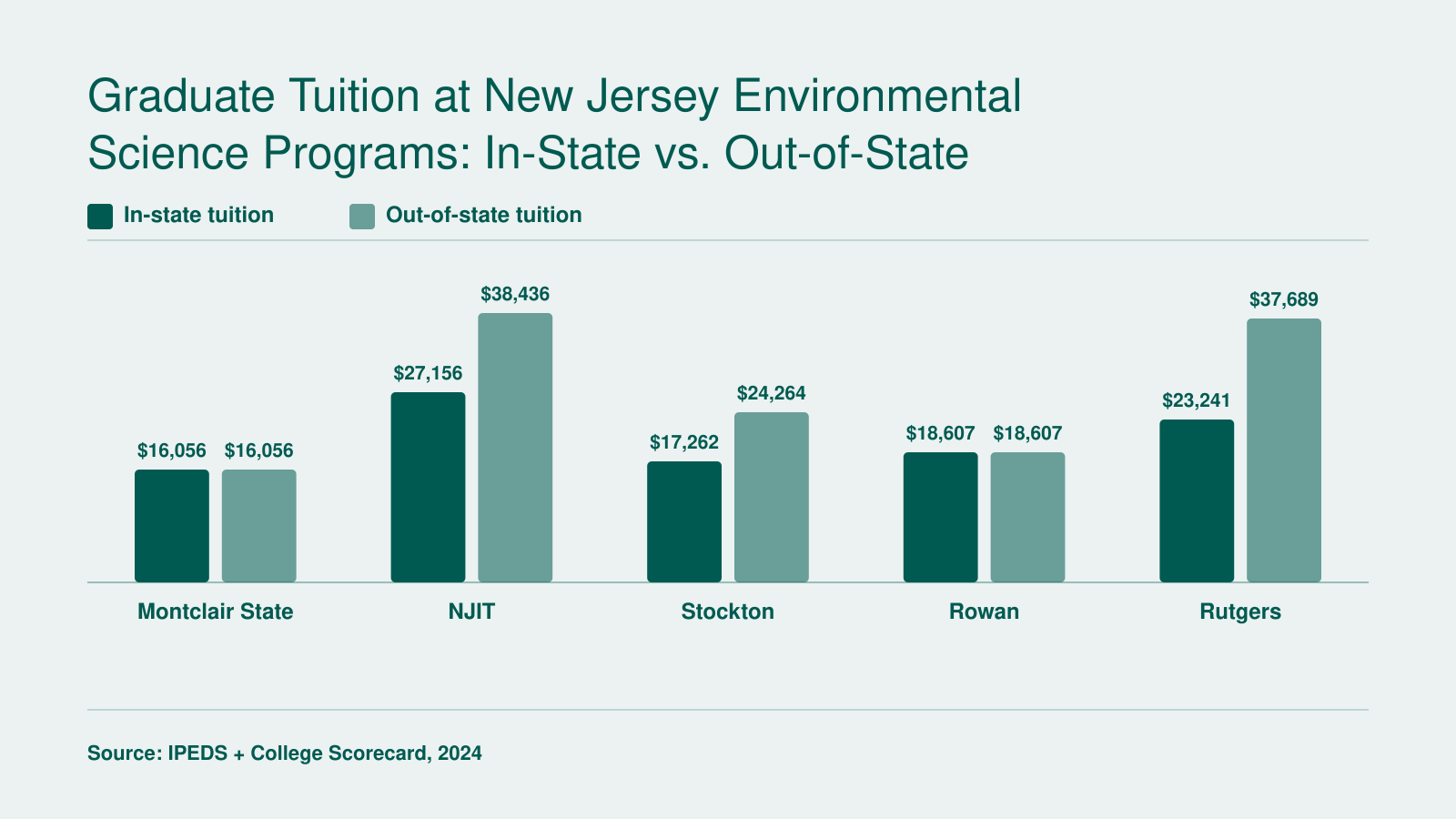
Graduate Tuition at New Jersey Environmental Science Programs: In-State vs. Out-of-State
Every school here is a public institution, so the gap that matters is residency. Out-of-state students pay $7,002 more at Stockton, $11,280 more at NJIT, and $14,448 more at Rutgers. Montclair and Rowan list one figure for both groups. Private universities usually work this way, charging one rate regardless of residency, so a public-private gap would show up as a higher in-state price rather than a residency premium. Check each program's bursar page for current per-credit rates and fees.
Master's in Environmental Science Cost, Financial Aid, and New Jersey Licensure
A New Jersey environmental science master's costs depend on per-credit tuition, mandatory fees, program length, and any aid you secure.
Tuition and Fees
Graduate tuition at the schools ranked here runs from $16,056 a year at Montclair State to $31,266 at NJIT for New Jersey residents, and up to $42,534 at NJIT for out-of-state students. Per-credit rates show the gap more clearly. Montclair State charges $962 in tuition plus $37.02 in fees, or $999.02 per credit in 2026-27, according to the Graduate Student Costs page. That rate is the same for in-state and out-of-state students, while F-1 and J-1 students pay $1,114.02. NJIT's resident rate is $1,442 plus $295 in mandatory fees, or $1,737 per credit, and those fees apply to part-time students too. NJIT's degree requires at least 30 credits.
Financial Aid
Montclair State notes that financial aid is available. Rutgers highlights funding support for doctoral students, so master's applicants should ask directly about assistantships or tuition remission. If you already work in the field, check whether your employer reimburses tuition. Average net price runs from $15,566 at Montclair State to $24,406 at Rutgers, but it is an institution-wide figure, not a quote for this degree; compare program-level costs through the Most Affordable Master's in Environmental Science Programs ranking.
Licensure and Certification
New Jersey requires no state license to work as an environmental scientist. Many graduates later pursue credentials that open regulated work. These include the NJDEP's Licensed Site Remediation Professional, Underground Storage Tank Certification, Certified UST Subsurface Evaluator, and Water and Wastewater Operators Licensing, plus the Certified Hazardous Materials Manager credential.12 Confirm current eligibility rules before planning coursework around one.
Spotlight: New Jersey's Licensed Site Remediation Professional Credential
What Environmental Science Master's Graduates in New Jersey Earn
Here is the honest answer: federal data does not publish median earnings for environmental science master's graduates at any of these New Jersey schools. That is not an oversight. Cohorts are small, and these degrees award only a handful of master's credentials in a given year. When a program graduates a few students annually, earnings and debt figures are suppressed to protect privacy. We will not substitute a university-wide average or a national estimate and call it a program outcome, because neither one tells you what graduates of that specific degree actually made.
So judge these programs on what is verifiable: published tuition, residency status, credit count, and whether the curriculum connects to work being done in the state.
Where graduates tend to land
- Environmental consultant, often on site assessment and compliance work for engineering and remediation firms
- Regulatory specialist with the New Jersey Department of Environmental Protection or the federal EPA
- Sustainability analyst inside corporate operations, utilities, or municipal government
- Remediation scientist, a path that pairs directly with New Jersey's site cleanup industry
Ask each department for placement data by employer and title. Programs this size usually know exactly where their graduates went.
Compare Environmental Science programs on the data that matters
Explore more Science & Engineering specializations or browse every graduate field.
All Science & Engineering programs