Best Master's in Environmental Science Programs in Indiana
Compare 6 accredited Environmental Science programs in Indiana at 3 schools, with graduate earnings, cost, debt, and completion data from IPEDS and the U.S. College Scorecard.

Indiana has few environmental science master's programs, and the degree name means different things by campus: engineering, ecology, or geoscience. Indiana University-Bloomington is the familiar name, but Purdue, Ball State and Notre Dame each offer a distinct route.
Listed annual tuition runs from $9,992 at Purdue to $64,826 at Notre Dame, though Notre Dame's research master's lists full-tuition scholarships and stipends.
The real decision is rarely prestige. An engineering degree and an ecology degree lead to different employers.
Key Points
- Notre Dame, Purdue, IU Bloomington and Ball State all teach their environmental master's degrees on campus.
- IU's O'Neill School does not require the GRE, though applicants may submit scores.
- Funded assistantships at research universities can offset tuition, so compare net cost before sticker price.
Best Master's in Environmental Science Schools in Indiana: 2027 Ranking
All four Indiana schools below deliver their environmental master's degrees on campus, and each takes a different angle: engineering, ecology and policy, or geoscience. Several schools list more than one program, so each card spells out how the degrees differ. Graduation rates are institution-wide, and net price is an approximate institution-wide average, not a quote for any single program.
University of Notre Dame
#1Notre Dame, IN · ~$65,000/yr (est.)
Best for: Research-minded students seeking funded study
Notre Dame is a private university with the highest institution-wide graduation rate in this group, about 95 percent, and graduate tuition of roughly $64,356. Its environmental offerings sit in civil and environmental engineering: a research-based, 30-credit MS that lists full-tuition scholarships and stipends, and a nine-month professional MEng with water-quality and fluid-dynamics concentrations. The approximate institution-wide net price is about $26,780, the highest here, so funding is central to the value case. The MEng listings state no GRE is required, while the MS lists GRE scores as optional.
- 30 credits, typically two to three years
- Research-based degree with thesis defense
- Full-tuition scholarships, stipends, health insurance subsidy
- Requires undergraduate engineering or physical sciences degree
- Three recommendation letters; GRE optional
- Professional master's degree, nine months
- Concentration in water quality, treatment, and recovery
- No GRE required
- Statement of intent, essay, and three recommendation letters
- Professional master's degree, nine months
- Concentration in fluid dynamics and modeling
- Curriculum vitae and 1,000-word essay required
- English proficiency tests for international applicants
Purdue University
#2West Lafayette, IN · ~$10,000/yr (est.)
Best for: Engineering graduates targeting environmental systems work
Purdue is a public research university with an institution-wide graduation rate near 83 percent and the lowest net price of the four schools, roughly $14,600 on average. Graduate tuition is about $9,718 for Indiana residents and $28,520 for out-of-state students. Its Environmental and Ecological Engineering program is a multidisciplinary, life-cycle-focused MS and PhD track, with assistantships and scholarships as funding routes. It suits applicants with an engineering or related background.
- General program with no concentration specified
- Interdisciplinary training across faculty
- Listed as ranked #10 in the U.S.
- Combined degree options and graduate handbook
- Research registration required
- Classic Environmental Engineering concentration
- Life cycle assessment and holistic problem-solving focus
- Bachelor's in engineering or a related field required
- Funding through assistantships and scholarships
- Fall deadline typical for spring enrollment
- Industrial Sustainability concentration
- Research areas include sustainability
- Listing states GRE scores are needed
- Part of the College of Engineering, 21 faculty members
Indiana University-Bloomington
#3Bloomington, IN · $12,000 – $33,000/yr (est.)
Best for: Science graduates blending ecology with public policy
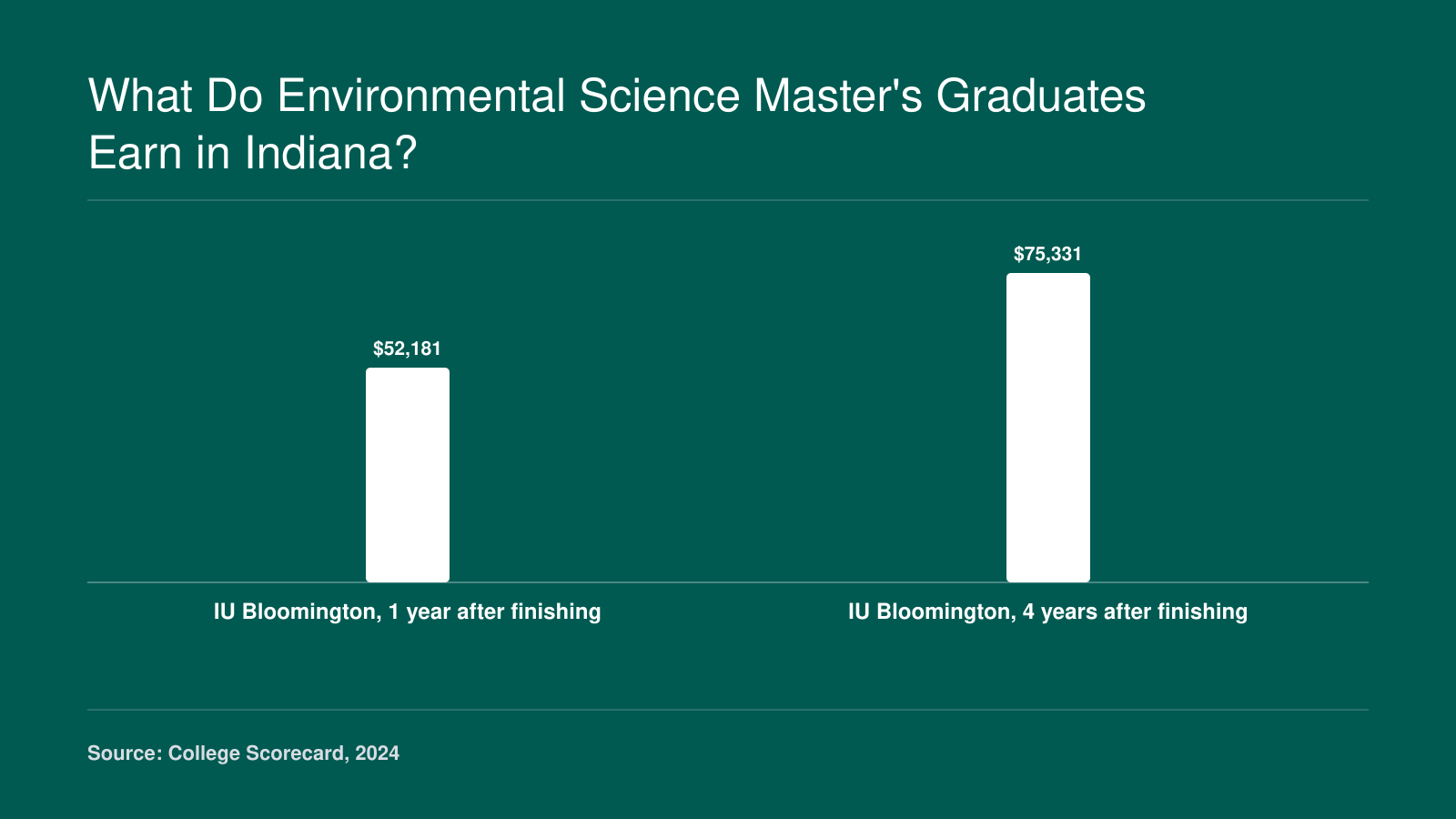
Indiana University Bloomington's O'Neill School offers the MSES, a 48-credit, two-year degree with three concentrations. It is the only school here with published program-level outcomes: median earnings of about $52,181 one year after graduation and $75,331 four years out, with median debt near $42,422. Graduate tuition is about $10,234 in-state and $31,932 out-of-state, and the institution-wide graduation rate is about 80 percent. IU also offers a dual MPA-MSES option and a 25 percent tuition fellowship for qualified IU graduates.
- 48 credit hours over two years
- Core in applied math, statistics, ecology, engineering, chemistry
- Experiential requirement and capstone project
- STEM OPT eligible
- Competitive funding available
- Concentration in energy and climate change science
- Interdisciplinary approach with research faculty
- Concentration options sit on the shared MSES core
- Concentration in environmental chemistry, toxicology, and risk assessment
- Dual degree available with the Master of Public Affairs
- Fall priority deadline January 15, spring deadline October 1
- Fulbright fellowships and faculty with NSF awards noted
Ball State University
#4Muncie, IN · $10,000 – $15,000/yr (est.)
Ball State in Muncie offers two 30-credit, on-campus geoscience routes: a Master of Arts in Environmental Geoscience and a research-intensive master's in Geology and Natural Resources. Graduate tuition is about $10,208 in-state and $27,918 out-of-state, and net price averages roughly $14,940 institution-wide. Its institution-wide graduation rate, about 62 percent, is the lowest of the four, and no program-level earnings are published. Small classes, field studies, and graduate assistantships are the main draws.
- 30 credits, on-campus
- Blends geology, geography, biology, chemistry, natural resources
- Small classes and field study opportunities
- Faculty research collaboration
- Graduate assistantships available
- 30 credits with thesis and thesis defense
- Research-intensive, with core methodology courses
- Electives in geology and resource management topics
- Verified advisor needed
Cost & outcomes by school
Federal data for the highest-earning Environmental Science programs, independent of the ranking above. Earnings are this field's master's graduates four years after completing, where the Scorecard reports them.
| School | Earnings | Tuition / yr | Debt | Grads/yr | Format |
|---|---|---|---|---|---|
| Indiana University-Bloomington IN | $75,331 | $11,756 | $42,422 | 46 | Campus |
| Purdue University IN | — | $9,992 | — | 1 | Campus |
| University of Notre Dame IN | — | $64,826 | — | — | Campus |
Sources: U.S. Department of Education. Tuition and graduates: IPEDS. Earnings and debt: College Scorecard, this field's master's graduates; a dash means no figure is reported.
Cost, debt & payoff
Median earnings of this field's master's graduates (4 yrs after completing) vs. their median federal loan debt · U.S. College Scorecard
Across these programs the median graduate earns about $75,331 and finishes with roughly $42,422 in debt — a ratio that clears a common rule of thumb (keep debt below first-year salary). Tuition and debt vary widely school to school, so check the per-school figures in the table above before you shortlist.
Online and Hybrid Environmental Science Master's Options in Indiana
If you need to keep working, flexibility is the constraint that narrows this list fast: among the Master's Programs in Indiana, the laboratory and field-heavy science degrees are built for campus attendance, while the sustainability-management side of the field is where online study exists.
All environmental science master's programs ranked here are listed as campus-based, including Notre Dame's environmental engineering master's, Purdue's environmental and ecological engineering, IU Bloomington's Master of Science in Environmental Science, and Ball State's environmental geoscience degree. IU's MSES runs 48 credits over roughly two years on campus, with an experiential requirement (internship, research project, or comparable professional work) and a semester-long group capstone, neither of which translates easily to distance study.
The online route at IU sits in a different degree. O'Neill's Master of Environmental Sustainability is offered in person (36 credits, about a year) with concentrations in sustainable environmental policy and planning or municipal and industrial sustainability, and fully online in an asynchronous, self-paced format that students can finish in as little as two years, with concentrations in sustainable environmental policy and planning or municipal and corporate sustainability. Published materials do not describe a required campus residency, and they do not detail online advising or library support, so ask admissions directly before enrolling.
GRE Requirements and Waivers: Which Indiana Master's Programs Are Test-Optional?
The O'Neill School at Indiana University Bloomington does not require the GRE for its environmental master's programs, though applicants may submit scores as supplementary material. Admissions policies and deadlines change from year to year, so confirm every detail on the official admissions page before you apply. For Notre Dame, Purdue, and Ball State, check each graduate admissions page directly for the current test policy.
| School | Program | GRE Policy | Application Deadline | Key Required Materials |
|---|---|---|---|---|
| Indiana University Bloomington (O'Neill School) | Master of Science in Environmental Science (MSES) | Not required. Official GRE scores may be submitted as supplementary material. | Fall: January 15 priority, March 1 international, May 1 final. Spring: October 1 international, November 15 final. | Unofficial transcripts from all schools attended, application fee, three letters of recommendation, personal essay, resume, proof of bachelor's degree, official transcripts before enrollment. Prerequisites: one semester each of calculus and chemistry with lab. |
| Indiana University Bloomington (O'Neill School) | Master of Environmental Sustainability (MES), accelerated 12-month on-campus format | Not required. Scores may be submitted as supplementary material. | Selected through O'Neill's deadline tool. A third-party listing reports January 15, 2027 priority, March 1, 2027 international, and May 1, 2027 final. | $70 application fee, three references, unofficial transcripts, resume or CV, personal statement. International applicants submit English-proficiency scores such as IELTS or TOEFL. |
| Indiana University Bloomington (O'Neill School) | Master of Environmental Sustainability (MES), self-paced fully online format | Optional. GRE and GMAT scores are optional for O'Neill online programs. | Selected through O'Neill's deadline tool. The general application page does not publish a single MES deadline. | $70 application fee, three references, unofficial transcripts, resume or CV, personal statement. International applicants submit English-proficiency scores such as IELTS or TOEFL. |
Related Articles
What a Master's in Environmental Science Costs in Indiana and Licensure Considerations
The cost of a master's in environmental science in Indiana is the tuition and required fees you pay to finish the degree. At public schools, that cost depends heavily on Indiana residency.
Annual Graduate Tuition by School
- Purdue University: $9,992 in-state, $28,794 out-of-state
- Ball State University: $12,342 in-state, $30,052 out-of-state
- Indiana University-Bloomington: $11,756 in-state, $33,454 out-of-state
- University of Notre Dame: $64,826 for all students
Full-Degree Price at IU Bloomington
The O'Neill School publishes the clearest full-program figures. Its 48-credit MSES charges $592.13 per credit for residents and $1,485.38 for nonresidents in 2026-27, plus $870 per semester in required fees. The school's published 2026-27 total is $31,904. The 36-credit Online Master's in Environmental Science program charges $690 per credit regardless of residency, about $24,840 in tuition before fees. Institution-wide average net price, the metric behind Most Affordable Master's in Environmental Science Programs, ranges from $14,600 at Purdue to $26,780 at Notre Dame. Treat those figures as rough context, not program quotes.
Licenses and Certifications
None of these degrees leads directly to a state license. Indiana Professional Geologist status requires education, an exam, and experience, so confirm your coursework qualifies. Graduates may also pursue the Certified Hazardous Materials Manager credential from the Institute of Hazardous Materials Management or Certified Ecologist from the Ecological Society of America. Both are professional certifications with their own eligibility rules.
What Do Environmental Science Master's Graduates Earn in Indiana?
Program-level earnings are shown for Indiana University-Bloomington, the one school here with a published figure for environmental science master's graduates. The bars compare earnings one year and four years after finishing, so the jump is visible. Reported IU O'Neill graduate employers include the USDA Forest Service, MISO, and Cascadia Consulting Group, with titles such as Environmental Scientist, Biologist, and Policy Planner I. Indiana firms that recruit master's candidates for environmental roles include Terracon in Carmel, Kimley-Horn in Indianapolis, and Mundell & Associates, which lists Environmental Scientist and Senior Consultant openings. Recruiting is not the same as a formal program partnership. IU Earth Sciences also points to IDEM environmental specialist and consulting project manager roles.
Choosing the Right Environmental Science Master's Specialization in Indiana
Choosing a specialization means deciding between two kinds of degree: a science master's built around lab, field and research work, or a professional master's built around managing environmental problems. At IU Bloomington, the M.S.E.S. is the science path. It requires a concentration, such as Ecology and Conservation, and offers either a thesis route (18 to 24 credits, guided by a committee of three faculty) or a non-thesis route that ends in a team capstone. The Master of Environmental Sustainability is the professional path. It is 36 credits blending science with law, policy and management, finishes with a client-based capstone, and has no published thesis option. The online version narrows to two concentrations: Municipal and Corporate Sustainability, and Sustainable Environmental Policy and Planning.
If you want a research career, a PhD or agency science work, choose a thesis program. Notre Dame's research-based environmental engineering degree requires a thesis defense, and Purdue's Classic Environmental Engineering concentration suits technical roles. Career-switchers and working professionals usually get more from the online MES, which fits around a job and points toward municipal, corporate or policy roles.
Compare Environmental Science programs on the data that matters
Explore more Science & Engineering specializations or browse every graduate field.
All Science & Engineering programs