Best Master's in Environmental Science Programs in Virginia
Compare 10 accredited Environmental Science programs in Virginia at 5 schools, with graduate earnings, cost, debt, and completion data from IPEDS and the U.S. College Scorecard.
Virginia's environmental science master's market now splits between research-intensive residential programs and a fully online professional degree, with resident tuition ranging from $8,982 to $23,526. The practical question is which option pays back that cost.
The ranked field below is deliberately small and complete, not padded to a longer list. Within it, the tension between public in-state pricing, out-of-state premiums, and online flexibility shapes the value calculation more than program prestige does.
Key Points
- Virginia Wesleyan's online master's costs $8,982 a year, versus $23,526 in-state at the University of Virginia.
- George Mason graduates of the Environmental Science and Policy MS earn a median of $76,524.
- Virginia has no general environmental scientist license, but DPOR credentials cover soil scientists, wetland professionals, and geologists.
Top-Ranked Environmental Science Master's Programs in Virginia
Five Virginia universities make this list, and they range from a one-department research powerhouse to a fully online professional degree. Required credits run from 30 to 33, and thesis and non-thesis paths are both well represented. Use each card to compare format, concentration, and tuition side by side.
University of Virginia
#1Charlottesville, VA · ~$24,000/yr (est.)
Best for: Aspiring researchers wanting thesis-based training
The University of Virginia houses its environmental science master's in a single department that integrates ecology, geosciences, hydrology, and atmospheric sciences. The M.S. is thesis-based, with a public proposal and defense. The university graduates about 96% of its students institution-wide, and the program is a strong fit if you plan to build a research record.
- 30 total credits, with at least 24 graded credits
- Thesis required, with a public proposal and defense
- One non-seminar course each in atmospheric sciences, ecology, geosciences, hydrology
- Department Seminar expected at least once
- Campus-based in Charlottesville
- Course enrollment approved each term by the Director of Graduate Studies
George Mason University
#2Fairfax, VA · $15,000 – $20,000/yr (est.)
Best for: Northern Virginia students focused on policy
George Mason University's Environmental Science and Policy master's pairs a 33-credit science core with policy training, and it publishes several concentrations. Its subject areas, including land and water management, wetland loss, and conservation biology, suit Northern Virginia students. The university graduates roughly 68% of its students institution-wide, and the program lists no GRE requirement for admission.
- Aquatic Ecology concentration on food webs, biogeochemical cycles, water quality
- 33 total credits, campus-based
- Bachelor's degree with 3.00 GPA, including chemistry and biology
- No GRE required for admission
- Three recommendation letters and a statement of interest
- Conservation Science and Policy concentration
- Prerequisites: two semesters of chemistry, three of biology, and an ecology course
- Research project or thesis option
- Accelerated master's option listed
- General Environmental Science and Policy concentration
- Core courses in science, statistics, and policy
- Faculty advisor coordination and supervisory committee
- Green Leaf designated program
Christopher Newport University
#3Newport News, VA · $13,000 – $23,000/yr (est.)
Best for: Hampton Roads students choosing thesis or non-thesis
Christopher Newport University offers an on-campus M.S. in Environmental Science with thesis and non-thesis choices and three focused concentrations. It also provides a five-year bachelor's-to-master's path for its own students, as well as a traditional route for applicants who already hold a degree. The university graduates about 72% of its students institution-wide.
- 30 to 33 credit hours depending on track
- Thesis and non-thesis options
- Five-year combined bachelor's-to-master's path
- Designed for biology or chemistry backgrounds
- Biological Conservation concentration
- Core courses in writing and biometry
- Restoration ecology, wetlands ecology, and marine ecology coursework
- GIS and spatial analysis, with a field studies component
- Restoration Ecology concentration
- Thesis or project option
- Wetlands Ecology and hands-on field studies
- Length varies by track
- Environmental Regulations concentration
- Includes a Technical Writing course
- Thesis or project option
Virginia Commonwealth University
#4Richmond, VA · ~$17,000/yr (est.)
Virginia Commonwealth University offers two environmental studies degrees in Richmond: a research-focused thesis M.S. and a non-thesis Master of Environmental Studies. M.S. applicants need a sponsoring faculty adviser, and those without one may be considered for the M.Envs. instead. The university graduates about 63% of its students institution-wide, and assistantships are available.
- 33 graduate credits, at least half at the 600 level or above
- Thesis required, with a defense
- Sponsoring faculty adviser required for admission
- 3.0 GPA, plus biology and chemistry prerequisites
- GIS and R programming skills built in
- 33 graduate credits, non-thesis
- 12 core credits, 18 elective credits, 3 practical experience credits
- Oral exam required
- Internship or independent study option
- Reduced out-of-state tuition noted
Virginia Wesleyan University
#5Virginia Beach, VA · ~$9,000/yr (est.)
Virginia Wesleyan University delivers its Master of Environmental Studies fully online, which makes it the one fully online option on this list. The 31-credit program can be finished in as little as 16 months and ends in a community-based capstone. Active practitioners serve as guest instructors. The university graduates about 42% of its students institution-wide.
- Online format, 31 total credits
- Completion in as little as 16 months
- Cost listed at $515 per credit hour
- Bachelor's degree and 2.7 minimum GPA; no GMAT required
- Capstone proposal course followed by a professional environmental capstone
- Coursework in policy, sustainability assessment, climate change, water resources
Cost & outcomes by school
Federal data for the highest-earning Environmental Science programs, independent of the ranking above. Earnings are this field's master's graduates four years after completing, where the Scorecard reports them.
| School | Earnings | Tuition / yr | Debt | Grads/yr | Format |
|---|---|---|---|---|---|
| Virginia Commonwealth University VA | $73,253 | $17,252 | — | 5 | Campus |
| Virginia Polytechnic Institute and State University VA | — | $18,564 | — | — | Online |
| Christopher Newport University VA | — | $13,050 | — | 9 | Campus |
| University of Virginia VA | — | $23,526 | — | 43 | Campus |
| George Mason University VA | — | $17,964 | — | 13 | Campus |
Sources: U.S. Department of Education. Tuition and graduates: IPEDS. Earnings and debt: College Scorecard, this field's master's graduates; a dash means no figure is reported.
How We Rank Virginia Environmental Science Master's Programs
Reputation surveys tell you which schools other academics admire. Outcome data tells you what a degree is likely to cost you and what it may pay back. This ranking relies on outcome data, comparing environmental science master's programs on graduate tuition, average net price, institution-wide graduation rate, and, where the federal College Scorecard publishes them, program-level earnings and debt for graduates.
Nothing here rests on peer reputation polls, paid placement, or a school's own marketing claims. Campus and online master's programs in Virginia are ranked together on the same criteria, so a format choice never earns a school extra credit.
The data has limits worth knowing. Net price is an average across the entire institution, not a figure specific to environmental science graduate students. Some programs also show no earnings figures because their graduating cohorts are too small for federal reporting.
Online and Hybrid Master's in Environmental Science Options in Virginia
An online or hybrid master's in environmental science lets you complete coursework over the internet rather than commuting to a Virginia campus, though some programs still require periodic field work, lab sessions, or a short residency. Virginia Wesleyan University delivers its Master of Arts in Environmental Studies fully online: 31 credit hours capped by a capstone project, with a focus on environmental policy, water resources, and sustainability rather than bench lab work, making it a fit for students comparing masters in sustainability online.
The remaining programs here, including those at the University of Virginia, George Mason University, Christopher Newport University, and Virginia Commonwealth University, run as campus-based, research-focused degrees with thesis and field or laboratory components.
Virginia Wesleyan charges the same tuition to in-state and out-of-state online students, a meaningful advantage if you live outside Virginia.
Practical tip: before enrolling, confirm whether a thesis, capstone, or in-person field requirement applies, since those can be hard to fit around a full-time job.
Which Virginia Environmental Science Master's Programs Make the GRE Optional?
Policies vary, and most of the schools here do not clearly publish one for their environmental science master's programs. Where no policy appears on an official admissions or program page, the table says so rather than guessing. Confirm current requirements directly with each program before applying.
| School | GRE Policy | Waiver or Notes |
|---|---|---|
| University of Virginia | Not required (scores not accepted) | The Environmental Sciences M.S. page states that GRE scores are neither required nor accepted. |
| George Mason University | No published policy | No master's GRE policy was identified. The program reviewed is Earth Systems Science, and the one related official page found covers a doctoral program, so it does not settle the master's requirement. |
| Christopher Newport University | No published policy | No GRE policy was identified on the official pages reviewed. No waiver conditions are published. |
| Virginia Commonwealth University | No published policy | No GRE policy was identified on the official pages reviewed. No waiver conditions are published. |
| Virginia Wesleyan University | No published policy | No GRE policy was identified in the admissions information reviewed. No waiver conditions are published. |
Related Articles
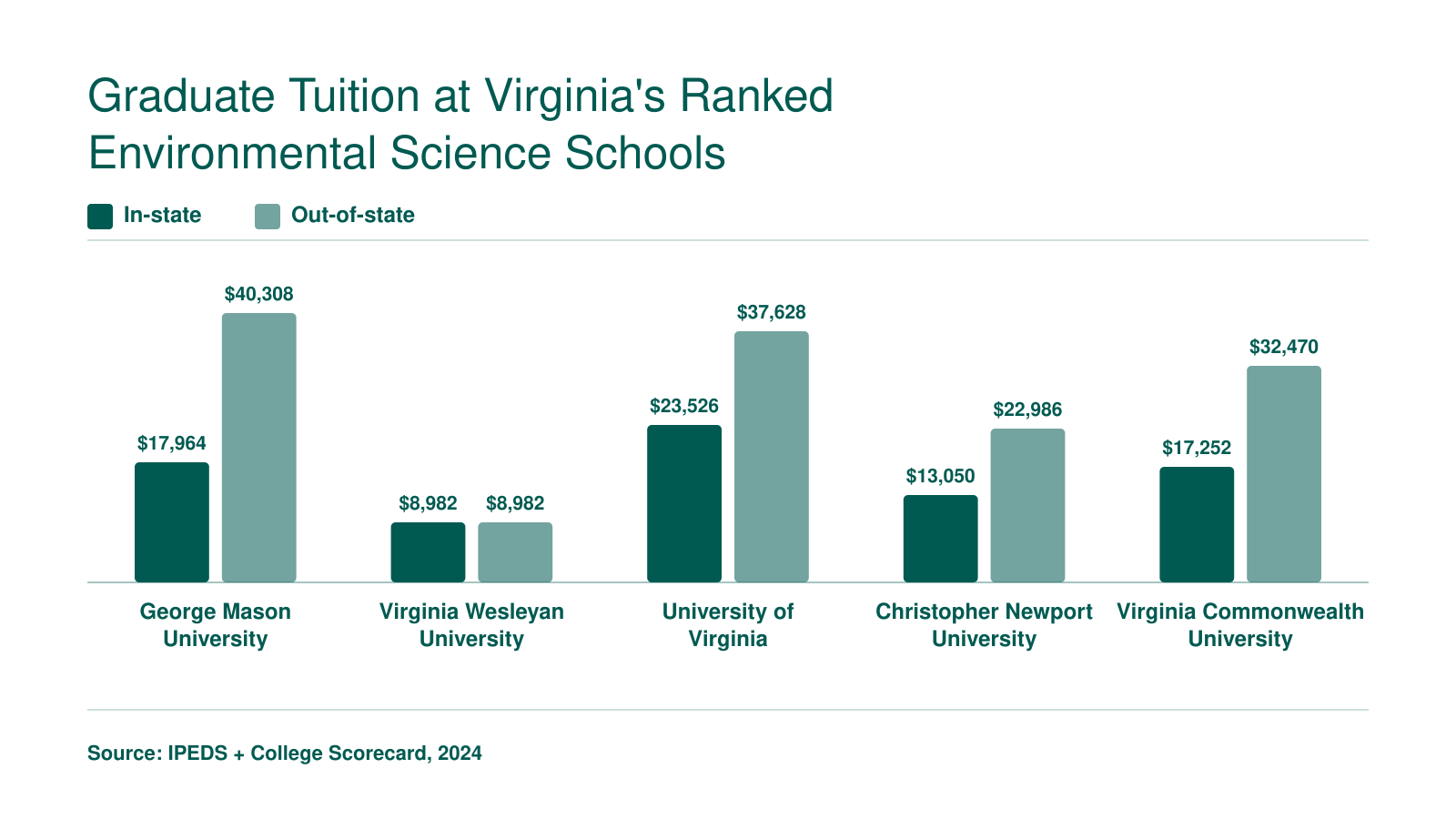
Graduate Tuition at Virginia's Ranked Environmental Science Schools
The in-state gap is $14,544 between the cheapest option here, Virginia Wesleyan University at $8,982, and the most expensive, the University of Virginia at $23,526. Virginia Wesleyan's program is online and charges one rate to all students. These figures are annual graduate tuition and fees, not the total cost of a degree, so multiply by the years or credits your program requires.
Master's in Environmental Science Cost, Accreditation, and Value in Virginia
Residents and nonresidents can pay very different prices for the same Virginia public master's. At the University of Virginia, annual graduate tuition is $23,526 in-state versus $37,628 out-of-state. George Mason charges $17,964 versus $40,308 for its 33-credit program. Christopher Newport ($13,050 versus $22,986) and Virginia Commonwealth ($17,252 versus $32,470) fall in between. Virginia Wesleyan's online program does not split by residency: 31 credits at $515 per credit comes to roughly $16,000 total.
Average net price after aid ranges from about $17,900 at George Mason to $23,400 at VCU. Those figures are institution-wide averages, not an amount any individual graduate student should expect to pay. Federal program-level median debt and monthly repayment figures are not yet available for these programs.
UVA (accredited since 1904, with reaffirmation due in 2027)1 and VCU2 both hold SACSCOC institutional accreditation. Check SACSCOC's directory to confirm current status for the other schools. No dedicated programmatic accreditor exists for environmental science master's degrees, so regional accreditation is what employers and certification bodies verify.
Virginia Environmental Certification and Licensure
Career Outcomes and Earnings for Virginia Environmental Science Master's Graduates
Program-level earnings for environmental science master's degrees are still thinly reported, but the Virginia figures that do exist point to a solid return.
- George Mason University: Graduates of the Environmental Science and Policy MS earn a median of $76,524 five years after finishing, the highest program-level figure here.
- Virginia Commonwealth University: Environmental Studies graduates report median earnings of $60,816 five years after finishing, and about 94% earn above the poverty line.
- University of Virginia: Environmental Sciences graduates earn a median of $60,738 one year after finishing, and every graduate in the tracked group was employed at that point.
UVA's figure is notable because it arrives so early. A one-year number that already matches VCU's five-year result suggests a fast start, though the windows differ and the comparison is not exact.
Where graduates go is fairly consistent across the state. Common paths include the Virginia Department of Environmental Quality, federal agencies and contractors in Northern Virginia, Chesapeake Bay restoration organizations, and environmental consulting firms working on permitting, water quality, and site assessment.
FAQs About Master's in Environmental Science Programs in Virginia
How much does a master's in environmental science cost in Virginia?
Which Virginia schools offer accredited environmental science master's degrees?
Can I complete a Virginia environmental science master's while working full-time?
Should I choose a thesis or non-thesis track?
Compare Environmental Science programs on the data that matters
Explore more Science & Engineering specializations or browse every graduate field.
All Science & Engineering programs