Best Master's in Environmental Science Programs in Oklahoma
Compare 5 accredited Environmental Science programs in Oklahoma at 2 schools, with graduate earnings, cost, debt, and completion data from IPEDS and the U.S. College Scorecard.

Which Oklahoma environmental science master's is built for the water, energy, and agricultural work the state actually hires for? Oklahoma's tribal and state environmental agencies and its oil, gas, and farming sectors all need scientists who can model contamination, manage watersheds, and keep permits moving. The programs ranked here split between OU's $30,450 online hydrology master's, Oklahoma State's research-heavy land-grant MS, and Tulsa's private non-thesis option. The real tension is price. Resident tuition runs from about $9,100 to $27,700 before assistantships, a wider spread than the environmental science master's salary and career outcomes data would suggest.
Key Points
- OU's online hydrology master's costs $30,450 in 2027.
- OSU's environmental science master's does not require the GRE in 2027.
- OSU's in-state tuition starts around $9,100 in 2027.
Best Master's in Environmental Science Programs in Oklahoma, Ranked
This ranking compares Oklahoma environmental science master's programs by cost, outcomes, and delivery format rather than by name recognition. The cards below highlight fully online, campus, and hybrid paths in hydrology, environmental geoscience, and interdisciplinary environmental management.
University of Oklahoma – Hudson College of Public Health
#1Norman, OK · ~$9,000/yr (est.)
Best for: Water-focused professionals seeking online hydrology training
University of Oklahoma is the strongest match for students who want a named Master of Environmental Science with a water-security focus. In-state and out-of-state graduate tuition and fees are $9,797 and $27,377, and the university graduates about 75% of students overall. The Hydrology and Water Security track is fully online, takes about 21 months, and offers Water Management, Water Quality, and Water Quantity concentrations. A campus-based Master of Environmental Science is also available.
- Campus-based training in chemistry, biology, and hydrology
- Includes lab studies and numerical modeling
- Requires a bachelor's degree and application materials
- Fully online and designed to finish in 21+ months
- 30 credit hours with a $30,450 total program cost
- $1,015 per credit hour
- Concentrations in Water Management, Water Quality, and Water Quantity
- Rolling admissions with fall and spring start dates
- No campus visits required
Oklahoma State University
#2Stillwater, OK · ~$9,000/yr (est.)
Best for: Interdisciplinary students wanting research and internships
Oklahoma State University's environmental science master's is one of the most interdisciplinary options in the state, drawing on more than 30 departments. In-state and out-of-state graduate tuition and fees are $10,234 and $25,754, and the university graduates about 68% of students overall. Students can choose a campus thesis or non-thesis MS, or a hybrid Professional Science Master in Environmental Science Management with a 240-hour internship.
- Thesis option requires 30 credits with 6 thesis hours
- Non-thesis option requires 32 credits with a formal report
- Draws on more than 30 departments and 200 courses
- Requires B or better in chemistry, biology, and algebra
- Three references, goal statement, CV, and advisor agreement
- A 3.0 GPA is recommended
- 33-credit non-thesis degree with HyFlex course options
- 240-hour internship built into the curriculum
- Environmental Science Management concentration
- Available at OSU Tulsa
- Requires a minimum 3.0 GPA
- First-in-Oklahoma professional science master
University of Tulsa
#3Tulsa, OK · ~$28,000/yr (est.)
Best for: Earth science graduates needing a geoscience path
The University of Tulsa offers a campus-based geosciences master's with an environmental geoscience concentration, suited to students who want a focused earth-science path. In-state and out-of-state graduate tuition and fees are both $50,061, and the university graduates about 72% of students overall. Thesis and non-thesis routes are available.
- Campus-based environmental geoscience concentration
- 30 credit hours with a non-thesis path
- Minimum 3.0 GPA for admission
- GRE scores and recommendation letters required
- Practical experience and graduate law courses available
- 30 credit hours minimum with a 6-credit thesis
- On-campus with oral defense and research proposal
- 12 credit hours at 7000 level
- 6 credit hours outside the major discipline
- Peer-reviewed publication option encouraged
Cost & outcomes by school
Federal data for the highest-earning Environmental Science programs, independent of the ranking above. Earnings are this field's master's graduates four years after completing, where the Scorecard reports them.
| School | Earnings | Tuition / yr | Debt | Grads/yr | Format |
|---|---|---|---|---|---|
| University of Oklahoma OK | — | $9,353 | — | 30 | Online or campus |
| Oklahoma State University OK | — | $9,092 | — | 8 | Campus |
Sources: U.S. Department of Education. Tuition and graduates: IPEDS. Earnings and debt: College Scorecard, this field's master's graduates; a dash means no figure is reported.
Online and Hybrid Environmental Science Master's Options in Oklahoma
OU's Master of Environmental Science in Hydrology and Water Security carries a 30-credit, 10-course load and a published $30,450 total at $1,015 per credit. The 100% online program offers Water Management, Water Quality, and Water Quantity concentrations, with full-semester courses (16 weeks in fall/spring, 14 in summer) typically completed in 21 to 24 months depending on start term. No campus-residency requirement is stated in current OU materials.
Oklahoma State's Professional Science Master's in environmental science pairs environmental coursework with business and professional skills, and students should expect an internship or capstone. Current OSU pages do not settle whether that PSM track is fully online, hybrid, or campus-based; its 2026-2027 online graduate rate is $512 resident or $555 nonresident per credit for 100% online degree programs,1 but that rate may not apply to a hybrid track.
The University of Tulsa's environmental science master's is campus-based.
Working professionals comparing online master's programs in Oklahoma should confirm before enrolling whether online students qualify for assistantships and in-state tuition, since these rules vary by program and residency classification.
Which Oklahoma Master's Programs Waive or Make the GRE Optional?
GRE policy by program
- Oklahoma State University: The GRE is not required for the Environmental Science MS or the Environmental Management PSM, placing it among Master's in Environmental Science Programs With No GRE Required.
- University of Oklahoma: Scores are optional for the Master of Environmental Science. Some faculty sponsors may still want them when considering you for a Qualifying Graduate Assistantship.
- University of Tulsa: No GRE policy is confirmed here, so check its graduate admissions page before you plan.
Deadlines and prerequisites
OSU's complete-application deadlines are September 30 for spring, January 30 for summer, and April 30 for fall. No separate priority date is published. OU's environmental science admissions page lists no fixed MES deadline. Its online MES information says admission may stay open until two weeks before classes, though some programs set earlier dates, so confirm with the department.
Both schools expect a 3.0 GPA and a B or better in prerequisites. OSU asks for chemistry, biology, and algebra. OU asks for two semesters of calculus plus one each of physics, chemistry, and biological science. Check each admissions page for letter and statement requirements.
If you want a thesis track, email a prospective faculty advisor before you apply.
Related Articles
Thesis vs. Non-Thesis Environmental Science Master's at OU and OSU
At Oklahoma State University, the environmental science master's program offers a 30-credit Plan A thesis option with 6 credits of thesis research and a 32-credit Plan B non-thesis option with 2 thesis-related credits. OU's Master of Environmental Science keeps both routes at 30 credits. The thesis option includes 5 credits of thesis research plus 1 technical communication credit and requires a final defense. The coursework-only option uses 10 to 11 core credits and 19 to 20 elective credits; the catalog does not specify a separate capstone or comprehensive exam. OSU requires at least two semesters of enrollment and 80% of graduate credits at the university. Neither catalog publishes standard full-time or part-time completion timelines, so pace your plan around credit load. Assistantship details are not spelled out in these entries, so confirm funding terms directly with each program.
Graduate Tuition: In-State vs. Out-of-State
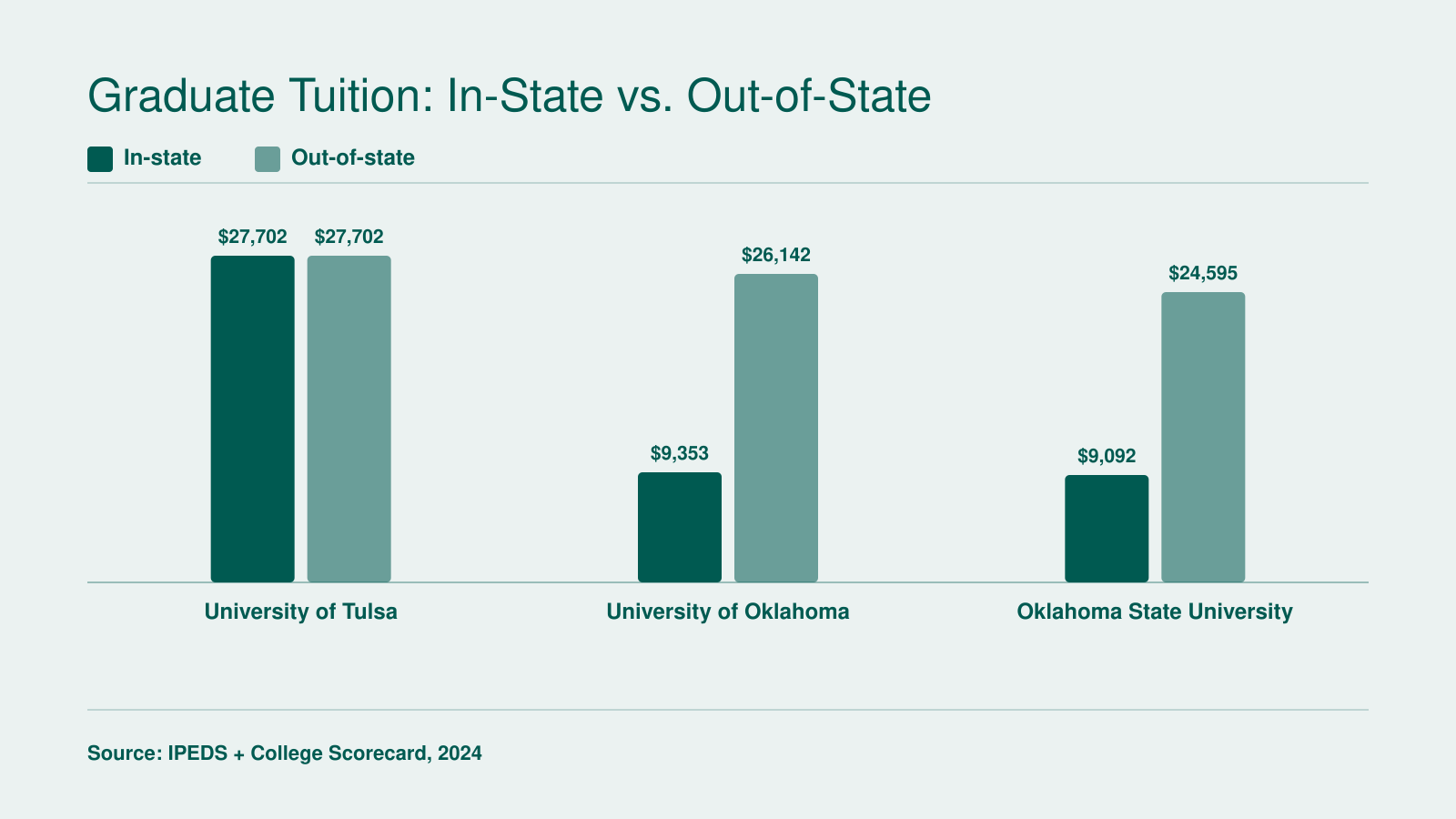
Resident and nonresident tuition can differ by more than $15,000 a year at some Oklahoma programs. The chart below compares the published graduate rates for each ranked school.
Cost, Assistantships, and Funding for Environmental Science Master's Students
Most funded environmental science master's students pay their way through a graduate assistantship, a part-time research or teaching job that carries a stipend and a tuition waiver. Without one, annual tuition runs from about $9,100 in-state at Oklahoma State University to roughly $27,700 at the University of Tulsa. The University of Oklahoma sits at about $9,400 in-state and $26,100 out-of-state. Net price estimates of roughly $15,000 to $17,400 are approximate institution-wide averages, so treat them as a rough guide, not a program quote.
Assistantships at OSU and OU
OSU considers Environmental Science applicants for a research assistantship automatically, with no separate application. Awards are usually fall-only and go to the strongest applicants. The tuition waiver requires at least a 0.50 FTE appointment (about 20 hours a week) and 6 enrolled hours. Stipends vary by department; a 2026 OSU research-assistantship posting listed $1,827 a month.
At OU, funding is considered at admission review, and aided master's students are almost always on the thesis track. From July 1, 2026, the university minimum for a 0.50 FTE assistant is $23,934 a year. Appointments also include a tuition waiver and health insurance, and students need 5 enrolled hours.
Scholarships and Waivers
OSU notes tuition-waiver scholarships and faculty-funded assistantships, but names no specific fellowships. The waiver terms we reviewed mention no residency condition, so ask each program about out-of-state eligibility.
Oklahoma Environmental Credentials Worth Knowing
How We Rank Oklahoma Environmental Science Master's Programs
Which numbers actually tell you whether an Oklahoma environmental science master's will pay off? This ranking starts with reported graduate tuition and net price, then weighs program-level earnings and debt where the College Scorecard publishes them. We also consider institution-wide graduation rates and whether a program offers an online master's in environmental science or hybrid option. A respected name alone does not earn a higher spot. The focus is on measurable cost and career signals, not prestige or reputation surveys. Where too few graduates completed a program to produce reliable earnings data, we say so rather than guess. That keeps the comparison focused on information you can actually use.
Frequently Asked Questions About Environmental Science Master's Programs in Oklahoma
Here are direct answers to common questions about Oklahoma environmental science master's programs.
What is the best master's in environmental science program in Oklahoma?
How much does an environmental science master's cost in Oklahoma?
Is a Professional Science Master's different from a traditional MS in environmental science?
Can online students in Oklahoma get assistantships or in-state tuition?
Compare Environmental Science programs on the data that matters
Explore more Science & Engineering specializations or browse every graduate field.
All Science & Engineering programs