Best Master's in Environmental Science Programs in Michigan
Compare 10 accredited Environmental Science programs in Michigan at 5 schools, with graduate earnings, cost, debt, and completion data from IPEDS and the U.S. College Scorecard.

Michigan sits on nearly 20 percent of the world's surface fresh water, and its environmental science programs reflect that: Great Lakes water quality, PFAS contamination, and the state's energy transition shape the research tracks graduates enter. Several of the schools ranked here build concentrations directly around water resources and environmental chemistry.
Campus and online programs appear together in the ranking; graduate tuition spans roughly $12,000 to nearly $58,000 depending on school and residency. The decision rarely comes down to prestige. Resident versus nonresident cost, assistantship funding, and whether a program still weighs the GRE often matter more to an applicant's return than the name on the diploma, especially for students comparing master's in environmental science programs with no GRE required.
Key Points
- Northern Michigan University is the cheapest option here: $12,196 in-state, $15,652 out-of-state.
- University of Michigan shows the widest resident/nonresident tuition gap, about $28,890 per year.
- Michigan requires no state license for environmental scientists, though engineering-track graduates may need a PE.
Top-Ranked Environmental Science Master's Programs in Michigan
Seven Michigan universities offer environmental science master's options, ranging from research-heavy engineering tracks to online programs built for working professionals. The cards below show each school's programs, concentrations, format, and graduate tuition, so you can compare cost and fit side by side.
University of Michigan
#1Ann Arbor, MI · $29,000 – $58,000/yr (est.)
Best for: Aspiring sustainability leaders pursuing dual degrees
The University of Michigan graduates about 93% of its students, the highest institution-wide rate among Michigan schools on this list. Its School for Environment and Sustainability pairs a campus-based MS with dual-degree options in engineering, and the Erb Institute links graduate students with the Ross School of Business on company-focused sustainability projects. Federal data for the field show median earnings of about $87,988 four years after completion, though results vary by program and individual.
- 30 credit hours, two-year program, full or part time
- Evening and occasional Saturday classes
- Thesis or project emphasis with three degree plan options
- Core work in biology, chemistry, and geology
- Geospatial Analysis Lab and Environmental Interpretive Center access
- B average, statement of purpose, three recommendation letters
- Dual degree with engineering, awarding MS and MSE degrees
- 54 credits over about 2.5 years
- Interdisciplinary curriculum focused on sustainable energy systems
- Separate applications, resume and recommendation letters required
- Credits can be double-counted across the two degrees
- Dual degree with engineering, awarding MS and MSE degrees
- 54 total credits over about 2.5 years
- Focus on sustainable design and sustainable systems
- Jointly administered with the College of Engineering
- Admissions through Rackham with statement of purpose and resume
- Dual degree with engineering, awarding MS and MSE degrees
- 54 credits over about 2.5 years
- Focus on protecting and restoring water systems
- Emphasis on socially, economically, and environmentally sustainable approaches
- Transcripts and letters of recommendation required
Michigan State University
#2East Lansing, MI · $22,000 – $42,000/yr (est.)
Best for: Science grads targeting environmental engineering roles
Michigan State University graduates about 81% of its students. Its environmental options sit on the engineering and geoscience side, with campus-based concentrations in chemistry, microbiology, and hydrology, plus an Environmental Geosciences MS. It suits applicants with a science or engineering bachelor's who want a technical path toward environmental protection and research roles.
- Campus-based concentration in chemical processes affecting the environment
- Related bachelor's degree required, such as engineering or science
- GRE scores may be needed
- Letters of recommendation required
- Typically about two years
- Campus-based concentration in environmental microbiology and biotechnology
- Requires a bachelor's degree
- GRE scores listed as needed
- Campus-based concentration in hydrology and water resources
- Two-year duration
- Minimum 3.0 GPA
- GRE scores and letters of recommendation needed
- Fall and spring admissions
- Campus-based MS in Environmental Geosciences
- Hands-on learning with interdisciplinary approaches
- Bachelor's degree, GRE scores, and recommendation letters required
Michigan Technological University
#3Houghton, MI · $25,000 – $30,000/yr (est.)
Best for: Water resources specialists wanting thesis flexibility
Michigan Technological University in Houghton graduates about 68% of its students and focuses on applied water and systems work. Its Environmental Engineering Science MS offers thesis, report, or coursework routes and states that no GRE is required. The program is designed to be completed full time in about 12 months, and a separate Environmental and Energy Policy master's offers tuition assistantships for those leaning toward policy.
- Minimum 30 credits with thesis, report, or coursework options
- No GRE required, 3.0 GPA expected
- Two recommendation letters
- Full-time completion in about 12 months
- TOEFL 79 or IELTS 6.5 minimum for international applicants
- Minimum 30 credits with thesis, report, or coursework options
- Concentration in environmental-systems modeling
- No GRE required, 3.0 GPA expected
- Advisory committee guides a tailored academic plan
- 30 credits with thesis, report, or coursework options
- Concentration in pollution prevention
- No GRE required, minimum 3.0 GPA
- Holistic admissions review
- Mostly 5000 to 6000 level courses
University of Michigan-Dearborn
#4Dearborn, MI · ~$17,000/yr (est.)
The University of Michigan-Dearborn graduates about 58% of its students. Its 30-credit MS in Environmental Science is built for working professionals, with evening, Saturday, and online classes. Students can choose thesis, project, or coursework-only paths aimed at government, industry, consulting, or academia.
- 30-credit program with thesis, project, or coursework-only paths
- Online and campus options
- Evening and Saturday classes for working students
- Minimum 3.1 GPA, statement of purpose, two recommendation letters
- Core courses include invasive species ecology and environmental chemistry
- Scholarships and funding opportunities noted
Western Michigan University
#5Kalamazoo, MI · $20,000 – $25,000/yr (est.)
Western Michigan University in Kalamazoo graduates about 58% of its students. Its campus-based MS in Geosciences suits students drawn to the physical-science side of environmental work, combining coursework, lab and field training, and original thesis research. It also prepares students for doctoral study.
- Concentrations in geochemistry, geophysics, and geomorphology
- Thesis research with a thesis advisor
- Lab and hands-on field training
- Bachelor's degree required, diverse science backgrounds accepted
- Conference presentations required
Wayne State University
#6Detroit, MI · ~$18,000/yr (est.)
Wayne State University in Detroit graduates about 58% of its students and offers both an online and a campus route. The fully online MA in Environmental Science charges in-state tuition rates regardless of residency, and the campus MS carries a reduced out-of-state rate of $1,195.26 per credit for 2026-27. Detroit's urban setting is a draw for climate and environmental management work.
- 30 credits, fully online, interdisciplinary
- In-state tuition rates regardless of residency
- Self-paced learning option
- GIS skills included
- Bachelor's degree required
- 30 credits, campus-based, thesis option only (Plan A)
- Minimum 2.75 GPA with science coursework prerequisite
- Statement of purpose and recommendation letters required
- Courses in geochemistry, biology, remote sensing, and climate science
Northern Michigan University
#7Marquette, MI · $12,000 – $16,000/yr (est.)
Northern Michigan University in Marquette graduates about 52% of its students. Its campus-based MS in Sustainability is the most policy- and community-oriented option here, with tracks in natural resources, planning, and sustainability leadership. It suits students heading to government, private-sector, or nonprofit roles.
- 32 credits, campus-based
- Tracks in Natural Resources Management, Community Development and Planning, Sustainability Leadership
- Thesis or practicum option
- Geospatial analysis training
- Bachelor's degree required for admission
Cost & outcomes by school
Federal data for the highest-earning Environmental Science programs, independent of the ranking above. Earnings are this field's master's graduates four years after completing, where the Scorecard reports them.
| School | Earnings | Tuition / yr | Debt | Grads/yr | Format |
|---|---|---|---|---|---|
| University of Michigan MI | $87,988 | $28,886 | $35,377 | 217 | Campus |
| Michigan State University MI | — | $21,772 | — | — | Campus |
| Michigan Technological University MI | — | $25,916 | — | — | Campus |
| University of Michigan-Dearborn MI | — | $17,126 | — | 10 | Hybrid |
| Wayne State University MI | — | $17,960 | — | 3 | Online |
Sources: U.S. Department of Education. Tuition and graduates: IPEDS. Earnings and debt: College Scorecard, this field's master's graduates; a dash means no figure is reported.
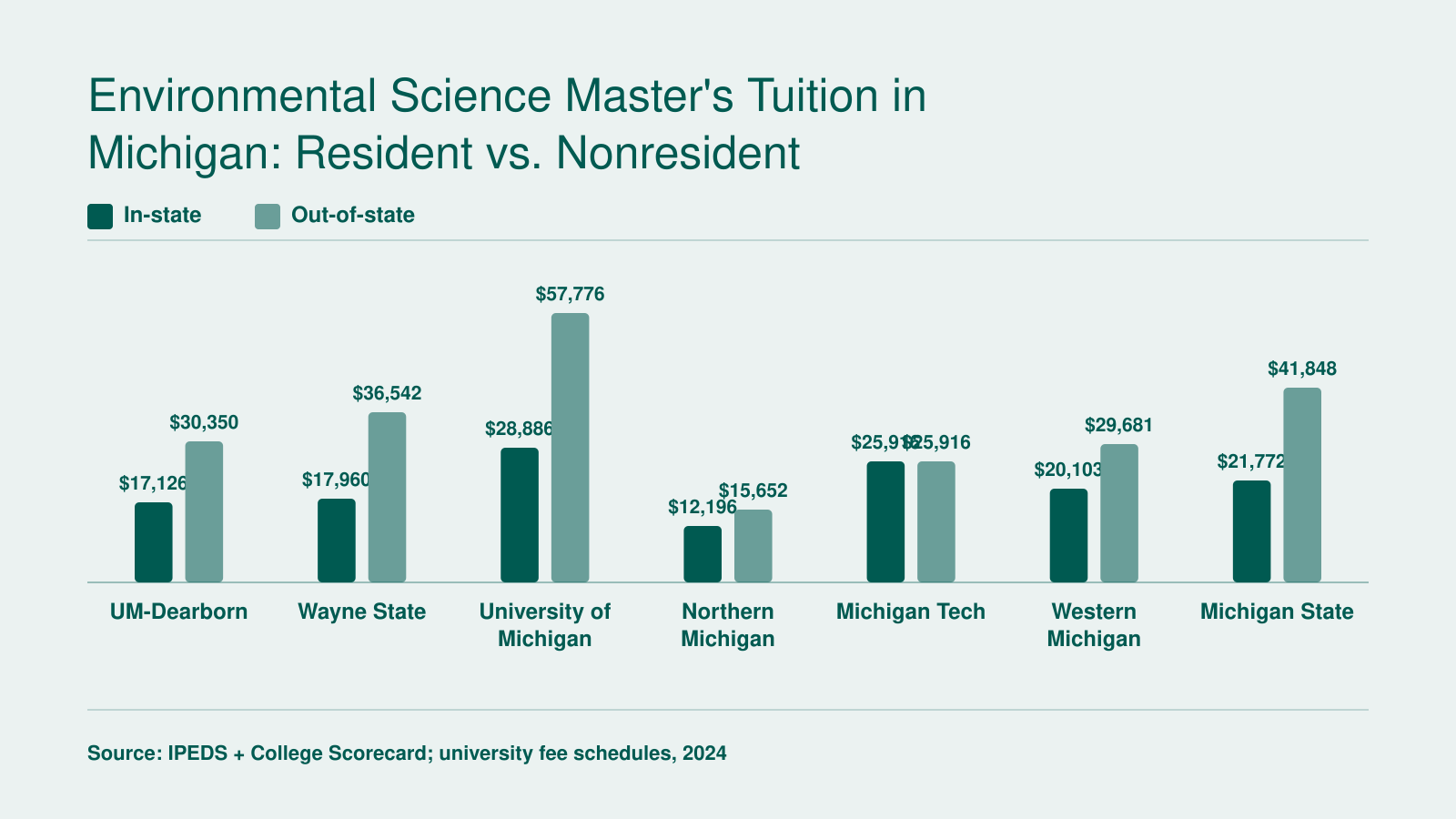
Environmental Science Master's Tuition in Michigan: Resident vs. Nonresident
University of Michigan shows the widest resident/nonresident gap here, about $28,890 ($28,886 in-state vs. $57,776 out-of-state). Northern Michigan University is the lowest-cost option on both counts, at $12,196 in-state and $15,652 out-of-state. Michigan Technological University charges the same figure to both groups. Treat these as program-level estimates, not quotes. Net price figures are institution-wide averages, and actual bills depend on credit load, fees and residency. University of Michigan's 2025-26 fee bulletin lists master's tuition at $8,156 per term for residents and $16,156 for nonresidents (full-time), and applies it regardless of remote instruction. Wayne State lists $832.70 per credit for residents and $1,803.63 for nonresidents, with a discounted out-of-state rate of $1,195.26 for 2026-27. Its online program page cites in-state rates, so confirm that with admissions. Michigan Tech's policy master's offers up to four semesters of tuition assistantships, though stipends are competitive and not guaranteed. Funding terms at other schools were not confirmed, so ask each department.
Michigan Licensure and Certification for Environmental Scientists
Online and Hybrid Master's in Environmental Science Options in Michigan
Which Michigan environmental science master's programs can you actually complete without relocating to campus? Wayne State and the University of Michigan-Dearborn offer the most flexible formats. Among the Best Online Master's in Environmental Science Programs, Wayne State's 30-credit Master of Arts in Environmental Science is listed as fully online with self-paced scheduling and in-state tuition rates. UM-Dearborn's Environmental Science M.S. combines online and campus options with evening and Saturday classes, a thesis or project path, and flexibility for working students, though hands-on research may require some campus time.
Campus and accelerated paths
Most of the remaining programs are campus-based. Michigan Tech's M.S. in Environmental and Energy Policy and M.S. in Environmental Engineering Science each require 30 credits. The Energy Policy degree typically takes two years, while the Engineering Science degree can be completed in about 12 months or three full-time semesters. Michigan Tech also offers accelerated one-year, full-time routes for eligible Michigan Tech undergraduates, allowing up to nine senior-level credits to apply. Those accelerated routes are not clearly open to students from other schools.
Who online suits best
Fully online formats tend to fit mid-career agency staff, regulators, or sustainability managers who need to keep working. Career changers who need lab, field, or thesis research experience should plan for the campus-based programs at Michigan Tech, Michigan State, University of Michigan, Western Michigan, or Northern Michigan.
Related Articles
Which Michigan Environmental Science Master's Programs Waive or Require the GRE?
Most of the programs below no longer require the GRE, and the University of Michigan School for Environment and Sustainability and Michigan State's Earth and Environmental Sciences program no longer accept or consider scores at all. Where a score is optional, as in Michigan State's Environmental Engineering M.S. or encouraged at Michigan Tech, a strong one can help in assistantship competition. Policies and deadlines change, so confirm them on each admissions page. If a program publishes no GRE policy, email its graduate coordinator before you apply.
| School | GRE Policy | Application Deadline | Funding Priority Deadline |
|---|---|---|---|
| University of Michigan, School for Environment and Sustainability M.S. | Not required or accepted | April 30, 2027 (domestic); April 1, 2027 (international) | December 15, 2026 |
| Michigan State University, Earth and Environmental Sciences | Not required or considered | December 31 | December 31 (assistantship consideration) |
| Michigan State University, Environmental Engineering M.S. | Optional (listed standards: 160 quantitative, 150 verbal, 3.0 analytical writing) | December 31 | December 31 (full funding consideration) |
| Michigan Technological University, Environmental Engineering M.S. | Not required, but strongly encouraged during the final bachelor's year | January 15 | No separate deadline published |
| Wayne State University, Environmental and Sustainability Engineering M.S. | Not required | No fixed fall deadline; applications reviewed up to each semester's start | No separate deadline published |
| Western Michigan University, Geography M.S. | Not required | Rolling admission; no fixed fall deadline | February 15 (departmental assistantship) |
Career Outcomes and Earnings for Michigan Environmental Science Master's Graduates
Career outcomes for an environmental science master's come down to two questions: what graduates earn after finishing, and what they borrowed to get there. Program-level federal earnings are published for only some Master's Programs in Michigan, so the evidence is uneven.
Earnings and debt
For the University of Michigan's environmental science master's, graduates earned a median of $59,248 one year after completion and $87,988 four years after finishing. Median debt was $35,377, which works out to about $402 a month on a standard 10-year plan, roughly 8 percent of that first-year median; readers weighing cost can compare these figures with the Most Affordable Master's in Environmental Science Programs. Treat the four-year figure cautiously, since small cohorts can swing.
The School for Environment and Sustainability's own surveys add context. Its Class of 2024 master's graduates reported a median salary of $72,000. Those surveys cover the whole school, and some placement figures blend master's and PhD graduates, so read them as school-wide signals.
Where graduates work
Recent University of Michigan employers include Argonne National Laboratory, Burns & McDonnell, the City of Detroit, Environmental Resources Management, GHD, and General Motors. Michigan Tech's policy program points to the EPA, USDA Forest Service, and UNEP. Available reports do not confirm hiring by EGLE or NOAA GLERL, so ask programs for current alumni lists.
Specialization and roles
- GIS: Wayne State and Northern Michigan both build in geospatial training, which suits mapping and planning roles.
- Water resources: Michigan Tech's focus fits utilities and consulting work.
- Policy: Michigan Tech's policy track leads toward agency and corporate compliance roles.
Frequently Asked Questions About Environmental Science Master's Programs in Michigan
Is a thesis required for an environmental science master's in Michigan?
What can you do with a master's in environmental science in Michigan?
Can I earn a master's in environmental policy in Michigan instead of a science-focused degree?
Compare Environmental Science programs on the data that matters
Explore more Science & Engineering specializations or browse every graduate field.
All Science & Engineering programs