Best Master's in Environmental Science Programs in Pennsylvania
Compare 11 accredited Environmental Science programs in Pennsylvania at 7 schools, with graduate earnings, cost, debt, and completion data from IPEDS and the U.S. College Scorecard.

Pennsylvania offers an Ivy League price tag on one end and a state-system price on the other. Listed tuition runs from $12,479 at Millersville University of Pennsylvania to $47,844 at the University of Pennsylvania.
Between them sit private schools such as Lehigh, Villanova, and Duquesne, plus campus and online formats, all ranked together here.
The degree title also varies. Some programs are environmental science, others ecology, biology, or environmental engineering, and sustainability master's programs are a related choice, so the name on the diploma often matters as much as the price.
Key Points
- Millersville is the one fully online option, and Shippensburg and Millersville charge residents less.
- Penn's Master of Environmental Studies makes the GRE optional, but its M.S. in Earth and Environmental Science requires it.
- Most Pennsylvania environmental jobs need no license, but Professional Geologist licensure requires five years of experience.
Best Master's in Environmental Science Programs in Pennsylvania: 2027 Rankings
This list compares Pennsylvania master's programs on cost, institution-wide graduation rate, delivery format, and graduate outcomes. Graduation rates below describe each school as a whole, not the individual program. Most programs here are campus-based, with one online option and one hybrid.
University of Pennsylvania
#1Philadelphia, PA · ~$48,000/yr (est.)
Best for: Career changers seeking interdisciplinary Ivy coursework
Penn's Master of Environmental Studies is a campus-based program in Philadelphia with concentrations in Environmental Biology, Policy, and Sustainability. Students complete 12 courses over two to four years, with interdisciplinary options across Penn's schools. The university's institution-wide graduation rate is about 97%, and Scorecard data shows median earnings of $83,058 four years after completion. The university is accredited by the Middle States Commission on Higher Education, though the MES itself has no separate programmatic accreditation. Note that the program does not offer institutional financial aid.
- Concentration in Environmental Biology
- 12-course program, completed in 2-4 years
- Full-time or part-time enrollment
- Internship and fieldwork experiences
- Research opportunities included
- Concentration in Environmental Policy
- Interdisciplinary curriculum across multiple Penn schools
- Bachelor's degree required for admission
- Individualized professional coaching
- Concentration in Environmental Sustainability
- Professional development coaching
- Dual degree options available
- Campus-based in Philadelphia
Lehigh University
#2Bethlehem, PA · ~$29,000/yr (est.)
Best for: Aspiring researchers pursuing a thesis
Lehigh in Bethlehem offers a research-oriented M.S. in Earth and Environmental Sciences alongside an Environmental Policy track with planning and justice concentrations. Both paths are campus-based and built around 30 credits. The university's institution-wide graduation rate is about 88%. Lehigh is accredited by the Middle States Commission on Higher Education, and no separate programmatic accreditation was identified for these programs.
- 30 credits including a required thesis
- Research in ecology, biogeochemistry, and geology
- Weekly seminars and an annual research symposium
- Ph.D. also offered in the same department
- 30 credit hours with thesis or coursework options
- Core courses in policy analysis
- Internships for non-thesis tracks
- Financial support available
- Concentration in Environmental Justice
- Focus on policy design and analysis
- Funding through assistantships and scholarships
- Internship required for non-thesis students
Villanova University
#3Villanova, PA · $20,000 – $25,000/yr (est.)
Best for: Students wanting GIS and policy training
Villanova's Master of Science in Environmental Science is a 30-credit campus program with research-thesis, non-thesis portfolio, and capstone routes. Coursework covers GIS, remote sensing, environmental policy, and sustainable systems. The university's institution-wide graduation rate is about 92%. Confirm Villanova's current Middle States accreditation on its accreditation page, as our research did not verify it.
- 30-credit degree on campus
- Thesis, non-thesis portfolio, or capstone tracks
- GIS and remote sensing coursework
- Environmental policy and sustainable systems courses
- Laboratory science electives
- Bachelor's degree required
Bucknell University
#4Lewisburg, PA · ~$30,000/yr (est.)
Bucknell in Lewisburg offers a thesis-based M.S. in Environmental Engineering, a better fit for applicants from engineering or science backgrounds than for general environmental studies. The university's institution-wide graduation rate is about 86%. Check Bucknell's current Middle States listing before applying, as our research did not verify it.
- Campus-based Master of Science
- Original research thesis required
- Bachelor's in engineering or science required
- Environmental engineering focus
Saint Joseph's University - Philadelphia
#5Philadelphia, PA · ~$20,000/yr (est.)
Saint Joseph's University in Philadelphia offers a STEM-designated M.S. in Biology with Ecology and Evolution and Cell and Molecular Biology concentrations. It is a closer match for ecology-minded applicants than for management or policy careers. The university's institution-wide graduation rate is about 79%. Confirm its current Middle States status on the school's accreditation page.
- 30 credits over two years, full-time recommended
- Hybrid format combining online and campus work
- Concentrations in Ecology and Evolution or Cell and Molecular Biology
- Thesis opportunity and teaching assistantships
- Rolling admissions with priority funding deadlines
- Two letters of recommendation and a personal statement
Drexel University
#6Philadelphia, PA · ~$39,000/yr (est.)
Drexel's M.S. in Ecology, Evolution and Earth Systems includes an Environmental Science and Policy concentration, plus tracks in biodiversity, conservation, and earth systems science. Students can study full-time or part-time and choose thesis or non-thesis routes. The university's institution-wide graduation rate is about 78%. Check Drexel's Middle States listing before applying, as our research did not verify it.
- Campus-based, full-time or part-time
- Thesis and non-thesis options
- Environmental Science and Policy concentration
- Prerequisites in biology, chemistry, and calculus
- Fieldwork, sampling, and surveying training
- Deadlines: May 1 international, September 1 domestic
Duquesne University
#7Pittsburgh, PA · $25,000 – $30,000/yr (est.)
Duquesne's Master of Science in Environmental Science and Management in Pittsburgh emphasizes regulatory compliance, pollution prevention, and conservation. Experiential partners include the Pittsburgh Zoo & Aquarium, the U.S. Environmental Protection Agency, and Pittsburgh Parks Conservancy. There is no application fee, and applicants need not hold a science degree. The university's institution-wide graduation rate is about 77%, and Scorecard data shows median earnings of $60,629 four years after completion. Duquesne states Middle States accreditation, but the program has no separate programmatic accreditation.
- 36 credits over about two years
- Focus on regulatory compliance and pollution prevention
- Rolling admissions; no application fee
- GRE required if undergraduate degree is within five years
- Assistantships with stipends and a thesis option
- Concentration in Conservation Biology
- Includes GIS and environmental law courses
- Field studies emphasis
- Internships and thesis option available
- Research concentration with thesis option
- Core courses in environmental chemistry and biology
- Graduate seminar included
- Statement of purpose and recommendation letters required
Temple University
#8Philadelphia, PA · $23,000 – $30,000/yr (est.)
Temple in Philadelphia offers three campus options: an Environmental Engineering M.S. with evening classes, an Environmental Geoscience M.S., and a Sustainability Professional Science Master's. It is the lowest-cost public option on this list for in-state students. The university's institution-wide graduation rate is about 75%. Program listings note Middle States accreditation for the Geoscience and Sustainability degrees.
- 30 credit hours with evening classes
- Thesis, project, or coursework tracks
- Water, wastewater, and hydrology focus
- Part-time study allowed within a five-year limit
- 30 credits, thesis research required
- Full-time two-year format
- Fieldwork, remote sensing, and geophysics
- Climate change topics covered
- 30 credits, full-time in 12 months
- Concentrations: Biodiversity and Conservation, Climate Justice, Energy Resources and Natural Systems
- Interdisciplinary core in sustainability
- Affiliated with the National Professional Science Master's Association
Juniata College
#9Huntingdon, PA · ~$15,000/yr (est.)
Juniata College in Huntingdon offers a Master of Applied Ecology and Natural Resource Management with hands-on research, advanced GIS, and drone applications. No test scores are required for domestic applicants, and there is no application fee. The college's institution-wide graduation rate is about 74%. Check Juniata's Middle States listing before applying, as our research did not verify it.
- Part-time and full-time options
- Thesis or internship required
- Courses in Conservation Biology and Advanced GIS
- Biology and chemistry prerequisites with labs
- No test scores for domestic applicants
Millersville University of Pennsylvania
#10Millersville, PA · $12,000 – $17,000/yr (est.)
Millersville is the one fully online option here: an M.S. in Integrated Scientific Applications with an Environmental Earth Systems Management concentration. It targets water resource, environmental risk, and sustainability management roles. The university's institution-wide graduation rate is about 58%, the lowest on this list. Millersville is accredited by the Middle States Commission on Higher Education, though the program page notes it is under major revisions, so confirm current details with the department.
- Online format
- Minimum 2.75 GPA for admission
- GRE, GMAT, or MAT scores if GPA is below 3.00
- Three recommendation letters and a goals statement
- Water resource and watershed sustainability management
- Environmental policy and law topics
Cost & outcomes by school
Federal data for the highest-earning Environmental Science programs, independent of the ranking above. Earnings are this field's master's graduates four years after completing, where the Scorecard reports them.
| School | Earnings | Tuition / yr | Debt | Grads/yr | Format |
|---|---|---|---|---|---|
| University of Pennsylvania PA | $83,058 | $47,844 | $77,225 | 165 | Campus |
| Duquesne University PA | $60,629 | $27,612 | — | 11 | Campus |
| Millersville University of Pennsylvania PA | — | $12,479 | — | — | Campus |
| Juniata College PA | — | $14,700 | — | — | Campus |
| Lehigh University PA | — | $28,840 | — | — | Campus |
| Villanova University PA | — | $22,335 | — | 6 | Campus |
| Drexel University PA | — | $39,261 | — | 7 | Campus |
Sources: U.S. Department of Education. Tuition and graduates: IPEDS. Earnings and debt: College Scorecard, this field's master's graduates; a dash means no figure is reported.
Cost, debt & payoff
Median earnings of this field's master's graduates (4 yrs after completing) vs. their median federal loan debt · U.S. College Scorecard
Across these programs the median graduate earns about $83,058 and finishes with roughly $77,225 in debt — a ratio that clears a common rule of thumb (keep debt below first-year salary). Tuition and debt vary widely school to school, so check the per-school figures in the table above before you shortlist.
Online and Hybrid Environmental Science Master's Options in Pennsylvania
Pennsylvania offers few online environmental science master's programs. Millersville University of Pennsylvania is the one program here listed as fully online: its Master of Science in Integrated Scientific Applications, with an Environmental Earth Systems Management concentration. It suits working professionals at agencies or consulting firms who want water resource, risk, or policy training without leaving a job. Millersville's page notes the program is under major revisions, so confirm current requirements before applying.
Saint Joseph's University describes its Biology M.S. as hybrid, mixing online and campus work. Every other program among the Master's Programs in Pennsylvania covered here is campus-based, including Penn, Lehigh, Villanova, Drexel, Duquesne, and Juniata.
Campus formats earn their place through access. Drexel highlights fieldwork, sampling, and surveying. Lehigh centers on faculty research. Juniata adds GIS and drone applications. Duquesne and Saint Joseph's both list assistantships, which can offset cost.
One caution: fieldwork-heavy programs may still require some in-person sessions, even when coursework is online or hybrid. Ask each admissions office what residency or field components apply.
Which Pennsylvania Master's Programs Waive or Skip the GRE
At Penn, the Master of Environmental Studies lists the GRE as optional, but the M.S. in Earth and Environmental Science still requires the GRE General Test. The split shows why applicants should check the exact program, not just the university, when comparing master's programs with no GRE required.
Not required or optional
- UPenn MES: GRE optional; MES/JD applicants may submit an LSAT instead.
- Penn State civil and environmental engineering graduate programs: GRE not required, though recommended.
- Drexel environmental engineering M.S.: GRE optional.
- Millersville: test scores needed only if your undergraduate GPA is below 3.00.
Waivable or conditional
- Duquesne environmental science and management: GRE required for applicants who finished undergrad within the last five years, with case-by-case waivers; the subject test is optional.
- Penn State environmental education: GRE or a comparable substitute is required, but provisional admission without scores may be possible at program discretion.1
Required or unpublished
- UPenn Earth and Environmental Science M.S.: GRE General Test required with no published waiver.2
- Shippensburg: the admissions page publishes no clear GRE policy, so do not guess.
Confirm all policies with the admissions office before the deadline, because requirements change and dual-degree pathways may have separate rules.
Related Articles
What a Master's in Environmental Science Costs in Pennsylvania
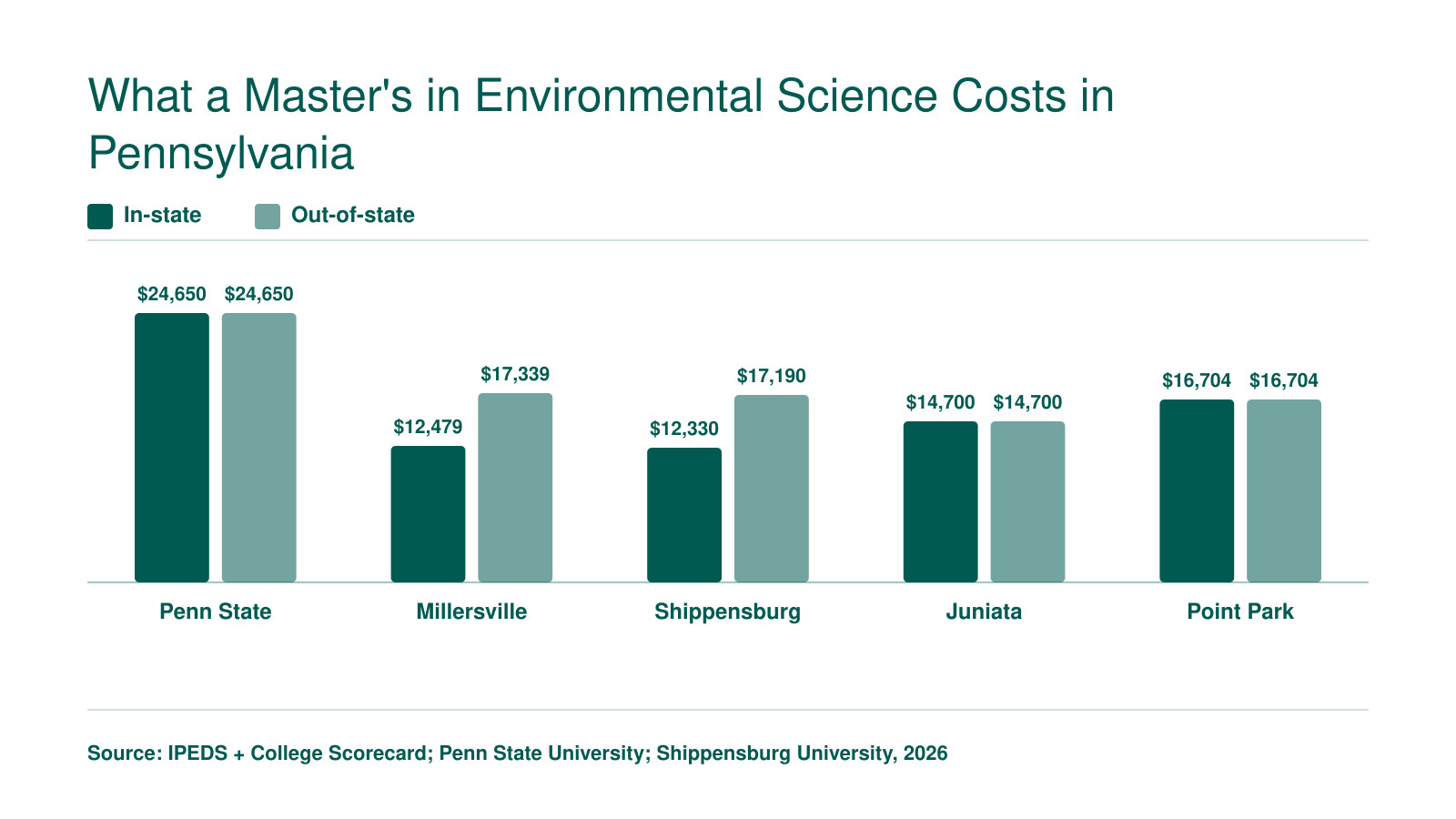
Millersville and Shippensburg charge residents less, listing about $12,330-$12,479 in-state against $17,190-$17,339 out of state. Penn State, Juniata and Point Park list one rate for everyone. To estimate total cost, multiply a school's published per-credit rate by required credits. Shippensburg and Point Park both describe 30-credit programs. Net price after aid is an approximate institution-wide average, from $19,550 at Penn State to $25,942 at Point Park, not an exact quote. On funding, Penn State assistantships are competitive and tied to faculty mentorship, and its Fall 2026 schedule lists a $22,060 academic-year rate for assistantships and fellowships, which is not standard tuition. Ask each department about tuition remission.
Pennsylvania Certification and Licensure for Environmental Science Graduates
Graduate Earnings and Debt at Top Pennsylvania Schools
This table pairs program-level earnings with debt for the schools whose graduates earn the most, using IPEDS and College Scorecard data. Program figures are medians for environmental science master's graduates, measured four years after finishing. School-wide earnings cover all students at the institution, measured ten years after entry, and are shown only as context, not as this program's own outcome. A monthly payment near $878 against $83,058 in earnings is a more manageable ratio than the debt total alone suggests.
| School | Program median earnings (four years after finishing) | Program median debt | Estimated monthly payment (10-year plan) | School-wide median earnings (ten years after entry, context only) |
|---|---|---|---|---|
| University of Pennsylvania | $83,058 | $77,225 | $878 | $111,371 |
| Duquesne University | $60,629 | $74,742 |
Environmental Science vs. Environmental Studies: Choosing the Right Master's
The choice comes down to whether you want to generate environmental data or decide what to do with it. A master's in environmental science emphasizes lab, field, and quantitative work. A studies or management degree leans toward policy, planning, and sustainability.
UPenn's Master of Environmental Studies is a clear example of the studies and management track. It requires 12 course units, including a proseminar, a research methods course, foundation courses, a concentration, and a capstone.1 Its catalog lists no thesis, internship, or portfolio requirement.1
Duquesne's M.S. in Environmental Science and Management shows the science-leaning alternative. Its 2026-2027 catalog lists "2 Internships or Graduate Thesis" as the culminating requirement, so students complete one path, not both.
Completion paths
- Thesis: Best for PhD preparation and research roles.
- Capstone or applied project: Best for consulting and agency work.
- Internships: Useful for building field contacts. Check each program's rules, since requirements differ.
Rule of thumb
Choose science if you want to collect and analyze data. Choose studies or management if you want to shape policy, projects, or organizations.
Admissions Prerequisites and How to Apply
Requirements differ by program, so confirm details on each school's admissions page before you apply.
- Degree and prerequisitesPenn State programs ask for a relevant bachelor's degree. Duquesne does not require a science degree, but it expects general biology and chemistry with labs, environmental science, and calculus or statistics.
- Minimum GPAPenn State's Biological Resources Engineering program calls a 3.00 junior-senior GPA competitive, not a hard cutoff. Duquesne and the University of Pennsylvania state no firm minimum.
- Application materialsExpect transcripts, a statement of purpose or essays, and recommendation letters: three at Penn State, two at Pennsylvania's Master of Environmental Studies. Duquesne's program page says two, though its catalog says three, so confirm. Penn also asks for a résumé.
- DeadlinesPenn State Civil and Environmental Engineering accepts applications on a rolling basis, with December 15 for full fall funding consideration and March 15 otherwise. Penn's fall 2027 priority deadline is December 15, 2026, and its regular deadline is March 15, 2027. Duquesne suggests July 1 for fall and March 1 for aid consideration.
Pennsylvania Environmental Science Master's FAQ
Are Pennsylvania environmental science master's programs STEM-designated for international student OPT?
What jobs can you get with a master's in environmental science in Pennsylvania?
Can you finish a master's in environmental science part-time while working?
Compare Environmental Science programs on the data that matters
Explore more Science & Engineering specializations or browse every graduate field.
All Science & Engineering programs