Best Master's in Environmental Science Programs in Wisconsin
Compare 4 accredited Environmental Science programs in Wisconsin at 3 schools, with graduate earnings, cost, debt, and completion data from IPEDS and the U.S. College Scorecard.

UW-Madison's 15-month hybrid conservation MS charges $1,000 per credit, and several Wisconsin schools offer master's in environmental science programs with no GRE required for applicants with a 3.0 GPA. Wisconsin's Great Lakes shoreline, inland lakes, farmland, and northern forests make that choice concrete.
The ranking weighs cost, debt, and graduate earnings for every eligible Wisconsin program, campus or online. Online and hybrid formats, no-GRE policies, and licensing costs vary enough to change the math, so the real tradeoff is rarely prestige; it is which track fits Wisconsin's water and land-use job market.
Key Points
- UW-Whitewater's Environmental Safety and Health master's is fully online, asynchronous, and open part-time.
- UW-Green Bay's Biodiversity Conservation and Management master's also runs online, and its resident tuition is the lowest listed.
- Wisconsin licenses geologists and hydrologists under Wis. Stat. ch. 470, so check requirements before choosing a track.
Best Master's in Environmental Science Programs in Wisconsin: Our Rankings
Wisconsin's master's options in environmental science range from a hybrid conservation degree and a fully online safety and health program to campus-based freshwater and public health tracks. Several schools list more than one program, so read each card for how the concentrations differ before comparing.
University of Wisconsin-Madison
#1Madison, WI · ~$12,000/yr (est.)
Best for: Aspiring conservation leaders in government or NGOs
The University of Wisconsin-Madison has the strongest institution-wide record in this group, with an overall graduation rate near 90%. Its three listings come from the Nelson Institute and the engineering college and serve different goals: conservation leadership, geospatial data work, and online environmental engineering. Graduates of the conservation program reported median earnings of about $53,300 one year out and about $67,200 four years out, and 95% were employed after one year. Note that the conservation options do not accept transfer credit and are not eligible for standard graduate-assistant tuition remission.
- Hybrid format combining on-campus and online courses
- 15-month program, 32 graduate credits at $1,000 per credit
- Covers conservation planning, environmental policy, and leadership
- Teaches GIS skills and sustainable development topics
- 3.0 GPA minimum; GRE not required at that GPA
- Summer term admission only; STEM OPT eligible
- Focus on remote sensing and geospatial analysis
- Portfolio submission required with application
- GRE optional for applicants with a high GPA
- Same 15-month hybrid structure as the base conservation track
- Two recommendation letters and a statement of interest
- Fully online Master of Engineering degree
- 30 graduate credits at $1,300 per credit
- 2 to 3 years to complete
- Coursework in hydraulics, water treatment, and wastewater treatment
- Waste management and environmental remediation topics
- Requires a bachelor's in engineering or a STEM field
- Fall, spring, and summer admission terms
- Does not support F-1 visas
University of Wisconsin-Whitewater
#2Whitewater, WI · $10,000 – $15,000/yr (est.)
Best for: Working professionals needing asynchronous online study
The University of Wisconsin-Whitewater offers a fully online Master of Science in Environmental Safety and Health with no campus visits and asynchronous coursework. It leans toward risk management and workplace and environmental stewardship rather than field ecology. The school's overall graduation rate is about 59%, and tuition is the lowest per credit of any program listed here.
- Fully online and asynchronous, no campus visits
- 30 to 36 credits, part-time or full-time
- Tuition of $708 per credit, with no residency-based difference
- Requires 20 semester hours in science or related fields
- Resume and application questions instead of a test score
- AACSB accredited
- Risk management focus with environmental stewardship content
University of Wisconsin-Milwaukee
#3Milwaukee, WI · $13,000 – $26,000/yr (est.)
Best for: Aspiring water scientists wanting Lake Michigan fieldwork
The University of Wisconsin-Milwaukee gives students two campus options: a public health route in environmental health and a research-oriented freshwater science degree on Lake Michigan. The school's overall graduation rate is about 49%. The Freshwater Sciences MS also has a 3+2 pathway with Carroll University for students who want a bachelor's and master's in as little as five years.
- 45-credit on-campus Master of Public Health
- Coursework in environmental risk assessment and epidemiology
- Includes field experience and a capstone seminar
- 3.0 GPA minimum for admission
- No online option; cost varies by residency
- Leads toward government and health institution careers
- On-campus MS with professional and thesis tracks
- Professional track requires a 480-hour internship
- Thesis track offers research assistantships
- Covers freshwater ecosystems, climate change impacts, and water policy
- Hands-on fieldwork and lab training
- 3+2 partnership with Carroll University
University of Wisconsin-Green Bay
#4Green Bay, WI · ~$10,000/yr (est.)
The University of Wisconsin-Green Bay runs a campus-based Master of Science in Environmental Science and Policy with small classes and direct ties to agencies such as the U.S. Fish and Wildlife Service, the U.S. EPA, and the Wisconsin DNR. Students do field and lab work in natural areas across northeastern Wisconsin. The school's overall graduation rate is about 48%, and program graduates reported median earnings of about $48,000 one year out and $55,200 four years out.
- Three concentrations: Ecosystems Studies, Environmental Policy and Administration, Environmental Technology and Analysis
- Thesis, internship, and course-based completion options
- No GRE required
- 3.0 GPA and an introductory statistics course required
- Two recommendation letters and a statement of interest
- Part-time and full-time study available
- Accelerated bachelor's/master's pathway offered
Cost & outcomes by school
Federal data for the highest-earning Environmental Science programs, independent of the ranking above. Earnings are this field's master's graduates four years after completing, where the Scorecard reports them.
| School | Earnings | Tuition / yr | Debt | Grads/yr | Format |
|---|---|---|---|---|---|
| University of Wisconsin-Madison WI | $67,161 | $12,325 | $28,394 | 33 | Hybrid |
| University of Wisconsin-Green Bay WI | $55,232 | $10,244 | $28,084 | 7 | Campus |
| University of Wisconsin-Milwaukee WI | — | $12,728 | — | — | Campus |
Sources: U.S. Department of Education. Tuition and graduates: IPEDS. Earnings and debt: College Scorecard, this field's master's graduates; a dash means no figure is reported.
Cost, debt & payoff
Median earnings of this field's master's graduates (4 yrs after completing) vs. their median federal loan debt · U.S. College Scorecard
Across these programs the median graduate earns about $67,161 and finishes with roughly $28,394 in debt — a ratio that clears a common rule of thumb (keep debt below first-year salary). Tuition and debt vary widely school to school, so check the per-school figures in the table above before you shortlist.
Online and Hybrid Environmental Science Master's Programs in Wisconsin
Yes, but the choices among online master's in environmental science programs are narrow. UW-Whitewater's Environmental Safety and Health master's is fully online and asynchronous, with no campus visits, and you can enroll part-time or full-time. UW-Green Bay's Biodiversity Conservation and Management master's also runs 100% online with no on-campus meetings.1 Its capstone includes fieldwork, which students may arrange through a current employer or an outside organization.
UW-Madison's Environmental Conservation MS is sometimes billed as hybrid, but plan on being in Madison. The 15-month, 32-credit program opens with a two-week intensive with field trips and continues with in-person fall and spring coursework. It ends with a 4-credit independent practice at a project site and a leadership experience of at least eight weeks. UW-Milwaukee's Environmental Health Sciences MPH is campus-only. UW-Green Bay's Environmental Science and Policy degree is campus-based but allows part-time study.
For working professionals, the takeaway is simple. If you cannot relocate or step back from your job, the Whitewater and Green Bay online master's programs in Wisconsin are the realistic paths. Most other options here expect regular time on campus.
Which Wisconsin Master's Programs Waive or Make the GRE Optional?
Policies below follow each school's 2026 admissions pages, so confirm them before you apply. Funding deadlines often come earlier than final deadlines, so check the priority date if you want assistantship or fellowship consideration. Even when the GRE is optional, strong scores can still help a funding application, and UW-Madison says so for its university fellowships.
| School | Program | GRE Policy | Fall Application Deadline |
|---|---|---|---|
| University of Wisconsin-Madison | Environment and Resources, MS | Not required, but may be considered if available; recommended for applicants seeking university fellowship consideration | December 1 |
| University of Wisconsin-Madison | Environmental Conservation, MS | Required if undergraduate GPA is below 3.0; not required at 3.0 or above | Priority: December 1; final international: February 1; final domestic: May 1 |
| University of Wisconsin-Green Bay | Environmental Science and Policy, MS | Not required | Not confirmed here; check the program admissions page |
| University of Wisconsin-Milwaukee | Environmental master's program | No published policy found for an environmental program (the Chemistry and Biochemistry page says the GRE is no longer a prerequisite, but that does not set policy for this program) | Not confirmed here; check the program admissions page |
Related Articles
How Much a Master's in Environmental Science Costs in Wisconsin, Plus Licensure to Plan For
Cost varies more by residency than by school name in Wisconsin, and several of the programs below offer meaningful discounts through reciprocity or regional exchange programs, discounts worth comparing against the most affordable master's in environmental science programs list.
Tuition by Residency
For Wisconsin residents, UW-Green Bay has the lowest listed program tuition at about $10,244, followed by UW-Whitewater at $10,543 and UW-Madison at $12,325. UW-Milwaukee is the priciest at about $12,728. Nonresident students see a wider gap: UW-Green Bay remains the most affordable at $20,229, UW-Whitewater is $21,603, UW-Madison is $25,651, and UW-Milwaukee is $26,159.
These sticker prices do not include aid. Aid lowers the average campuswide net price, but that figure is institution-wide, not specific to environmental science master's programs. UW-Green Bay averages about $13,369, UW-Whitewater about $14,158, UW-Milwaukee about $15,014, and UW-Madison about $17,354.
Ways to Lower the Real Price
Minnesota residents may qualify for Minnesota-Wisconsin Tuition Reciprocity at UW-Madison, UW-Green Bay, and UW-Milwaukee, but only in qualifying or approved programs, so verify with the department. UW-Green Bay also lists the Midwest Student Exchange Program for graduate students from Indiana, Kansas, Missouri, Nebraska, North Dakota, and Ohio; MSEP caps nonresident tuition at 150 percent of resident tuition.1 Assistantships and tuition remission can lower costs further, but none of these programs guarantees those awards, so ask before enrolling.
Licensing to Plan For
Most environmental science master's careers do not require a Wisconsin state license. Credentials become relevant in specialized paths: geology, hydrology, soil science, and wastewater or drinking water operator roles. If you plan to sit for one of those, compare coursework now so the program supports the specific eligibility path.
Wisconsin Credentials for Environmental Science Graduates
Career Outcomes and Graduate Earnings by Program
Figures below come from IPEDS and College Scorecard (2024), U.S. Department of Education. Earnings are program-level medians measured four years after finishing, and debt is the program-level median among completers. Earnings at this level are typical of roles such as environmental consultant, DNR scientist, sustainability coordinator, and water resources specialist, though pay varies by employer, region, and experience.
| School | Program | Median earnings (four years after finishing) | Median debt (completers) |
|---|---|---|---|
| University of Wisconsin-Madison | Environmental Conservation MS | $67,161 | $28,394 |
| University of Wisconsin-Green Bay | Environmental Science and Policy | $55,232 | $28,084 |
| University of Wisconsin-Whitewater | Environmental Safety and Health | N/A | N/A |
| University of Wisconsin-Milwaukee | Environmental Health Sciences, MPH | N/A | N/A |
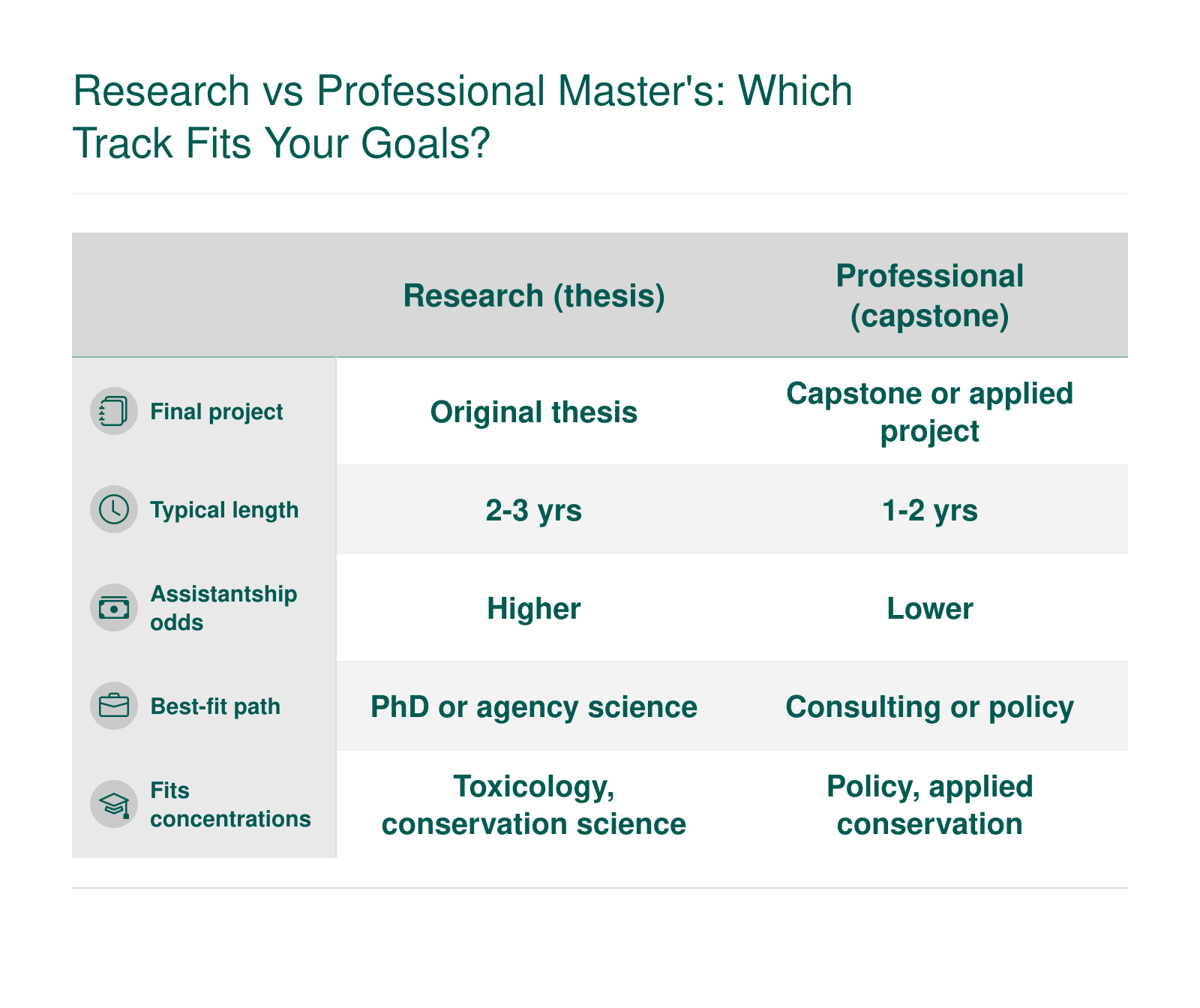
Research vs Professional Master's: Which Track Fits Your Goals?
Many environmental science master's programs in Wisconsin offer both a thesis route and a professional or capstone route. The right choice depends on whether you want to keep doing original research or move quickly into practice. Check each program's current requirements, since options vary by school and concentration.
Common Questions About Environmental Science Master's Programs in Wisconsin
Which Wisconsin environmental science master's program is best overall?
Can I earn an environmental science master's in Wisconsin while working full time?
What careers can I pursue with a master's in environmental science?
Is an environmental toxicology master's different from environmental science?
Compare Environmental Science programs on the data that matters
Explore more Science & Engineering specializations or browse every graduate field.
All Science & Engineering programs