Best Master's in Environmental Science Programs in Idaho
Compare 7 accredited Environmental Science programs in Idaho at 3 schools, with graduate earnings, cost, debt, and completion data from IPEDS and the U.S. College Scorecard.

Environmental scientists in Idaho study soil, water, air, and ecosystems to inform decisions about public lands, drought and irrigation, wildfire recovery, and agricultural runoff. Much of the state is federally managed, so demand for this work runs through agencies, consulting firms, and resource-management offices rather than any single industry.
Graduate programs cluster at Idaho's public universities, where in-state tuition for an environmental science master's runs from roughly $8,600 to $11,500 a year. Residency drives that figure, and out-of-state rates climb well past $27,000.
In a field this small, where you study and whether you pay resident rates shape the return more than program prestige does.
Key Points
- University of Idaho offers the state's only clear online environmental science master's.
- Residency creates the biggest tuition gap in Idaho's environmental science master's programs.
- Idaho had 620 environmental scientists in May 2023; mean wage $74,220.
Best Master's in Environmental Science Programs in Idaho, Ranked
Idaho has only a small number of graduate programs in environmental science, so format and tuition choices carry real weight. The University of Idaho offers the state's clearest dedicated environmental science master's, with online and Moscow-based options, while Boise State and Idaho State deliver related environmental management and science-and-management degrees. Comparing tuition, net price, and program focus below can help you identify the strongest return.
University of Idaho
#1Moscow, ID · $10,000 – $15,000/yr (est.)
Best for: Dedicated environmental science students wanting online flexibility
University of Idaho is home to the state's clearest dedicated environmental science master's, offered through a 30-credit M.S. with campus and online delivery. Admission asks for a bachelor's degree, a 3.0 GPA, three references, and no GRE. Related Master of Natural Resources options add concentrations in Integrated Natural Resources, Fire Ecology and Management, and Environmental Education and Science Communication. Federal data show a median salary of $92,396 four years after completing the environmental science master's.
- 30 credits required
- Campus and online options
- 3.0 GPA admission requirement
- No GRE required
- Three references required
- Two-year typical completion
- Sustainability-focused interdisciplinary curriculum
- Financial aid available
Idaho State University
#2Pocatello, ID · ~$12,000/yr (est.)
Best for: Campus learners seeking science and management depth
Idaho State University offers a campus-based Master of Science in Environmental Science and Management that requires at least 30 credits and gives students thesis or non-thesis paths. Admission prerequisites include MATH 1160 and CHEM 1111/1112 with a C or better, and students choose an academic emphasis such as chemistry or environmental engineering. The university also lists a Master of Science in Environmental Engineering and a geology master's with an environmental geoscience emphasis. In the latest federal data, one student completed the environmental science and management master's.
- 30 credits required
- Thesis or non-thesis option
- Prerequisites: MATH 1160, CHEM 1111/1112
- Minimum 15 credits at 6600 level
- Emphasis areas include chemistry and environmental engineering
- Interdisciplinary advisory committee guidance
- Thesis path: 30 credits
- Non-thesis path: 33 credits
- Minimum GPA: 2.5
- GRE required for some applicants
- Oral exam for non-thesis option
- Part of College of Science and Engineering
- 9 additional environmental credits
- No GRE required
- $60 application fee
- Three recommendation letters
- Letter of intent required
- Covers hydrology and geochemistry
- Includes hazard assessment
Boise State University
#3Boise, ID · $10,000 – $15,000/yr (est.)
Best for: Students comparing environmental management concentrations
Boise State's Master of Environmental Management is a campus-based program built around a 10-credit core, with concentrations in Human Dimensions, Biophysical Dimensions, and Research Track. Each track includes experiential learning and requires a bachelor's degree for admission. The Research Track adds a thesis, while the Biophysical and Human Dimensions options emphasize scientific solutions and human-environment interaction.
- Human Dimensions concentration
- Focus on human-environment interaction
- Experiential learning included
- 10 core credits required
- Bachelor's degree admission requirement
- Biophysical Dimensions concentration
- Science-focused curriculum
- Core courses: MEM 500, 501, 598, 692
- Data analysis methods taught
- Environmental preservation emphasis
- Research Track concentration
- Thesis requirement included
- Focus on environmental data collection
- Practical skills development
- Financial aid available
Cost & outcomes by school
Federal data for the highest-earning Environmental Science programs, independent of the ranking above. Earnings are this field's master's graduates four years after completing, where the Scorecard reports them.
| School | Earnings | Tuition / yr | Debt | Grads/yr | Format |
|---|---|---|---|---|---|
| University of Idaho ID | $92,396 | $10,816 | — | 56 | Online or campus |
| Boise State University ID | — | $10,803 | — | — | Campus |
| Idaho State University ID | — | $11,522 | — | — | Campus |
Sources: U.S. Department of Education. Tuition and graduates: IPEDS. Earnings and debt: College Scorecard, this field's master's graduates; a dash means no figure is reported.
Online and Hybrid Master's in Environmental Science Options in Idaho
Only one master's in environmental science among Master's Programs in Idaho clearly offers an online route: the University of Idaho M.S. in Environmental Science. Boise State University's Master of Environmental Management and Idaho State University's Master of Science in Environmental Science and Management are both campus-based.
How the University of Idaho online track works
The online option is non-thesis. It requires at least 30 credits: 27 of coursework plus at least 3 of ENVS 5990. The thesis path is campus-based, offered in Moscow and Coeur d'Alene, and needs 6 to 10 thesis credits. The university describes the non-thesis degree as a fully Online Master's in Environmental Science. Its published materials do not describe a separate residency or campus visit, and they do not say whether any course involves fieldwork, so ask the program directly.
Online students design a study plan with an advisor, and the catalog says graduate programs are built with a major professor and supervisory committee. No online-specific matching process is described. Expect to confirm who your advisor will be early.
For 2026-27, online tuition is $649 per credit plus a $35 per credit web fee, and the rate is the same for residents and nonresidents.
A tip for working professionals
Choose online non-thesis if you want a credential on your own schedule. Choose campus if you want a thesis, since research degrees depend on a faculty member agreeing to advise you.
Thesis vs. Non-Thesis Master's in Environmental Science: Which Path Fits?
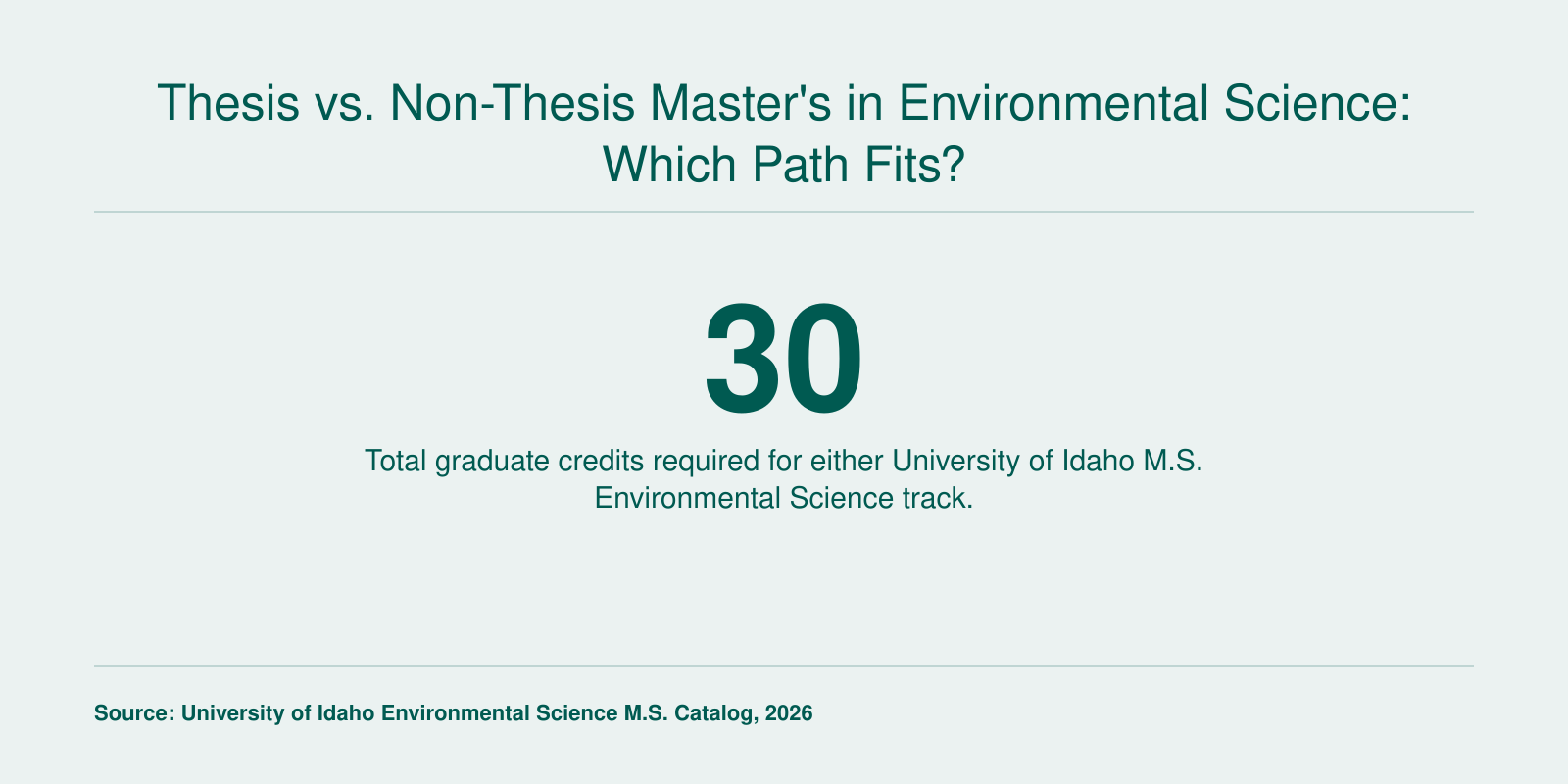
At the University of Idaho, the M.S. in Environmental Science offers a thesis and a non-thesis route. Both require at least 30 graduate credits. Thesis students complete 24 credits of coursework plus 6 to 10 credits of original research on campus, while non-thesis students complete 27 credits of coursework plus a 3-credit applied project online or on campus. Choose thesis if you plan to pursue a PhD or research career. Choose non-thesis if you are a working professional targeting agency, industry, or consulting work.
Which Idaho Master's in Environmental Science Programs Waive or Make the GRE Optional?
GRE requirements differ by school; some programs below do not require the exam, but confirm current policy before applying.
- University of Idaho, GRENot required for the M.S. in Environmental Science. A bachelor's degree and a 3.0 GPA are standard. Fall 2026: Jan. 15 priority, May 1 final; spring: Sept. 1 priority, Oct. 1 final.
- Boise State University, GREThe MEM does not list the GRE among required materials. Requires a bachelor's degree, 3.0 GPA, letter, three recommendations, and transcripts. Fall 2026: Jan. 15 priority, Apr. 10 final; spring: Sept. 15 priority, Nov. 15 final.
- Idaho State University, GREIdaho State University does not publish a current program-level GRE policy in the materials reviewed. Program-specific GPA and deadlines are also not clearly stated; confirm directly with the program.
- Common application materialsOfficial transcripts, recommendation letters, and a statement of purpose are typically required. International applicants may need TOEFL 79 or IELTS 6.5 at University of Idaho.
- Prerequisites and thesis advisorScience and math preparation is common, but specific prerequisite lists aren't published for every program. Thesis-track applicants should contact faculty early; advisor commitment may be encouraged.
Related Articles
What a Master's in Environmental Science Costs in Idaho, Plus Licensure and Certification
Tuition for Idaho's public environmental science master's programs turns heavily on residency, and the dollar gap between in-state and out-of-state rates is the single biggest cost variable to plan around.
Tuition and Residency
At Idaho State, resident tuition and fees run about $11,522 a year against $30,632 for nonresidents, a residency gap near $19,000. University of Idaho's resident tuition and fees run about $11,796 a year against $31,272 for nonresidents; its online environmental science rate is a flat $649 per credit plus a $35 per-credit web-course fee across the 30-credit program. Boise State charges about $10,803 for residents and $29,543 for nonresidents.
Institution-wide average net price after aid is lower still: roughly $12,200 at Idaho State, $14,800 at University of Idaho, and $21,600 at Boise State. Treat these as broad averages, not program quotes, when comparing affordable environmental science master's programs.
Funding and Licensure
- Assistantships: Graduate teaching or research assistantships often carry tuition waivers, though no program-specific amount is published.
- WRGP: University of Idaho lists the thesis track as WRGP-eligible, and Boise State offers resident rates to qualifying WICHE-state residents with a 3.30 GPA.1
Idaho has no general environmental scientist license. The most relevant credential is the Professional Geologist license through the Idaho Board of Professional Geologists, which requires the Fundamentals of Geology (ASBOG) exam, 30 semester units of geological science (24 upper-level), a $100 application fee, and a $20 certification fee.2
Idaho had 620 people working as environmental scientists and specialists (including health) in May 2023, according to the U.S. Bureau of Labor Statistics. The occupation's mean annual wage was $74,220. It's a small, specialized field, so a master's degree and local connections can matter.
Career and Salary Outcomes for Idaho Environmental Science Master's Graduates
Environmental science hiring in Idaho is increasingly tied to water, wildfire, and public-lands work, so master's graduates often land in agency, consulting, and natural resource roles rather than a single dominant industry. Among the schools here, University of Idaho offers the clearest published earnings figure. Its environmental science master's graduates reported median earnings of $92,396 four years after finishing and $68,029 five years after finishing. Those figures point to strong environmental science master's salary and career outcomes relative to the region's cost of living.
Typical Idaho career paths for these graduates include state and federal agencies such as the Idaho Department of Environmental Quality and the U.S. Forest Service, environmental consulting firms, water and natural resource management districts, and national laboratory research around Idaho Falls. Boise State's human-dimensions emphasis and Idaho State's environmental science and management track feed into many of those same conservation, compliance, and land-management positions. For prospective students, the key is to treat the earnings figure as one part of a wider value calculation that includes tuition, location, and the specific agency or consulting track you want. The program you choose should fit the sector you want to enter, not just the headline salary.
Compare Environmental Science programs on the data that matters
Explore more Science & Engineering specializations or browse every graduate field.
All Science & Engineering programs