Best Master's in Environmental Science Programs in Colorado
Compare 7 accredited Environmental Science programs in Colorado at 3 schools, with graduate earnings, cost, debt, and completion data from IPEDS and the U.S. College Scorecard.

Colorado is one of the few states where water-rights law, federal land management, and the energy transition can all be studied within a day's drive of campus. The Colorado River basin, public lands, and mountain ecosystems serve as working labs.
The tension is cost against fit. Annual tuition in the programs here runs from under $10,000 to over $40,000, and some degrees are research-heavy while others lean toward policy; students comparing the most affordable master's in environmental science programs should weigh those same differences.
The ranking combines campus and online programs, so thesis tracks and professional degrees can be weighed side by side.
Key Points
- CU Denver charges Colorado residents $9,298; University of Denver reaches $42,173.
- University of Denver offers an online Environmental Policy and Management master's.
- CU Boulder's Environmental Studies master's program is GRE optional.
Best Master's in Environmental Science Programs in Colorado: 2027 Rankings
Colorado places environmental science graduate students within reach of state agencies, federal labs, mountain communities, and a growing sustainability sector. The programs below stand out for their mix of research depth, applied capstones, and affordability.
University of Colorado Boulder
#1Boulder, CO · $15,000 – $20,000/yr (est.)
Best for: Colorado-bound sustainability professionals wanting agency projects
CU Boulder combines a research-oriented Environmental Studies MS with a professional Master of the Environment focused on applied capstones. The MENV program connects students directly with Colorado state agencies, municipalities, and mountain communities through projects on decarbonization, electrification, and climate adaptation. Graduate programs are campus based and draw on a broad natural and social science faculty.
- 30 credit hours required
- Campus-based program
- Thesis defense required
- Focus on interdisciplinary perspectives
- Includes natural and social sciences
- Ethics and policy coursework
- Original research project
- Guidance committee support
- Two-year program length
- Campus-based delivery
- 48 credit hours total
- Environmental and Natural Resources Policy concentration
- Core courses and specialization required
- Capstone project component
- Interdisciplinary curriculum
- Real-world applicability
- Renewable and Sustainable Energy concentration
- Five specializations available
- Capstone project included
- Hands-on training
- Leadership development focus
- Sustainability and energy sector emphasis
- Sustainability in the Outdoor Industry concentration
- Cohort-based immersive experience
- Capstone project with partners
- Workshops and field trips offered
- Funding opportunities available
University of Denver
#2Denver, CO · ~$42,000/yr (est.)
Best for: Working professionals needing online no-GRE format
The University of Denver offers a flexible online MS in Environmental Policy and Management with concentrations in environmental management and a customizable flex path. It does not require the GRE or GMAT and uses 10-week terms, with a free application and an 18-month potential completion time. A campus MA in Global Environmental Sustainability adds an interdisciplinary option.
- Online format
- 48 credit hours
- $859 per credit
- No GRE or GMAT required
- Free application
- 18 months duration
- 10-week terms
- Environmental Management concentration
- Customizable curriculum
- 12 courses total
- 4 core courses
- 5 concentration courses
- 3 elective courses
- Capstone project option
- Flexible course selection
- Advisor support available
- Campus-based program
- Interdisciplinary approach
- Prepares for global careers
- Undergraduate degree required
- Focus on sustainability impact
Colorado State University-Fort Collins
#3Fort Collins, CO · ~$14,000/yr (est.)
Best for: Online learners wanting sustainability concentrations
Colorado State University offers both a campus MS in Ecosystem Sustainability and an online PSM in Ecosystem Science and Sustainability with concentrations in carbon management, climate adaptation, and sustainable food systems. The PSM includes an internship component and can be completed in three semesters. Students can access graduate assistantships and financial aid through the university.
- On-campus program format
- Focus on ecosystem science
- Addresses real-world sustainability issues
- Develops leadership in sustainability
- Collaborative partnerships emphasized
- Graduate teaching assistantships possible
- Online with in-person component
- 36 credits required
- $733 per credit tuition
- Minimum 3.0 GPA required
- No GRE required
- Three semesters completion time
- Concentrations in Carbon Management, Climate Adaptation, and Sustainable Food Systems
- Includes internship experience
Regis University
#4Denver, CO · ~$24,000/yr (est.)
Regis University's MS in Environmental Biology is a campus program in Denver with both a 10-month intensive track and a two-year option. The curriculum emphasizes fieldwork, scientific writing, and data analysis, with tuition at $835 per semester hour. New students may qualify for a Dean's Scholarship of up to $5,000.
- 10-month intensive option
- Two-year program available
- Campus-based learning
- Tuition $835 per semester hour
- Fieldwork required
- Externship or research
- 35 semester hours total
- Faculty with doctorates
University of Colorado Denver/Anschutz Medical Campus
#5Denver, CO · $5,000 – $10,000/yr (est.)
CU Denver offers a campus MS in Environmental Sciences with thesis and non-thesis options and concentrations in climate systems, ecosystems, and environmental policy and management. The program emphasizes hands-on study and prepares graduates for roles at agencies such as the EPA and private consulting firms. Financial aid may include assistantships and internships.
- 36 credit hours required
- Thesis or non-thesis options
- Climate Systems concentration
- Core courses in sustainability
- Electives in air quality
- Hands-on study emphasis
- Internships encouraged
- Focus on ecosystems concentration
- Minimum GPA of 3.0 required
- Prerequisites in natural sciences
- Graduate-level courses only
- Hands-on research opportunities
- B or better in core courses
- Independent study allowed
- Multidisciplinary curriculum
- Focus on policy and management
- Minimum B grade in core courses
- Admissions require science background
- Program director: Gregory Simon
- Career opportunities in consulting
- Electives from approved list
Western Colorado University
#6Gunnison, CO · ~$16,000/yr (est.)
Western Colorado University's Master in Environmental Management is a hybrid program with concentrations in global sustainability, integrated and public lands, and sustainable and resilient communities. It does not require the GRE and includes project-based fieldwork across the Rocky Mountain region, with particular relevance for public lands and rural community careers. Financial support may include fellowships and grants.
- Hybrid program format
- Global Sustainability concentration
- No GRE required
- Bachelor's degree prerequisite
- Hands-on experiential learning
- Financial aid available
- Interdisciplinary curriculum
- Focus on climate change
- Integrated and Public Lands concentration
- Bachelor's degree prerequisite
- Total cost around $42,388
- Includes in-person intensives
- Hands-on project work
- Focus on land management careers
- Financial aid options
- Admissions open year-round
- Sustainable and Resilient Communities concentration
- Approximately 46 credit hours
- Tuition $847 per credit
- Bachelor's degree required
- 3.0 GPA recommended
- Statement of purpose needed
- Two recommendation letters
- Core coursework included
Colorado State University Pueblo
#7Pueblo, CO · ~$10,000/yr (est.)
Colorado State University Pueblo offers a campus MS in Biology with an environmental concentration, preparing students for research, industry, and education roles. The program includes thesis or internship options and requires the GRE for admission. Competitive tuition and scholarship opportunities support a range of students.
- Environmental concentration available
- Campus-based learning format
- Thesis or internship options
- Hands-on learning emphasized
- GRE required for admission
- Competitive tuition costs
- Scholarships available
- Prepares for research careers
Cost & outcomes by school
Federal data for the highest-earning Environmental Science programs, independent of the ranking above. Earnings are this field's master's graduates four years after completing, where the Scorecard reports them.
| School | Earnings | Tuition / yr | Debt | Grads/yr | Format |
|---|---|---|---|---|---|
| University of Colorado Boulder CO | $81,568 | $16,634 | $57,931 | 97 | Campus |
| University of Colorado Denver/Anschutz Medical Campus CO | $77,438 | $9,298 | — | 14 | Campus |
| Colorado State University-Fort Collins CO | $69,954 | $14,125 | $22,600 | 56 | Hybrid |
Sources: U.S. Department of Education. Tuition and graduates: IPEDS. Earnings and debt: College Scorecard, this field's master's graduates; a dash means no figure is reported.
Cost, debt & payoff
Median earnings of this field's master's graduates (4 yrs after completing) vs. their median federal loan debt · U.S. College Scorecard
Across these programs the median graduate earns about $77,438 and finishes with roughly $57,931 in debt — a ratio that clears a common rule of thumb (keep debt below first-year salary). Tuition and debt vary widely school to school, so check the per-school figures in the table above before you shortlist.
Online and Hybrid Master's in Environmental Science Options in Colorado
Much of the coursework in the best online master's in environmental science programs can be completed away from campus, though the field rarely goes fully remote. The University of Denver's Master of Science in Environmental Policy and Management (Environmental Management concentration) is the clearest online option, with 10-week terms and evening or online delivery. Its page does not say whether sessions are synchronous. Western Colorado University's Master in Environmental Management is hybrid and includes fieldwork, but residency details are not spelled out.
Colorado State University's Professional Science Master's in Ecosystem Science and Sustainability is online with an in-person component.1 Students attend a five-day field experience in their first fall semester (August 17 to 21, 2026). The ESS 500 course adds required field trips, two overnights at the CSU Mountain Campus, and a course fee. Part-time availability and scheduling style are not established. CU Denver's 36-credit MS in Environmental Sciences mixes on-campus, hybrid, and online courses, includes lab and field work, and allows part-time study.
Several programs stay on campus. Regis University's environmental biology master's has no online option and requires fieldwork. CU Boulder's MS in Sustainable Engineering is on-campus only, and Colorado State University Pueblo's biology master's with an environmental concentration is campus-based.
Online master's programs in Colorado fit working professionals at state agencies or consulting firms who can set aside a few days for field blocks.
Which Colorado Master's in Environmental Science Programs Waive the GRE?
Test-optional and test-required programs sit side by side in Colorado, so the GRE matters a great deal or not at all depending on which No-GRE master's programs you apply to.
No GRE Needed or Optional
- University of Colorado Boulder: The Environmental Studies MS does not consider GRE scores, a policy shared by many Master's in Environmental Science Programs With No GRE Required. Fall 2027 deadlines are December 1, 2026 for international applicants and December 15, 2026 for domestic applicants.
- University of Denver: The online MS in Environmental Policy and Management lists no GRE or GMAT requirement. DU's MA in Global Environmental Sustainability also makes scores optional and gives full consideration to applications without them.1
- CU Denver: GRE scores are optional, though they may help an application that is light on academic record or professional experience. Admission is fall only, with a February 1 priority deadline and an August 1 final deadline.
- Western Colorado University: The hybrid Master in Environmental Management does not require the GRE.
Required or Not Published
- Colorado State University Pueblo: The Biology MS with an environmental concentration requires the GRE.
- Colorado State University-Fort Collins: The Ecosystem Sustainability M.S. page publishes no GRE policy and directs applicants to the department.
- Regis University: Program materials list a bachelor's degree, a recommended 3.0 GPA and prerequisite courses, but publish no GRE policy.
Test policies change from cycle to cycle, so confirm the current rule and deadline directly with the program before you register for an exam.
Related Articles
Cost, Financial Aid, and Colorado Licensure or Certification
The real question about the cost of a master's in environmental science is less about the lowest sticker price than about which program you can afford once funding is factored in.
Tuition Ranges
Graduate tuition for Colorado residents runs from $9,298 at CU Denver1 to $42,173 at the University of Denver, a private school that charges everyone the same rate. CSU Pueblo ($10,064 in-state) sits close behind CU Denver. For nonresidents, Western Colorado University is lowest at a flat $15,550, and DU is again highest.
Program pricing can differ from institution figures. Regis lists $835 per credit hour for its 35-hour environmental biology degree. DU's online environmental policy and management master's lists $859 per credit across 48 credits, roughly $41,000 before fees. CSU says its professional master's in ecosystem science and sustainability can cost as little as $16,000 a year for residents, plus a $1,250-per-semester differential fee.2
Funding Routes
- WRGP: CU Denver and CSU bill eligible WICHE-state residents at the resident rate.12 CSU estimates savings near $15,000 a year, for newly admitted students in approved programs only.2
- Assistantships: CU Denver offers teaching assistantships, usually decided by late spring or early summer, and research assistantships typically arranged with faculty after enrollment. CSU's professional track sets none aside.2
Licensure
Colorado issues no single "environmental scientist" license. The credentials that matter are covered in the box below.
Colorado Credentials for Environmental Science Professionals
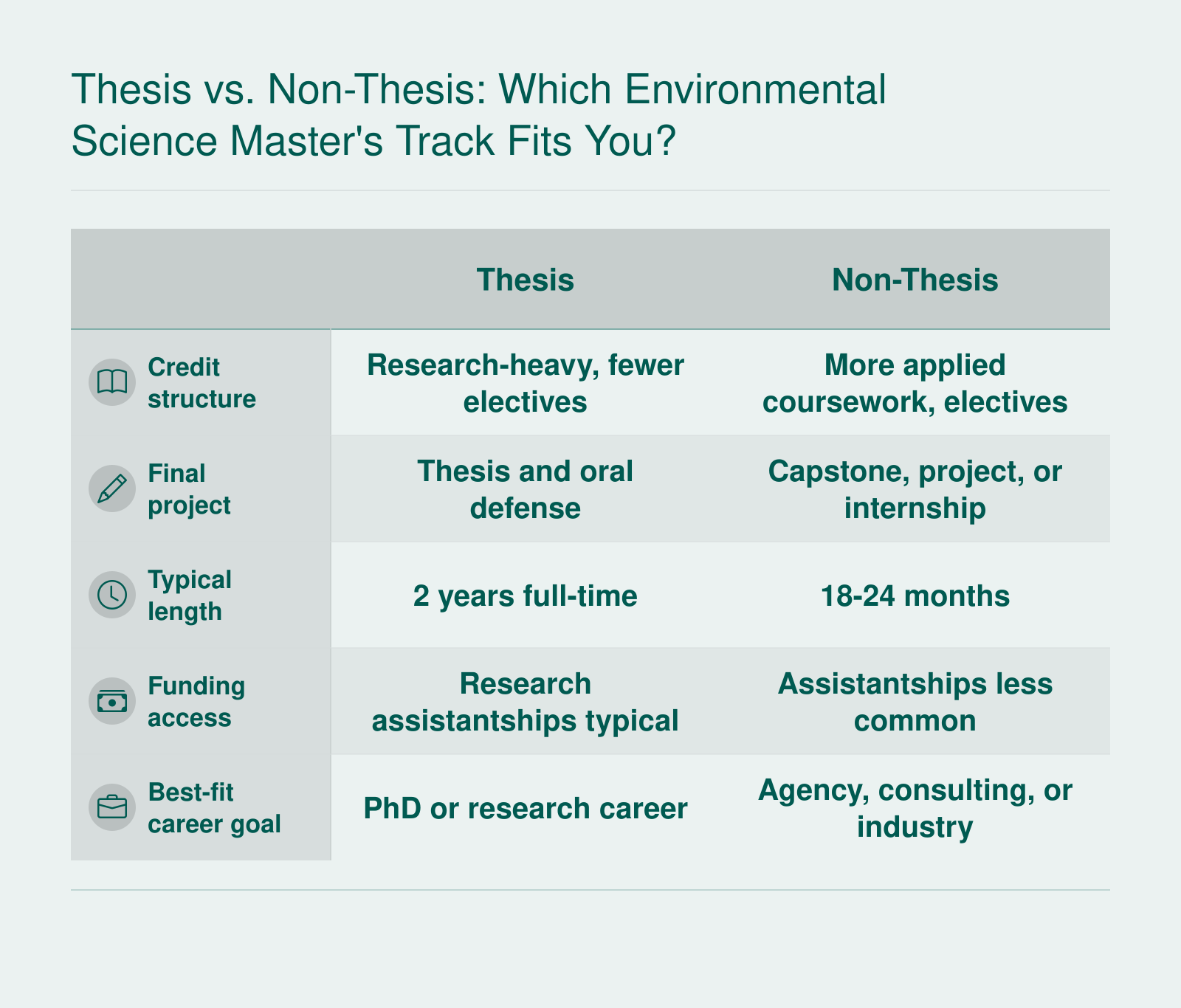
Thesis vs. Non-Thesis: Which Environmental Science Master's Track Fits You?
A thesis track builds a research portfolio and often leads toward a PhD or lab career. A non-thesis track replaces the thesis with applied work such as a capstone, project, or internship. Most Colorado programs either offer both tracks or lean toward one, so check each program's handbook before deciding.
Career Outcomes and Salaries for Environmental Science Master's Graduates in Colorado
Where you land after graduation depends partly on the credential and partly on the employer you target: a research-heavy thesis track points toward agency science and consulting, while a management-oriented degree leans toward policy and operations roles. Federal earnings data gives a partial but useful picture.
What Graduates Earn
Several programs here report median earnings from federal data, measured four years after completion unless noted:
- CU Boulder (Environmental Studies): about $81,600, with roughly $19,500 in typical graduate debt.
- CU Denver (Environmental Sciences): about $77,400.
- CSU Fort Collins (Ecosystem Sustainability): about $70,000, against median debt near $20,000.
- Western Colorado University (Environmental Management): about $54,900 (measured five years out), with median debt near $20,250.
Not every program on this list has a published earnings figure, so we leave those out rather than substitute a broader campus-wide number that would not reflect this degree.
Where Graduates Work
Colorado employers hiring at this level include the Colorado Department of Public Health and Environment (CDPHE), federal land agencies, municipal and regional water utilities, and private environmental consulting firms. Roles range from environmental scientist and watershed analyst to sustainability coordinator and compliance specialist. HLC-accredited coursework and hands-on fieldwork or research help graduates move into these positions and compete for agency and consulting work.
Compare Environmental Science programs on the data that matters
Explore more Science & Engineering specializations or browse every graduate field.
All Science & Engineering programs