Best Master's in Environmental Science Programs in Tennessee
Compare 5 accredited Environmental Science programs in Tennessee at 4 schools, with graduate earnings, cost, debt, and completion data from IPEDS and the U.S. College Scorecard.

On campus or online is a short debate in Tennessee: environmental science graduate study is mostly campus-based, and the hybrid options are sustainability degrees rather than the Best Online Master's in Environmental Science Programs. Only a handful of universities offer the master's, so the choice is narrow but consequential.
In-state graduate tuition runs from $11,110 at the University of Tennessee-Chattanooga to $17,334 at Lipscomb University. The other schools fall between.
Thesis and non-thesis tracks are common, and a program's research focus, from soil chemistry to sustainability metrics, often matters more than a few thousand dollars of tuition; applicants who want to skip the GRE can compare Master's in Environmental Science Programs With No GRE Required.
Key Points
- No school here is fully online; Lipscomb offers the main hybrid option.
- Tennessee Tech is the cheapest out-of-state option at $15,746.
- Geology graduates can seek Tennessee's Professional Geologist license, created in 2007.
Top-Ranked Environmental Science Master's Programs in Tennessee
Tennessee's master's options range from soil-science research degrees in Knoxville to a hybrid sustainability program in Nashville. Four of the five schools below teach on campus, and graduate tuition ranges from about $9,100 a year in-state at Chattanooga to about $17,300 at Lipscomb. Where a school lists thesis and non-thesis tracks, we note both, because that choice shapes cost, timeline, and career direction.
The University of Tennessee-Knoxville
#1Knoxville, TN · ~$16,000/yr (est.)
Best for: Aspiring soil and water scientists
The University of Tennessee-Knoxville is the state's flagship, and its Environmental and Soil Sciences MS sits within the Herbert College of Agriculture. Graduate tuition in federal data is $13,720 in-state and $32,208 out-of-state, and the university graduates about 74% of its students. The campus-based program offers three concentrations with both thesis and non-thesis paths, and applicants should plan for GRE scores.
- Concentration in soil and water chemistry
- Thesis and non-thesis options
- 30 to 33 credit hours required
- GRE scores, transcripts, and three letters of reference
- Advisory committee guides the research project
- Comprehensive exam required
- Concentration in nutrient and elemental cycling
- Statement of goals required for admission
- Prerequisite coursework may be required
- Campus-based, no online option listed
- Concentration in land management and reclamation
- Applied focus on managing and restoring disturbed land
- Research component with an advisory committee
- Bachelor's degree required
Tennessee Tech
#2Cookeville, TN · $10,000 – $15,000/yr (est.)
Best for: Professionals blending science with management skills
Tennessee Tech in Cookeville offers a Professional Science Master's in Environmental Science that pairs science coursework with business and leadership skills. Federal data lists graduate tuition of $11,000 in-state and $14,360 out-of-state, a narrow gap that helps non-residents, and the university graduates about 58% of its students. Tech also takes part in the Tennessee Cooperative Fishery Research Unit with state and federal wildlife agencies, which can carry stipends and tuition waivers, though applicants should confirm eligibility with faculty.
- 30-hour degree on the Cookeville campus
- Thesis option: 6 thesis credits plus 6 elective credits
- Non-thesis option: 12 committee-approved elective credits
- Includes an internship component
- Core courses in statistics and environmental law
- Interdisciplinary electives across agriculture, biology, and chemistry
The University of Tennessee-Chattanooga
#3Chattanooga, TN · ~$11,000/yr (est.)
Best for: Students aiming for environmental management roles
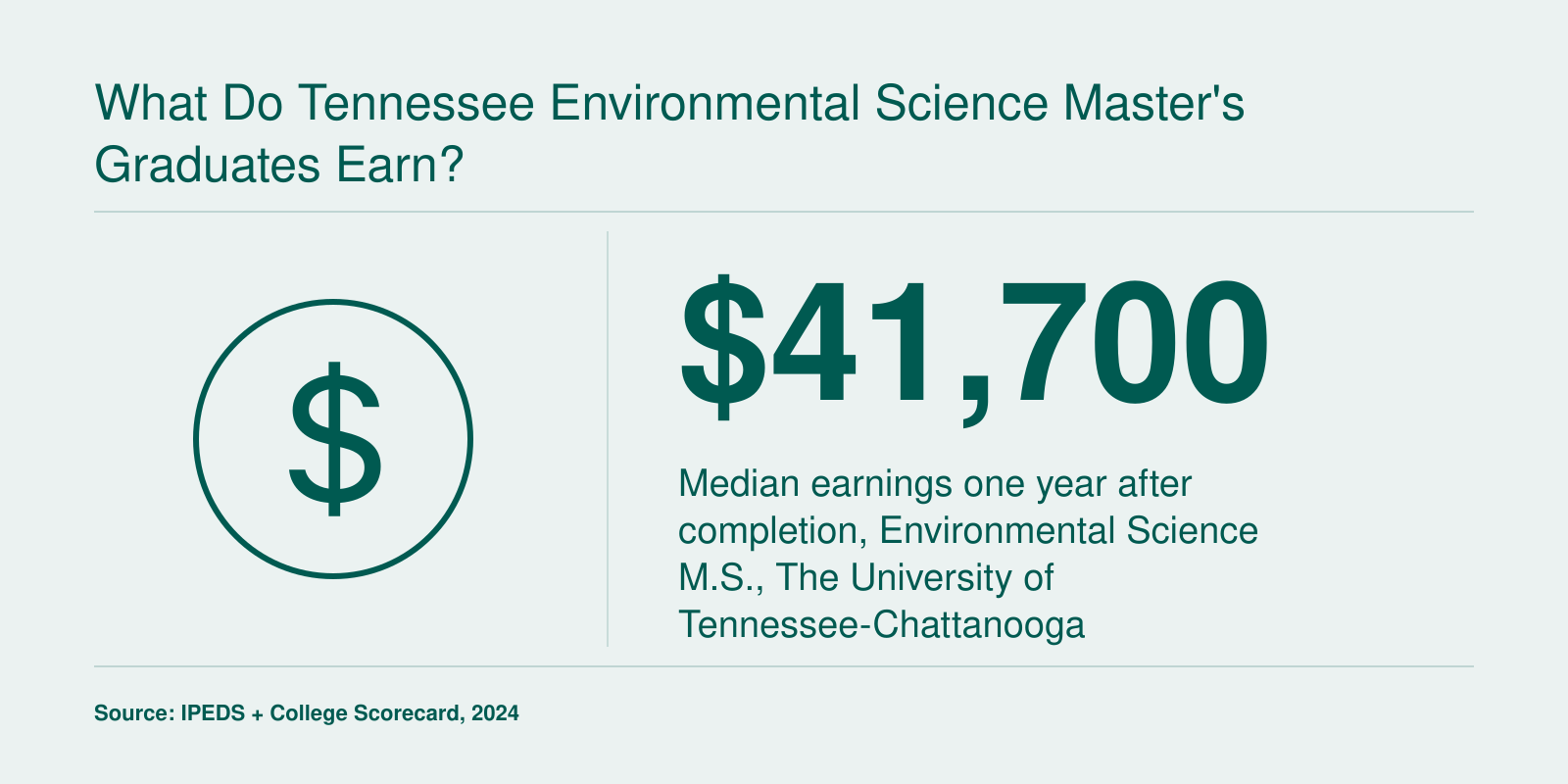
The University of Tennessee-Chattanooga offers a campus-based MS in Environmental Science built around lab and field research, plus a track in environmental administration and management. Federal data lists graduate tuition of $9,120 in-state and $17,184 out-of-state, the lowest in-state figure among these schools, and the university graduates about 50% of its students. Scorecard data shows a median of $41,700 one year after graduation from a small program with 10 completions, so treat that figure with caution.
- Research-focused program with lab and field work
- No concentration specified
- Letter of intent, three references, and transcripts required
- Rolling admission for fall, spring, and summer
- Concentration in administration and management
- Coursework in policy and law
- Internships available for experience
- Resume, references, and letter of intent required
- Emphasis on sustainability
Tennessee State University
#4Nashville, TN · $11,000 – $24,000/yr (est.)
Tennessee State University in Nashville delivers its MS in Environmental Science through the College of Agriculture, with three concentrations: Natural Resources, Plant Sciences, and Geospatial Sciences. Federal data lists graduate tuition of $9,940 in-state and $22,560 out-of-state, and the university graduates about 34% of its students, the lowest rate in this group. The program is flexible, with thesis and non-thesis tracks and admission that accepts either GRE or MAT scores.
- Natural Resources concentration
- Thesis track: at least 26 coursework credits plus a 4-credit thesis
- Non-thesis track: at least 35 credits, with independent study
- Minimum 2.50 GPA for admission
- GRE or MAT scores required
- Plant Sciences concentration
- Electives in plant breeding and applied entomology
- Soil classification and organic agriculture principles
- Comprehensive exams for non-thesis students
- Geospatial Sciences concentration
- Electives in spatial analysis and remote sensing
- Listed score thresholds: GRE 290 or MAT 370
- Advisory committee guides the program
Lipscomb University
#5Nashville, TN · ~$17,000/yr (est.)
Lipscomb University in Nashville offers a Master of Science in Sustainability, a closely related alternative for students who want business and policy skills alongside environmental knowledge. It is a hybrid program with evening classes and online or in-person options, and the university graduates about 72% of its students. It is the priciest option here at $1,091 per credit hour, with an 18% discount for fully online study, but it requires no standardized test.
- Hybrid format with evening and asynchronous options
- Concentrations: green buildings and sites, renewable energy, business metrics such as ESG
- 30 credit hours, typically 12 to 16 months
- $1,091 per credit hour, with an 18% online discount
- No standardized test required
- Capstone project included
- Writing sample and two references required
Cost & outcomes by school
Federal data for the highest-earning Environmental Science programs, independent of the ranking above. Earnings are this field's master's graduates four years after completing, where the Scorecard reports them.
| School | Earnings | Tuition / yr | Debt | Grads/yr | Format |
|---|---|---|---|---|---|
| Tennessee Tech TN | — | $12,386 | — | — | Campus |
| The University of Tennessee-Knoxville TN | — | $15,972 | — | — | Campus |
| The University of Tennessee-Chattanooga TN | — | $11,110 | — | 13 | Campus |
| Tennessee State University TN | — | $11,188 | — | 9 | Campus |
Sources: U.S. Department of Education. Tuition and graduates: IPEDS. Earnings and debt: College Scorecard, this field's master's graduates; a dash means no figure is reported.
Online and Hybrid Environmental Science Master's Options in Tennessee
Environmental Science graduate study in Tennessee is still mostly campus-based, and flexibility comes chiefly through hybrid sustainability degrees.
Formats by School
- Fully online: None of the schools here is listed as fully online.
- Hybrid: Lipscomb University's M.S. in Sustainability combines in-person and online courses, with evening classes and asynchronous options. It is a 30-credit program with a stated length of 12 to 16 months.
- Campus-only: The University of Tennessee-Knoxville, Tennessee Tech, the University of Tennessee-Chattanooga, and Tennessee State University.
UT Knoxville also runs a separate 30-credit sustainability master's described as mostly on-ground with some online courses.1 Confirm details with the department.
Time and On-Campus Requirements
Tennessee State's catalog lists two years for both thesis and non-thesis tracks. Most other schools do not publish a clear full-time versus part-time timeline, so ask the program directly. Don't assume an internship, capstone, or thesis can be done remotely. Tennessee Tech requires an internship or capstone, and UTC's program includes lab and field work.
Who Should Choose Which
Hybrid study suits working professionals at state agencies, utilities, and consulting firms who need evening or asynchronous courses. Campus programs fit students seeking research assistantships or lab and field-intensive thesis work.
Out-of-state students should compare in-state and out-of-state tuition at the public schools on the Master's Programs in Tennessee guide, where the gap can be wide. Lipscomb, a private school, charges one rate regardless of residency and advertises an online discount.
Which Tennessee Environmental Science Master's Programs Waive the GRE?
More graduate programs are moving toward GRE-optional admissions, but Tennessee schools are not uniform. Some require scores, some offer a GPA-based alternative, and some publish nothing on their program pages. Policies change, so confirm with the graduate school before you apply.
| School | GRE Policy | Waiver or Notes |
|---|---|---|
| Tennessee Tech | Not required for applicants to the Environmental Informatics professional science master's who hold a STEM bachelor's degree with a GPA of at least 3.0. Other applicants need a combined verbal and quantitative score of at least 300 and an analytical writing score of at least 3.5. | Waived by a GPA criterion: a STEM undergraduate GPA of 3.0 or higher replaces GRE scores. |
| Tennessee State University | Required for unconditional admission to the M.S. in Environmental Sciences: at least 290 on verbal and quantitative combined, or 370 on the MAT. The Geospatial Sciences concentration also lists a 290 minimum. | No general waiver. A higher GPA or GRE scores may offset minor deficiencies in other requirements, and a sliding scale for GPA and GRE may apply to U.S. degrees. |
| The University of Tennessee-Chattanooga | The M.S. in Environmental Science listing requires GRE verbal and quantitative scores only from applicants who are also applying for an assistantship. | The excerpt reviewed states no general GRE requirement for admission. Confirm whether scores are needed if you are not seeking an assistantship. |
| The University of Tennessee-Knoxville | No published policy | Confirm directly with the graduate admissions office. |
| Lipscomb University | No published policy | Confirm directly with the graduate admissions office. |
Related Articles
Cost, Funding, and Tennessee Licensure or Certification for Environmental Science Master's Graduates
In-state graduate tuition runs from $11,110 at the University of Tennessee-Chattanooga to $17,334 at Lipscomb University, and the gap widens for nonresidents. Tennessee Tech is the cheapest out-of-state option at $15,746, while the University of Tennessee-Knoxville is the highest at $34,760. Tennessee State's in-state rate is $11,188 and its out-of-state rate is $23,808. Lipscomb is private, so residents and nonresidents pay the same rate.
Net price after aid
Average net price after aid is roughly $14,246 at Tennessee Tech, $14,265 at Chattanooga, $15,796 at Tennessee State, $18,976 at Knoxville, and $24,739 at Lipscomb. These are institution-wide averages, not quotes for any graduate program, so treat them as a rough guide rather than the Most Affordable Master's in Environmental Science Programs ranking.
Tennessee credentials
Tennessee has no single environmental scientist license. Your path depends on the job:
- Professional Geologist: The state Board of Examiners for Land Surveyors and Geologists requires 30 semester hours in geology, five years of experience, and the FG and PG exams.12 The fee is $115, filed through CORE.3 A master's may support this route but does not automatically supply the geology hours, so check your transcript.
- Water and wastewater operator: TDEC offers 14 certification types.4 Applicants file Form CN-0704 with a $100 fee at least 60 days before the exam and need a score of 70% or higher.54
- National credentials: Some graduates add the QEP, CHMM, or ESA Certified Ecologist designation.
Tennessee Environmental Credentials at a Glance
What Do Tennessee Environmental Science Master's Graduates Earn?
Program-level earnings are published for only one school here: The University of Tennessee-Chattanooga. The other schools do not report a figure for their environmental science master's graduates, so they are left out rather than filled in with institution-wide numbers. Tennessee graduates typically look to TDEC, TVA, environmental consulting firms, and federal labs for roles in compliance, field science, and data analysis, but those employers' pay is not captured in this figure.
Admission Requirements and Deadlines for Tennessee Environmental Science Master's Programs
Requirements differ by school, so confirm them on each graduate admissions page before you apply. Full-time study typically takes about two years, and part-time study takes longer.
- Degree and prerequisitesTennessee State expects a bachelor's in agricultural sciences, environmental sciences, forestry, geography, or a related area. The University of Tennessee-Knoxville names no required courses and says varied backgrounds may be considered. UTC publishes no prerequisite course list.
- GPA and testsTennessee State lists a 2.50 minimum plus a GRE of 290 (verbal and quantitative) or an MAT of 370; no waiver policy is confirmed. Knoxville's ecology and evolutionary biology department expects a 3.0 overall and in science and math, and lists no GRE. UTC publishes no admission GPA. Knoxville requires TOEFL or IELTS for non-native English speakers.
- Application materialsUTC asks for a letter of intent, résumé or CV, three references, and transcripts. Knoxville asks for three recommenders, a departmental application, a professional-goals statement, an independent-research statement, and a $35 fee.
- Deadlines and start termsKnoxville's department sets a December 1 deadline for the following fall or spring. Tennessee State's priority dates are July 1 for fall, November 1 for spring, and April 1 for summer. UTC admits on a rolling basis for fall, spring, and summer. Ask each program about assistantship timing.
Compare Environmental Science programs on the data that matters
Explore more Science & Engineering specializations or browse every graduate field.
All Science & Engineering programs