Best Master's in Geography Programs in Texas
Compare 8 accredited Geography programs in Texas at 6 schools, with graduate earnings, cost, debt, and completion data from IPEDS and the U.S. College Scorecard.

Texas puts spatial analysis to work on problems few other states face at this scale: oil and gas siting, aquifer and river-basin management, fast-growing metros like Austin and San Antonio, and hurricane and flood response along the Gulf. Employers in each area hire people who can build and interpret GIS data.
The schools ranked here offer campus programs, and some courses are available online. Tuition ranges from roughly $9,000 to $13,000 a year in-state, so cost and funding matter as much as curriculum.
The practical tension is that the strongest research programs are the ones most likely to be funded through assistantships, while flexible formats lean toward applied GIS.
Key Points
- Out-of-state premiums run from about $7,400 at UNT and Texas State to $18,600 at UTSA.
- Texas A&M does not require the GRE for its M.S. in Geography.
- Texas requires no license for geographers or GIS professionals, though land surveying does.
Ranked: Best Geography Master's Schools in Texas
Rankings weigh cost, outcomes, and format flexibility. Graduation rates shown are institution-wide figures from federal data, not program-specific numbers, and net price is an approximate average across the whole institution.
The University of Texas at Austin
#1Austin, TX · ~$12,000/yr (est.)
Best for: Future PhD applicants focused on research
The University of Texas at Austin offers a research-intensive M.A. in Geography designed mainly for students heading toward doctoral study. Core seminars in geographic theory and methods, a minor subject, and a supervising committee give it a scholarly, mentored feel. The institution-wide graduation rate is roughly 89%, the highest among the Texas schools listed here. Expect a selective admissions process that puts heavy weight on fit with faculty research interests.
- 30 to 36 semester hours with a thesis or report
- Typically earned en route to a PhD
- Foreign language or methods proficiency required
- Minor subject required
- Core seminars in geographic theory and methods
- Supervising committee assigned
- Dual degree option with Community and Regional Planning
Texas A&M University-College Station
#2College Station, TX · ~$12,000/yr (est.)
Best for: Fieldwork-minded students targeting government careers
Texas A&M University offers an M.S. in Geography that blends fieldwork, classroom study, and laboratory analysis across physical, cultural, and economic geography. Thesis and non-thesis tracks let students aim for either research or professional practice, and graduates head into government, industry, and non-profit roles. The institution-wide graduation rate is roughly 84%. It is a strong fit for full-time students who can commit to a compact, on-campus program.
- 32 total credit hours over four semesters
- Full-time, on-campus enrollment
- Thesis and non-thesis tracks
- Field, classroom, and laboratory learning
- Coursework in spatial analysis and physical and cultural geography
- Careers in government, industry, and business
Texas Tech University
#3Lubbock, TX · $5,000 – $10,000/yr (est.)
Best for: Funding-focused students seeking assistantships
Texas Tech University pairs physical geography, human geography, environmental science, and GIScience in its M.S. in Geography and the Environment. Students use GIS and remote sensing labs, an Esri site license, and high-performance computing. Teaching and research assistantships are a major draw, and the program notes that out-of-state tuition is waived for assistants. The institution-wide graduation rate is roughly 69%.
- Teaching assistantships with tuition waiver
- Research assistantships available
- GIS lab and remote sensing lab
- Esri University site license
- High-performance computing access
- Thesis option for research or PhD paths; non-thesis option for career skills
- Research themes include climate change and land-use dynamics
University of North Texas
#4Denton, TX · $9,000 – $16,000/yr (est.)
The University of North Texas offers an M.S. in Geography in Denton with both professional (non-thesis) and research (thesis) tracks. Students can tailor study to concentrations such as GIS and remote sensing or applied geomorphology, with specialized labs and internship opportunities. Faculty collaborate with the UNT Health Science Center, which suits those interested in health geography. The institution-wide graduation rate is roughly 61%.
- 36 credit hours, typically completed in 2 to 3 years
- Professional and research tracks available
- Thesis Boot Camp offered
- Faculty collaboration with the UNT Health Science Center
- Internship opportunities available
- Specialized labs for geomorphology and GIS
- Addresses floods, droughts, and other hazards
- Interdisciplinary research with public health experts
- Advanced information technology competence
- Specialized GIS and remote sensing labs
- Spatial analysis skills for real-world problems
- Collaboration with the School of Public Health
- Prepares students for urban planning careers
- Numerous internship opportunities
Texas State University
#5San Marcos, TX · ~$9,000/yr (est.)
Texas State University in San Marcos offers two degree paths: a thesis-based M.S. and an applied M.A.Geo. built around a research paper and including a GIS pathway. The M.A.Geo. can be completed with up to 100% of coursework online, which makes this the most flexible format option on the list. The program does not require the GRE and uses rolling admissions. The institution-wide graduation rate is roughly 55%.
- M.S. is 30 credit hours with a thesis; M.A.Geo. is 33 with a research paper
- M.A.Geo. offers up to 100% online coursework
- GRE not required; test optional
- Rolling admissions with fall and spring starts
- Department GPA standards: 3.4 for M.S., 3.2 for M.A.Geo. (last 60 hours)
- Three letters of recommendation minimum; $55 application fee
- Specialization options include GIS and geographic education
The University of Texas at San Antonio
#6San Antonio, TX · $10,000 – $29,000/yr (est.)
The University of Texas at San Antonio offers an M.A. in Geography and Environmental Sustainability that connects human and physical geography to urban sustainability, climate change, and migration. Thesis and non-thesis tracks serve students aiming for doctoral study, government, nonprofits, or planning. It has the lowest tuition of the ranked schools. The institution-wide graduation rate is roughly 53%.
- Two-year program with thesis and non-thesis tracks
- Minimum 3.0 GPA required
- Two letters of recommendation minimum
- Comprehensive examination required
- Prerequisite courses required
- Focus on just sustainability and social and physical environments
- Internship and conference opportunities through international faculty ties
Cost & outcomes by school
Federal data for the highest-earning Geography programs, independent of the ranking above. Earnings are this field's master's graduates four years after completing, where the Scorecard reports them.
| School | Earnings | Tuition / yr | Debt | Grads/yr | Format |
|---|---|---|---|---|---|
| Texas State University TX | — | $8,997 | — | 14 | Campus |
| University of North Texas TX | — | $9,091 | — | 13 | Campus |
| The University of Texas at San Antonio TX | — | $10,116 | — | 4 | Campus |
| The University of Texas at Austin TX | — | $12,006 | — | 6 | Campus |
| Texas Tech University TX | — | $9,518 | — | 3 | Campus |
| Texas A&M University-College Station TX | — | $11,748 | — | 4 | Campus |
Sources: U.S. Department of Education. Tuition and graduates: IPEDS. Earnings and debt: College Scorecard, this field's master's graduates; a dash means no figure is reported.
Online and Hybrid Master's in Geography Options in Texas
Flexibility and format rarely line up perfectly: the most convenient delivery often points you toward applied GIS work rather than a traditional master's in geography research degree. The online and hybrid options among these master's programs in Texas run as follows.
- Texas A&M University, College Station: The Master of Geoscience, GIS and Technology Track is fully online, 36 credits, and non-thesis. It uses five course starts a year with Fall, Spring, and Summer admission, and can finish in about 18 months. This is an applied, GIS-focused path, distinct from the campus research M.S.
- Texas State University: The Master of Applied Geography, GIS concentration1 runs in a hybrid format, with roughly 51% to 100% of required coursework delivered online. It leans applied rather than mirroring the campus research track.
Neither university's program page lists fixed synchronous meetings or required on-campus residencies, so confirm live-session expectations before you enroll.
Working professionals should pace deliberately: take one or two courses per term, and where the program allows, aim your capstone at a spatial problem from your current job so coursework doubles as deliverable work.
GRE Waiver and Test-Optional Policies at Ranked Texas Master's Programs
Do Texas geography master's programs still require the GRE in 2026? The ranked programs are mostly test-flexible, part of a broader shift toward No-GRE master's programs. Texas A&M University does not require the GRE for its M.S. in Geography and states no minimum GPA or experience-based waiver. Texas Tech University makes the GRE optional for its M.S. in Geography and the Environment, according to its Texas Tech Geography Graduate Advising page, without a published minimum GPA. Texas State University does not require the GRE for its geography master's tracks (M.A.Geo. in Geography, M.A.Geo. in Geographic Information Science, and M.S. in Geography)12, but listed GPA minimums vary: the Graduate College page shows 3.0,1 while the department FAQ lists 3.2 or 3.4 depending on program. No ranked school here publishes a hard GRE requirement. The University of Texas at Austin, University of North Texas, and The University of Texas at San Antonio do not publish a clear GRE policy on the pages reviewed, so contact the graduate advisor before applying.
Application Deadlines and Required Materials for Texas Geography Master's Programs
Requirements vary by school, so confirm each program's admissions page. Applying by the earliest deadline often matters most for assistantship and scholarship consideration.
- Bachelor's degree and minimum GPATexas State and UTSA both ask for a 3.0 GPA, and both list prerequisite coursework. Texas State's fall priority deadline is December 1; standard deadlines are August 1 (U.S.) and June 1 (international).
- Statement of purposeTexas State requires one naming your degree, concentration, and research interests. Its spring deadlines are November 1 (U.S.) and October 1 (international).
- Letters of recommendationTexas State asks for three letters and UTSA for two. Texas Tech requires letters for spring consideration, with a complete application due October 15.
- Resume/CV and writing sampleTexas State's pages do not list either. Check the other schools' pages before assuming. Texas Tech wants a complete application by February 1 for funding consideration, so apply early.
- TOEFL or IELTS for international applicantsTexas State's GIS master's track requires IELTS Academic 6.5 overall, with TOEFL thresholds that changed in January 2026. Check the current score tables before you apply.
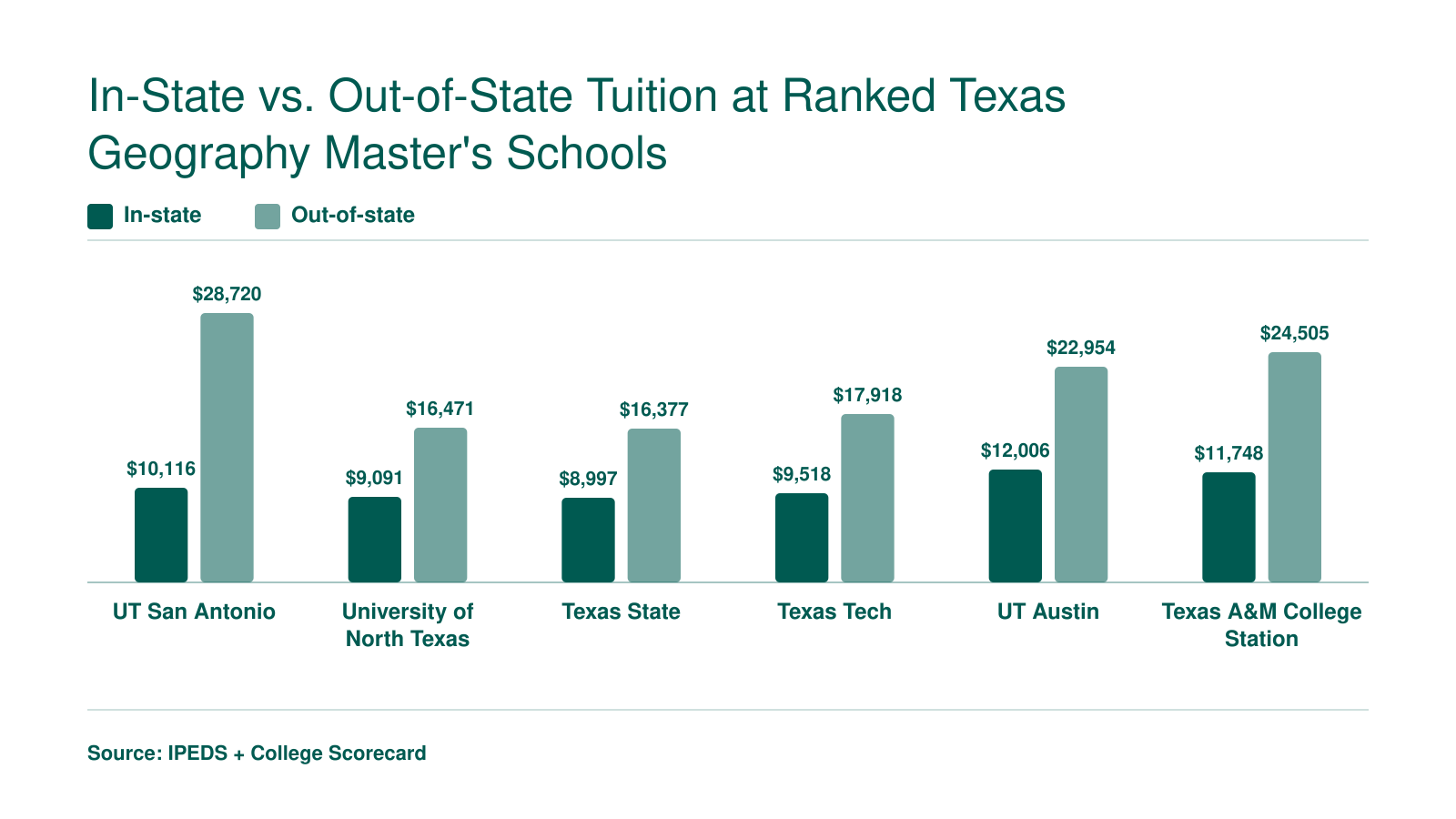
In-State vs. Out-of-State Tuition at Ranked Texas Geography Master's Schools
Residency changes the bill more than most applicants expect. The out-of-state premium runs from about $7,400 at University of North Texas and Texas State University to about $18,600 at The University of Texas at San Antonio. Assistantships can unlock in-state rates or tuition remission, and Texas Tech lists teaching assistantships with a tuition waiver, so ask each department before budgeting at the higher rate.
Related Articles
Cost and Funding: Assistantships, Stipends, and Net Price for a Geography Master's in Texas
A geography master's can look cheap on paper and still cost real money if you enroll without funding. In-state program tuition across these schools runs roughly $9,000 to $12,000 a year, lowest at Texas State and UNT, highest at UT Austin. Out-of-state tuition spreads wider, from about $16,400 at Texas State to about $28,700 at UTSA. Net price (approximate and institution-wide) runs from about $10,800 at UTSA to about $21,300 at Texas A&M.
Assistantships change that math, but terms differ by school:
- Texas State: $14,500 for nine months, renewable up to two years, with the out-of-state portion of tuition waived.
- UNT: limited, competitive teaching assistantships with an out-of-state waiver. Research roles depend on faculty grants. No current stipend is published.
- Texas A&M: teaching assistantships typically last two years for the M.S. Some pay tuition, others only confer in-state status. No stipend is published.
- Texas Tech: lists teaching assistantships with tuition waiver and research assistantships.
- TCU: $16,500 per year with a full tuition waiver, teaching-only appointments for eight students over two years.1
- Texas A&M, Corpus Christi: a 50% FTE assistantship qualifies for in-state tuition, with 6 credits required in fall/spring (3 in summer).2
No statewide rule applies, and UT Austin and UTSA do not detail assistantship terms on the pages reviewed.
Before accepting any offer, ask for the stipend, what tuition is covered, and how many semesters it lasts. Then apply by the priority deadline. Texas State's full-funding deadline last cycle was December 1.
Do Geographers Need a License in Texas?
Thesis vs. Non-Thesis Geography Master's: Which Path Fits Your Goals?
Geography master's programs generally offer a research thesis, an applied report or professional project, or a coursework-plus-exam track. Available national data does not break down earnings or job placement by track, so choose based on your goals and funding needs rather than a presumed salary gap. Typical credit loads and timelines below are general patterns, so confirm exact requirements with each department.
| Factor | Thesis track | Report or professional project track | Non-thesis (coursework plus exam) track |
|---|---|---|---|
| Typical credit load | About 30 to 36 credits, with several hours devoted to thesis research | About 30 to 36 credits, with a capstone, internship, or portfolio replacing the thesis | About 30 to 36 credits, with more elective coursework than the other tracks |
| Typical time to finish | Often 2 to 3 years, since original research and a defense can extend the timeline | Often 1.5 to 2 years, with a shorter, structured final project | Often 1.5 to 2 years, ending in a comprehensive exam |
| Best fit | PhD plans or research-focused roles that value original scholarship | GIS, industry, and government roles where a portfolio shows applied skills | Working professionals or students who want broad skills without a research project |
| Link to assistantship funding | Most closely tied to research assistantships and faculty-advised work, though funding varies by department | Funding is less commonly tied to this track, so ask the department directly | Often the least connected to funding, so confirm availability before applying |
| What the evidence says | Faculty at one program described thesis research as a far more robust intellectual experience | Professional GIS programs commonly use capstones or portfolios to prepare students for applied careers | Employers value business and organizational skills that geography curricula rarely teach, so electives can matter |
Career Outcomes and ROI for Texas Geography Master's Graduates
A geography master's in Texas typically leads to work as a GIS analyst, urban planner, environmental consultant, or emergency management specialist. Texas also has energy-sector employers that hire for spatial analysis and mapping roles. The table below lists each school's program-level earnings and median program debt from IPEDS and College Scorecard (2024), along with graduate counts from the same federal data.
| School | Degree | Graduates in federal data |
|---|---|---|
| The University of Texas at Austin | Master of Arts in Geography | 3 |
| Texas A&M University-College Station | Master of Science in Geography | 9 |
| Texas Tech University | Master of Science in Geography and the Environment | 3 |
| The University of Texas at San Antonio | Master of Arts in Geography and Environmental Sustainability | 10 |
| University of North Texas | M.S. in Geography | 13 |
| Texas State University | Geography (M.A.Geo./M.S.) | 20 |
Compare Geography programs on the data that matters
Explore more Science & Engineering specializations or browse every graduate field.
All Science & Engineering programs