Accelerated Master's in Geography Programs
Compare 190+ accredited fastest Geography programs at 110+ schools, with graduate earnings, cost, debt, and completion data from IPEDS and the U.S. College Scorecard.

A geography or GIS master's can follow a bachelor's in about five years when senior-year courses count toward both degrees. In an accelerated 4+1 pathway, 6 to 12 graduate credits often satisfy undergraduate requirements, compressing the second degree into one extra year.
The geography accelerated master's programs below are ordered by the fastest bachelor's-to-master's paths. Credit-sharing rules, GPA cutoffs, master's in geography cost, online availability, and postgraduate earnings determine how much time and money the shortcut actually saves. Early application matters because the shared-credit window closes fast.
Key Points
- Sharing 6 to 12 credits cuts a semester of graduate tuition.
- Most ranked programs are campus-based; Kentucky offers an online digital mapping master's.
- Program-level median earnings four years out reflect GIS and planning careers.
Best Accelerated Geography Master's Programs for 2027
The schools below are ordered by the fastest bachelor's-to-master's pathways, with an emphasis on real graduate costs and outcomes rather than prestige. Each entry summarizes what makes the geography or GIS program distinctive for students weighing time, money, and career fit.
Virginia Polytechnic Institute and State University
#1Blacksburg, VA · ~$19,000/yr (est.)
Best for: Research-oriented students seeking STEM designation
Virginia Tech's geography master's is a 31-credit STEM-designated program with thesis and non-thesis paths, and the accelerated option lets current undergraduates share selected 4000-level courses between degrees. It is research-oriented, with faculty mentorship, assistantships, and the Sidman P. Poole Endowment for field research. The accelerated M.S. is intended as a terminal degree and is reserved for Virginia Tech undergraduates who meet the GPA and advisor requirements.
- 31 total credit hours
- No entrance exam required and test optional
- Thesis or non-thesis option
- STEM-designated program with up to 36 months of OPT
- Research assistantships and Sidman P. Poole Endowment funding
- Accelerated M.S. option for Virginia Tech undergraduates
- Faculty advisor assigned upon admission
- Three recommendation letters minimum
University of Massachusetts-Amherst
#2Amherst, MA · $15,000 – $20,000/yr (est.)
Best for: Geospatial professionals wanting one-year GIST training
UMass Amherst offers a flexible research-driven M.S. in geography with a thesis or non-thesis track, plus an accelerated one-year GIST concentration focused on geospatial technologies. Students can build skills in cartography, remote sensing, GIS, and geocomputation. The accelerated option is designed for highly motivated students and professionals heading into public- or private-sector geospatial roles.
- Thesis or non-thesis track
- Independent study available
- Focus on human geography, environmental geography, and geocomputation
- Cartography, remote sensing, and GIS coursework
- One-year accelerated program
- Focus on geospatial technologies
- Spatial modeling and applied experience
- Careers in public and private sectors
- Designed for highly motivated students and professionals
University of Cincinnati
#3Cincinnati, OH · ~$15,000/yr (est.)
Best for: Job-focused students wanting non-thesis route
The University of Cincinnati's geography M.A. offers an accelerated one-year non-thesis track for students entering the job market and a two-year thesis track for doctoral preparation. The curriculum emphasizes economic, urban, and historical-cultural geography, with an optional physical geography concentration and small cohorts.
- Accelerated one-year non-thesis option for job market
- Two-year thesis track for PhD preparation
- GRE required with minimum 300 verbal plus quantitative
- 3.0 GPA minimum and three recommendation letters
- Optional concentration in physical geography
- Application deadline April 15
University of Kentucky
#4Lexington, KY · ~$15,000/yr (est.)
Kentucky's online Master of Science in Digital Mapping is built around web mapping development and open-source GIS tools. The 30-credit program runs on 10-week terms with four start dates per year, making it a flexible option for working professionals who want technical mapping skills.
- 30 total credit hours
- Four start dates per year
- Online program focused on web mapping development
- 10-week accelerated course terms
- New Maps Plus partnership with open-source emphasis
- Only online MSc in web mapping
- Career prep for web mapping and GIS analysis
Arizona State University
#5Tempe, AZ · ~$14,000/yr (est.)
Arizona State's geography M.A. offers four interdisciplinary themes, including computational spatial science, earth systems and climate science, place identities and culture, and sustainability science. It is available on campus in Tempe or online, with thesis and capstone options, and an accelerated bachelor's plus master's path for qualifying undergraduates.
- Four concentration options
- 30 total credit hours
- 3.0 GPA minimum and one recommendation letter
- Thesis or capstone option
- Available on campus Tempe or online
- Accelerated bachelor's plus master's degree option
- Concentration in computational spatial science
- Research centers: Spatial Analysis and Urban Climate
- Career examples: environmental scientist, GIS technician, geoscientist
- STEM-OPT extension not eligible
- Concentration in sustainability science and studies
- Themes span earth systems, climate science, place identities, and culture
- Program outcomes include spatial analysis and research methods
George Mason University
#6Fairfax, VA · $15,000 – $20,000/yr (est.)
George Mason's M.S. in Geographic and Cartographic Sciences focuses on geospatial technologies, cartographic design, GIS, quantitative methods, and remote sensing. The program offers thesis and non-thesis tracks, an accelerated pathway for high-achieving undergraduates, and no GRE requirement.
- No entrance exam required
- Two recommendation letters minimum
- Thesis and non-thesis options
- Prerequisite courses required
- Accelerated master's pathway
- State-of-the-art GIS labs and 700+ alumni network
- Prepares for government and industry careers
University of Nebraska-Lincoln
#7Lincoln, NE · $5,000 – $10,000/yr (est.)
Nebraska's geography M.A. provides thesis and non-thesis options with specializations in GIS and geovisualization, human-environment relations, cultural and historical geography, and urban and political geography. Students benefit from close faculty mentorship, interdisciplinary collaboration, and teaching assistantships that can include tuition remission.
- Four concentration options
- 30 total credit hours
- No entrance exam required and test optional
- Thesis and non-thesis options
- Teaching assistantships with tuition remission
- Priority deadline January 1
- Accelerated Master's program available
- Concentration in human-environment relations
- Dual degree programs offered
- Close faculty mentorship and interdisciplinary collaboration
- Career pathways: GIS specialist and cartography technician
South Dakota State University
#8Brookings, SD · $5,000 – $10,000/yr (est.)
South Dakota State's geography M.S. with a Geographic Information Sciences specialization emphasizes GIS, remote sensing, and geospatial modeling, including web GIS and machine learning for remote sensing. Students can choose thesis or non-thesis portfolio tracks, and the program offers an accelerated option plus internships with the EROS Data Center.
- No entrance exam required and test optional
- Two recommendation letters minimum
- Prerequisite undergraduate geography coursework required
- Thesis or non-thesis track with portfolio option
- Accelerated Master's program available
- Internships with EROS Data Center
- Coursework in GIS, remote sensing, and machine learning
Western Michigan University
#9Kalamazoo, MI · $20,000 – $25,000/yr (est.)
Western Michigan offers an M.S. in Geography with concentrations in Geographic Information Science, Environmental and Resource Analysis, and Community Development and Planning. The program combines GIS coursework with extensive lab time and offers an accelerated graduate option for undergraduates with senior standing.
- No entrance exam required and test optional
- State-of-the-art GIS software with 30 hours lecture and lab
- Independent study or professional internships available
- Accelerated graduate degree option
- Concentration in environmental and resource analysis
- No GRE required for admission
- Faculty research in multiple areas
- Assistantships available
- Concentration in community development and planning
- Career prep in government planning
- GIS labs with extensive hands-on time
- Flexible independent study and internships
Northern Arizona University
#10Flagstaff, AZ · ~$13,000/yr (est.)
Northern Arizona's M.S. in Geography is structured around geographic science, community planning, and parks and recreation management, with the option of graduate certificates in community planning or GIS. Students complete a thesis or professional practicum with an oral defense, and an accelerated bachelor's-to-master's plan allows sharing 12 units.
- 30 total credit hours
- 3.0 GPA minimum
- Thesis or professional practicum with oral defense
- Accelerated bachelor's to master's plan with 12 shared units
- GIS and geodesign coursework
- Some online or blended coursework required
- Six-year completion limit
None of the ranked Geography programs match the fastest lens yet. The full ranking is at the link above.
Cost, debt & payoff
Median earnings of this field's master's graduates (4 yrs after completing) vs. their median federal loan debt · U.S. College Scorecard
Across these programs the median graduate earns about $80,622 and finishes with roughly $30,093 in debt — a ratio that clears a common rule of thumb (keep debt below first-year salary). Tuition and debt vary widely school to school, so check the per-school figures in the table above before you shortlist.
How Accelerated Geography Master's Programs Work: Shared Credits and Timelines
How can you finish a master's in geography in one extra year instead of two? The answer is double-counting. In a 4+1 or combined BA/MS pathway, you take graduate geography or GIS courses during your senior year, and those credits count toward both the bachelor's and the master's. You stop repeating coursework and start the graduate degree with a head start.
How Many Credits Overlap
Shared-credit caps usually land between 9 and 12. George Mason University's accelerated Geographic and Cartographic Sciences MS lets up to 12 graduate credits double-count if you earn at least a B-, and you can begin that coursework after 75 undergraduate credits. Arizona State University's accelerated Geography MA also permits up to 12 graduate hours in the senior year,1 though its graduate college policy separately allows up to 15 shared credits across programs.2
Time to Degree
Most of these programs advertise both degrees in about five years, one year beyond a typical bachelor's. Maryland's combined BS/MS fulfills its 30 master's credits in a single added year.3 What slows students down is course sequencing and choosing a thesis over a non-thesis or capstone track, since a thesis adds research time most comprehensive-exam routes avoid.
Who Qualifies: GPA, Credits, and Eligibility Rules
- Minimum GPAMost programs require a 3.0 overall; Rowan and Portland State set 3.3, and Portland State also asks 3.5 in geography courses.
- Credit thresholdTypically 60–90 undergraduate credits. George Mason and Rowan ask 60+, Idaho State 64, and Portland State 139 including 36 upper-division.
- Home-university eligibilityThese tracks usually serve the university's own undergraduates. Portland State is the clearest exception, with a transfer path subject to residence-credit rules.
- Materials and GREGRE is not required at most programs. Recommendation letters vary from zero (George Mason) to two or three; Rowan's deadline is November 1.
- Maintaining standingAdmitted students must keep a minimum GPA in graduate courses, Portland State expects 3.30 overall and 3.0 in the major.
Related Articles
What an Accelerated Geography Master's Costs: The 3 Most Affordable Options
List prices and actual costs differ. The table below shows published in-state and out-of-state tuition for each program alongside the school's average net price after aid; net price is an institution-wide average, not a quote for every student. Per-credit comparison adds context: Arizona State's published 2026-2027 digital immersion rate is $580 per undergraduate credit and $605 per graduate credit, and its accelerated online policy allows up to 15 graduate credits during senior year to be billed at the undergraduate rate, a $25 per-credit saving. Penn State World Campus lists $1,048 per credit for its 33-credit online GIS master's in 2026-2027, a $12,572 semester rate for 12 or more credits, and a tuition-only total of $34,584. Marshall and Northern Arizona list financial aid or scholarships among their options.
| School | In-state tuition | Out-of-state tuition | Average net price |
|---|---|---|---|
| Marshall University | $9,510 | $22,192 | $7,502 |
| New Mexico State University | $6,605 | $19,448 | $8,889 |
| Northern Arizona University | $13,023 | $19,306 | $14,158 |
Online Accelerated Geography Master's Degrees vs. Campus Programs
Can you finish an accelerated geography master's online? Sometimes, but not often in online master's in geography programs. Most of the programs ranked here are campus-based, including Virginia Tech, UMass Amherst, Cincinnati, George Mason, and Nebraska. Kentucky's Master of Science in Digital Mapping is the clearly online option on this list, while Arizona State and Northern Arizona mention online or blended coursework. Accelerated tracks usually begin on campus during your undergraduate years, so the graduate year is where flexibility appears, mostly in GIS-focused degrees. Michigan Tech's online accelerated route, which lets current students share up to 9 credits, is one example to check.4
Technology matters for online GIS study. ArcGIS Pro is a Windows application, so confirm compatibility before enrolling. Some schools reduce hardware demands: USC says local installation isn't needed1, though you need a webcam and at least DSL internet2. Maryland provides free ArcGIS Pro and a virtual lab.3 No universal RAM or graphics standard exists, so ask each program for current specs and license terms.
A quick cue: choose campus for thesis or fieldwork-heavy research, and online if you plan to start a GIS job early.
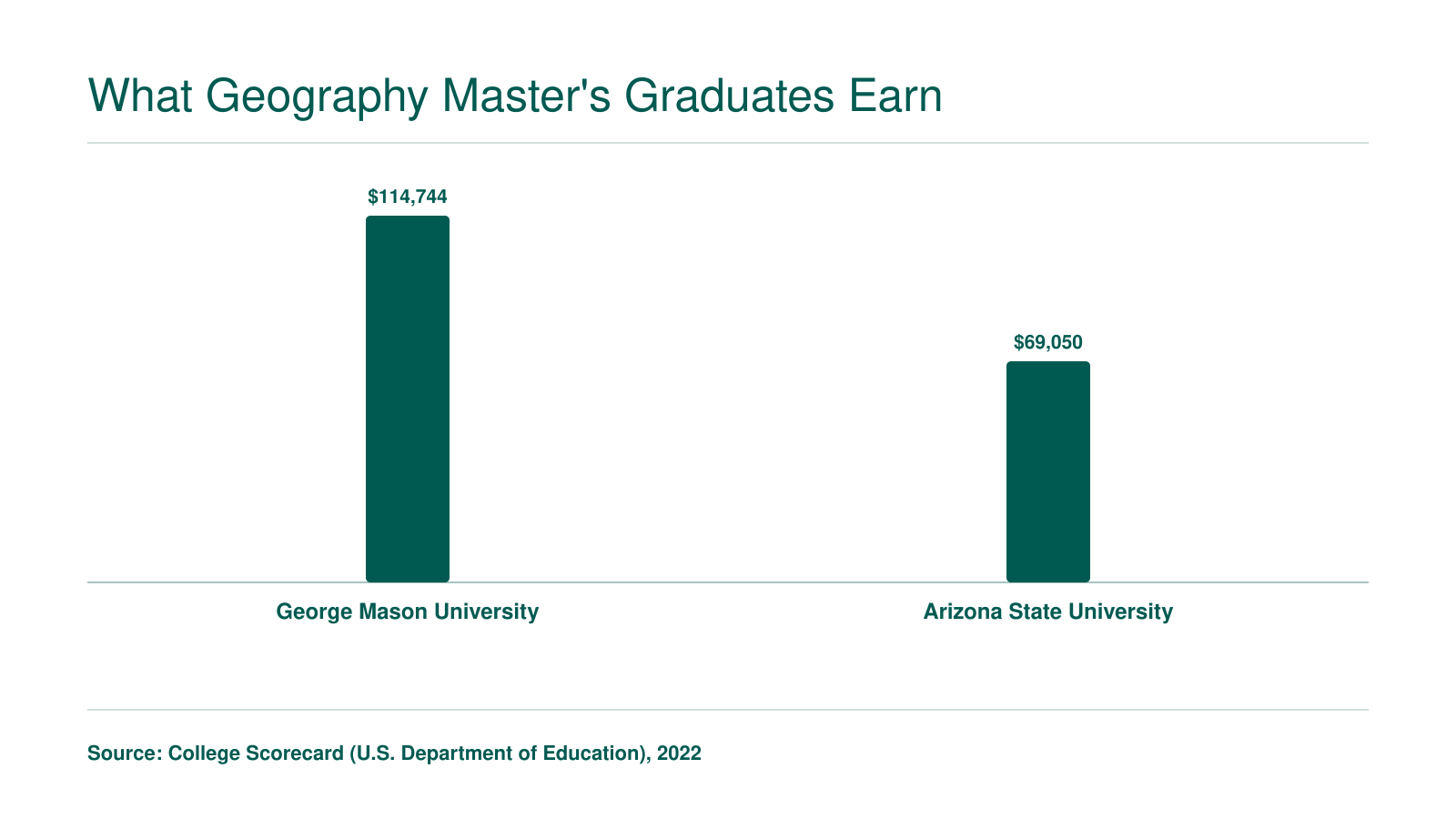
What Geography Master's Graduates Earn
Program-level median earnings four years after completion help show what graduates may expect in roles such as GIS analyst, urban planner, cartographer, and environmental consultant.
Geography programs by state
Accelerated Geography Master's FAQs
These are the questions prospective accelerated geography students ask most often. Answers draw on current program policies and deadlines, but individual requirements can shift between cycles, so confirm details with the program you are considering.
How many credits can count toward both degrees in an accelerated geography program?
When should I apply to an accelerated geography master's program?
Can I leave the accelerated track and just finish my bachelor's?
What careers can I pursue with a master's in geography?
Compare Geography programs on the data that matters
Explore more Science & Engineering specializations or browse every graduate field.
All Science & Engineering programs