Best Online MBA/MD Programs
Compare 20 accredited online MBA/MD programs, with graduate earnings, cost, debt, and completion data from IPEDS and the U.S. College Scorecard.

A medical degree cannot be earned online. Clinical rotations, patient contact, and licensing requirements keep the MD on campus and in hospitals for most of four years. Flexibility almost always applies to the MBA half, which is why the programs here are hybrid, pairing online or evening business coursework with in-person medical training.
That is the tradeoff to weigh. Several schools let you fold MBA courses into the medical school years or add one extra year, but the schedule, cost, and GMAT waiver rules vary widely. Fully online MD/MBA programs do not exist, and any program claiming otherwise deserves skepticism.
Key Points
- No fully online MD program exists; clinical training remains in person.
- In 2027, in-state graduate tuition ranges from about $7,000 to $15,800 annually.
- IU Indianapolis reports the top program-level earnings among ranked schools.
Best Online and Hybrid MD/MBA Programs Ranked for 2027
Because the MD years include clinical training that must happen in person, most MD/MBA options combine an online or hybrid MBA with campus-based medical education. The order here reflects a mixed quality composite, not a claim that one delivery format is cheaper, faster, or higher-earning. Use the cards to compare tuition, net price, and each school's graduation rate.
Texas Tech University Health Sciences Center
#1Lubbock, TX · ~$7,000/yr (est.)
Best for: Physicians pursuing healthcare organization management
Texas Tech University Health Sciences Center pairs medical training with a 42-credit Health Organization Management MBA, so students can complete both degrees within four years. The lock-step HOM concentration adds specialized courses in managed care and integrated healthcare operations alongside a field experience with local executives. For future physician leaders who want a health administration focus, this program keeps the MBA coursework inside the medical school timeline.
- AACSB and Liaison Committee on Medical Education accredited
- Complete both degrees within four years
- 42-credit MBA component
- Five HOM-specific courses
- Field experience with healthcare executives
- Online courses in second year
- Cohort-based structure
- Prerequisite tool courses for non-business backgrounds
The University of Texas Medical Branch at Galveston
#2Galveston, TX · ~$13,000/yr (est.)
Best for: Medical students seeking Houston campus pathways
The University of Texas Medical Branch at Galveston combines an MD with a flexible MBA through the University of Houston-Clear Lake, using online and in-person classes that fit around the clinical years. The program is designed for students who want healthcare finance, strategy, and leadership training without pausing medical school.
- Partnership with University of Houston-Clear Lake
- Flexible schedule with online and in-person classes
- Complete in about five years
- 39-credit MBA curriculum
- Healthcare-oriented electives
- Shared credit hours between degrees
- Separate application to College of Business
- No concurrent enrollment in courses
The University of Texas Health Science Center at Houston
#3Houston, TX · $11,000 – $34,000/yr (est.)
Best for: Working clinicians needing weekend MBA classes
UTHealth Houston's McGovern Medical School students can earn an MD/MBA through either University of Houston-Clear Lake or the Texas McCombs School of Business, with shared credit hours and online coursework. A fall 2026 partnership brings the McCombs Hildebrand MBA to Houston with weekend classes, designed to fit continued medical-school participation. This is a strong fit for Houston and Galveston students who want a Texas-based executive pathway.
- Complete in 4 or 5 years
- Shared credit hours with MBA
- Online class availability
- Two business school partners: UHCL and UT Austin McCombs
- Apply at any point in medical school
- MBA integrates with MD curriculum
- Financial aid available for each degree
University of Arkansas for Medical Sciences
#4Little Rock, AR · $10,000 – $15,000/yr (est.)
The University of Arkansas for Medical Sciences partners with the Walton College of Business to add one year of full-time MBA coursework, completed in person at the Fayetteville campus. The curriculum focuses on finance, management, and strategy for physician leaders who want to run practices or health systems. Because the business year is residential, this program suits students who can relocate for the MBA portion.
- Partnership with Walton College of Business
- One year of full-time MBA coursework
- In-person classes at Fayetteville campus
- Full-time enrollment
- Prepares future physician leaders
- Focus on finance, management, and strategy
New York University
#5New York, NY · ~$43,000/yr (est.)
New York University's dual MD/MBA in General Management, offered by Grossman School of Medicine and Stern, blends a 51-credit business curriculum with medical training. The program waives the GMAT and GRE, requiring only the MCAT, and offers an MD tuition scholarship plus merit-based support during MBA semesters. It is a strong option for students who want a finance and strategy foundation in a four-year timeline.
- GMAT and GRE waived; MCAT required
- 51-credit MBA curriculum
- Four-year dual degree timeline
- Apply during second year of medical school
- MD tuition scholarship available
- Merit-based scholarships or paid fellowships
- Capstone in professional responsibility
- Careers include medical director and consultant
University of Iowa
#6Iowa City, IA · $13,000 – $32,000/yr (est.)
The University of Iowa combines the Carver College of Medicine with the Tippie College of Business, allowing medical students to complete 33 credit hours of MBA coursework in one additional year. Classes use 8-week sessions, weeknights, and online or in-person options, and the program waives both the GMAT/GRE and the work experience requirement. It is a practical fit for students who want to add business skills without delaying residency.
- No GMAT or GRE required
- Work experience requirement waived for medical students
- 33 total credit hours
- Complete MBA in one additional year
- 8-week sessions with weeknight classes
- Online and in-person course options
- Cross-counted credits reduce total by 24 hours
- 8 concentration options
Texas Tech University
#7Lubbock, TX · $5,000 – $10,000/yr (est.)
Texas Tech University's Rawls College of Business and the Texas Tech University Health Sciences Center School of Medicine jointly offer an MD/MBA in Health Organization Management. Students complete 42 credit hours of business coursework in 18 months, including summer classes and two online courses by December of the second year, finishing both degrees within four years. The program requires acceptance from both the business and medical schools.
- 42 total credit hours
- 18-month program
- Both degrees completed in four years
- Summer classes around first medical year
- Two online courses in second year
- Joint degree with TTUHSC School of Medicine
- Advisors from both colleges
Pennsylvania State University
#8University Park, PA · ~$26,000/yr (est.)
Penn State's MD/MBA is a five-year plan that places the first three years at the College of Medicine in Hershey, the fourth year in Smeal College of Business MBA coursework at University Park, and the fifth year in combined clinical and business training. The structure gives students a residential MBA year while keeping the MD and MBA integrated. It suits students who value a dedicated on-campus business year.
- Five-year integrated program
- First three years at Hershey College of Medicine
- MBA coursework at Smeal College of Business
- Final year combines MBA and clinical rotations
- Apply separately to both programs
- Dedicated academic and student services
East Carolina University
#9Greenville, NC · ~$8,000/yr (est.)
East Carolina University's MD/MBA is open to medical students, residents, and practicing physicians, with a streamlined 14-course business curriculum and a typical GMAT waiver. The program emphasizes financial management, organizational behavior, and healthcare policy for physicians moving into administrative and executive roles. It is a flexible option for those already in clinical training or practice.
- No entrance exam required
- 14 total courses
- GMAT waiver typically available
- Open to medical students, residents, and physicians
- Focus on financial and management practices
- Prepares for healthcare leadership roles
Temple University
#10Philadelphia, PA · $23,000 – $30,000/yr (est.)
Temple University's Fox School of Business and the Lewis Katz School of Medicine offer an online MBA path for MD students, with nine of 36 MBA credits transferred from the MD program. A high MCAT percentile can waive the GMAT, and MD application materials support the business school process. The online format lets students keep medical training on schedule while building management skills.
- Online MBA option available
- 36 total MBA credit hours
- Nine MD credits transferred toward MBA
- GMAT waived with high MCAT percentile
- MD application materials support MBA process
- Dedicated academic advisor
- Partnership with Lewis Katz School of Medicine
Cost & outcomes by school
Federal data for the highest-earning MBA/MD programs, independent of the ranking above. Earnings are this field's master's graduates four years after completing, where the Scorecard reports them.
| School | Earnings | Tuition / yr | Debt | Grads/yr | Format |
|---|---|---|---|---|---|
| Augusta University GA | — | $6,992 | — | — | Hybrid |
| University of South Dakota SD | — | $7,118 | — | — | Hybrid |
| Texas Tech University Health Sciences Center TX | — | $7,153 | — | — | Hybrid |
| East Carolina University NC | — | $7,658 | — | — | Hybrid |
| Texas Tech University TX | — | $9,518 | — | — | Hybrid |
| Indiana University-Indianapolis IN | — | $11,180 | — | — | Hybrid |
| The University of Texas Health Science Center at Houston TX | — | $11,367 | — | — | Hybrid |
| University of Arkansas for Medical Sciences AR | — | $12,460 | — | — | Hybrid |
| The University of Texas Medical Branch at Galveston TX | — | $12,759 | — | — | Hybrid |
| West Virginia School of Osteopathic Medicine WV | — | $12,700 | — | — | Hybrid |
| University of Iowa IA | — | $13,425 | — | — | Hybrid |
| Wright State University OH | — | $15,771 | — | — | Hybrid |
Sources: U.S. Department of Education. Tuition and graduates: IPEDS. Earnings and debt: College Scorecard, this field's master's graduates; a dash means no figure is reported.
What Our Online and Hybrid MD/MBA Scores Actually Measure
A brand-name medical school and a truly flexible online MBA can look equally impressive on paper, but they serve different needs. A school with no online MBA option cannot help a working clinician, no matter how strong its name recognition. The scores below reward measurable outcomes and flexible delivery over reputation.
Because almost no fully online MBA/MD dual degree path exists in the United States, the ranking mixes online and hybrid programs. Online here describes MBA coursework availability only; clinical MD training stays in person everywhere, from clerkships through residency preparation.
What the scores do not mean: graduation rates are institution-wide, not program-specific, and net price is an average after aid, not a personal quote. Use those figures as comparison points, not promises. Programs are ordered by delivery flexibility combined with baseline quality signals from federal IPEDS and College Scorecard data. Prestige can sit alongside a strong score, but it is not the score.
In practice, a lower-cost hybrid program with strong graduate earnings can outrank a famous medical school whose MBA courses require frequent on-campus weekends. The question is whether the pathway works for your schedule and budget, not whether the name impresses.
Online vs Hybrid MD/MBA Formats: Residencies, Live Sessions, and Clinical Years
Fully online MD programs do not exist; the clinical training that defines medical school cannot move to a screen. What can shift online is the MBA half, and that is where formats diverge across the best online MBA programs.
Fully Online vs Hybrid Business Coursework
The business courses are the flexible piece. The University of Iowa's MD/MBA, which totals 33 semester hours across nine core courses and two electives, offers an online option, though some core classes are taught on the Iowa City campus. Indiana's Kelley Physician MBA runs as a hybrid, pairing online work with Indianapolis residencies. Johns Hopkins Carey's dual degree concentrates its coursework at the Harbor East campus, so expect in-person attendance there.
Synchronous, Asynchronous, and Shared Credits
Asynchronous courses let you log in on your own schedule; synchronous sessions and immersion weekends require you to be present at a set time. Published delivery details vary by program, so confirm the mix before enrolling. Credit-sharing shortens the road: Iowa cross-counts 24 semester hours, while Carey accepts 18 MD credits toward its 54-credit MBA, leaving 36. The business year often sits between the third and fourth years of medical school.
If you are deep in clinical rotations, favor asynchronous formats with minimal travel.
Related Articles
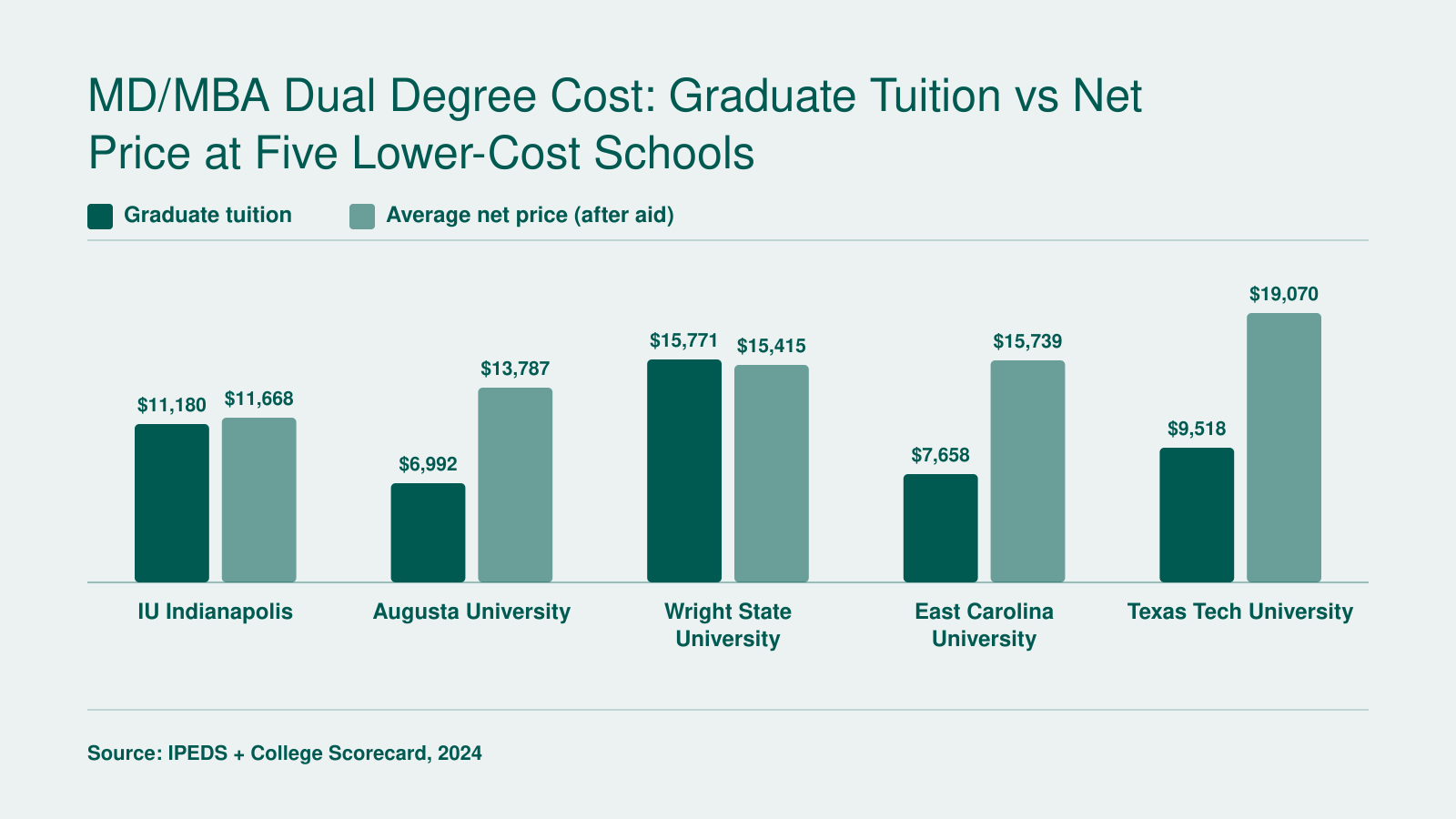
MD/MBA Dual Degree Cost: Graduate Tuition vs Net Price at Five Lower-Cost Schools
Annual graduate tuition at these schools ranges from about $7,000 to $15,800 in-state, while the institution-wide average net price after grant and scholarship aid runs from about $11,700 to $19,100. For context, AAMC reports a median four-year cost of attendance of about $297,700 at public medical schools and $408,200 at private medical schools, though individual costs vary widely. The medical-school portion dominates the total bill: published MBA-portion prices from a few programs include $1,868 per credit at Hofstra's online MBA and $93,582 total for Maryland Smith's online MBA, but a lower-cost MBA typically shaves only a small fraction off the combined MD/MBA total. These are sticker and average figures, not a personal price guarantee.
MD/MBA Admissions: Med School Acceptance, GMAT/GRE Waivers, and Deadlines
Admissions usually mean two decisions: secure your place at the medical school, then apply separately to the business school, often with the MCAT replacing the GMAT or GRE.
- Check your medical-school home firstWhere eligibility is published, the online or hybrid MBA is usually limited to students already enrolled at the affiliated medical school, such as Minnesota Carlson, Texas McCombs at Houston, or Rice Jones.
- File a separate business-school applicationApply on a separate timeline, often during the first or second year of med school. Texas McCombs accepts candidates in years 1–3.
- Ask about GMAT/GRE waivers and MCAT useMany programs waive the GMAT/GRE or accept the MCAT. WMed, Rotman, and Minnesota Carlson use the MCAT; Texas McCombs offers a waiver only after a successful petition.
- Track deadlines and cohort startsPublished 2026 dates include Texas McCombs May 28, 2026 and Rice Jones Round 2 January 6, 2026; WMed accepts rolling applications until two weeks before any semester. MBA cohort starts vary by school.
The top reported outcome among ranked programs belongs to IU Indianapolis.
Career Payoff: Where MD/MBA Graduates Lead and What ROI Looks Like
The MD/MBA question is rarely about whether the business degree helps; it is about whether it helps enough to justify the mba md dual degree cost and time for your particular path. The return looks very different for a physician aiming at a hospital corner office than for one who plans to stay in clinic.
What the Numbers Suggest
Across the online master's programs ranked here, the strongest value signals come from the Texas health science centers, where institution-wide earnings sit high against moderate debt. At Indiana University-Indianapolis, the one school reporting program-level outcomes, graduates carried median debt near $37,000 against solid earnings a few years out. Treat these return figures as a proxy built from institution-wide earnings and debt, not an MD/MBA-specific measure.
Where the Degree Pays
MD/MBA holders cluster in hospital administration, health-system C-suites, physician-executive roles, healthcare consulting, and biotech or health startups. Compensation reflects the climb: a 2016 physician-leadership survey reported median total compensation around $350,000, with physician CEOs averaging $437,500 and non-CEO physician executives averaging $499,000. Leaders holding an MBA earned about 13% more than those without.
The Timing Catch
Residency delays everything. Earnings payoff shows up years after graduation, not on day one. The practical verdict: the MBA rewards physicians targeting leadership or entrepreneurship, and adds little for a purely clinical career.
MBA/MD programs by state
Compare MBA/MD programs on the data that matters
Explore more MBA specializations or browse every graduate field.
All MBA programs