Best MBA/MD Programs in California
Compare 5 accredited MBA/MD programs in California, with graduate earnings, cost, debt, and completion data from IPEDS and the U.S. College Scorecard.

An MD/MBA is a dual degree that folds business coursework into medical school, typically stretching the standard four-year MD to five. Stanford, UCLA, UC Irvine, UC Davis, and USC all offer a version, and several admit only students already enrolled in or accepted to their medical schools.
Institution-level net prices run from about $12,500 at UCLA to about $32,700 at USC.
Tuition is only part of the bill, though. The extra year of deferred physician income usually costs more than the MBA itself.
Key Points
- Stanford GSB requires a GMAT or GRE and publishes no MD/MBA waiver.
- No fully online MD/MBA exists, since the MD portion requires in-person clinical training.
- Program-level earnings and debt for MBA/MD graduates are not published for any school here.
Best MBA/MD Schools in California: Ranked List
All five California programs below are five-year dual degrees that pair a medical school with an MBA. They differ in when you apply, how many MBA units you complete, and whether admission to medical school carries over to the business school. Graduation rates shown are each school's institution-wide figure, not a rate for the MD/MBA itself.
Stanford University
#1Stanford, CA · $60,000 – $65,000/yr (est.)
Best for: Aspiring physician-founders in biotech and venture
Stanford's MD/MBA is a five-year program that combines the School of Medicine with the Graduate School of Business, with a focus on health-care management, biotech, venture capital and consulting careers. The school's institution-wide graduation rate is about 92%. Its Silicon Valley location and hospital affiliations are a real draw for physician-entrepreneurs. Accreditation: the medical school holds full LCME status, but we could not confirm the business school's AACSB status from our sources.
- Five-year curriculum combining medical and business training
- Spans the School of Medicine and the Graduate School of Business
- Aimed at health-care management and business careers
- Draws on Silicon Valley's biotech and venture ecosystem
University of California-Los Angeles
#2Los Angeles, CA · ~$14,000/yr (est.)
Best for: Small-cohort seekers focused on California health systems
UCLA runs its MD/MBA as a five-year concurrent degree through PRIME-LA, with a small cohort of about 18 students and a leadership focus on California health care. The MBA year runs alongside the final year of medical school, and clinical shadowing keeps students connected to patient care. The school's institution-wide graduation rate is about 93%. Accreditation: Geffen School of Medicine holds full LCME status and Anderson is AACSB accredited.
- Five-year program; MBA year concurrent with final medical year
- At least 76 MBA units, with clerkships, electives and a capstone
- Apply to Anderson online in the October, January or April round
- Entrance exam required: MCAT and GRE listed
- Small cohort of about 18 students
- Financial aid and scholarships cover all five years
- Option to pursue the MBA at another accredited institution
University of California-Irvine
#3Irvine, CA · ~$15,000/yr (est.)
Best for: Current medical students adding an MBA
UC Irvine offers a five-year MD/MBA through its School of Medicine and the Paul Merage School of Business. Only current MD students in good standing may apply, and Merage makes the final admission decision. The school's institution-wide graduation rate is about 87%. Accreditation: the School of Medicine holds full LCME status and Merage is AACSB accredited.
- Five-year integrated MD and MBA curriculum
- Open to current MD students only, in good academic standing
- Apply in the second or third year of medical school
- MBA coursework begins after the third medical year
- At least 76 MBA units required
- GMAT waived with MCAT and USMLE Step 1
University of California-Davis
#4Davis, CA · $15,000 – $20,000/yr (est.)
UC Davis offers a dual MD/MBA for students who want to combine clinical training with business leadership in health-care administration and medical entrepreneurship. Admission is a two-step process: you must first be accepted to the medical school, then apply separately to the MBA program. The school's institution-wide graduation rate is about 86%. We did not verify LCME or AACSB status for UC Davis for this update, so check both directly before applying.
- Must be accepted to the medical school first
- Separate application to the MBA program
- Prepares graduates for hospital management and medical entrepreneurship
- Course-level details are not listed on the program page
University of Southern California
#5Los Angeles, CA · ~$72,000/yr (est.)
USC's MBA/MD is jointly offered by the Keck School of Medicine and USC Marshall. Students complete core medical coursework first, then 48 units of business classes, with clerkships tied to business electives. The school's institution-wide graduation rate is about 92%. Accreditation: Keck holds full LCME status, but we could not confirm Marshall's AACSB status from our sources.
- Five-year program
- No entrance exam required
- Apply after the second or third year of medical school
- 48 units of business coursework required
- Jointly offered by Keck School of Medicine and USC Marshall
- Joint degree awarded after both schools' requirements are met
Cost & outcomes by school
Federal data for the highest-earning MBA/MD programs, independent of the ranking above. Earnings are this field's master's graduates four years after completing, where the Scorecard reports them.
| School | Earnings | Tuition / yr | Debt | Grads/yr | Format |
|---|---|---|---|---|---|
| University of California-Los Angeles CA | — | $14,476 | — | — | Campus |
| University of California-Irvine CA | — | $14,827 | — | — | Campus |
| University of California-Davis CA | — | $15,141 | — | — | Campus |
| Stanford University CA | — | $61,878 | — | — | Campus |
| University of Southern California CA | — | $71,515 | — | — | Campus |
Sources: U.S. Department of Education. Tuition and graduates: IPEDS. Earnings and debt: College Scorecard, this field's master's graduates; a dash means no figure is reported.
How We Rank California MBA/MD Programs
Our ordering rests on verifiable federal data, not reputation surveys or admissions selectivity. We weigh published net price, graduate-level tuition, completion rates, and the earnings and debt figures that appear in College Scorecard where a school reports them.
One caveat matters more than any other here: MBA/MD dual degree tracks are small, and federal reporting rarely isolates them. Institution-wide numbers describe the whole university, including undergraduates and unrelated graduate fields, so treat them as context rather than a forecast of what an MD/MBA graduate earns or borrows.
Net price, the figure behind affordable MBA programs rankings, is also an average after grant aid. Your own cost depends on residency, scholarships, and how many years you spend in each degree.
Online and Hybrid MBA/MD Options in California
Online and hybrid MBA formats have expanded across online masters programs in California, but even among Best MBA Programs no fully online MD/MBA exists because the MD portion requires in-person clinical training. Stanford's joint degree is full-time and on campus, with no online or hybrid pathway identified. UC Irvine's MD/MBA uses the Full-Time MBA1; the Flex MBA can be all online, but public pages do not confirm joint-degree students may choose it. UCLA lists Saturday, weeknight, and distance/in-person FEMBA schedules without confirming MD/MBA access.2 USC Marshall offers online, hybrid, and executive MBA formats, but the joint-degree catalog does not state whether dual-degree students may use them. UC Davis lists a campus-based program without indicating an online or hybrid MBA option. Even hybrid schedules can require campus blocks, so check relocation and clinical rotation site expectations.
MBA/MD Programs That Waive or Make the GMAT/GRE Optional
Do you need the GMAT for an MBA/MD? It depends on the program. Stanford GSB requires a GMAT or GRE from all applicants, with no minimum, and publishes no MD/MBA waiver. UCLA Anderson allows a general test opt-out, but unlike many master's programs with no GRE required, that policy is not specific to MD/MBA applicants and does not establish MCAT substitution.1 USC Marshall requires the GMAT or GRE except for USC medical students in the MD/MBA; the exception is not described as MCAT substitution. UC Irvine's MD/MBA is the clearest exception: current M.D. students can use the MCAT, three years of medical school in good standing, and USMLE Step I passage as a GMAT waiver. UC Davis does not publish a waiver policy for its MD/MBA on its admissions page.
Related Articles
California MBA/MD Cost and Employer Demand
Public and private price tags in California now diverge more sharply than the degrees themselves do. UCLA has the lowest in-state graduate tuition on this list, followed closely by UC Irvine and UC Davis; net prices for California residents run in the low-to-mid teens annually. Stanford and USC, both private, carry graduate tuition above $60,000 and $70,000 respectively, though Stanford's effective net price after aid lands far below its sticker.
Published figures for 2026-27 give some sense of scale. Stanford assesses MD/MBA candidates 12 quarters of MD tuition at $24,034 each plus five quarters of General MBA tuition at $29,729, with reduced-rate quarters after that.1 USC's Keck medical budget lists $76,640 in annual tuition and estimated total costs of roughly $113,000 to $121,000 per year, including Los Angeles living expenses.2 (USC's registrar publishes medicine tuition differently by term, so treat any single figure cautiously.)3
The real cost is the extra year
Tuition is only half the math. Add a year of foregone attending-physician income to the extra year of tuition, and that is your true cost.
Who hires MD/MBAs here
California concentrates large integrated health systems, a dense biotech and life-sciences corridor around the Bay Area and San Diego, insurers, and consulting firms with healthcare practices, all of which recruit clinically trained leaders into strategy and operations roles, roles central to an MBA in Management.
How Long Does an MBA/MD Take in California?
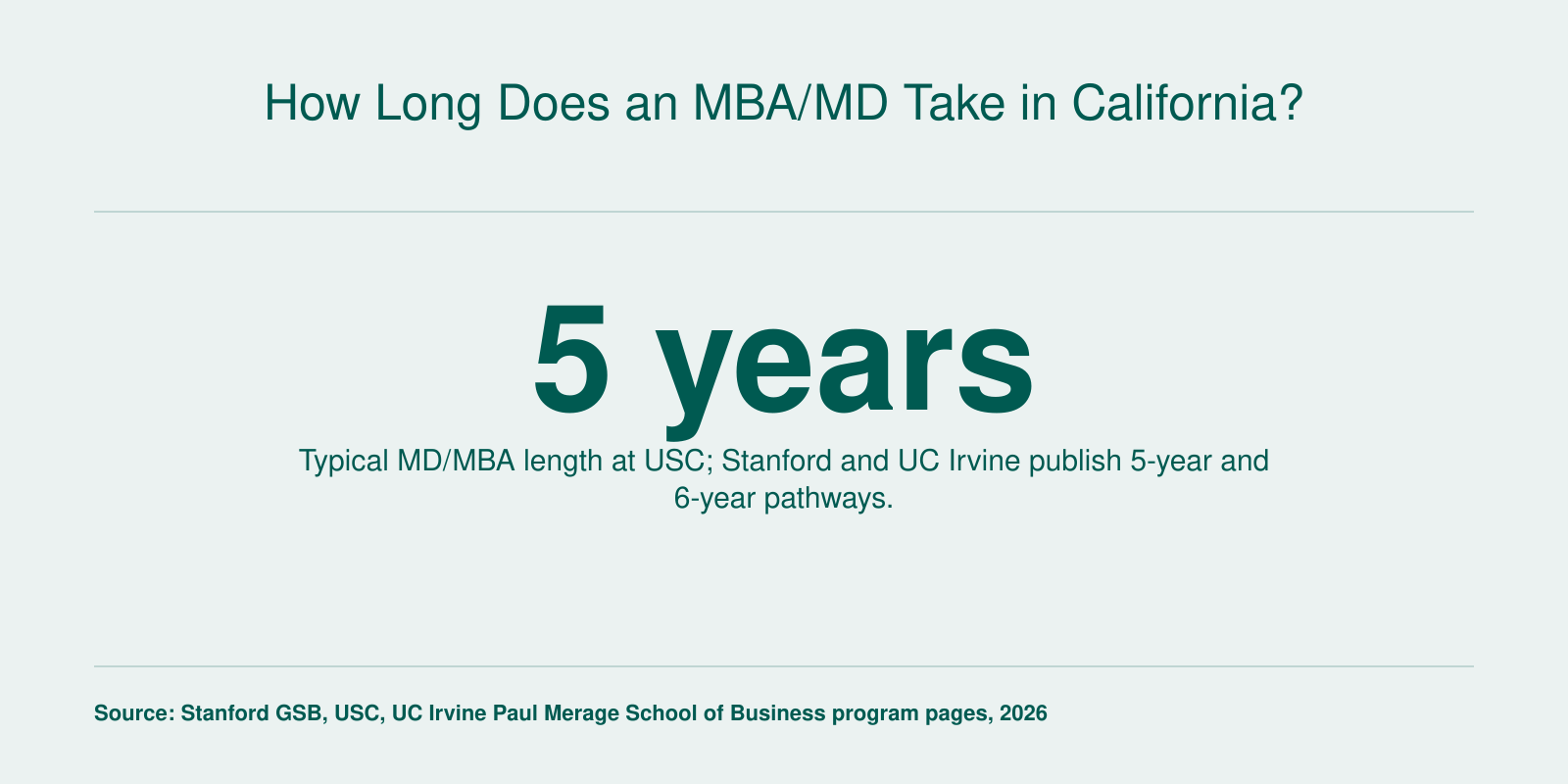
Most joint degrees follow a similar arc: preclinical MD years, a dedicated MBA stretch, clinical clerkships, then the final year and residency applications. The MBA year typically falls after year 2 or year 3 of medical school, though it varies by program. Stanford publishes 5-year and 6-year sequences depending on MD academic plan, USC states 5 years, and UC Irvine states 5 or 6 years. Published 2026 program pages do not confirm a 4-year option at any of these schools, and no MD/MBA timeline is established here for UCLA.
Is an MBA/MD Worth It? Salary and Career Outcomes
Program-level earnings and median debt for MBA/MD graduates are not published for any school on this list, so there is no school-specific payoff figure to quote. We won't substitute institution-wide numbers.
What exists is national and cautious. A 2026 dual-degree review found overall residency match rates of 84% to 88% across degree pathways, with no significant difference between MD-MBA and MD-only students. That study used Texas data, not California programs. Typical paths include CMO, health-system executive, consulting, and biotech. National CMO pay is reported at roughly $378,000 to $502,000, but that is not specific to California or to the MBA itself.
The verdict: the dual degree pays off for physicians heading toward organizational leadership, industry, or entrepreneurship, where business training is directly relevant. For a purely clinical career, the added year and tuition are harder to justify, since the evidence does not show the MBA raises clinical earnings or match outcomes.
The fifth year of an MD/MBA is rarely free: students pay a year of tuition while giving up a year of attending-physician income, which is the larger cost of the two.
Admissions Requirements for California MBA/MD Programs
MD/MBA admission is usually two decisions, not one. Confirm current details on each school's admissions pages, since policies and dates change.
- Two separate admissions tracksMedical school admission comes first, through AMCAS. The business school application is separate, and students often file it during medical school. Stanford states that applicants need admission to both the School of Medicine and the Graduate School of Business.
- Required testsThe MCAT is part of the medical application. Stanford's MBA requires the GMAT or GRE. UCLA's 2026–2027 MBA requirements list the GMAT Focus, GRE, and Executive Assessment as optional. USC, UC Irvine, and UC Davis do not have an MD/MBA test policy confirmed here, so check their pages.
- Timing and deadlinesStanford's MBA deadlines for 2026 entry are Sept. 9, 2026, Jan. 6, 2027, and Apr. 7, 2027. UCLA lists October, January, and April rounds, with exact dates on its MBA site. UCLA's MD deadlines, including the Oct. 1, 2026 AMCAS primary, are not MBA deadlines.
- Concurrent or after matriculationStanford advises MD students to apply to the MBA in year 2 or 3, and applicants in year 1 or 2 may be eligible to defer enrollment. The sources reviewed do not establish whether Stanford allows a fully concurrent application. They also do not establish the process at UCLA, USC, UC Irvine, or UC Davis, so confirm with each program.
- Essays, interviews, recommendationsExpect MBA essays, recommendations, and an interview, separate from your medical school materials. Requirements vary by school, so review each program's current application instructions.
MBA/MD in California: Common Questions
Is there financial aid or scholarship money specifically for MD/MBA students in California?
Do federal loans and med school scholarships cover the MBA year?
What is the salary after an MD/MBA?
Can you add the MBA after you've already started medical school?
Compare MBA/MD programs on the data that matters
Explore more MBA specializations or browse every graduate field.
All MBA programs