Best Master's in Marriage and Family Therapy Programs in Connecticut
Compare 6 accredited Marriage and Family Therapy programs in Connecticut at 4 schools, with graduate earnings, cost, debt, and completion data from IPEDS and the U.S. College Scorecard.

In Connecticut, the cheapest program, the most flexible format, and the accredited choice are not always the same school.
Annual graduate tuition runs from $14,562 at Central Connecticut State University to $21,448 at Fairfield University, with Southern Connecticut State University and University of Saint Joseph in between.
Only Central Connecticut State, Fairfield, and Southern Connecticut State hold COAMFTE accreditation, which shapes clinical placement and licensure.
Key Points
- CCSU keeps in-state graduate tuition near $13,050 for Connecticut residents.
- Fairfield University MFT graduates earn a median $74,031 four years later.
- Southern Connecticut State waives the GRE and offers online MFT tracks.
Connecticut's Best Master's in Marriage and Family Therapy Programs, Ranked
Each spot in this ranking reflects what a student pays, how graduates fare after leaving, and how flexibly the degree can be earned, rather than prestige alone. The four Connecticut master's in marriage and family therapy programs below are compared on those practical terms.
Fairfield University
#1Fairfield, CT · ~$21,000/yr (est.)
Best for: Learners wanting in-person clinical practice
Fairfield University's 60-credit Master of Arts in Marriage and Family Therapy stands out for its two Connecticut-focused concentrations: Queer and Trans Mental Health and School-Based Marriage and Family Therapy. Its on-campus Kathryn P. Koslow Center provides supervised clinical experience with individuals, couples, and families, and the program is COAMFTE-accredited through 2027, though the directory does not specify an exact expiration date. The university reports an institution-wide graduation rate of about 84%, and the program is delivered on campus.
- 60-credit master's program
- 3.0 GPA required
- 500 direct clinical hours
- 100 hours of supervision
- 3-6 year completion time
- Clinical training sequence
- Relational therapy focus
- Diverse communities coursework
- 21-credit certificate for school certification
- Seven required courses
- 300 hours supervised experience
- For current MFT master's students
- For licensed MFT graduates
- Connecticut state certification focus
- 9-credit concentration
- Requires 60-credit MFT master's
- Clinical training sequence mandatory
- Tevera Site Placement Process
- One-time $215 site placement fee
- Capstone presentation required
- Thesis seminar included
Central Connecticut State University
#2New Britain, CT · ~$15,000/yr (est.)
Best for: Working adults needing flexible evening classes
Central Connecticut State University offers a 63-credit Master of Science in Marriage and Family Therapy with a hybrid schedule built for working adults. The program is COAMFTE-accredited with a current period through May 1, 2030 and a next review in Spring 2030, and it does not require the GRE or GMAT. The university's institution-wide graduation rate is about 48%, and the curriculum includes practicum and internship placements.
- 63-credit Master of Science
- Flexible evening schedule
- No GRE or GMAT required
- COAMFTE accredited
- Meets Connecticut licensure requirements
- Practicum and internship included
- Three-year completion timeline
- State-of-the-art clinical lab
Southern Connecticut State University
#3New Haven, CT · ~$15,000/yr (est.)
Best for: Students comparing campus and online tracks
Southern Connecticut State University's Marriage and Family Therapy program lets students choose between identical on-ground and online coursework. On-ground students can complete a two-year or three-year track with the program's on-site clinic, while the online track is a two-year format with off-campus clinical placements. The program is COAMFTE-accredited with a next review in Fall 2030, and the institution-wide graduation rate is about 50%.
- On-ground or online tracks
- Identical coursework in both tracks
- On-ground includes on-site clinic
- Online clinical work at off-campus placements
- Two-year on-ground option
- Three-year on-ground option
- Online track is two years
- Year-long internship required
University of Saint Joseph
#4West Hartford, CT · ~$18,000/yr (est.)
University of Saint Joseph in West Hartford offers a 60-credit Master of Arts in Marriage and Family Therapy with full-time and part-time options. The family systems curriculum includes practicum experiences, basic therapy skills, and DSM and psychopathology. COAMFTE lists the university among Connecticut master's programs, but the available directory does not confirm a current accreditation status or next review date for this program, so students should verify directly with the program.
- 60-credit program
- Full-time and part-time options
- Family systems orientation
- Includes practicum courses
- Covers DSM and psychopathology
- Requires 2.7 GPA
- Two reference letters required
- Personal essay and group interview required
Cost & outcomes by school
Federal data for the highest-earning Marriage and Family Therapy programs, independent of the ranking above. Earnings are this field's master's graduates four years after completing, where the Scorecard reports them.
| School | Earnings | Tuition / yr | Debt | Grads/yr | Format |
|---|---|---|---|---|---|
| Fairfield University CT | $74,031 | $21,448 | $51,250 | 47 | Campus |
| Central Connecticut State University CT | $68,969 | $14,562 | $61,500 | 17 | Hybrid |
| Southern Connecticut State University CT | $61,932 | $14,930 | $41,000 | 37 | Campus |
| University of Saint Joseph CT | — | $17,604 | — | 21 | Campus |
Sources: U.S. Department of Education. Tuition and graduates: IPEDS. Earnings and debt: College Scorecard, this field's master's graduates; a dash means no figure is reported.
Cost, debt & payoff
Median earnings of this field's master's graduates (4 yrs after completing) vs. their median federal loan debt · U.S. College Scorecard
Across these programs the median graduate earns about $74,031 and finishes with roughly $51,250 in debt — a ratio that clears a common rule of thumb (keep debt below first-year salary). Tuition and debt vary widely school to school, so check the per-school figures in the table above before you shortlist.
Behind the List: How We Scored Connecticut MFT Master's Programs
The rankings here for best marriage and family therapy master's programs lean on a few concrete, verifiable inputs rather than reputation:
- Cost: Published graduate tuition plus the average net price an institution charges after aid is applied.
- Outcomes: Program-level graduate earnings and typical borrowing drawn from federal College Scorecard data.
- Scale and access: How many students complete each program, and whether it runs on campus, hybrid, or online.
The net price figure is a school-wide average after aid, not a quote for any individual student. Your actual cost depends on your own aid package.
Accreditation is reported alongside each program, but treat it as a licensure must-check, not a scoring bonus. In Connecticut, COAMFTE accreditation can shape your path to licensure, so confirm it before you enroll.
GRE Policies at Connecticut MFT Master's Programs: Required, Optional, or Waived?
Only Southern Connecticut State University states plainly that GRE scores are not required, a policy shared by many master's in marriage and family therapy programs with no GRE required. It also asks for a 3.0 GPA, though applicants between 2.5 and 2.99 may be admitted conditionally if they earn a 3.5 over their next 12 MFT credits. Applicants interview in a group, and no specific 2026 deadline is published.
- Fairfield University: Its own pages do not state a GRE policy; a secondary profile says none is required for 2026-2027, so confirm it. Interview: mandatory in-person group. Priority deadlines: March 1 (fall) and October 1 (spring). Whether later applications are accepted is not stated.
- Central Connecticut State University: No GRE policy appears on the pages we reviewed for CCSU master's programs. GPA minimums are 2.70 undergraduate, with one page also citing 3.00 for graduate work. Interview by invitation. Fall admission only, with a February 1 deadline.
- University of Saint Joseph: No official GRE policy or dates are published here; a secondary profile describes test-optional admission and a possible supplemental interview. Deadlines shift yearly.
No psychology major is required at CCSU or SCSU. Both ask only for a bachelor's degree.
Online and Hybrid Master's in MFT Options for Connecticut Students
Nationally, online master's in marriage and family therapy programs have expanded, but Connecticut's programs remain largely campus-based once clinical work begins. Southern Connecticut State University is the clearest exception: it offers on-ground and fully online tracks, with the online track using the same courses and clinical expectations and requiring a yearlong internship at Connecticut-approved sites. Central Connecticut State University's catalog describes an evening track rather than a separate online or hybrid path, though some directories label the program hybrid, so verify the current format with the department. Fairfield University and University of Saint Joseph are primarily on campus, with USJ classes often held late afternoon and evening.
Even in SCSU's online track, clinical practicum hours must be completed in person at approved placements. Published timelines point to roughly two years full-time at SCSU, about three years full-time at CCSU, and 30 to 42 months at Fairfield depending on pace, with USJ reporting about two to three years full-time; students prioritizing speed should compare accelerated master's in marriage and family therapy programs carefully. Connecticut residents considering out-of-state online COAMFTE programs should confirm clinical placement support in the state before enrolling.
Graduate Tuition Compared: In-State vs. Out-of-State at Connecticut MFT Schools
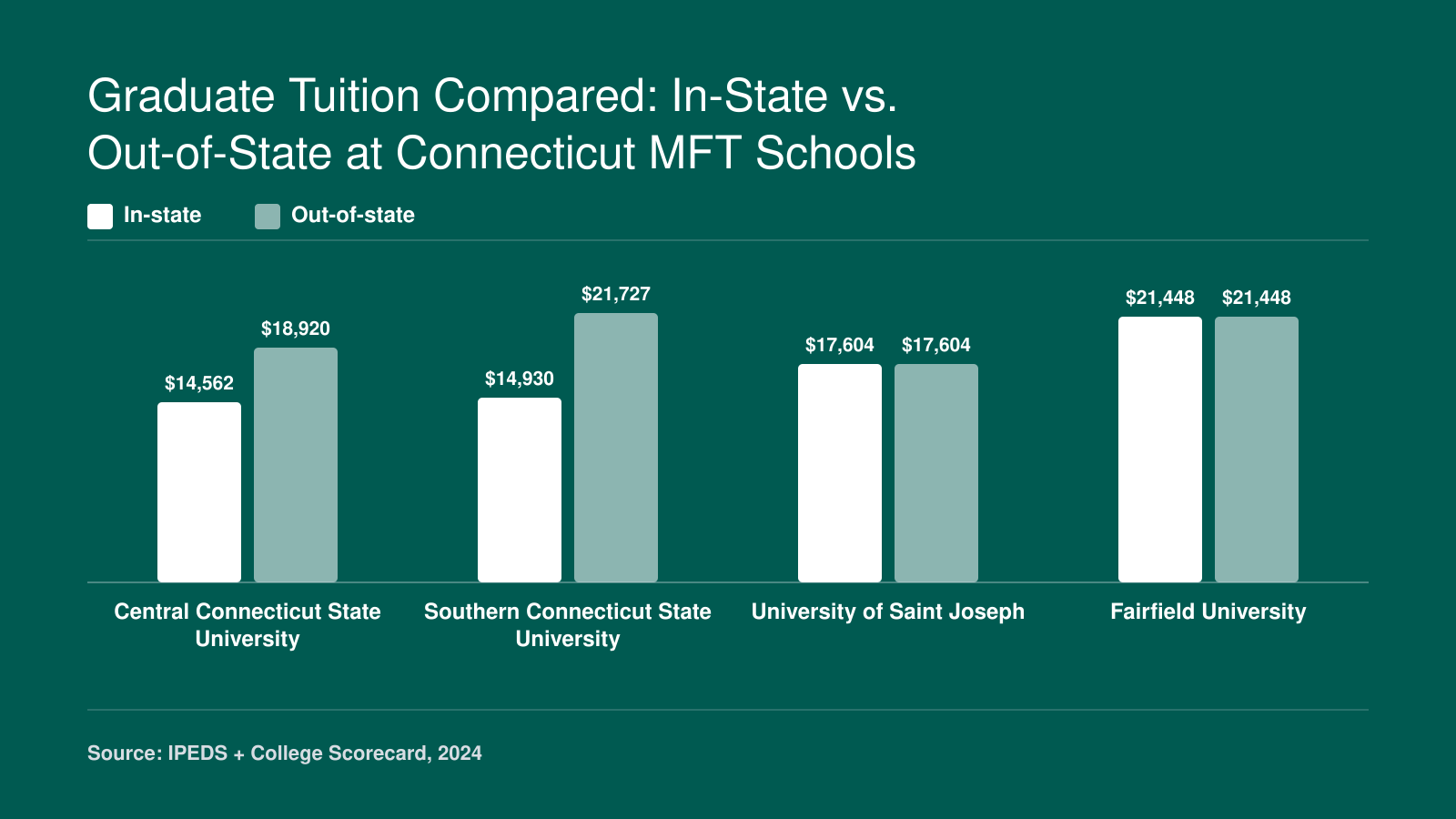
These figures are annual graduate tuition and fees, not the full degree cost. Public universities in Connecticut charge separate in-state and out-of-state rates, while private universities typically charge the same rate for all students.
What a Connecticut MFT Master's Costs and What Licensure Requires After Graduation
CCSU is the most affordable starting point here, placing it among the Most Affordable Master's in Marriage and Family Therapy Programs, with published graduate tuition near $13,050 for in-state students and an estimated net price around $16,900 once fees are counted. Its program runs 63 credits, so your total tuition cost scales with that credit load. SCSU sits in a similar range for in-state enrollment, though its out-of-state rate climbs sharply. The two private options, University of Saint Joseph and Fairfield University, carry notably higher published tuition, with Fairfield the steepest of the group. Fairfield also lists a $65 application fee, which is nonrefundable but separate from enrollment costs.
Debt and Repayment
Median program debt runs roughly $22,000 to $27,000 across the schools where it is reported, translating to estimated monthly payments in the range of about $470 to $580 on a standard ten-year plan. Treat these as typical figures, not guarantees; your own borrowing depends on aid, living costs, and how long you take to finish.
The Path to Licensure
Connecticut's LMFT credential requires a graduate degree from a COAMFTE-accredited program (CCSU, SCSU, and Fairfield qualify) plus 500 direct clinical hours and 100 supervision hours during your practicum. After graduating, you complete 24 months of supervised postgraduate work totaling at least 1,000 direct client-contact hours and 100 supervision hours, at least 50 of them individual, then pass the AMFTRB national exam.
Many graduates hold the associate LAMFT license ($125, renewable every two years) while logging those postgraduate hours. Expect two to three years of study plus roughly two years of supervised practice before full licensure.
Related Articles
Practicum and Internship Hours: How Connecticut MFT Programs Compare
One path trains you in a university-run clinic before sending you into the community. The other places you at an approved outside site from the start. Fairfield follows the first model, and CCSU follows the second.
Against the COAMFTE baseline of 500 direct client contact hours, Fairfield requires 500, including 200 relational (couple and family) hours. Its practicum pairs five weekly hours at the on-campus Koslow Center, which serves clients in person or by telehealth, with five to 10 hours at a community family-therapy agency. Internship is off-campus at 10 to 15 clinical hours weekly.
CCSU's handbook lists 400 clinical hours, 200 of them relational, with practicum at a community site for 12 hours weekly. A separate policies document cites 500 hours, so confirm which figure applies to your cohort. There is no named on-campus MFT clinic at CCSU.
Supervision
Fairfield requires 100 supervision hours, at least 50 of them individual and directly observed. CCSU also requires 100 hours under an AAMFT Approved Supervisor, with weekly individual and group components. SCSU's hour requirements are not confirmed here, so ask the program directly.
Tip: ask admissions how placements are arranged, because some students must find their own sites.
Connecticut LMFT Licensing at a Glance
What Connecticut MFT Master's Graduates Earn After Completion
A higher salary figure means little if the debt behind it is larger, so read earnings and borrowing together. Fairfield University graduates of the master's in marriage and family therapy report median earnings of $74,031 four years after finishing, against median program debt of $51,250. Southern Connecticut State University graduates report $61,932 four years after finishing, with median debt of $41,000, the lowest borrowing among the schools with published figures. Central Connecticut State University graduates report $55,602 five years after finishing, but median debt of $61,500 is higher than that figure, so budget carefully there.
Treat these numbers as early-career snapshots. Much of that window overlaps the supervised, pre-licensure period, when associates typically earn less than fully licensed therapists. Pay often rises after licensure, so these medians likely understate what a settled career pays.
Compare Marriage and Family Therapy programs on the data that matters
Explore more Counseling specializations or browse every graduate field.
All Counseling programs