Accelerated Master's in Marriage and Family Therapy Programs
Compare 270+ accredited fastest Marriage and Family Therapy programs at 220+ schools, with graduate earnings, cost, debt, and completion data from IPEDS and the U.S. College Scorecard.

An accelerated master's in marriage and family therapy is a clinical degree packed into a year-round calendar: Arizona State's 39-credit program runs 16 to 18 months, versus the usual two to three years. Speed does not lower the licensure bar, though. COAMFTE still expects 300 direct client-contact hours.
The programs here span campus, online, and hybrid formats, with average annual net prices from $19,409 to $25,890. A shorter degree trims tuition months, not the supervised post-degree hours state boards require before independent practice.
Key Points
- Summer terms and year-round enrollment compress the standard 24 to 36 month timeline.
- COAMFTE mandates at least 100 relational client-contact hours, even on compressed calendars.
- Just 29 of 98 COAMFTE-accredited master's programs offer online or distance formats.
Accelerated Marriage and Family Therapy Master's Programs Worth Your Shortlist
A faster MFT degree is only a good value if it still fits your state licensure path and clinical hour requirements. These programs are arranged with the shortest realistic timeline in mind, so compare delivery format, accreditation, and out-of-pocket cost rather than name recognition.
University of the Pacific
#1Stockton, CA · ~$55,000/yr (est.)
Best for: California licensure-focused students preferring hybrid flexibility
This hybrid counseling psychology degree is built for a faster route to California MFT licensure, with coursework in family systems, psychopathology, ethics, and practicum. It has small classes and an experiential focus, and it is not currently listed as COAMFTE-accredited but is approved by California's Board of Behavioral Sciences.
- Hybrid online and in-person course format
- Two-year curriculum with accelerated pacing
- Includes counseling practicum and licensure preparation
- No I-20 for international visa students
Arizona State University
#2Scottsdale, AZ · ~$11,000/yr (est.)
Best for: Related-field graduates seeking clinical immersion
This accelerated 16-to-18-month master's targets students who already hold a related bachelor's or master's with a 3.0 minimum GPA. It requires 39 credits, a research paper, and a 12-month supervised internship with 300 client-contact hours; COAMFTE accreditation is not listed, but it prepares graduates for Arizona licensure.
- 39 credit hours and a master's research paper
- 300 client-contact hours in a 12-month internship
- Application includes three recommendations and English proficiency proof
- Prepares for Arizona MFT licensure
Mount Mercy University
#3Cedar Rapids, IA · $10,000 – $15,000/yr (est.)
Best for: Iowa students prioritizing evening campus pacing
This COAMFTE-accredited program is Iowa's only such degree, delivered in evening campus classes and 5- and 10-week blocks. The 60-credit, 24-month path includes a one-year clinical practicum at an on-site clinic, and applicants do not need a GRE.
- 60 credit hours completed in 24 months
- Evening classes in 5- and 10-week blocks
- $635 per credit; partner employees get 10% discount
- Median earnings one year after completion: $45,912
La Salle University
#4Philadelphia, PA · ~$29,000/yr (est.)
This on-campus master's can be completed full time or part time in two to four years and includes a one-year clinical placement. The COAMFTE-accredited curriculum emphasizes systems theory, assessment, and intervention, with start terms in August and January.
- COAMFTE-accredited master's program
- Full-time or part-time enrollment
- One-year clinical placement with field assistance
- Median earnings one year after completion: $35,143
Toccoa Falls College
#5Toccoa Falls, GA · $10,000 – $15,000/yr (est.)
This fully online, asynchronous MFT degree uses 60 credits and takes about two and a half years. It is SACSCOC-accredited and pursuing COAMFTE accreditation, and its clinical sequence includes 150 relational client contact hours as part of a 300-hour requirement for Georgia LMFT licensure.
- Fully online and asynchronous
- $525 per credit; total tuition under $32,000
- 300 direct client contact hours, 100 supervision hours
- Pursuing COAMFTE; meets Georgia LMFT requirements
Geneva College
#6Beaver Falls, PA · ~$13,000/yr (est.)
This marriage, couple, and family counseling concentration is CACREP-accredited, not COAMFTE-accredited, and requires 60 credit hours. It includes a 100-hour practicum and 600-hour internship, with accelerated 8-week online courses in a low-residency hybrid format.
- 60 credit hours at $699 per credit
- 100-hour practicum and 600-hour internship
- Hybrid and accelerated 8-week online courses
- Minimum 3.0 GPA; up to 9 transfer credits
None of the ranked Marriage and Family Therapy programs match the fastest lens yet. The full ranking is at the link above.
Cost, debt & payoff
Median earnings of this field's master's graduates (4 yrs after completing) vs. their median federal loan debt · U.S. College Scorecard
Across these programs the median graduate earns about $60,234 and finishes with roughly $57,049 in debt — a ratio that clears a common rule of thumb (keep debt below first-year salary). Tuition and debt vary widely school to school, so check the per-school figures in the table above before you shortlist.
How Fast-Track MFT Degrees Shrink a Two- to Three-Year Timeline
A standard marriage and family therapy master's typically takes 24 to 36 months, while an accelerated track usually finishes in roughly 16 to 24 months. Most fast-track programs pull three levers:
- Year-round enrollment: summer terms keep you moving instead of pausing.
- Heavier course loads: you carry more courses in each term.
- Cohort models: you move through a fixed sequence of courses with the same group.
Colorado Christian University, for example, runs courses two at a time in blocks that typically last seven weeks.
Actual timelines vary by school. Arizona State University's accelerated option takes 16 to 18 months for 39 credits. Utah Valley University runs five sequential semesters, about 20 months if you stay on schedule. Whitworth University fits 64 credits into 23 months.
Acceleration shrinks the calendar, not the workload. MFT@Northwestern's 21-month and 36-month paths share the same curriculum and the same 400 fieldwork hours. Colorado Christian requires 63 credits whether you finish in 24 months or 33.
COAMFTE Status and State Licensure: Will a Faster Degree Still Qualify You?
Accreditation shortcuts are narrower than many fast-track marketing pages suggest. Every state and DC licenses MFTs, but boards differ on education rules: some treat COAMFTE accreditation as strong proof, while others still review coursework one applicant at a time.
- California: The Board of Behavioral Sciences recognizes COAMFTE but not CACREP, and it still checks each transcript against state unit, coursework, and practicum rules. The licensing handbook lists a 60-unit degree and a 150-hour practicum minimum, while a 2025 board presentation describes 300 direct clinical contact hours, 100 of them relational. Ask the board which applies to your cohort. The 3,000 supervised hours over at least 104 weeks come after graduation.
- Texas: A COAMFTE master's is a listed qualifying route, but the Behavioral Health Executive Council does not pre-evaluate coursework. You submit a full application for review. The 300/150/75 practicum thresholds belong to the CACREP alternative.
- New York: A COAMFTE degree counts as equivalent only when accredited under the 2005 Standards, and qualifying programs need a 300-hour supervised practicum.
Before enrolling, confirm with your target state board and review LMFT licensure requirements by state, especially if an online MFT program is based in another state.
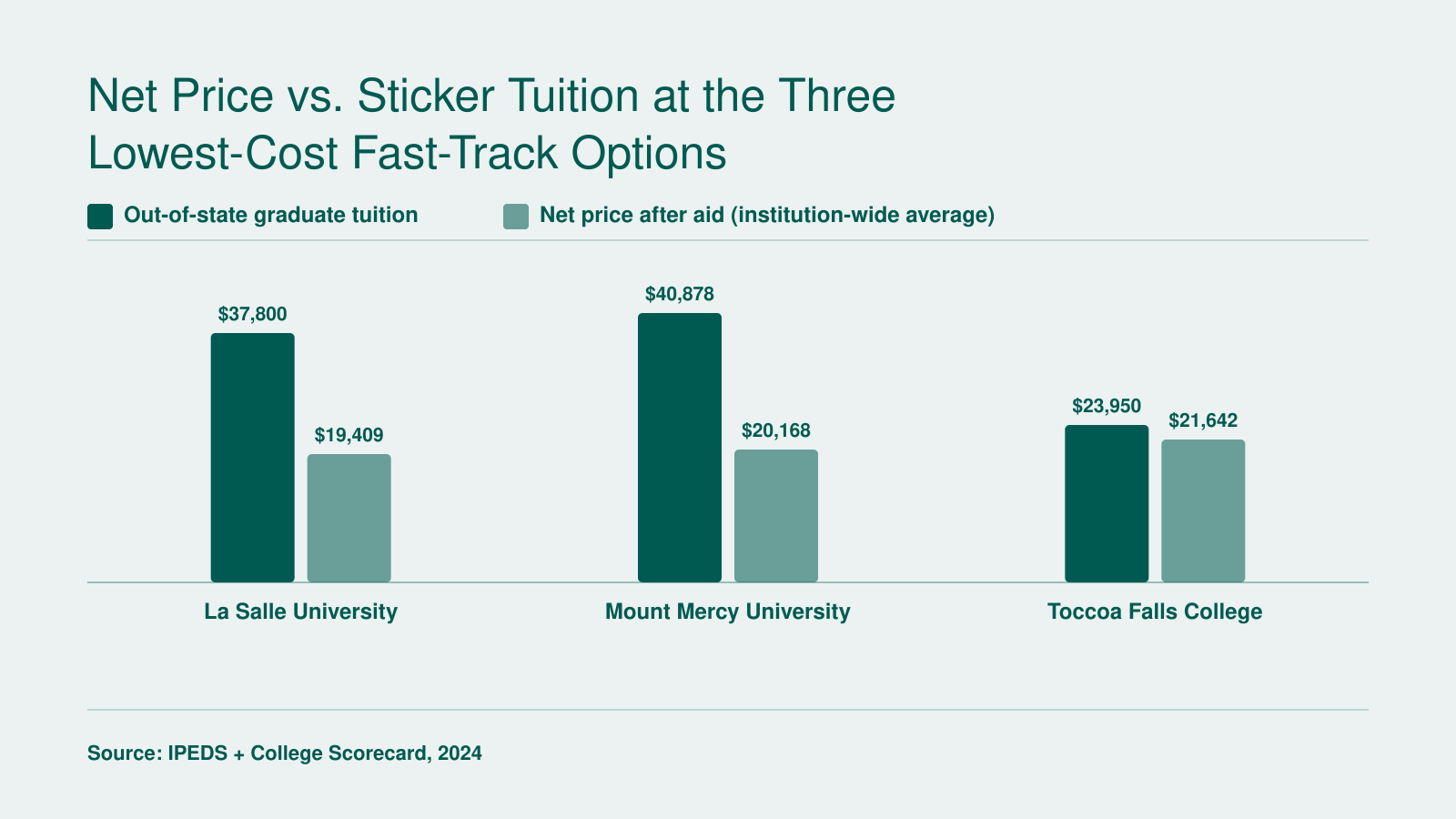
Net Price vs. Sticker Tuition at the Three Lowest-Cost Fast-Track Options
The out-of-state tuition figures reflect published sticker prices from federal data; net price is an institution-wide average after grants and scholarships, not a guaranteed quote for any student. Technology fees, residency travel, liability insurance, and supervision or practicum fees are common additional costs not included in these bars.
Related Articles
Client-Contact Hours on a Compressed Calendar
Speed is the selling point of fast-track MFT degrees, but clinical hours are the one part of the curriculum that cannot be compressed. COAMFTE requires at least 300 direct client-contact hours, including at least 100 relational hours, spread over a minimum of 12 months of clinical practice. Students also need 100 hours of supervision, and at least 50 of those must use recorded or live observable data. Accelerated and online tracks get no exemption, and some programs set higher totals than the minimum.
So faster programs rearrange the work rather than shrink it. They start placements earlier, run clinic alongside coursework, and often lean on on-site training clinics where supervision is built in.
Who Secures Your Site
COAMFTE requires formal site agreements and oversight, not a guaranteed placement. Models differ. Some programs maintain approved-site networks or placement staff. Others expect you to find the site. Capella's online program makes the student responsible for locating a site, then verifies it can deliver the required activities and supervision. Kairos University's 2025-2026 MFT program also puts placement on the student, with an internship of 21 to 24 months.
A student-found site that stalls or falls through can delay graduation, so ask each program how placement works before you commit.
According to COAMFTE's 2026 directory, 98 master's programs hold accreditation. Only 29 offer online or distance formats, and just 13 are fully online. A fully remote, accredited degree is far rarer than most applicants expect.
Fully Online, Hybrid, or Campus: Residency Rules for Fast-Track Students
Online delivery has widened access to fast-track MFT programs, but residency rules still differ sharply from one program to the next. Northwestern's online program requires one 3-day immersion in Chicagoland, and its live classes run Tuesday and Thursday. Syracuse's online M.A. meets synchronously two evenings a week and encourages, but does not require, a 3-day campus residency. National University has no residency at all. Concordia Irvine asks for one Irvine residency, though its length is not specified.1 Loma Linda is fully online with no relocation, over nine consecutive quarters.
In-person clinical work is the one thing no format removes. Even a "fully online" program places you at a site in your own community with an approved supervisor. Northwestern requires 400 clinical hours, including 100 relational. National requires 300 direct client-contact hours, at least 50 of them in person. California counts two-way real-time video as face-to-face, but other states may not, so check your state board before choosing a format, since that choice affects licensure portability.
What Accelerated MFT Programs Ask of Applicants
- Degree and GPAA bachelor's degree is standard; published GPAs vary from 2.5 at Mercer to 3.0 at Loma Linda, Utah Valley, and Azusa Pacific, with CSUN at 2.75.
- PrerequisitesNorthwestern expects psychology or human-development coursework unless your major fits; PLU and CSUN list specific psychology courses; APU may require abnormal psychology.
- Tests and interviewsGRE is not required at USC, Loma Linda, or UVU, but CSUN does require it. Interviews are often by invitation, including a Zoom interview at Loma Linda.
- Deadlines and termsNorthwestern's January 2027 cohort closes October 26, 2026; UVU's fall deadline is December 1, 2026; CSUN's is January 15, 2027; Loma Linda's is March 1, 2027; USC's summer final is March 15, 2027.
- Cohort selectivityCohort-size caps aren't published; invited interviews and priority or final deadlines signal selective entry.
Marriage and Family Therapy programs by state
Quick Questions Before You Commit to a Fast-Track MFT Degree
Is a full-time job realistic during an accelerated MFT program?
How long after an accelerated MFT degree until I can see clients without supervision?
How long does an accelerated MFT program take to complete?
Compare Marriage and Family Therapy programs on the data that matters
Explore more Counseling specializations or browse every graduate field.
All Counseling programs