Best Master's in Marriage and Family Therapy Programs in Maryland
Compare 2 accredited Marriage and Family Therapy programs in Maryland, with graduate earnings, cost, debt, and completion data from IPEDS and the U.S. College Scorecard.

Maryland does not license "LMFTs." Its Board of Professional Counselors and Therapists issues the LGMFT at the graduate level and the LCMFT after supervised practice, so searchers using "LMFT" are in the right place.
The catch is supply. In-state master's options in marriage and family therapy are scarce, so the program you pick shapes your licensure path from day one.
Only the University of Maryland-College Park holds COAMFTE accreditation in the state. The others hinge on how their coursework maps to Board rules.
Key Points
- University of Maryland-College Park is the only COAMFTE-accredited MFT master's in the state.
- Maryland licensure asks for 60 credits, so UMD's 45-credit degree needs extra coursework.
- Check each school's admissions page for GRE rules before you apply for 2027.
Maryland's Master's in MFT Programs, Ranked by Value and Outcomes
This list weighs what students pay against what they get back, using federal IPEDS and College Scorecard data. Only three Maryland schools in our dataset offer a master's-level path in marriage and family therapy, and they differ sharply in accreditation, licensure focus, and cost. Tuition figures are annual graduate rates. Net price is an institution-wide average after aid, not a quote.
University of Maryland-College Park
#1College Park, MD · ~$18,000/yr (est.)
Best for: Aspiring therapists wanting on-campus clinic training
The University of Maryland-College Park offers a Master of Science in Couple and Family Therapy through its School of Public Health. The program is COAMFTE accredited and trains students at the on-campus Center for Healthy Families clinic. Graduate tuition runs about $16,891 for in-state students and $36,822 for nonresidents, and the institution's average net price after aid is about $15,678. The university graduates 89% of its students. The degree can be extended with approved electives toward the 60 credits generally required for Maryland licensure.
- COAMFTE accredited
- 45 to 51 credits, with thesis and non-thesis options
- Add approved electives to reach Maryland's 60-credit licensure standard
- Supervised clinical training at the Center for Healthy Families
- Clinic serves English- and Spanish-speaking couples and families
- Fall admission only, with a December 1 deadline
- Application goes through the Graduate School portal
Mount St. Mary's University
#2Emmitsburg, MD · $10,000 – $15,000/yr (est.)
Best for: Students planning California licensure
Mount St. Mary's University, in Emmitsburg, offers a Master of Science in Counseling Psychology with a specialization in Marriage and Family Therapy. The listed program is campus-based and oriented toward California licensure. Maryland applicants should compare its credit structure with the state's requirements before applying. Graduate tuition is about $14,351, the institution's average net price after aid is about $22,655, and the university graduates 65% of its students.
- Marriage and Family Therapy specialization
- Campus-based format
- Prepares students for California licensure
- Requires a bachelor's degree with a 3.00 GPA
- Introductory psychology course required if the degree is not in psychology
- Emphasizes evidence-based practice and cultural competence
- Includes applied-setting experience
Washington Adventist University
#3Takoma Park, MD · $10,000 – $15,000/yr (est.)
Best for: Psychology graduates pursuing counseling licensure in Maryland
Washington Adventist University, in Takoma Park, offers a 60-credit Master of Arts in Clinical Mental Health Counseling with a Marriage and Family Counseling concentration. It is built around Maryland counselor licensure rather than a stand-alone MFT degree. Graduate tuition is about $11,250, the lowest of the three schools. The institution's average net price after aid is about $18,526, and the university graduates 29% of its students.
- 60 credit hours
- Prepares for Maryland LCPC and LCADC licensure
- Campus-based delivery
- 1,000 hours of field experience, practicum, and internship
- 5 hours of personal counseling before practicum
- Requires a bachelor's in psychology or a related field, 2.75 minimum GPA
- GRE scores may be required for applicants with a 2.60 to 2.74 GPA
- 9 hours of prerequisite courses
Cost & outcomes by school
Federal data for the highest-earning Marriage and Family Therapy programs, independent of the ranking above. Earnings are this field's master's graduates four years after completing, where the Scorecard reports them.
| School | Earnings | Tuition / yr | Debt | Grads/yr | Format |
|---|---|---|---|---|---|
| Washington Adventist University MD | — | $11,525 | — | — | Campus |
| University of Maryland-College Park MD | — | $18,276 | — | 9 | Campus |
Sources: U.S. Department of Education. Tuition and graduates: IPEDS. Earnings and debt: College Scorecard, this field's master's graduates; a dash means no figure is reported.
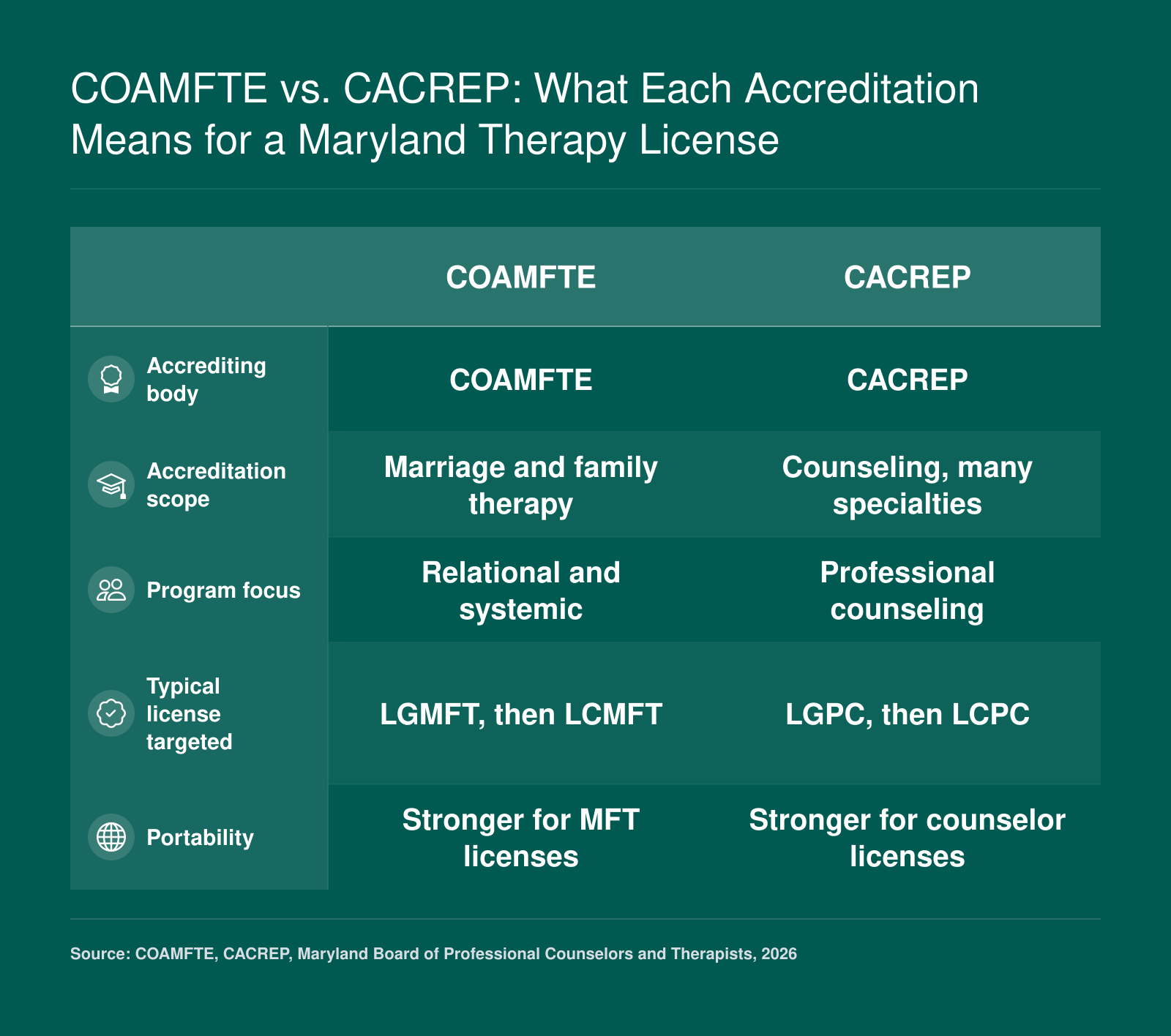
COAMFTE vs. CACREP: What Each Accreditation Means for a Maryland Therapy License
Two accreditors shape most graduate therapy training, and they point toward different Maryland licenses. The comparison below shows how they differ. Maryland's Board sets the final eligibility rules, not the accreditor.
Online and Hybrid Master's in MFT Options for Maryland Residents
Will a COAMFTE-accredited online program satisfy Maryland's 60-credit and 300-client-hour requirements? It can, but only if you arrange supervised practicum hours in Maryland and confirm the curriculum maps to state coursework standards.
Online and hybrid study
Among Master's Programs in Maryland, the in-state COAMFTE master's, at the University of Maryland, College Park, is not described as fully online. Students considering the best online master's in marriage and family therapy programs generally look to accredited programs based outside Maryland; nationally, 14 accredited MFT programs are listed as online and 17 as hybrid. Online does not mean fully remote: each program still requires face-to-face practicum or internship near you, and Maryland still requires 300 total client-contact hours, including 100 relational hours and 60 supervised hours.
Confirm placement first
Get written confirmation that the program can approve a practicum site in your community. Some online programs accept Maryland residents but leave placement to the student; others may not have approved sites near you.
Nearby campus options
Accredited marriage and family therapy masters programs in Falls Church, Virginia and Philadelphia, Pennsylvania are within commuting distance for some Maryland residents; Washington, DC had no COAMFTE master's program listed for 2026, and Delaware was not a nearby source in the 2026 directory. Graduates of out-of-state programs can apply for Maryland licensure, but the Board evaluates coursework and clinical content, so confirm any credit gaps before enrolling.
Maryland Marriage and Family Therapy Licensure Snapshot
Which Maryland MFT Programs Waive or Make the GRE Optional?
The GRE is a standardized graduate admissions exam, and the schools here handle it in different ways. The University of Maryland-College Park does not require the GRE. Its Couple and Family Therapy master's appears among Master's in Marriage and Family Therapy Programs With No GRE Required, and applicants are told not to submit scores.
Washington Adventist University's program materials tie the GRE to grades: applicants with a GPA of 2.60 to 2.74 submit scores, against a 2.75 minimum. Mount St. Mary's University lists a 3.00 GPA requirement but publishes no GRE policy that we could find, so ask before assuming either way.
UMD application details
- Deadline: December 4, 2026 for the 2027-2028 cycle. Admission is for fall only, and late applications are not accepted.
- Prerequisites: No specific major is required. Preferred coursework includes family studies, human development, research methods, abnormal psychology, and introductory counseling skills. Statistics must be done before entry or in the first semester.
- Materials: Transcripts, a statement of purpose, personal-experience responses, a resume, three recommendation letters, and a writing sample. International applicants add TOEFL, IELTS, or PTE. A 3.0 undergraduate GPA is expected.
Test policies change by cycle, so confirm with the admissions office before applying.
Related Articles
What a Master's in MFT Costs in Maryland and How It Maps to the 60-Credit Rule
The University of Maryland-College Park degree looks cheaper at 45 credits than it is, because Maryland's licensure rule asks for 60.
Tuition and the extra credits
UMD's Couple and Family Therapy MS is 45 credits non-thesis or 51 with a thesis. One report of 2026-2027 rates puts tuition at $913 per credit for Maryland residents and $1,916 for nonresidents, with $382.50 in fees. The billing basis for those fees is unclear, so confirm it with the university. At the resident rate, 45 credits come to roughly $41,000 in tuition, a figure worth checking against the most affordable master's in marriage and family therapy programs before you assume the 45-credit total is a bargain. Closing the gap to 60 takes 15 more credits on the non-thesis track (about $13,700) or 9 on the thesis track (about $8,200). Treat these as estimates, since UMD says students can reach 60 within the program through electives; that pace may still trail some accelerated master's in marriage and family therapy programs.
Federal program data lists tuition of $18,276 in-state and $38,207 out-of-state, probably reflecting an earlier year or a different basis. Institution-wide, the average net price is $15,678, and that figure covers every UMD student, not just graduate therapists in training.
Mapping the 60 credits
Maryland's LCMFT requires a master's with 60 semester credits (or 90 quarter hours), at least 45 of them in set content areas:
- Family systems: three courses, including personality development across the lifespan and psychopathology.
- Family therapy: one survey of major models and four theory and technique courses.
- Clinical and professional: one diagnosis and treatment course and one ethical, legal and professional course.
- Practice: supervised clinical work, including 300 direct client-contact hours and 100 relational-therapy hours.
UMD's COAMFTE-accredited curriculum includes a two-year Center for Healthy Families internship with at least 500 clinical hours. Ask the program for its course-by-course map against the board's list before you enroll.
Questions Maryland MFT Applicants Ask Before Enrolling
These answers cover accreditation, licensure pathways, portability, and scheduling. Confirm details with the Maryland Board and each program before you apply.
Is the University of Maryland the only COAMFTE-accredited marriage and family therapy master's program in the state?
Can a CACREP-accredited counseling master's still lead to a marriage and family therapy license in Maryland?
If I earn a Maryland MFT degree, can I transfer my license to Virginia or Pennsylvania later?
Does UMD's Couple and Family Therapy program offer part-time or evening study for working adults?
Compare Marriage and Family Therapy programs on the data that matters
Explore more Counseling specializations or browse every graduate field.
All Counseling programs