Best Master's in Public Policy Programs in California
Compare 24 accredited Public Policy programs in California at 15 schools, with graduate earnings, cost, debt, and completion data from IPEDS and the U.S. College Scorecard.
A policy analyst in California can work three miles from the state Capitol in Sacramento, inside a county agency larger than most state governments, or at a Los Angeles think tank or nonprofit. Graduate tuition across these programs spans the same range: roughly $13,700 a year at Cal Poly, about $71,500 at USC, with campus and hybrid options competing for the same applicants.
Price and payoff rarely move together in public policy. What a program charges tells you very little about what its graduates actually earn.
Key Points
- Hybrid formats, like Pacific McGeorge's Sacramento MPP, are how most California schools reach working professionals.
- GRE policies vary sharply by school, and test-free programs often still check quantitative readiness another way.
- Public versus private pricing and resident versus nonresident status drive the biggest cost gaps in California MPP programs.
The 10 Best Master's in Public Policy Programs in California
Ten California schools make this list, from research universities in the UC system to private programs in Los Angeles, Malibu, and Stockton. Program-level earnings appear only where federal data publishes them, with the time window stated. Graduation rates are the school's overall rate, not the policy program's.
Stanford University
#1Stanford, CA · $60,000 – $65,000/yr (est.)
Best for: Current Stanford students adding policy credentials
Stanford's policy master's is a compact degree with ten concentration options, including Computational Public Policy, Health Care Policy, and Science and Technology Policy. Admission is limited to current Stanford students, alumni within five years, and joint-degree applicants, so it suits a narrow group. The school's graduation rate is about 92%. Program-level earnings are not yet published for this degree.
- 45-unit degree completed in one year
- Three paths: Public Policy, Economics, or other majors
- Subplans include Urban Policy and Legal and Regulatory Intervention
- Thesis required for non-coterminal students
- Two quarters of Public Policy Colloquium
- Minimum 3.0 GPA, core courses letter-graded
- Calculus and ECON 1 equivalents expected before entry
- Serves as a gateway to the MPP degree
University of California-Berkeley
#2Berkeley, CA · ~$16,000/yr (est.)
Best for: Career changers with several years of experience
Berkeley's Goldman School runs a two-year, full-time campus MPP built around a summer internship and a second-year policy analysis project. Entering students typically bring three to four years of work experience, and the cohort is small, at about 102 students. Program-level data show median earnings of $116,708 about five years after finishing. The school's graduation rate is about 93%. Berkeley also announced a separate Master of Public Affairs in Sacramento, which is not part of the MPP.
- Two-year full-time program on campus
- Summer internship after the first year
- Second-year policy analysis project with real clients
- Electives across UC Berkeley
- Training in statistical software and quantitative analysis
- Includes legal analysis of public policy
- Dedicated career advisors
- Concurrent degrees available with other Berkeley schools
University of California-Los Angeles
#3Los Angeles, CA · ~$14,000/yr (est.)
Best for: Students pairing policy with a joint degree
UCLA Luskin offers a two-year MPP with an emphasis on quantitative and analytical skills and flexibility in personalizing study. Joint degrees with Law, Management, Public Health, Medicine, and Social Welfare are available, along with certificates in Global Public Affairs and Leaders in Sustainability. Program-level data show median earnings of $66,078 one year after finishing and $100,925 four years after finishing. The school's graduation rate is about 93%.
- Two-year campus program
- Bachelor's degree and 3.0 GPA required
- GRE recommended for domestic applicants, required for international
- Three letters of recommendation and statement of purpose
- Joint degrees available across several UCLA schools
- Rolling admission with a January 9 funding deadline
- Interdisciplinary certificate in Global Public Affairs
- Work experience preferred
- No specific undergraduate major required
- Access to UCLA research resources
- Leaders in Sustainability certificate option
- Virtual open house events offered
- Admissions webinars for MPP applicants
- Fee waivers available
University of California-San Diego
#4La Jolla, CA · $15,000 – $20,000/yr (est.)
UC San Diego's MPP sits in the School of Global Policy and Strategy and carries a STEM designation, which gives international graduates a longer OPT window. Students choose tracks such as Program Design and Evaluation, Environmental Policy, and Health Policy, and finish with a capstone. Program-level data show median earnings of $53,035 one year after finishing. The school's graduation rate is about 86%.
- Two-year full-time program, fall start
- 92 units, eight core courses, plus capstone
- Tracks include Program Design and Evaluation, Environmental Policy, Health Policy
- No entrance exam required
- Rolling admissions
- STEM-designated, OPT extension eligible
- Fellowships available, some near full program cost
- All courses in person on campus
University of Southern California
#5Los Angeles, CA · ~$72,000/yr (est.)
USC Price's MPP centers on a year-long practicum with real clients, including past projects for the Los Angeles Mayor's Sustainability Office. Dual-degree paths with urban planning and law broaden the options. Program-level data show median earnings of $64,952 one year after finishing and $94,114 four years after finishing. The school's graduation rate is about 92%, though private tuition makes net price a key factor to weigh.
- Two-year full-time cohort program
- Year-long policy analysis practicum
- Specialization electives available
- Scholarships and financial aid offered
- Employment and sector data published by the program
- Dual degree combining policy and urban planning
- Same practicum structure as the MPP
- Planning-focused customization of the curriculum
- Dual degree combining policy and law
- Practicum designed like a consulting engagement
- Global Trojan Network access
California Polytechnic State University-San Luis Obispo
#6San Luis Obispo, CA · ~$14,000/yr (est.)
Cal Poly's MPP is a two-year program aimed at analytic careers in government, nonprofits, and regulated businesses. Students build a concentration through electives, complete a two-term research seminar, and can pursue policy internships or joint graduate degrees. The school's graduation rate is about 86%. Program-level earnings are not yet available for this degree.
- Two-year program, 50 or 60 approved units by start date
- Core courses in policy analysis, quantitative methods, and economic policy
- Two-term seminar for individual research projects
- Build a concentration through electives
- Joint graduate degree options
- Policy internships available
University of California-Irvine
#7Irvine, CA · ~$15,000/yr (est.)
UC Irvine's MPP is a 72-unit professional degree administered through the School of Social Ecology, with a required summer internship and a second-year capstone. A three-year part-time option adds flexibility. Program-level data show median earnings of $38,262 one year after finishing and $75,045 four years after finishing. The school's graduation rate is about 87%.
- Two-year professional degree, 72 graduate units
- Part-time option over three years
- Summer internship required after first year
- Core courses in statistics, economics, and policy analysis
- Seven elective courses at the 200 level
- GRE recommended but not required for applicants from English-language institutions
University of California-Riverside
#8Riverside, CA · ~$15,000/yr (est.)
UC Riverside's MPP emphasizes evidence-based analysis and experiential learning, with an internship and a client-based capstone. Classes meet on weekdays during the day. Program-level data show median earnings of $40,275 one year after finishing and $76,103 four years after finishing. The school's graduation rate is about 76%, the second lowest on this list.
- Internship required
- Client-based capstone project
- Daytime classes, Monday to Friday, 8 a.m. to 5 p.m.
- Rolling admissions review
- BA/MPP five-year option and MD/MPP dual degree
- School of Public Policy scholarships available
Pepperdine University
#9Malibu, CA · $40,000 – $45,000/yr (est.)
Pepperdine's MPP is a 48-unit, 20-month program with in-person classes on the Malibu campus and a Washington, DC track option. The program reports that over 95% of admitted students receive scholarships, covering an average of 70% of tuition, and it requires no GRE. Its P4 Policy Partners Program adds benefits for eligible applicants. Program-level data show median earnings of $63,804 one year after finishing and $81,037 four years after finishing. The school's graduation rate is about 83%.
- 48 units completed in 20 months
- No GRE or standardized test required
- Washington, DC track option
- Capstone policy seminar and internships
- Joint degrees and professional certificates offered
- Concentration in American policy and politics
- One of five specializations offered
- Merit-based scholarships tied to admission deadlines
- Concentration in public policy and dispute resolution
- Values-centered curriculum with viewpoint diversity focus
- Faith-based university environment
- Concentration in international relations and national security
- James Q. Wilson core curriculum
- Involvement with policy institutes
University of the Pacific
#10Stockton, CA · ~$55,000/yr (est.)
University of the Pacific delivers its MPP through McGeorge School of Law in Sacramento, near the State Capitol. The hybrid format pairs online coursework with in-person Saturday sessions, which suits working professionals. The school's graduation rate is about 69%, the lowest on this list. Program-level earnings are not yet available.
- Hybrid: online coursework plus in-person Saturday sessions
- 39 units required
- Two years full-time or three years part-time
- Concentrations in Environmental and Water Policy, Public Policy Advocacy
- Also Non-Profit and Social Capacity Management, and Local Government
- Core courses in law, public policy, analytics, and leadership
- Optional externship component
- Bachelor's degree required, scholarships awarded
Cost & outcomes by school
Federal data for the highest-earning Public Policy programs, independent of the ranking above. Earnings are this field's master's graduates four years after completing, where the Scorecard reports them.
| School | Earnings | Tuition / yr | Debt | Grads/yr | Format |
|---|---|---|---|---|---|
| University of California-Los Angeles CA | $100,925 | $14,476 | $41,000 | 63 | Campus |
| University of Southern California CA | $94,114 | $71,515 | $81,516 | 82 | Campus |
| Pepperdine University CA | $81,037 | $44,056 | $60,660 | 27 | Hybrid |
| University of California-Riverside CA | $76,103 | $14,912 | $41,775 | 19 | Campus |
| University of California-Irvine CA | $75,045 | $14,827 | $41,000 | 15 | Campus |
| University of California-San Diego CA | — | $15,097 | $33,242 | 67 | Campus |
| University of California-Berkeley CA | — | $15,866 | — | 119 | Campus |
| California State University-Sacramento CA | — | $9,542 | — | — | Hybrid |
| Claremont Lincoln University CA | — | $18,150 | — | — | Online |
| California Polytechnic State University-San Luis Obispo CA | — | $13,685 | — | 10 | Campus |
| California Lutheran University CA | — | $22,046 | — | — | Hybrid |
| University of Redlands CA | — | $25,172 | — | 5 | Hybrid |
Sources: U.S. Department of Education. Tuition and graduates: IPEDS. Earnings and debt: College Scorecard, this field's master's graduates; a dash means no figure is reported.
Cost, debt & payoff
Median earnings of this field's master's graduates (4 yrs after completing) vs. their median federal loan debt · U.S. College Scorecard
Across these programs the median graduate earns about $81,037 and finishes with roughly $60,660 in debt — a ratio that clears a common rule of thumb (keep debt below first-year salary). Tuition and debt vary widely school to school, so check the per-school figures in the table above before you shortlist.
How We Rank California Master's in Public Policy Schools
One applicant chases the most famous campus name; another asks what a Public Policy degree actually delivers after graduation. This list is built for the second kind of reader. It rewards what a graduate can verify on federal data, not brand-name prestige. The ranking weighs graduate tuition and fees, net price after aid, and institution-wide graduation rate, then adds College Scorecard program-level earnings and debt when those figures are published. Both of those inputs describe the whole school, not just the MPP cohort, because federal reporting works at the institution level. Campus, online, and hybrid programs are scored together on one list, so a strong virtual option can sit next to a traditional on-campus program without a separate ranking. Missing data is not treated as a good outcome; it is treated as an open question.
Online and Hybrid Master's in Public Policy Options in California
Hybrid formats, not fully online degrees, are how most California master's programs reach working professionals. University of the Pacific's McGeorge School of Law runs its MPP in Sacramento near the Capitol, with live synchronous online classes plus six to seven in-person Saturdays each semester. Students finish in two years full-time or three part-time, completing 39 units (33 core, 6 concentration). That rhythm suits state and local government staff who can't leave a job but can give up weekends, though the campus visits are mandatory.
California Lutheran University offers the most flexible format here. Its Master of Public Policy and Administration lets students choose online, the Thousand Oaks campus, evenings, or a mix. It has part-time and full-time paths, 39 credits, five start dates a year, and typical completion in 18 to 24 months. Its pages don't say whether online classes are live or self-paced, or what hybrid students must attend on campus, so ask admissions before enrolling.
The other programs here are campus-based. UC San Diego is in person and full-time with no part-time route. Claremont Graduate University is in person but allows part-time study. Pepperdine describes in-person daytime classes in Malibu, and Cal Poly San Luis Obispo is taught on its campus.
Related Articles
Which Ranked California MPP Schools Waive the GRE?
The GRE is no longer a universal gate for California public policy programs, and policies now vary sharply from school to school, as they do among no-GRE master's programs. Going test-free rarely means skipping the math. Programs that drop the exam often still check quantitative readiness through your transcript, so prior coursework in statistics, economics, or calculus can carry more weight.
Here is where schools with published policies stand for 2026, based on each program's admissions page:
- University of California-Berkeley (Goldman MPP): Required. Every Fall 2026 applicant must submit scores, and no waivers are granted.1
- University of California-Los Angeles (Luskin MPP): Optional.2
- University of Southern California (Price MPP): Not required. Price has discontinued the GRE and reviews applications holistically.
- California Polytechnic State University-San Luis Obispo (MPP): Optional. The program recommends scores but does not require them.
- California State University-Sacramento (MPPA): Not required. The requirement is suspended indefinitely for all applicants and all future admission cycles.3
For the remaining programs on this list, no current published GRE policy was confirmed, so treat them as Not published. Check with each admissions office before scheduling a test.
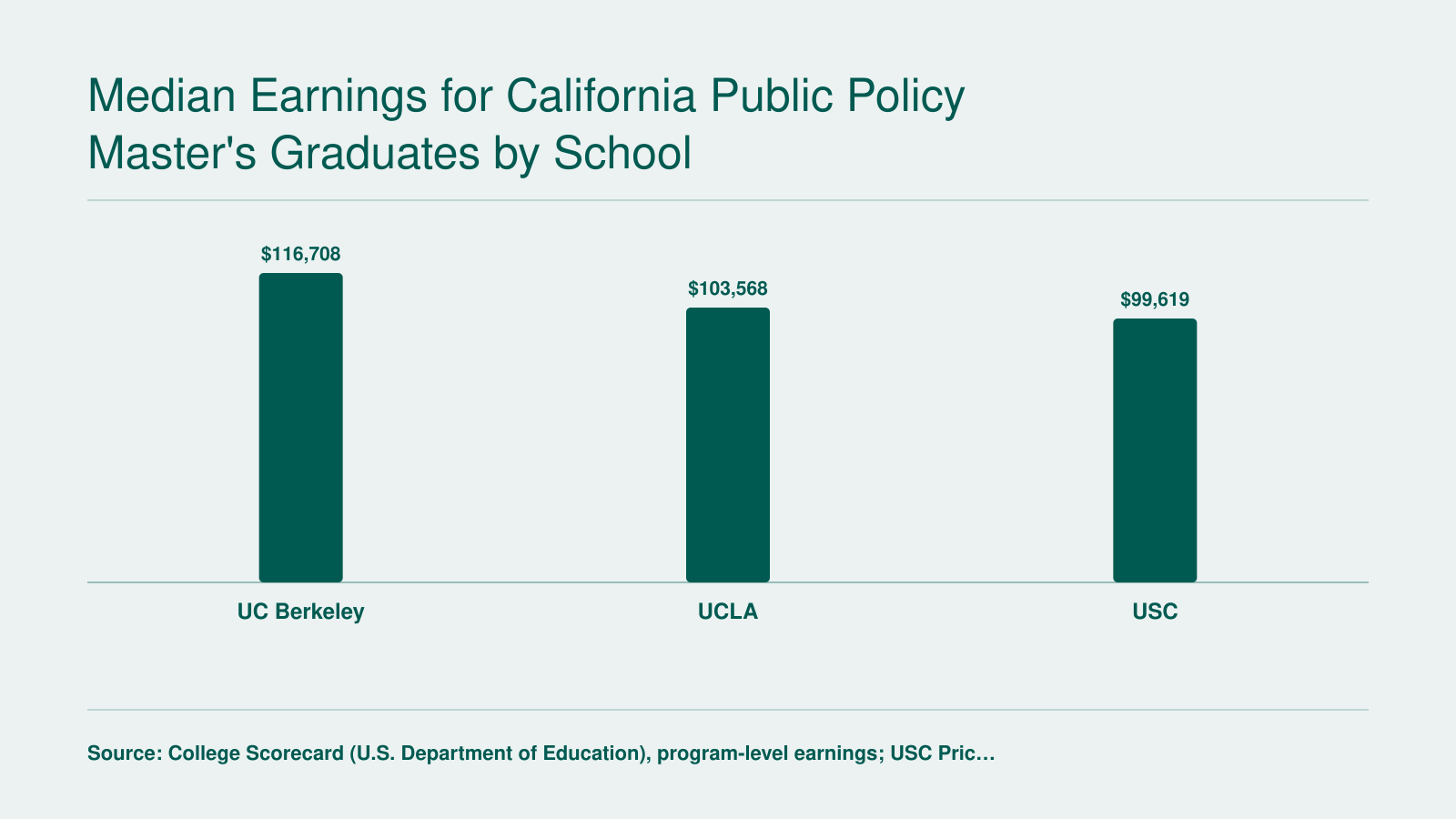
Median Earnings for California Public Policy Master's Graduates by School
These are federal program-level median earnings five years after completion. Schools without a published program figure are left out, and institution-wide earnings are never substituted. Compare them with school-reported outcomes: USC Price reports 85% employed or in continued education at 12 months, a figure that includes Ph.D. and other study, with an 87% knowledge rate. Its sectors split 32% nonprofit, 32% private, 29% public and 6% graduate school. UCLA Luskin reports six-month outcomes and lists employers such as California Community Foundation, but its excerpt shows no Public Policy-specific placement rate. Different timeframes and definitions mean the two sources should not be read as one measure.
What a California Master's in Public Policy Costs, and Whether You Need a License
The financial spread among California MPP programs is wider than the policy debates they study, so the first tradeoff is public versus private and resident versus nonresident.
Public resident and nonresident price gaps
At UC Berkeley's Goldman School, 2024-2025 resident tuition and fees were $36,581 versus $49,877 for nonresidents, with $12,245 of that gap coming from nonresident supplemental tuition.1 The $36,581 total included $13,872 in mandatory systemwide fees and $1,707 in campus fees.1 UCLA lists the same $12,762 tuition for resident and nonresident students in 2024-2025 before adding nonresident supplemental tuition. UC San Diego's School of Global Policy and Strategy posts resident tuition around $35,381 and nonresident around $47,626. Sacramento State lists graduate tuition of $8,018 resident and $20,618 nonresident, while Cal Poly San Luis Obispo lists $13,596 resident and $23,765 nonresident. Private programs sit at the top: USC lists $72,097, Pepperdine $69,918, and Stanford $65,910.
Living costs, debt, and licensing
California living expenses add heavily. UC Berkeley's Goldman School estimates $33,248 for annual living costs, while UCLA's 2026-2027 graduate budget lists $18,221 for housing, $10,546 for food, and a total resident cost of attendance near $60,932; nonresident total near $76,034.2 Federal data show median graduate debt around $41,000 at UCLA (about $466 a month over 10 years) and $81,500 at USC (about $927 a month). The net price figure is an average for the whole institution, not a promise for any specific program. California requires no state license to work as a policy analyst, and voluntary credentials are not required for most MPP career paths.
Common Questions About California Public Policy Graduate Schools
Which master's in public policy program in California ranks highest on our list?
When are fall application deadlines for California MPP programs?
What materials do California MPP applications typically ask for?
How selective are California MPP programs?
Compare Public Policy programs on the data that matters
Explore more Criminal Justice & Law specializations or browse every graduate field.
All Criminal Justice & Law programs