Best Master of Legal Studies (MLS) Programs
Compare 80+ accredited Legal Studies programs, with graduate earnings, cost, debt, and completion data from IPEDS and the U.S. College Scorecard.

The Master of Legal Studies is built for human resource management professionals, compliance officers, healthcare management professionals, and business professionals who work alongside law daily but have no plan to practice it. Programs such as Cornell's and Texas A&M's run 30 credits, and no MLS qualifies a graduate to sit for the bar exam.
Among the ten schools ranked here, institution-wide net price runs from roughly $12,500 at UCLA to $41,700 at Boston College, and eight of the ten offer an online option. Duke's program is currently on hiatus, so confirm availability before applying.
Because the degree carries no license, what you pay matters more than it would for a credential tied to a protected professional title.
Key Points
- Florida State online, UCLA, and Arizona State post the lowest net prices, about $11,300 to $15,000.
- Program-level MLS earnings are not yet published, so ROI comparisons rest on cost and completion data.
- The ABA does not accredit MLS degrees, and none of them qualify you to practice law.
10 Master of Legal Studies Schools for 2027
These ten schools stand out for combining an established law school experience with flexible delivery and concentrations that track compliance, privacy, and business roles. We compare institution-wide graduation rates and net price alongside each program's format so you can judge value, not just name recognition. None of these MLS degrees qualifies you to sit for the bar or practice law.
Cornell University
#1Ithaca, NY · ~$30,000/yr (est.)
Best for: Business professionals in compliance roles
Cornell Law School's online MS in Legal Studies targets business professionals who need legal literacy for compliance and management roles. The 30-credit part-time curriculum covers contracts, negotiations, corporate governance, employment, immigration, and privacy, ending with a capstone. There is no GRE, GMAT, or LSAT requirement, and online delivery means no campus visits are required.
- Part-time 30-credit online MS for business professionals
- No GRE, GMAT, or LSAT required
- Covers contracts, negotiations, compliance, employment, and immigration law
- Advanced standing available through eCornell certificates
- Capstone project required
University of California-Los Angeles
#2Los Angeles, CA · ~$14,000/yr (est.)
Best for: Working learners wanting hybrid flexibility
UCLA Law's Master of Legal Studies is flexible, delivered online, hybrid, or on campus, and opens with core legal concepts before students choose from nine concentrations. The program can be completed in nine months full time or two to four years part time. A dedicated international cohort pairs global business law study with F-1 visa eligibility.
- Nine concentration options including business, entertainment, and health law
- Online, hybrid, or on-campus delivery
- Complete in nine months full time or two to four years part time
- International F-1 cohort with Global Business Law track
- Capstone required
University of Southern California
#3Los Angeles, CA · ~$72,000/yr (est.)
Best for: Los Angeles professionals wanting on-campus study
USC Gould's Master of Studies in Law is an on-campus Los Angeles program for non-lawyer professionals. It can be finished in nine months full time or sixteen months part time, with certificate tracks in business law, human resources, social justice, and media and entertainment. No LSAT or GRE is required, and applicants need a bachelor's degree with a 3.0 undergraduate GPA.
- On-campus Los Angeles program with fall start
- Complete in nine months full time or sixteen months part time
- Four certificate tracks: business law, HR, social justice, media and entertainment
- No LSAT or GRE required
- Automatic scholarship consideration
Duke University
#4Durham, NC · ~$67,000/yr (est.)
Duke Law's campus-based Master of Legal Studies is currently listed as on hiatus, so there is no 2026 admissions cycle to evaluate. When active, the program would cover foundational legal principles and analytical skills for non-lawyer professionals.
- Program currently on hiatus
- Campus-based program through Duke Law when active
- Designed for non-lawyer professionals seeking legal foundations
Vanderbilt University
#5Nashville, TN · ~$58,000/yr (est.)
Vanderbilt Law's online Master of Legal Studies gives working professionals broad U.S. legal knowledge without a JD. The part-time program can be completed in under two years, combining asynchronous coursework with biweekly live sessions and an optional Nashville short course. No entrance exam is required, and the application fee is zero.
- Part-time online format with biweekly live sessions
- No entrance exam required
- $0 application fee
- Optional on-campus short course in Nashville
- Complete in under two years
Washington University in St Louis
#6St. Louis, MO · ~$65,000/yr (est.)
Washington University in St. Louis School of Law offers a fully online MLS with six concentrations, including AI in the law, business law, and regulatory compliance. The curriculum pairs asynchronous work with weekly live sessions, and optional on-campus immersions add face-to-face networking. Career support comes through the WashU Center for Career Engagement.
- 100% online MLS from WashU Law
- Six concentrations including AI and regulatory compliance
- Asynchronous coursework plus weekly live sessions
- Optional on-campus immersions
- Career support through the WashU Center for Career Engagement
Boston College
#7Chestnut Hill, MA · ~$38,000/yr (est.)
Boston College Law School's MLS focuses specifically on cybersecurity, risk, and governance, making it a niche choice for compliance and privacy professionals. The 30-credit program mixes ten required courses with electives across cybercrime, national security, incident response, and risk management. Students can study on campus or virtually, and the program holds DHS NICCS provider approval.
- 30-credit cybersecurity, risk, and governance MLS
- 10 required courses plus 18 electives
- On-campus or virtual delivery
- DHS NICCS approved provider and ISACA student chapter
- US Cyber Command Academic Engagement Network member
Texas A&M University-College Station
#8College Station, TX · ~$12,000/yr (est.)
Texas A&M's MLS is a 30-credit, non-thesis legal studies degree with 14 areas of specialization. The online format offers asynchronous or synchronous classes, and up to three in-person courses can be taken at the Fort Worth campus. Students can also design a personalized curriculum instead of choosing a preset concentration.
- 14 areas of specialization plus a personalized curriculum option
- 30-credit non-thesis degree
- Online with asynchronous or synchronous options
- Up to three in-person courses at Fort Worth campus
- Certificate programs available alongside the degree
Emory University
#9Atlanta, GA · ~$49,000/yr (est.)
Emory Law's online MLS concentrates in business law and regulation, delivered as ten sequential part-time courses over about twenty months. No LSAT is required, and students apply with transcripts, a personal statement, and two recommendation letters. Graduates typically pursue compliance, HR, and operations management roles.
- Business Law and Regulation concentration
- 30-credit part-time online sequence
- No LSAT required
- Two recommendation letters required
- Fall and spring start dates
William & Mary
#10Williamsburg, VA · $15,000 – $20,000/yr (est.)
William & Mary Law School's online MLS offers a compliance and risk management track and four concentrations, completing in as few as sixteen months. The 32-credit program uses asynchronous eight-week courses and applied projects. Applicants who already hold a JD are not eligible.
- 32-credit MLS in compliance and risk management
- Asynchronous eight-week online courses
- Complete in as few as sixteen months
- Four concentration options
- Applicants with a prior JD not eligible
Cost & outcomes by school
Federal data for the highest-earning Legal Studies programs, independent of the ranking above. Earnings are this field's master's graduates four years after completing, where the Scorecard reports them.
| School | Earnings | Tuition / yr | Debt | Grads/yr | Format |
|---|---|---|---|---|---|
| Thomas Jefferson School of Law CA | — | $3,692 | — | — | Campus |
| Crestpoint University AZ | — | $6,045 | — | — | Online |
| University of Nebraska-Lincoln NE | — | $8,434 | — | — | Campus |
| Abraham Lincoln University CA | — | $8,160 | — | — | Online |
| University of Utah UT | — | $8,724 | — | — | Hybrid |
| Liberty University VA | — | $8,730 | — | — | Online |
| American Public University System WV | — | $8,700 | — | — | Online |
| University of Pikeville KY | — | $8,550 | — | — | Online |
| Texas State University TX | — | $8,997 | — | — | Campus |
| University of Oklahoma OK | — | $9,353 | — | — | Online |
| Ohio University OH | — | $9,720 | — | — | Hybrid |
| University of New Mexico NM | — | $9,860 | — | — | Campus |
Sources: U.S. Department of Education. Tuition and graduates: IPEDS. Earnings and debt: College Scorecard, this field's master's graduates; a dash means no figure is reported.
How We Rank the Best MLS Schools
A low sticker price and a low actual cost are not always the same thing, and that gap shapes how we compare MLS programs across the broader Criminal Justice, Law & Public Policy Master's Programs category.
Where the Numbers Come From
We rely on federal data rather than prestige or advertising. IPEDS supplies tuition, net price, and graduation rates. College Scorecard supplies program-level earnings and debt for graduates. Because every school is measured against the same public sources, a well-known name gets no automatic advantage over a lesser-known program that delivers better value.
Why Net Price Beats Sticker Tuition
Net price is what students pay after grants and scholarships are subtracted from the published cost. It usually tells you more than tuition alone, since many schools discount heavily. It is still an average across students, not a personal quote. Your own figure will depend on your aid offer, so use net price to compare schools, then ask each admissions office for an estimate based on your situation.
What the Data Can't Tell You
Two limits are worth knowing before you lean on any number:
- Graduation rates: These cover the whole institution, not the MLS program alone, so they signal overall student success rather than completion in a specific degree.
- Earnings and debt: Some MLS programs are too small to have published figures. When that is the case, we say the data is unavailable instead of guessing.
Format Is Part of the Picture
Many MLS students work full time, so we factor in whether a program is offered online, on campus, or both. That helps working professionals find flexible options without sacrificing the outcomes that matter. We do not assign fixed numeric weights to these factors, and we encourage you to decide which ones count most for your own budget and schedule.
MLS Programs at a Glance: Cost, Format, and Completion
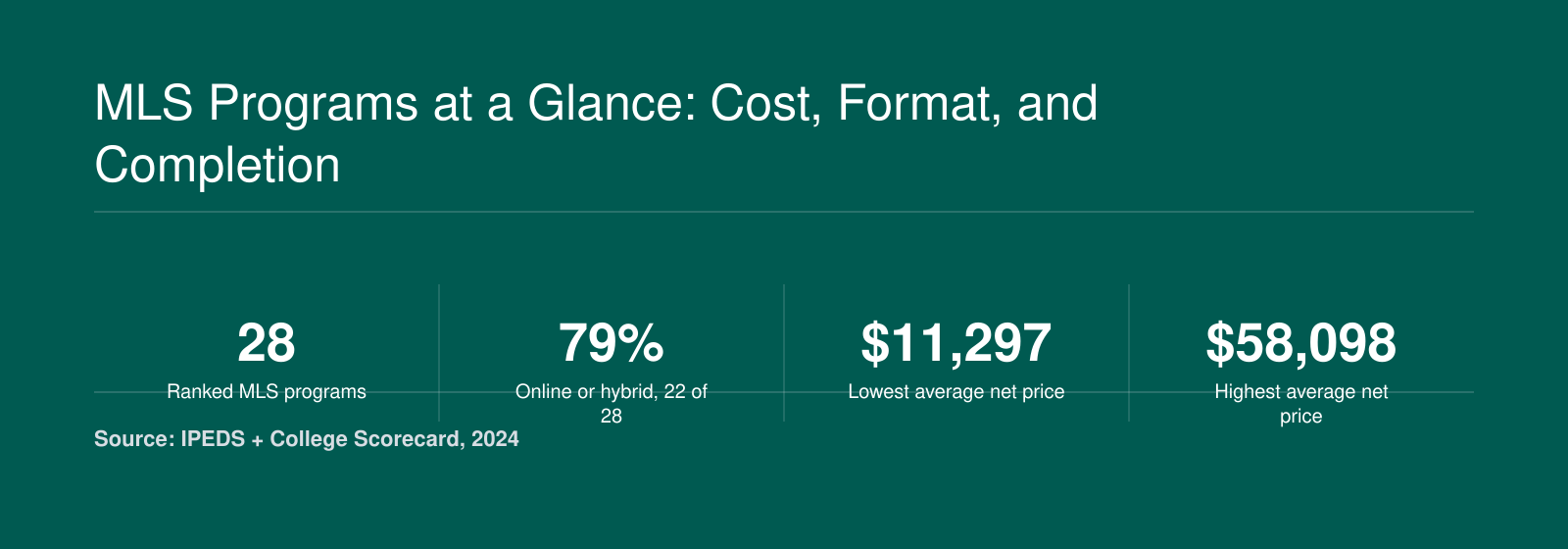
Here is how the 28 ranked Master of Legal Studies programs compare on format, price, and completion. Net price is an average after grant aid, so your own cost will vary. Graduation rates are school-wide, not specific to MLS students, and net price is not reported for one school.
Cost and Financial Aid: What You'll Really Pay for an MLS
Florida State, UCLA, and Arizona State have the lowest published net prices after aid among the programs below. Florida State lists in-state tuition at $10,553 and out-of-state tuition at $26,707, but its net price after aid is $11,297; UCLA posts an in-state figure of $14,476 and a net price of $12,548, while Arizona State posts $13,587 in-state and a net price of $14,967. For a simple estimate, UCLA Law's MLS multiplies a $2,575 per-credit rate by 26 credits, which equals $66,950, close to its published total of about $67,000. Drexel University Online offers a lower per-credit benchmark at $995 with a $125 online program fee, so readers can apply the same math to any program's required credits. Graduate funding typically comes from federal Direct Unsubsidized and Grad PLUS loans, employer tuition assistance, and school scholarships.
| Program | In-state tuition | Out-of-state tuition | Net price after aid |
|---|---|---|---|
| Florida State University | $10,553 | $26,707 | $11,297 |
| University of California, Los Angeles (UCLA) | $14,476 | $29,578 | $12,548 |
| Arizona State University | $13,587 | $27,521 | $14,967 |
Related Articles
Career Outcomes: MLS Earnings, Debt, and ROI
What do MLS graduates actually earn, and does the degree pay off after accounting for what you borrow?
The data gap on MLS earnings
For this year's ranking, program-level median earnings at one, two, four, and five years after completion are not yet reported in the federal data used here. The same is true for program-level median debt, the ten-year monthly payment, and the share of completers employed one year out. That means we cannot honestly state a typical MLS salary or debt-to-income ratio for these programs right now. Do not confuse a university's overall graduate earnings or debt with what the MLS program itself produces; those institution-wide figures include law, business, medicine, and other fields and can hide real differences. This absence is common for newer or smaller MLS cohorts, where federal privacy and sample-size rules suppress figures until enough graduates are reported.
What you can compare instead
Use published sticker price as a starting point, then estimate your own borrowing.
- Northeastern: lists $36,570 total program tuition.
- Vanderbilt: lists $57,060 total program tuition.
Other programs are priced by credit hour or academic year, so the all-in cost depends on how quickly you finish. Tuition is not the same as debt; whether you borrow, how much interest accrues, and your repayment term determine the monthly payment, and those details are not included in the current program-level data.
Where the ROI really comes from
In practice, MLS value usually shows up as a promotion or a move into compliance, contracts, human resources leadership, or risk management, not as a new attorney salary. An MLS does not qualify you to sit for the bar, so entry-level legal pay is not the right benchmark. The payoff question is whether the credential helps you cross a salary band in your current industry. A $36,000 program may pay for itself quickly if it yields a $15,000 annual raise; the same program is harder to justify if your employer will not recognize the credential. Without program-level earnings data, prospective students should compare program price against their own likely post-completion role change rather than relying on generic legal salary averages.
MLS vs. JD vs. LLM: Which Legal Degree Is Right for You?
A Juris Doctor (JD) typically takes 36 months of full-time study, while a Master of Legal Studies (MLS) usually runs 12 to 24 months and a Master of Laws (LLM) often wraps in about 12 months.1 That length difference drives much of the cost and career tradeoff among the three.
Degree Format, Prerequisites, and Bar Eligibility
- MLS (also called MSL or MJ): Requires a bachelor's degree. Designed for nonlawyers who need legal fluency. Does not qualify graduates to sit for the bar under the standard ABA path, and it is not a license to practice law.1
- JD: Requires a bachelor's degree and typically the LSAT. It is the standard U.S. professional law degree and is bar-qualifying. Three years full-time.2
- LLM: Requires a JD or an equivalent law degree. It is an advanced degree for people who already hold a law degree, often foreign-trained lawyers seeking U.S. legal expertise. Bar eligibility for an LLM alone is state-specific and generally depends on the applicant's prior legal education.2
What Each Degree Leads To
An MLS prepares you for law-adjacent work where legal knowledge helps but lawyer licensure is not the goal: careers in compliance, HR, Healthcare Administration, regulatory affairs, sports, or public policy programs. A JD leads to attorney positions: law firm associate, prosecutor, public defender, in-house counsel, or judge. An LLM leads to specialization for practicing attorneys in areas like tax, business, international law, or technology.
How to Choose
Before comparing tuition, ask whether the role you want requires bar admission. If it does, only the JD offers the standard U.S. route. If it does not, an MLS can provide the legal vocabulary and compliance skills without three years of law school.
Choose the MLS if you want legal fluency to advance in your current field without becoming a lawyer. Choose the JD if you want to represent clients and sit for the bar. Choose the LLM only if you already hold a law degree and need deeper specialization or U.S. credentials.
Because the JD takes three years, it generally carries the highest total tuition and opportunity cost. An MLS, at one to two years, is typically the lowest-cost option for nonlawyers. An LLM adds a focused year of graduate legal study, but its value depends on your existing legal credentials and career goals.
MLS Admission Requirements at Top Schools
MLS admissions are more flexible than JD admissions, but requirements vary by school. Official pages don't publish every detail, so confirm specifics with each program before you apply.
- Bachelor's degreeA completed undergraduate degree is the baseline. No prior legal training is needed, and programs such as Vanderbilt's and Stanford's are built for non-lawyers.
- Minimum GPAWhere a minimum is stated, it runs from 2.75 (Cincinnati) to 3.0 (UCLA and USC). ASU lists a 3.00 in the last 60 credit hours as preferred, and Vanderbilt sets no minimum.
- Application materialsExpect a resume, a personal statement, and recommendation letters at many schools. Cincinnati asks for a Statement of Interest and one recommendation, Emory asks for two letters, and some pages list none.
- Test policyMost top programs don't require the LSAT or GRE. This applies at ASU, UCLA, Cincinnati, Vanderbilt, Regent, and Emory. UCLA accepts optional scores.
- Work experience and interviewsCincinnati requires two years of professional experience. UCLA may admit applicants with substantial work experience whose GPA falls short. The reviewed pages did not show an interview requirement.
- Deadlines and start datesVanderbilt, Cornell, and William & Mary offer fall, spring, and summer starts. Emory offers fall and spring, and USC offers fall only. Vanderbilt listed a July 27, 2026 deadline, which has passed, so check the next cycle.
Legal Studies programs by state
Frequently Asked Questions About MLS Programs
These answers cover the questions prospective students ask most often about the Master of Legal Studies. Program details vary by school, so confirm specifics with any program you are considering.
Can you practice law with a Master of Legal Studies?
Is a Master of Legal Studies worth it?
What jobs can you get with a Master of Legal Studies?
How long does a Master of Legal Studies take to complete?
Can MLS credits transfer toward a JD later?
Compare Legal Studies programs on the data that matters
Explore more Criminal Justice & Law specializations or browse every graduate field.
All Criminal Justice & Law programs