Best Master of Legal Studies (MLS) Programs in Virginia
Compare 3 accredited Legal Studies programs in Virginia, with graduate earnings, cost, debt, and completion data from IPEDS and the U.S. College Scorecard.

A Master of Legal Studies is a law degree for people who will never practice law: compliance analysts, HR managers, hospital administrators, and government contracting officers who read statutes and regulations all day without a license. Virginia's offerings are thin, and the ranked programs here are all delivered online, running roughly 30 to 32 credits.
The constraint to settle first is licensure. An MLS does not qualify anyone to sit for the Virginia bar exam; Virginia's routes are a J.D., the Law Reader Program, or an LL.M. for lawyers already admitted elsewhere. Published graduate tuition across these schools ranges from $8,730 to $17,869 a year.
Key Points
- William & Mary ranks first, with a fully online, asynchronous MLS from a well-known law school.
- Liberty's published graduate tuition is $8,730 a year, versus $17,869 at Regent.
- An MLS cannot qualify you for the Virginia bar; that requires a J.D.
Top-Ranked Master's in Legal Studies Programs in Virginia
William & Mary is the best overall Virginia master's in legal studies on this list. It pairs the strongest institution-wide graduation rate with a program run by a well-known law school, and its listed total tuition is competitive. Graduation rates below describe each university as a whole, not the legal studies program itself. Net price figures are institution-wide averages after aid, so treat them as estimates rather than quotes. Program-level earnings are not yet available for any of these programs.
William & Mary
#1Williamsburg, VA · $15,000 – $20,000/yr (est.)
Best for: Aspiring compliance officers
William & Mary offers its online Master of Legal Studies through William & Mary Law School, the nation's first law school. The university graduates about 89% of its students, the highest rate among the three Virginia schools here. Its institution-wide average net price after aid is roughly $19,100. The Compliance and Risk Management concentration is built for non-lawyers who work in regulated settings such as healthcare, government, corporate, and non-profit organizations.
- Fully online, asynchronous classes in 8-week sessions
- 32 credit hours, finishable in as few as 16 months
- Listed total program tuition of $41,216
- 4 concentration options; this track covers compliance and risk
- No J.D. required; applicants expected to have six months of relevant work experience
- Starts fall, spring, and summer; applicants need a bachelor's degree and generally a 3.0 GPA
- Applied projects and case studies build a portfolio of work
- Application needs a résumé, personal statement, transcripts, and one recommendation
Liberty University
#2Lynchburg, VA · ~$9,000/yr (est.)
Best for: Military-connected working adults
Liberty University in Lynchburg offers a Juris Master (J.M.) in General legal studies, delivered entirely online. The university graduates about 65% of its students, and its institution-wide average net price after aid is about $29,400. Flexible pacing, frequent starts, and a generous transfer policy make it a practical option for working adults and military-connected students.
- 30 credit hours, fully online in 8-week courses
- 8 start dates a year, including January 18, 2027
- No set login times
- Transfer up to 50% of the degree's credits
- Military rate of $310 per credit hour
- Electives in health care law, intellectual property, and corporate law
- No application fee; applicants generally need a 3.0 GPA
- Institutionally accredited by SACSCOC
Regent University
#3Virginia Beach, VA · ~$18,000/yr (est.)
Best for: Faith-minded professionals
Regent University in Virginia Beach delivers its online Master of Legal Studies from a Christian perspective. The university graduates about 57% of its students, and its institution-wide average net price after aid is roughly $19,900. The program was renamed from Master of Arts in Law for spring 2026 enrollees. It stands out for its choice of 14 concentrations and a one-year full-time pace.
- Fully online, 32 credit hours
- 14 concentrations, including business, cybersecurity, and healthcare law
- Listed tuition of $715 per credit
- Finishable in one year full-time, or part-time
- No entrance exam required
- Six start dates a year
- Taught from a Christian perspective
- Non-licensure credential track
Cost & outcomes by school
Federal data for the highest-earning Legal Studies programs, independent of the ranking above. Earnings are this field's master's graduates four years after completing, where the Scorecard reports them.
| School | Earnings | Tuition / yr | Debt | Grads/yr | Format |
|---|---|---|---|---|---|
| Liberty University VA | — | $8,730 | — | — | Online |
| William & Mary VA | — | $17,666 | — | — | Online |
| Regent University VA | — | $17,869 | — | — | Online |
Sources: U.S. Department of Education. Tuition and graduates: IPEDS. Earnings and debt: College Scorecard, this field's master's graduates; a dash means no figure is reported.
Online and Hybrid Master's in Legal Studies Options in Virginia
Working professionals can earn a Virginia master of legal studies online, and the schools here differ mainly in how much they disclose about format.
- William & Mary: Fully online and asynchronous, with no required login times and no campus residency. An online, non-credit orientation comes before the first semester. Courses run in 8-week sessions, two per semester, across 10 courses. Its pages describe completion in 16 months, while the careers page cites about two years part-time.
- Liberty University: The Juris Master (General) has a fully online option. Its 8-week courses have no set login times, so they are asynchronous. A residency requirement is not published in the details reviewed.
- Regent University: The Master of Legal Studies is listed as online, with full-time and part-time options and completion in as little as one year. Live-session timing and residency are not published in the details reviewed.
Can you finish while working full time? At William & Mary, yes: the two-course rhythm and asynchronous format are built for it. Liberty's format suggests the same, but neither it nor Regent publishes weekly workload.
Which Virginia MLS Programs Waive the GRE?
Master's in legal studies programs are aimed at working professionals rather than future lawyers, and test requirements have largely fallen away; many are now among the master's programs with no GRE required. Still, the published policies differ by school.
- William & Mary: The online MLS checklist does not list the GRE or LSAT. That is silence, not an announced waiver, and no waiver policy is stated.
- Regent University: The admissions page says the LSAT is not required and does not mention the GRE. The program page advertises no entrance exam.
- Liberty University: The admissions material reviewed for the Juris Master does not state a GRE or LSAT policy, so no policy is published there.
What programs ask for instead
William & Mary asks for a bachelor's degree, a 3.0 GPA (with exceptions in exceptional circumstances, and extra weight on your last 60 credit hours), a résumé, a personal statement, official transcripts, and one recommendation letter. Regent lists an online application, unofficial transcripts, and a government-issued ID, with official transcripts requested after you apply. It states no minimum GPA.
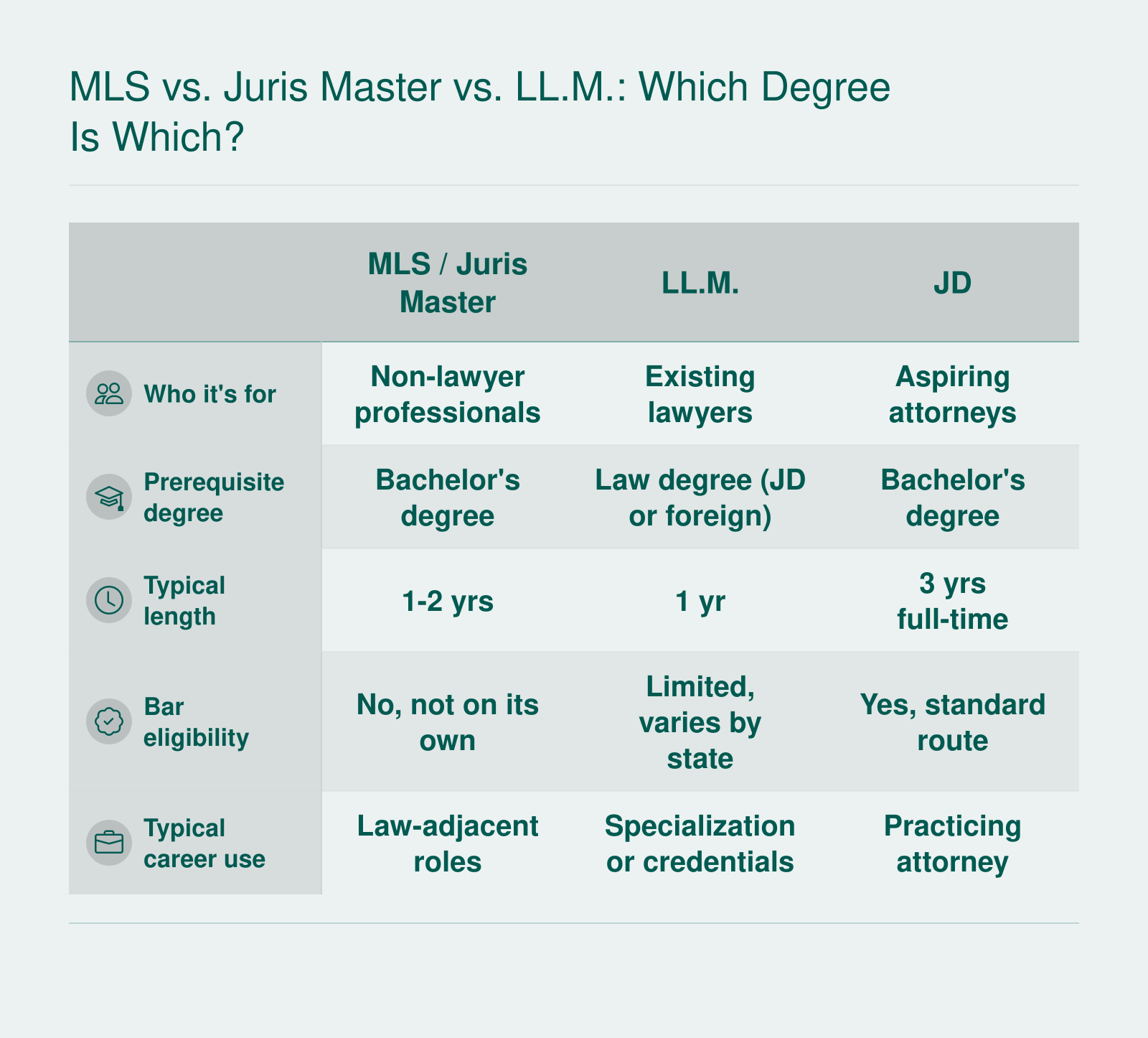
MLS vs. Juris Master vs. LL.M.: Which Degree Is Which?
The MLS, M.S.L., and Juris Master are the same family of non-JD law degrees under different names. The LL.M. is for people who already hold a law degree, and the MLS is for non-lawyers. The JD is the degree that leads to practicing law.
Cost of a Master's in Legal Studies in Virginia and What It Doesn't License You For
What the schools publish
On published graduate tuition, Liberty is the lowest-cost option among Master's Programs in Virginia at $8,730 a year, charged at the same rate whether you live in Virginia or not. Regent's published graduate rate is $17,869, also flat for residents and nonresidents. William & Mary, as a public university, posts separate resident and nonresident graduate rates ($17,666 and $36,684), but its online legal studies degree is priced per credit instead.
Estimating the full bill
William & Mary charges $1,288 per credit across 32 credits, which the law school puts at $41,216 in tuition, plus a mandatory $112 per semester. Regent charges $715 per credit for 2026-27 and lists 32 credit hours, so tuition lands near $22,880; add the University Services Fee of $900 per semester on campus in fall and spring, $750 in summer, and $750 per semester for online students. Neither school publishes separate technology or graduation fees, so budget from tuition plus the semester fee and confirm the rest with the bursar before you enroll.
Completing a legal studies master's grants no Virginia license, certification, or authority to practice law. The bar admission section below explains what it does and doesn't open.
Can an MLS Get You Into the Virginia Bar?
Related Articles
What Can You Do With a Master's in Legal Studies, and Is It Worth It?
Roles by concentration
Compliance tracks lead to analyst, privacy-compliance, and ethics officer roles. Contracts concentrations feed contract specialist, procurement analyst, and subcontract administrator jobs. HR-focused graduates pursue employee-relations and labor-and-employment analyst positions. Healthcare and government-contracting compliance are among the most in-demand specializations in Virginia, according to Compliance Jobs in Virginia, with Northern Virginia, Richmond, and Virginia Beach the busiest markets. Employers include Booz Allen Hamilton, Capital One, and General Dynamics.
Northern Virginia's federal contracting base is a real demand driver. Contractors hire across contract administration, procurement, compliance, cybersecurity, and HR.3 Postings are not MLS outcomes, though. An Arlington contract specialist listing offered $80,000 to $90,0001, and a Federal Contractor HR Specialist Job in Arlington, VA offered $90,000 to $114,000 but required a Secret clearance. Titles such as corporate counsel still require a JD, not a Master's in Business Law.2
Is it worth it?
Program-level earnings and median program debt are not yet published for the schools here, so no payoff figure can be stated honestly. On cost, William & Mary lists $41,216 in total tuition, Regent University lists $715 per credit, and Liberty University offers a military rate of $310 per credit.
The degree pays off most for people already in, or moving into, law-adjacent roles where regulatory fluency adds to existing experience. Without that foundation, expect clearances, certifications, or prior experience to matter as much as the credential.
How We Rank Virginia Master's in Legal Studies Programs
Published graduate tuition at the schools ranked here spans roughly $8,730 to $17,869 a year, and that spread is one of the first things we weigh. Our rankings draw on federal sources: the College Scorecard and IPEDS. We look at graduate tuition and net price, median debt at graduation, earnings where the government publishes them, and the institution's graduation rate.
Two caveats matter. Earnings, debt, net price, and graduation rate are reported institution-wide, not for the legal studies program specifically; read them as school-level figures, not degree outcomes. Program-level earnings for legal studies in Virginia are not yet published.
Only Virginia institutions awarding a master's-level legal studies credential are eligible, and campus and online formats are ranked together, since most working adults are choosing on cost and schedule, not delivery mode.
Compare Legal Studies programs on the data that matters
Explore more Criminal Justice & Law specializations or browse every graduate field.
All Criminal Justice & Law programs