Best Master's in Homeland Security Programs
Compare 80+ accredited Homeland Security programs, with graduate earnings, cost, debt, and completion data from IPEDS and the U.S. College Scorecard.

A master's in homeland security is a graduate degree, usually 30 to 36 credit hours, that prepares students for emergency management, intelligence analysis, counterterrorism, and security and public policy work. The titles vary widely: a Master of Professional Studies at George Washington and Tulane, a Master of Science at Albany and Towson, even a criminal justice M.A. with a homeland security track at Monmouth.
Price varies more than the curriculum does. George Washington charges $1,506 per credit and American University $2,080, while Kansas lists $695.
Because the coursework often overlaps, cost, graduation rates, and debt are the clearest points of difference between programs.
Key Points
- Thomas Edison State University graduates report the lowest median debt in our ranking: $12,500.
- Arkansas Tech charges $525 per credit, while Columbia Southern's published rate is $278.
- Program-level earnings aren't published yet, so compare net price and debt for 2027.
The 10 Best Master's in Homeland Security Programs for 2027
The strongest homeland security master's programs pair focused security coursework with schedules working professionals can actually complete. Several schools below stand out for affordability, online or hybrid delivery, and concentrations in counterterrorism, emergency management, and intelligence analysis. The cards let you compare tuition, delivery format, and the school's overall graduation rate side by side.
George Washington University
#1Washington, DC · ~$36,000/yr (est.)
Best for: Professionals targeting federal agency leadership
George Washington University's homeland security master's is built around Washington, DC, giving students direct proximity to federal security agencies and the National Capital Region's coordination network. The 36-credit program can be completed in as little as 16 months and covers terrorism, cybersecurity, intelligence analysis, and AI. It is offered fully online or in a hybrid format with one night per week in Arlington, and applicants do not need a GRE score.
- 36 credit hours, 12 total courses
- Complete in as little as 16 months
- Fully online or hybrid with one night per week in Arlington
- Covers terrorism, cybersecurity, AI, intelligence analysis
- No GRE required and capstone required
- Up to 9 credits for prior learning
- $54,216 total program tuition
Texas A&M University-Central Texas
#2Killeen, TX · $5,000 – $10,000/yr (est.)
Best for: Working adults in Central Texas
Texas A&M University-Central Texas offers an interdisciplinary homeland security master's that is especially affordable for Texas residents. Students can choose thesis or non-thesis tracks and take courses face to face or online, which fits working security and military personnel. The curriculum covers policy, terrorism, cybersecurity, emergency management, and research methods.
- 36 total credit hours
- Thesis or capstone option
- Face-to-face and online courses
- Interdisciplinary curriculum covering terrorism, cybersecurity, emergency management
- Graduates prepared for FBI or Border Patrol careers
- Prepares for doctoral study
Tulane University of Louisiana
#3New Orleans, LA · ~$69,000/yr (est.)
Best for: Emergency managers pursuing stackable certificates
Tulane's fully online homeland security master's is a strong fit for military, intelligence, and emergency-management professionals. The curriculum covers terrorism and counterterrorism, emergency management, intelligence analysis, and critical infrastructure protection, and students can build an individualized plan with a program director. Stackable graduate certificates allow focused specialization, and partnerships with agencies such as the National Guard Bureau and U.S. Strategic Command expand career pathways.
- Fully online with rolling admissions
- No entrance exam required
- $900 per credit
- Stackable graduate certificates available
- Individualized plan of study with program director
- Credit for prior work and life experience
- National Guard Bureau certificate can transfer nine credits
Northeastern University
#4Boston, MA · ~$26,000/yr (est.)
Northeastern's homeland security and emergency management track sits within a broader national security and intelligence master's taught by experienced practitioners. Students study the intelligence cycle, structured analytic methods, and threat assessment across cyber, geopolitical, and infrastructure domains, then complete an experiential capstone. The program is primarily online with rolling admissions, making it accessible to working professionals and career changers.
- $42,800 total program tuition
- Complete in 12 to 18 months
- Rolling admissions with full-time or part-time options
- Delivered mostly online
- Capstone applies learning to real-world problems
- Faculty include CIA and military intelligence practitioners
American University
#5Washington, DC · ~$37,000/yr (est.)
American University's online master's in counter-terrorism and homeland security is designed for students aiming at federal intelligence and security roles. The curriculum combines terrorism studies, national security law, cybersecurity, and intelligence analysis, taught by faculty who are active intelligence professionals. It is fully online with multiple start terms and no GRE requirement, making it practical for working adults.
- No GRE required
- $2,080 per credit
- 36 credit hours, 12 courses
- Complete in 18 to 24 months
- Faculty are active intelligence professionals
- Optional residency with real-world leaders
- Earn a Certificate in Analytics and Management
University at Albany
#6Albany, NY · ~$14,000/yr (est.)
SUNY Albany's emergency management and homeland security master's offers a Homeland Security track focused on terrorism, counterterrorism, and risk analysis. Students can choose from five concentrations and take classes online, on campus, or through synchronous simulcast. A practicum or thesis brings hands-on application to public, private, and nonprofit security roles.
- 36 total credit hours
- Five concentration options including Intelligence Analysis
- Online, on-campus, or synchronous simulcast delivery
- Homeland Security specialization track
- Accelerated 4+1 bachelor's to master's
American Public University System
#7Charles Town, WV · $5,000 – $10,000/yr (est.)
American Public University System's homeland security master's is built for military, government, and public safety professionals who need a fully online format. The curriculum covers homeland defense, intelligence methods, terrorism, weapons of mass destruction, and consequence management, with a General Concentration that lets students tailor electives across emergency management, cybersecurity, and criminal justice. A capstone project ties the coursework to real security challenges.
- 36 total credit hours
- Eight concentration options
- Capstone required
- Highly credentialed instructors
- Prepares for analyst or manager roles
Towson University
#8Towson, MD · ~$13,000/yr (est.)
Towson's integrated homeland security management master's balances broad strategic knowledge with specialized expertise in security policy, information assurance, or health preparedness. The 100% online program includes hybrid options, small classes, and an applied capstone that tackles real-world security problems. Core courses also lead to a graduate certificate in security assessment and management.
- Three concentration options
- Capstone required
- 100% online with hybrid options
- Core courses lead to a graduate certificate
- National Honor Society chapter available
University of Kansas
#9Lawrence, KS · $12,000 – $27,000/yr (est.)
Kansas offers a fully online, synchronous homeland security master's focused on law and policy, designed for professionals in defense, emergency management, and law enforcement. The curriculum emphasizes critical thinking for complex security incidents and ends with a culminating simulation course. At $695 per credit, it is one of the more affordable options on this list.
- $695 per credit
- Fully online synchronous classes
- Rolling admissions
- 3.0 GPA minimum
- Capstone simulation course
- Designed for defense, emergency management, law enforcement
Monmouth University
#10West Long Branch, NJ · $25,000 – $30,000/yr (est.)
Monmouth's criminal justice master's with a homeland security track is a compact 30-credit hybrid program for students targeting national security agencies. Core coursework covers ethics, data analysis, and cyberterrorism, with a capstone, internships, and study abroad options. Faculty bring both academic and practitioner experience, and alumni have gone on to Homeland Security Investigations.
- 30 total credit hours
- Hybrid online and in-person format
- Homeland Security Track
- 2.8 GPA minimum
- Capstone project required
Cost & outcomes by school
Federal data for the highest-earning Homeland Security programs, independent of the ranking above. Earnings are this field's master's graduates four years after completing, where the Scorecard reports them.
| School | Earnings | Tuition / yr | Debt | Grads/yr | Format |
|---|---|---|---|---|---|
| George Washington University DC | $134,847 | $36,414 | $39,152 | 49 | Online |
| University of South Florida FL | $114,398 | $10,428 | $20,907 | 26 | Campus |
| Pennsylvania State University PA | $106,535 | $26,034 | $32,931 | — | Online |
| Pennsylvania State University PA | $106,535 | $24,650 | $32,931 | 97 | Online |
| American Public University System WV | $96,527 | $8,700 | $38,384 | 279 | Online |
| Columbia Southern University AL | $93,851 | $3,936 | $37,075 | 193 | Online |
| Middle Georgia State University GA | — | $4,534 | — | — | Online |
| University of Maine at Fort Kent ME | — | $6,000 | — | — | Online |
| Texas A & M International University TX | — | $6,650 | — | — | Online |
| East Texas A&M University TX | — | $7,338 | — | — | Online |
| Tarleton State University TX | — | $7,527 | — | — | Hybrid |
| Stephen F. Austin State University TX | — | $7,829 | — | — | Online |
Sources: U.S. Department of Education. Tuition and graduates: IPEDS. Earnings and debt: College Scorecard, this field's master's graduates; a dash means no figure is reported.
Cost, debt & payoff
Median earnings of this field's master's graduates (4 yrs after completing) vs. their median federal loan debt · U.S. College Scorecard
Across these programs the median graduate earns about $93,521 and finishes with roughly $36,475 in debt — a ratio that clears a common rule of thumb (keep debt below first-year salary). Tuition and debt vary widely school to school, so check the per-school figures in the table above before you shortlist.
How We Ranked These Schools: Data, Not Prestige
This ranking rewards what a degree costs and what it returns, not institutional prestige. Every program here earned its spot on verifiable federal numbers rather than reputation or marketing copy.
What We Measured
We built each profile from a consistent set of inputs so you can compare programs on the same terms:
- Tuition: Published graduate tuition for both in-state and out-of-state students, so residents and non-residents can see their likely rate.
- Net price: The average yearly cost after grants and scholarships, which is often far lower than the sticker tuition.
- Graduation rate: The institution-wide completion rate, a signal of whether students actually finish.
- Earnings and debt: Program-level graduate earnings and median borrowing from the U.S. Department of Education, where they are published.
Source Data
The figures draw on IPEDS (the federal higher education data system) and the U.S. Department of Education's College Scorecard. All values reflect the latest available snapshot, currently the 2024 reporting year. We report them as published and do not adjust or estimate.
The Limits You Should Know
Be honest with yourself about what these numbers can and cannot tell you. Those completion and price figures are institution-wide, not specific to the homeland security program, so they describe the school's overall track record. Federal data does not yet report earnings for several of these degrees, and we say so plainly rather than guessing.
Treat this list as a shortlist, not a final verdict. Use it to narrow your options, then verify tuition, format, and admissions details against each school's current program page before you apply.
Real Costs: What a Homeland Security Master's Degree Costs at Each School
Tuition below is the full-time graduate sticker rate for the 2026 academic year as reported to the U.S. Department of Education; the format field comes from each program's listing. The most affordable online programs often remove the out-of-state penalty by charging one rate for all students. American Public University System and Columbia Southern University, for example, report the same in-state and out-of-state tuition, and Fairleigh Dickinson University also lists a single price across its campus and online options. Several programs publish total required credits: American Public University, Texas A&M University-Central Texas, Fairleigh Dickinson, and Sam Houston State each require 36 credits; Western Kentucky and Idaho State require 30; Indiana University-Indianapolis requires 39. Where per-credit rates are published, Arkansas Tech lists $525 per graduate credit, and Columbia Southern lists $359 per credit with textbooks included. At the higher end, George Washington University's 36-credit homeland security master's costs about $54,216 before a $140 registration fee at $1,506 per credit. Net price is an institution-wide average after aid, not an individual graduate student quote.
| School | Graduate In-State Tuition | Graduate Out-of-State Tuition | Format |
|---|---|---|---|
| Texas A&M University-Central Texas | $7,363 | $17,154 | Hybrid |
| American Public University System | $8,400 | $8,400 | Online |
| Western Kentucky University | $11,652 | $27,000 | Campus |
| Indiana University-Indianapolis | $10,762 | $34,891 | Campus |
| Idaho State University | $8,610 | $27,720 | Online |
| Arkansas Tech University | $8,674 | $14,668 | Campus |
| Columbia Southern University | $6,760 | $6,760 | Online |
| Angelo State University | $8,460 | $18,300 | Online |
| Fairleigh Dickinson University-Metropolitan Campus | $38,004 | $38,004 | Campus |
| Sam Houston State University | $9,228 | $19,068 | Online |
Graduate Earnings and Debt: What the Scorecard Data Shows
Thomas Edison State University graduates leave with a median debt of $12,500, the lowest figure among the ten schools in this ranking. The University of Maryland, Baltimore sits close behind at $15,000, followed by the University at Albany at $19,500 and George Washington University at $20,449. At the other end, Monmouth University graduates carry a median of $27,000 and National University $25,000.
Program-level earnings: the data gap
Here is the honest answer to the question most readers come with: federal outcomes reporting does not yet include graduate earnings for the homeland security master's programs on this list. No school in this ranking has a published figure showing what its homeland security graduates earn one, two, or four years after finishing. That gap is common for smaller and newer graduate programs, where completion counts fall below the threshold required for an earnings figure to be released.
We will not paper over that absence with a substitute. Some ranking sites quote an institution-wide figure, usually the median earnings of all former students a decade after they first enrolled, and present it as if it described the master's cohort. It does not. At a university like Northeastern or George Washington, that number is dominated by undergraduates and by professional programs in law, business, and health. Applying it to a 36-credit homeland security degree tells you nothing useful about your own repayment math.
What you can actually compare
Until earnings data appears, debt and price are the two verifiable sides of the equation, and they vary enormously here. Published program tuition runs from roughly $7,110 at the University of Management and Technology and $12,150 at Thomas Edison State to about $36,414 at George Washington and $36,754 at American University. In-state students at the University at Albany pay roughly $13,808. That is a five-fold spread for degrees that cover substantially similar ground across criminal justice, law, and public policy master's programs: terrorism studies, critical infrastructure, emergency management, intelligence analysis, and security policy.
The practical takeaway
Most homeland security graduates move into federal, state, or municipal roles, the kinds of roles targeted by MPA programs, where pay is set by published schedules, not by institutional reputation. When two programs carry comparable accreditation, comparable curricula, and comparable practitioner faculty, the cheaper one wins on arithmetic alone. Borrowing an extra $20,000 for a better-known brand only pays off if that brand measurably changes your hiring outcome, and right now there is no published data showing that it does.
Related Articles
A bigger name on the diploma won't lower your net price or raise your starting salary. Compare programs on verified graduate earnings and debt, not prestige.
Admissions Checklist: GRE Policies, Experience, and Transfer Credits
Requirements vary by program, so confirm details with each admissions office before you apply. The program data below reflects what the schools in our ranking publish.
- Bachelor's degree and GPAPrograms expect a bachelor's degree from a regionally accredited institution. Where a minimum GPA is published, it is usually 3.0, as at George Washington, Tulane, Albany, and Kansas. Monmouth lists 2.8. Not every school publishes a threshold.
- GRE policyMost programs in our ranking do not require the GRE. American University and Tulane both state that no entrance exam is required. Several other schools list no test requirement among their application materials. Confirm current policy directly, since waivers can change.
- Professional experienceGeorge Washington lists work experience as required. Other programs we reviewed do not list an experience requirement. Whether law enforcement, military, or emergency services experience can offset a lower GPA is not published, so ask admissions.
- Transfer credit and prior learningGeorge Washington accepts up to 9 credits for prior learning. Tulane notes credit for prior work and life experience. Policies on military or FEMA training are not specified for most programs, so request a written credit evaluation.
- Supporting documentsExpect a statement of purpose or goals, a resume or CV, and recommendation letters. Kansas requires a statement of goals, a resume, and proof of English proficiency. American requires at least one recommendation letter. Albany and Monmouth require three and two, respectively. Application fees range from $55 to $80 where listed.
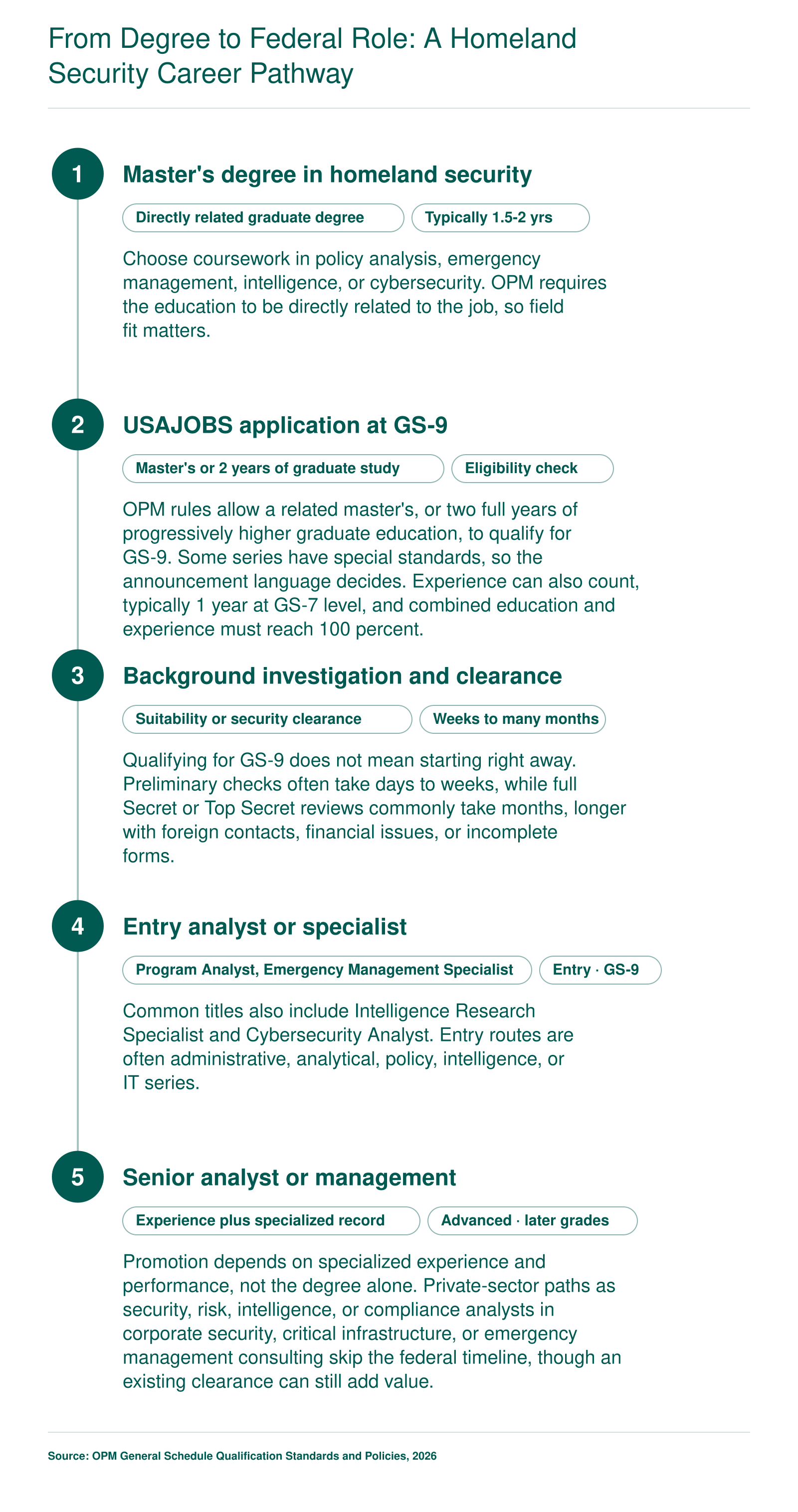
From Degree to Federal Role: A Homeland Security Career Pathway
A homeland security master's can shorten the path to a federal analyst or specialist job, but qualifying for a grade and getting cleared to start are two separate steps. Timelines below are typical ranges, not official guarantees, and each USAJOBS announcement controls its own requirements.
Homeland Security programs by state
Compare Homeland Security programs on the data that matters
Explore more Criminal Justice & Law specializations or browse every graduate field.
All Criminal Justice & Law programs