Most Affordable Master's in Homeland Security Programs
Compare 80+ accredited most affordable Homeland Security programs, with graduate earnings, cost, debt, and completion data from IPEDS and the U.S. College Scorecard.

Choosing between public in-state tuition and a flat online per-credit rate often decides whether a homeland security master's fits a working budget. Among the affordable programs here, in-state tuition runs from about $3,900 to $13,000 a year, while institution-wide net price (an average across all students, not a program quote) spans roughly $1,300 to $14,600.
For emergency managers, service members, and analysts already on the job, the gap between a $6,000 degree and a $20,000 one shapes enrollment more than prestige does. Cost, not curriculum, is the first filter most of these applicants apply.
Key Points
- Columbia Southern charges active-duty students $250 per credit, matching federal tuition assistance.
- Lowest-debt programs in this ranking show 10-year payments of $298 to $437.
- Online asynchronous delivery lets students manage rotating shifts, on-call schedules, and deployment.
The 10 Most Affordable Homeland Security Master's Programs for 2027
These ten programs stand out for keeping graduate tuition and net price manageable while preparing students for roles in emergency management, intelligence, and security policy. The cards below compare format, concentration options, and details that shape real cost for 2026 applicants.
Texas A&M University-Central Texas
#1Killeen, TX · $5,000 – $10,000/yr (est.)
Best for: Working professionals choosing thesis or capstone
Texas A&M University-Central Texas offers a Master of Science in Homeland Security that balances policy, terrorism, cybersecurity, and emergency management. The program's thesis and non-thesis tracks let working professionals align the degree with agency careers or doctoral preparation. Online and face-to-face course options add flexibility.
- 36 total credit hours
- Thesis or capstone option
- Face-to-face and online course options
- Interdisciplinary homeland security curriculum
- Prepares for doctoral study
- Federal career pathways including FBI and Border Patrol
The University of Texas at El Paso
#2El Paso, TX · $5,000 – $10,000/yr (est.)
Best for: Public administration students balancing evening coursework
The University of Texas at El Paso delivers homeland security training through its accredited Master of Public Administration, with homeland security as one of five concentrations. Evening and online courses are designed for working public and nonprofit professionals. Graduates work across local, state, federal, and international employers.
- Homeland Security concentration within the MPA
- Evening and online course scheduling
- Five concentration options available
- Accredited by the Network of Schools of Public Policy, Affairs and Administration
- Classmates include public and nonprofit leaders
American Public University System
#3Charles Town, WV · $5,000 – $10,000/yr (est.)
Best for: Online learners customizing homeland security coursework
American Public University System's online Master of Arts in Homeland Security covers homeland defense, intelligence, terrorism, weapons of mass destruction, and interagency operations. The General Concentration allows students to blend electives from cybersecurity, emergency management, criminal justice, and transportation security. Graduates in this program reported median earnings of $77,276 one year after finishing.
- 36 total credit hours
- Eight concentration options
- Capstone required
- General Concentration tailors security electives
- Prepares for analyst or manager roles
- Online delivery for working adults
University of Management and Technology
#4Arlington, VA · $5,000 – $10,000/yr (est.)
University of Management and Technology's Master of Science in Homeland Security combines theory with practical application in emergency management, terrorism, hazard mitigation, and international relations. The 39-credit structure includes foundation courses for newcomers and advanced electives in communication, government, and leadership. A capstone research project builds analytical and policy skills for federal, state, and private security roles.
- 39 total credit hours
- Capstone required
- Theoretical and applied emphasis
- Core courses in security, emergency management, and international relations
- Elective options in communication and leadership
- Designed for entry-level and current professionals
Sul Ross State University
#5Alpine, TX · $5,000 – $10,000/yr (est.)
Sul Ross State University offers a 36-credit, non-thesis homeland security master's built around crisis and risk management, terrorism, weapons of mass destruction, and immigration policy. Elective options from political science and other approved disciplines let students tailor the degree to law enforcement, border security, or emergency management. The program is designed for working professionals seeking government or criminal justice advancement.
- 36 total credit hours
- No thesis or capstone required
- Electives from political science and approved disciplines
- Covers crisis and risk management, terrorism, and weapons of mass destruction
- Designed for working professionals
- Prepares for government service
Arkansas Tech University
#6Russellville, AR · $5,000 – $10,000/yr (est.)
Arkansas Tech University's Master of Science in Emergency Management and Homeland Security is recognized as the world's first accredited program in the field. Students may choose online, on-campus, or hybrid delivery, and coursework covers emerging technology plus the social, political, legal, and leadership dimensions of crisis management. Graduates in this program reported median earnings of $65,382 one year after finishing.
- World's first accredited program in the field
- Online, on-campus, or hybrid format options
- Emerging technology and leadership focus
- Prepares for doctoral study
- Designed for career professionals
Columbia Southern University
#7Orange Beach, AL · ~$4,000/yr (est.)
Columbia Southern University's online Master of Science in Homeland Security offers a Homeland Security Management concentration with tuition of $359 per credit hour and textbooks included. The program accepts transfer credits and provides dedicated military tuition rates, with active-duty tuition capped at $250 per credit. Graduates in this program reported median earnings of $85,364 one year after finishing.
- $359 per credit hour
- Textbooks included in tuition
- Transfer credits accepted
- Active-duty military tuition capped at $250 per credit
- Military benefits accepted
- Scholarships and financial aid available
- Homeland Security Management concentration
University of Alaska Fairbanks
#8Fairbanks, AK · ~$13,000/yr (est.)
The University of Alaska Fairbanks offers a fully online Master of Security and Disaster Management with asynchronous weekly deadlines and no set meeting times. The university estimates total program tuition at $20,762 to $22,700 depending on course choices, and allows transfer of up to six graduate-level courses from approved American Council on Education credit programs. Faculty include military and law enforcement professionals, and the program is a member of FEMA's Emergency Management Higher Education Program.
- $20,762 total program tuition estimate
- Fully online asynchronous classes
- Transfer up to six graduate-level courses
- FEMA Emergency Management Higher Education member
- DHS University and Agency Partnership Initiative member
- Faculty include military and law enforcement professionals
Western Kentucky University
#9Bowling Green, KY · $12,000 – $18,000/yr (est.)
Western Kentucky University's Master of Science in Homeland Security Sciences offers a Cybersecurity concentration with hands-on labs in ethical hacking, network defense, and computer forensics. The 30-credit, campus-based program requires an IT-related bachelor's degree or equivalent and emphasizes protecting critical infrastructure. Graduates prepare for roles like cybersecurity analyst, penetration tester, or homeland security specialist.
- 30 total credit hours
- Three concentration options
- Cybersecurity concentration
- Hands-on labs in ethical hacking and network defense
- Covers computer forensics and cybersecurity policy
- Requires IT-related bachelor's or equivalent
Idaho State University
#10Pocatello, ID · ~$12,000/yr (est.)
Idaho State University's online Master of Science in Homeland Security and Emergency Management is a 30-credit, fully online program covering risk assessment, emergency protocols, cybersecurity, intelligence, counterterrorism, and disaster management. Students complete a practical field experience or research thesis, with courses averaging 13 to 15 hours per week. Admission requires a 3.0 GPA, two recommendations, and a self-assessment essay.
- 30 total credit hours
- Fully online program
- 3.0 GPA minimum for admission
- Two recommendation letters and self-assessment essay required
- Thesis or capstone option
- Topics include cybersecurity, counterterrorism, and intelligence
Cost & outcomes by school
Federal data for the highest-earning Homeland Security programs, independent of the ranking above. Earnings are this field's master's graduates four years after completing, where the Scorecard reports them.
| School | Earnings | Tuition / yr | Debt | Grads/yr | Format |
|---|---|---|---|---|---|
| George Washington University DC | $134,847 | $36,414 | $39,152 | 49 | Online |
| University of South Florida FL | $114,398 | $10,428 | $20,907 | 26 | Campus |
| Pennsylvania State University PA | $106,535 | $24,650 | $32,931 | 97 | Online |
| Pennsylvania State University PA | $106,535 | $26,034 | $32,931 | — | Online |
| American Public University System WV | $96,527 | $8,700 | $38,384 | 279 | Online |
| Columbia Southern University AL | $93,851 | $3,936 | $37,075 | 193 | Online |
| Middle Georgia State University GA | — | $4,534 | — | — | Online |
| University of Maine at Fort Kent ME | — | $6,000 | — | — | Online |
| Texas A&M University-Central Texas TX | — | $6,242 | — | 5 | Hybrid |
| Texas A & M International University TX | — | $6,650 | — | — | Online |
| Sul Ross State University TX | — | $6,661 | — | 7 | Online |
| University of Management and Technology VA | — | $7,110 | — | 2 | Online |
Sources: U.S. Department of Education. Tuition and graduates: IPEDS. Earnings and debt: College Scorecard, this field's master's graduates; a dash means no figure is reported.
Cost, debt & payoff
Median earnings of this field's master's graduates (4 yrs after completing) vs. their median federal loan debt · U.S. College Scorecard
Across these programs the median graduate earns about $93,521 and finishes with roughly $36,475 in debt — a ratio that clears a common rule of thumb (keep debt below first-year salary). Tuition and debt vary widely school to school, so check the per-school figures in the table above before you shortlist.
What a Homeland Security Master's Really Costs: Credits, Fees, and Transfer Savings
Many online homeland security programs now charge one per-credit rate regardless of residency, which makes prices easier to compare but still hides the full bill. Your homeland security master's degree cost is the per-credit rate times required credits, plus technology, distance-learning, registration, and graduation fees that schools often list separately.
Build the Real Total
- UMass Lowell: $610 per credit for Fall 20261, the same for in-state, out-of-state, and international students. At 30 credits, that is $18,300 before a $30 term registration fee and $50 application fee. The school expects the rate to rise next semester.
- Auburn University at Montgomery: $483 per credit across 30 credits, or about $14,490 in tuition.
- Liberty University: The online M.S. in National Security, Homeland Security track lists $310 per credit for 2026-2027, so 36 credits run about $11,160. Its public safety version charges $600 per credit full-time or $665 part-time.
Request each school's complete fee schedule before comparing the total cost of a master's degree.
Transfer Credits Shrink the Bill
Auburn Montgomery accepts up to 12 transfer credits, worth roughly $5,796 at its rate. Liberty caps transfers at half the degree (15 or 18 credits), and Colorado State allows 24 toward a 36-credit degree. The University of Alaska Fairbanks accepts up to six graduate-level courses.
Published Tuition vs. What You Pay
Graduate students rarely receive institutional grants, so net price usually sits close to sticker price. Federal loans, employer tuition assistance, and military benefits do most of the work in closing the gap.
Top Graduate Earnings Among Ranked Programs
Related Articles
Military Tuition Rates, GI Bill, and Yellow Ribbon Benefits
Columbia Southern University prices its online homeland security master’s at $250 per credit for active-duty students, matching the Department of Defense Tuition Assistance per-credit cap. Because TA stops at that cap, a program priced at or below $250 can leave service members with little or no out-of-pocket tuition.
Published military and veteran rates
Liberty University lists a $310 per-credit graduate military rate for 2026-2027, covering active duty, Reserve/Guard, veterans, retirees, spouses, and DoD employees. Belhaven University's Military and Veteran Benefits page posts a $375 per-credit active-military rate for 2026-2027 and extends discounts to veterans and spouses. Norwich University Online's Online Military Benefits page advertises a $550 per-credit military discount that includes spouses, veterans, and first responders.
GI Bill and Yellow Ribbon
Post-9/11 GI Bill pays full public in-state tuition, and at private schools it covers up to $30,908.34 in 2026-2027; Yellow Ribbon can cover the rest where schools participate, according to Post-9/11 GI Bill Rates. Belhaven participates and may cover up to 100% of remaining out-of-pocket costs for eligible students. Tulane University also participates, offering unlimited additional funds for students with 100% Chapter 33 eligibility.
Online Formats: Asynchronous Classes, Residencies, and Specializations
Fully asynchronous delivery makes this degree workable for anyone on rotating shifts, on-call schedules, or deployment. With no set login times, coursework bends around a 24-hour shift or a time zone change instead of the reverse. The University of Alaska Fairbanks advertises asynchronous online classes, and Idaho State's program runs fully online. Check the format notes on the others. Texas A&M University-Central Texas mixes face-to-face and online courses, Western Kentucky's program is campus-based, and Arkansas Tech offers online, on-campus, or hybrid paths.
Term structure shapes your pace. American Public University uses 8-week sessions.1 Short terms with several starts per year shrink the wait between deciding and enrolling, and stacking back-to-back terms can shorten the timeline for an accelerated homeland security master's program.
Specializations vary widely:
- Cybersecurity: Western Kentucky offers a dedicated information security and assurance concentration.
- Management: Columbia Southern centers on homeland security management.
- Broad coverage: Idaho State's curriculum touches cybersecurity, counterterrorism, and intelligence.
- Choice: American Public University lists eight concentration options.1
Before enrolling, ask whether exams require a paid proctoring service and what computer, webcam, or software you'll need. Those costs rarely show up in per-credit tuition.
Lowest-Debt Homeland Security Master's Programs
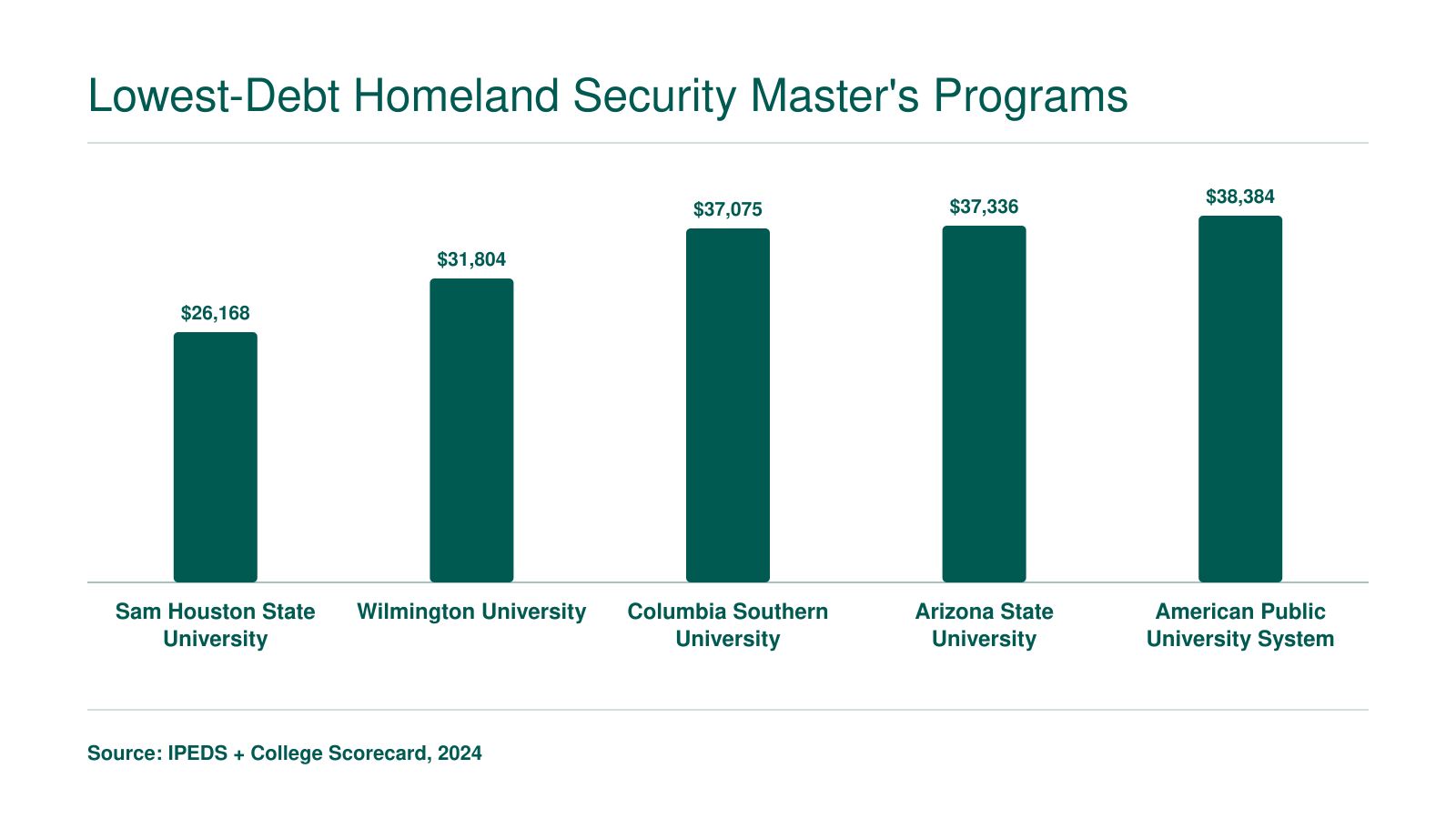
Low federal debt matters most when it lines up with strong earnings. The chart below shows median federal loan debt at graduation for the lowest-debt programs in this ranking, with estimated 10-year monthly payments of $298-$437. Lower debt plus solid earnings makes the return on investment easier to defend.
Homeland Security programs by state
Homeland Security Master's FAQs
Is a master's in homeland security worth it?
What jobs can you get with a master's in homeland security?
Are online homeland security master's degrees respected for federal jobs?
Do I need a specially accredited homeland security program?
Compare Homeland Security programs on the data that matters
Explore more Criminal Justice & Law specializations or browse every graduate field.
All Criminal Justice & Law programs