Best Online Master's in Homeland Security Programs
Compare 60+ accredited online Homeland Security programs, with graduate earnings, cost, debt, and completion data from IPEDS and the U.S. College Scorecard.

Can you earn a homeland security master's while working rotating shifts or deploying overseas? Yes. Police officers, service members, emergency managers, and corporate security staff need a credential that fits around 12-hour shifts and drill weekends, not a fixed lecture schedule.
Every program ranked here can be completed 100% online, with no required residency or campus visits. Price is where they split: annual graduate tuition runs from $7,110 at the University of Management and Technology to $69,310 at Tulane University.
The rankings, cost and earnings data, admissions steps, and career paths follow. That tuition gap rarely tracks outcomes, so a higher sticker price is no guarantee of a bigger paycheck.
Key Points
- Only fully online programs with no required residencies made the 2027 ranking.
- Tuition among affordable ranked programs spans about $3,900 to $15,000 yearly.
- George Washington University leads on earnings for homeland security master's completers.
Best Fully Online Master's in Homeland Security Programs for 2027
This list ranks fully online homeland security master's programs that do not require campus residencies. Hybrid formats are excluded, and the order reflects a composite of graduation outcomes, affordability, and program characteristics rather than prestige or employer reputation.
George Washington University
#1Washington, DC · ~$36,000/yr (est.)
Best for: Policy-focused professionals seeking strategic leadership
George Washington University's fully online Homeland Security Master of Professional Studies prepares working professionals for leadership across local, national, and global security challenges. The 36-credit program can be completed in as little as 16 months and covers terrorism, cybersecurity, AI, intelligence analysis, and security policy. Taught by experienced practitioners, it emphasizes strategic leadership and interagency cooperation, with no GRE required. The university is accredited by the Middle States Commission on Higher Education.
- $54,216 total program tuition
- $1,506 per credit
- 36 total credit hours
- 16-month completion possible
- 3 start dates per year
- Capstone required
- No GRE required
- Covers terrorism, cybersecurity, and AI
American Public University System
#2Charles Town, WV · $5,000 – $10,000/yr (est.)
Best for: Working professionals needing monthly online starts
American Public University System's 36-credit Master of Arts in Homeland Security blends homeland defense, intelligence methods, terrorism, weapons of mass destruction, consequence management, and interagency issues. The General Concentration lets students tailor electives across emergency management, cybersecurity, criminal justice, and transportation security. With highly credentialed instructors and a capstone project, the program prepares graduates for analyst or manager roles in government, military, and public safety organizations.
- 8 concentration options
- 36 total credit hours
- Capstone required
- Highly credentialed instructors
- Prepares for analyst or manager roles
- Customize concentration courses
- General Concentration available
Towson University
#3Towson, MD · ~$13,000/yr (est.)
Best for: Security professionals choosing three specializations
Towson University's M.S. in Integrated Homeland Security Management balances broad strategic knowledge with specialized expertise in Security Policy, Information Assurance, or Health Preparedness. The applied capstone emphasizes real-world security problem-solving, and core courses also form a graduate certificate in security assessment and management. Students can join the Order of the Sword and Shield National Honor Society in a program designed for working professionals.
- 3 concentration options
- Capstone required
- Small classes with strong faculty interaction
- National Honor Society chapter available
- Core courses form a graduate certificate
- Designed for working professionals
- Focus on crisis response and risk management
- Online learning via Blackboard platform
University of Kansas
#4Lawrence, KS · $12,000 – $27,000/yr (est.)
The University of Kansas offers a fully online Master of Science in Homeland Security: Law & Policy, a synchronous program for defense, emergency management, law enforcement, and related professionals. The curriculum builds critical thinking for managing complex security incidents, and a culminating simulation course develops crisis leadership. With per-credit tuition of $695 and rolling admissions, the program is designed for working adults.
- $695 per credit
- Rolling admissions
- Starts fall/spring
- Synchronous online classes
- 3.0 GPA minimum
- Capstone required
- Military benefits accepted
- Financial aid available
Thomas Edison State University
#5Trenton, NJ · $10,000 – $15,000/yr (est.)
Thomas Edison State University's 36-credit Master of Science in Homeland Security is built for working adults moving into policy, leadership, and operational roles. Students complete an 18-credit core covering terrorism, border security, cybersecurity, immigration administration, and emergency management, then choose a 12-credit area of study in Counterterrorism, Cybersecurity, or Emergency Management. Completing a track also earns a graduate certificate in that specialty.
- 3 concentration options
- 36 total credit hours
- Asynchronous online classes
- 3.0 GPA minimum for standard admission
- Financial aid available
- 18-credit core plus 12-credit specialty track
- Graduate certificate earned within degree program
- Tracks in Counterterrorism, Cybersecurity, or Emergency Management
University of Management and Technology
#6Arlington, VA · $5,000 – $10,000/yr (est.)
University of Management and Technology's Master of Science in Homeland Security blends theory with practical application across emergency management, terrorism, hazard mitigation, disaster recovery, and international relations. Core courses also cover physical and aviation security, bioterrorism, and legal frameworks, with advanced electives in communication, government, and leadership. Designed for both newcomers and experienced professionals, the 39-credit program includes a capstone research project.
- 39 total credit hours
- Capstone required
- Theoretical and applied emphasis
- For entry-level and current professionals
- Core courses in security, emergency management, and international relations
- Elective options in communication and leadership
American University
#7Washington, DC · ~$37,000/yr (est.)
American University's online Master of Science in Counter-Terrorism and Homeland Security prepares students for roles in government and private agencies, with faculty who are active intelligence professionals. The 36-credit, 12-course curriculum covers terrorism studies, national security law, cybersecurity, and intelligence analysis. Students can add a Certificate in Analytics and Management, and no GRE is required.
- No entrance exam required
- $2,080 per credit
- 24-month program
- 36 total credit hours
- 12 total courses
- 3 start dates per year
- Faculty are intelligence professionals
- Earn a Certificate in Analytics and Management
Tulane University of Louisiana
#8New Orleans, LA · ~$69,000/yr (est.)
Tulane University's fully online Master of Professional Studies in Homeland Security Studies covers terrorism, emergency management and disaster response, intelligence analysis, critical infrastructure protection, and legal and ethical issues. Students can create an individualized plan of study with a program director and add stackable graduate certificates for focused specialization. Faculty are industry practitioners, and the program requires no thesis or entrance exams.
- No entrance exam required
- $900 per credit
- Rolling admissions
- 3.0 GPA minimum
- No thesis or capstone required
- Individualized plan of study with program director
- Stackable graduate certificates available
- Faculty are practicing industry leaders
Arizona State University
#9Scottsdale, AZ · ~$11,000/yr (est.)
Arizona State University's online Master of Arts in Emergency Management and Homeland Security, with a Homeland Security concentration, prepares students for leadership roles in law enforcement, public safety, and emergency management. The 33-credit program culminates in a capstone applied project, and faculty include fellows of the Academy of Criminal Justice Sciences and the National Academy of Public Administration. Courses are delivered in 7.5-week sessions, allowing working professionals to finish while employed.
- Homeland Security concentration
- 33 total credit hours
- 11 total courses
- 7.5-week class sessions
- Capstone applied project required
- 3.0 GPA minimum
- 2 letters of recommendation required
- Faculty from Academy of Criminal Justice Sciences
Monmouth University
#10West Long Branch, NJ · $25,000 – $30,000/yr (est.)
Monmouth University offers a 30-credit Master of Arts in Criminal Justice with a Homeland Security Track for professionals seeking careers in national security. The curriculum covers ethics, data analysis, and cyberterrorism, and alumni work at agencies such as Homeland Security Investigations. The program includes a capstone project and is designed for working professionals.
- Homeland Security Track
- 30 total credit hours
- 2.8 GPA minimum
- 2 letters of recommendation required
- Capstone required
- Alumni work at Homeland Security Investigations
- Expert faculty with practitioner experience
- Internships and independent research available
Cost & outcomes by school
Federal data for the highest-earning Homeland Security programs, independent of the ranking above. Earnings are this field's master's graduates four years after completing, where the Scorecard reports them.
| School | Earnings | Tuition / yr | Debt | Grads/yr | Format |
|---|---|---|---|---|---|
| George Washington University DC | $134,847 | $36,414 | $39,152 | 49 | Online |
| Pennsylvania State University PA | $106,535 | $26,034 | $32,931 | — | Online |
| Pennsylvania State University PA | $106,535 | $24,650 | $32,931 | 97 | Online |
| American Public University System WV | $96,527 | $8,700 | $38,384 | 279 | Online |
| Columbia Southern University AL | $93,851 | $3,936 | $37,075 | 193 | Online |
| Middle Georgia State University GA | — | $4,534 | — | — | Online |
| University of Maine at Fort Kent ME | — | $6,000 | — | — | Online |
| Texas A & M International University TX | — | $6,650 | — | — | Online |
| East Texas A&M University TX | — | $7,338 | — | — | Online |
| Tarleton State University TX | — | $7,527 | — | — | Hybrid |
| Stephen F. Austin State University TX | — | $7,829 | — | — | Online |
| Columbia College MO | — | $8,477 | — | — | Online |
Sources: U.S. Department of Education. Tuition and graduates: IPEDS. Earnings and debt: College Scorecard, this field's master's graduates; a dash means no figure is reported.
Cost, debt & payoff
Median earnings of this field's master's graduates (4 yrs after completing) vs. their median federal loan debt · U.S. College Scorecard
Across these programs the median graduate earns about $93,521 and finishes with roughly $36,475 in debt — a ratio that clears a common rule of thumb (keep debt below first-year salary). Tuition and debt vary widely school to school, so check the per-school figures in the table above before you shortlist.
How We Ranked the Best Fully Online Homeland Security Master's Programs
Online flexibility is easy to advertise and harder to verify, so the first filter is about format, not reputation.
Fully Online Only
Hybrid programs and programs with required residencies were removed before any scoring began. If a degree asks you to relocate or travel for mandatory campus time, it does not compete here, because working professionals earning a master's in homeland security usually cannot do either.
What Goes Into the Score
Each program receives a composite built from four things: graduate tuition, average net price, institution-wide graduation rate, and College Scorecard outcome data where it is published. In plain terms, affordable master's in homeland security programs that cost less, graduate more of their students, and show stronger results after graduation move up.
What the Numbers Can't Tell You
Graduation rates and average net price describe the whole institution, undergraduates included, not just homeland security students. Program-level earnings and debt are not published for every school, so some programs are scored on fewer measures than others. Read the order as a well-informed starting point, then confirm details on each program's own page.
No Paid Placement
Many "best of" pages rank schools by who pays for the listing. Nothing here works that way. No school paid for placement, and no school can buy a higher position in these rankings.
How Much an Online Homeland Security Master's Really Costs
Tuition and the Residency Question
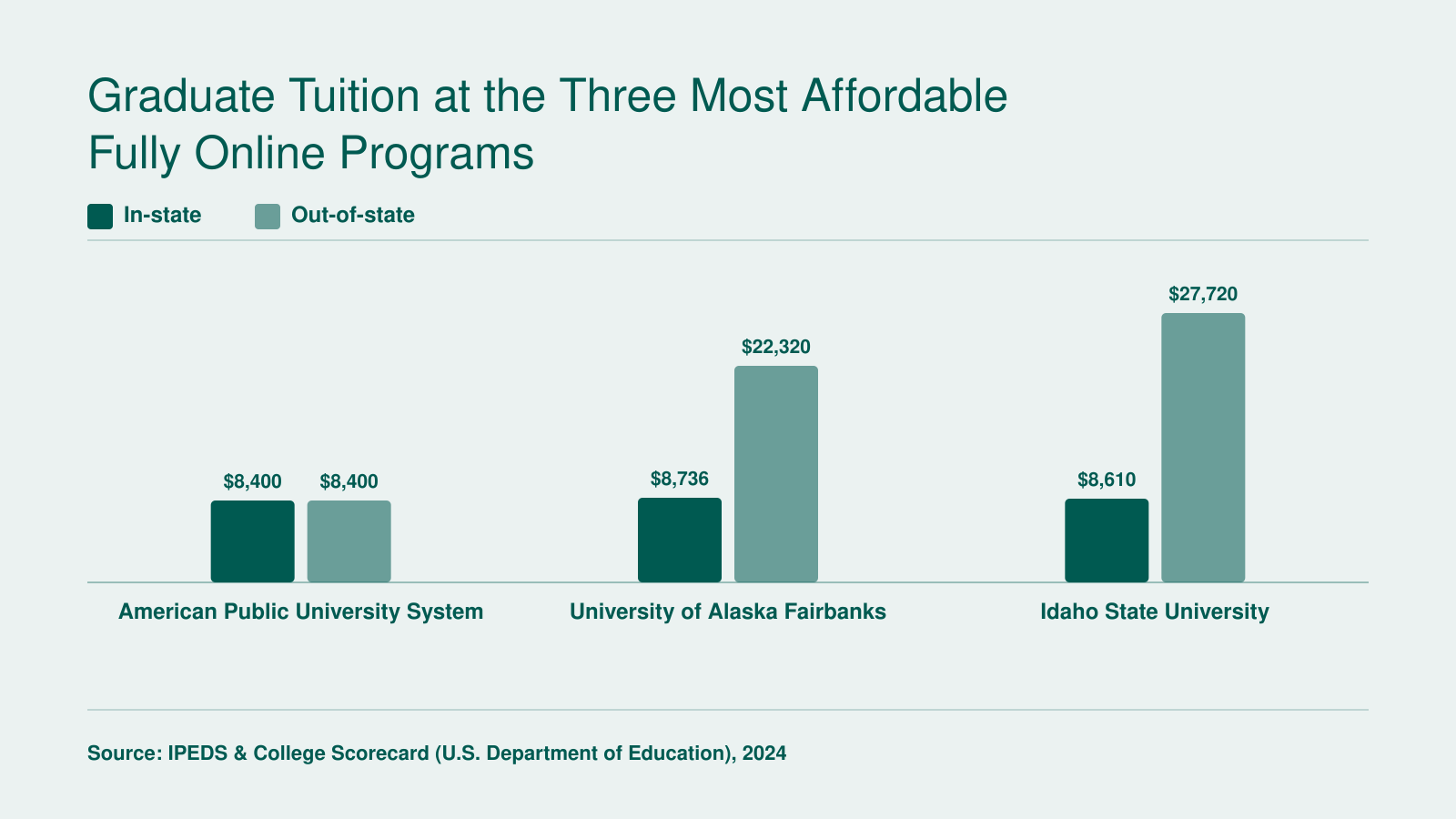
Among the most affordable programs ranked here, graduate tuition runs from about $3,900 a year at Columbia Southern to roughly $15,000 at Western Connecticut State. Residency matters less than you might expect. Columbia Southern and American Public University charge one flat rate regardless of where you live, so the in-state and out-of-state figures are identical. Where a gap exists, it can be steep: Idaho State's published out-of-state rate runs nearly three times its in-state figure. Always confirm which rate applies to online learners before you commit.
You may also see an average net price for a school, the typical cost after grant aid. Treat that number as background, not a quote. It blends all students across every program and degree level, so it rarely reflects the homeland security master's tuition and fees a graduate student will actually pay.
Credits Drive Total Cost
Because programs differ in length, annual tuition makes a poor comparison. The degrees here typically require 30 to 36 credits. A 30-credit program at a given per-credit rate simply costs less than a 36-credit one at the same rate. Auburn at Montgomery, for example, lists $483 per credit across 30 credits1; Columbia Southern lists $359 per credit2. Multiply the per-credit price by the required credits to get a real apples-to-apples homeland security master's program cost.
Transfer Credit Cuts Both Cost and Time
Bringing in prior graduate work shortens the degree. Auburn at Montgomery and Keiser each accept up to 12 transfer credits13, while Liberty allows up to 50 percent of a program (15 credits in its 30-credit track, 18 in its 36-credit tracks). Keiser requires transferred courses to carry a B or higher3. Every credit you transfer is one you don't pay for twice.
One Practical Tip
Before you apply, ask two questions: does the school offer a reduced military or first-responder rate, and does your employer provide tuition assistance? Several programs here accept military benefits, and either discount can change which program is genuinely the better value.
Graduate Tuition at the Three Most Affordable Fully Online Programs
These are annual graduate tuition and fee figures for the three most affordable fully online programs, not total program cost. American Public University System charges the same rate regardless of residency, while the public universities charge higher out-of-state tuition.
Graduate Outcomes: What Homeland Security Master's Completers Earn and Owe
Earnings after a homeland security master's vary widely by program, and the gap in debt matters nearly as much as the gap in pay.
What Completers Earn
George Washington University leads on program-level earnings. Its master's completers have a median of $111,258 one year after finishing and $134,847 four years after finishing. Penn State follows at $85,563 after one year and $106,535 after four. American University reports $70,939 after one year and $96,954 after four.
Further down, Arizona State University shows $90,117 five years after finishing. American Public University System shows $91,488 at the same mark, and National University shows $93,112. Sam Houston State University reports $82,876 four years out, and Northwestern State University of Louisiana reports $81,715 at four years.
Monmouth University's figure of $78,542 five years after finishing covers its criminal justice master's with a homeland security track, so treat it as a close proxy rather than a pure homeland security result.
What They Owe
- George Washington: median debt of $39,152, with a 10-year payment near $445 a month.
- Penn State: $32,931 in debt, about $375 a month.
- American University: $41,000 in debt, about $466 a month.
- Arizona State: $37,336 in debt, about $425 a month.
- Columbia Southern University: $37,075 in debt, about $422 a month, against $83,721 five years out.
- Sam Houston State: $26,168 in debt, about $298 a month.
National University, Northwestern State and Monmouth have earnings figures but no program-level debt figure, so we describe them without a payment number.
A Simple Rule of Thumb
Total debt below your first-year salary is generally manageable. Every school above with both figures clears that bar comfortably. Penn State's $32,931 sits against $85,563 one year out, and George Washington's $39,152 sits against $111,258.
Read the Numbers Carefully
Many students in these programs already work in the field, often in government, the military or emergency services. Their reported earnings can reflect seniority they had before enrolling, not only what the degree added. Weigh a program's pay figure against your own starting point before assuming it will repeat for you.
Related Articles
Admissions Checklist for Online Homeland Security Master's Programs
Requirements vary by school, so confirm current terms directly with each program before applying.
- Bachelor's degreeMost programs require a regionally accredited bachelor's degree; Penn State World Campus and Tulane are examples. Arizona State's online program is more specific, asking for a bachelor's or master's in a closely related field.
- GPA and GREPublished GPA minimums are most often 3.0, though Monmouth lists 2.8. A GRE score is not required at several schools here: Penn State's program page lists the GRE as not required, American University lists no GRE, and Tulane notes no entrance exam.
- Work experienceArizona State expects at least two years of related professional experience unless the applicant has a related degree or current field employment. Penn State's geospatial-focused option may require five or more years on the standard route. A public-safety background is not a universal requirement.
- Other application materialsTypical packets include a statement of purpose, resume or CV, recommendation letters, and official transcripts. Penn State asks for three references; Arizona State requires two recommendations; Tulane requests a 250–500-word statement.
- Start dates and deadlinesMany programs offer multiple starts or rolling admission. Tulane lists January and May terms; George Washington and American University list three starts annually; Kansas uses rolling admissions.
The U.S. Department of Homeland Security says on its official About DHS page that it has "more than 260,000 employees." Their jobs range from aviation and border security to emergency response, cybersecurity analysis, and chemical-facility inspection, so a homeland security master's can point toward many different careers.
Emergency management directors are projected to see 4% employment growth from 2025 to 2035, yet the Bureau of Labor Statistics Occupational Outlook Handbook still expects about 1,100 job openings each year, largely from workers retiring or leaving the field.
Homeland Security programs by state
Frequently Asked Questions About Online Homeland Security Master's Degrees
Use this section as a step-by-step verification checklist. Completion timelines, accreditation status, and clearance eligibility vary by school and agency, so confirm the specifics below rather than relying on general claims.
How do I verify the actual completion time for an online homeland security master's program?
Are online homeland security master's programs accredited?
Does earning the degree qualify me for a federal security clearance?
Which career and earnings sources should I use?
What should I do next to compare programs?
Compare Homeland Security programs on the data that matters
Explore more Criminal Justice & Law specializations or browse every graduate field.
All Criminal Justice & Law programs