Accelerated Master's in Homeland Security Programs
Compare 80+ accredited fastest Homeland Security programs, with graduate earnings, cost, debt, and completion data from IPEDS and the U.S. College Scorecard.

Finishing a homeland security master's program in 12 months and paying the least for it are rarely the same decision. Most programs run 30 to 45 credits; the fastest online tracks compress that into back-to-back 7- or 8-week terms.
That pace works for a patrol sergeant, a service member, or an emergency manager only when start dates and course loads line up with shift work. Programs are ordered by speed first, then cost and graduate earnings.
Key Points
- Accelerated tracks finish in 12 to 18 months with the same credits.
- Purdue Global, Austin Peay State, East Texas A&M have lowest net price.
- Seven week terms at Tiffin and Texas A&M International ease full-time work.
Best Accelerated Homeland Security Master's Programs for 2027
Accelerated homeland security master's degrees typically run 30 to 45 credits, with several online tracks structured to finish in about 12 to 18 months. This list prioritizes programs that compress time to completion while still attaching graduate earnings, debt, and institution-wide graduation data. Keep in mind that net price is an institution-wide average after financial aid, not a quote for this specific degree.
University at Albany
#1Albany, NY · ~$14,000/yr (est.)
Best for: Mid-career professionals wanting synchronous online or campus delivery
Albany offers a hybrid MS in emergency management and homeland security with a dedicated Homeland Security specialization track. Students choose among five concentrations, complete a practicum or thesis, and can take courses online, on campus, or through synchronous simulcast sessions. The program also supports an accelerated 4+1 bachelor's-to-master's pathway for qualifying undergraduates.
- 36 total credit hours
- 5 concentration options
- Synchronous online or on-campus delivery
- 3.0 GPA minimum and 3 recommendation letters
- Thesis or capstone option
- Accelerated 4+1 bachelor's-to-master's pathway
Sam Houston State University
#2Huntsville, TX · ~$9,000/yr (est.)
Best for: Working professionals needing flexible online course pacing
Sam Houston State's online program is built around accelerated 7.5-week graduate sessions and can be finished in as little as one year. The curriculum spans emergency management, information and intelligence management, and critical infrastructure protection, with faculty bringing field experience into the classroom. The delivery fits working professionals who need start dates throughout the year.
- 36 total credit hours
- Complete in as little as one year
- 7.5-week course sessions
- Covers emergency management and intelligence management
- Faculty with real-world experience
- Multiple start dates throughout the year
Wilmington University
#3New Castle, DE · ~$10,000/yr (est.)
Best for: Military and law enforcement professionals wanting practitioner-led training
Wilmington's safety and security track blends risk management, public safety, and information security with a required capstone and field practicum. The 33-credit program is fully online with eight-week course starts, and it is designed for law enforcement, military, and working security professionals. Active practitioners teach the courses.
- 33 total credit hours
- Fully online with 8-week course starts
- Capstone with field practicum
- 4 concentration options available
- Taught by active practitioners
- Hands-on field experience
Excelsior University
#4Albany, NY
Excelsior's criminal justice master's lets students focus in homeland security and emergency management through an asynchronous, fully online format. The 30-credit degree accepts up to 15 transfer credits, and courses begin every eight weeks. No criminal justice background is required, making it accessible to career changers.
- 30 total credit hours
- Can be completed in one year
- Asynchronous fully online classes
- Transfer up to 15 credits
- 3 concentration options
- No criminal justice background required
- MSCHE accredited institution
Rosemont College
#5Rosemont, PA · ~$13,000/yr (est.)
Rosemont's online MA in homeland security and emergency management is grounded in ethics and offers embedded certificates in forensic psychology or strategic leadership. Accelerated seven-week online semesters run six times per year, and transfer credits from law enforcement or military training can shorten the path. Small classes create a mentorship-oriented environment.
- Accelerated 7-week online semesters
- 6 start dates per year
- Embedded certificates in forensic psychology and strategic leadership
- Capstone project required
- Transfer credits from law enforcement and military accepted
- Small class sizes
- Affiliated with CHDS, FBI, and FEMA
Austin Peay State University
#6Clarksville, TN · ~$11,000/yr (est.)
Austin Peay's online criminal justice master's includes a homeland security concentration and can be finished in as little as one year. The 30-credit program requires a comprehensive exam, and rolling admission makes start times flexible. Faculty connections with Fort Campbell bring practical experience to the coursework.
- 30 total credit hours
- Complete in as little as one year
- Fully online format
- Rolling admissions
- 2.7 GPA minimum
- Only such program in Tennessee
- Comprehensive exam required
- Faculty from Fort Campbell
East Texas A&M University
#7Commerce, TX · ~$7,000/yr (est.)
East Texas A&M's applied criminology master's offers a homeland security track through accelerated eight-week online courses. The 36-credit program can be completed in about 18 months and does not require a thesis or capstone. Its pricing and simple application make it a practical option for working adults.
- 36 total credit hours
- Complete in about 18 months
- Accelerated 8-week courses
- 100% online delivery
- No thesis or capstone required
- One recommendation letter minimum
- 4 concentration options
Purdue University Global
#8West Lafayette, IN · $10,000 – $15,000/yr (est.)
Purdue Global's homeland security and emergency management master's is a project-based online degree that can be completed in one year of full-time study. The 45-credit program carries IFSAC accreditation, and military students may qualify for tuition reductions. Students network with professionals nationwide through the graduate resource center.
- 45 total credit hours
- Complete in one year with full-time study
- IFSAC accredited
- 9 total courses
- Hands-on project-based learning
- Military tuition reduction up to 30%
- 15 hours weekly course effort
University of Maryland Global Campus
#9Adelphi, MD · ~$10,000/yr (est.)
UMGC's homeland security leadership master's is a 30-credit online program aimed at strategic roles in government, private sector, and nonprofits. Students choose among three specialization tracks and complete a leadership capstone, with transfer credit and accelerated bachelor's-to-master's options available. Military benefits and no-cost digital materials reduce costs.
- 30 total credit hours
- Complete in as little as two years
- Three specialization tracks
- Capstone in leadership required
- Transfer up to 12 credits
- Military tuition rate available
- No-cost digital materials
- Accelerated pathway for UMGC bachelor's
Cost & outcomes by school
Federal data for the highest-earning Homeland Security programs, independent of the ranking above. Earnings are this field's master's graduates four years after completing, where the Scorecard reports them.
| School | Earnings | Tuition / yr | Debt | Grads/yr | Format |
|---|---|---|---|---|---|
| Texas A & M International University TX | — | $6,650 | — | — | Online |
| Purdue University Global IN | — | $10,211 | — | — | Online |
| Austin Peay State University TN | — | $10,518 | — | — | Online |
| Tiffin University OH | — | $17,000 | — | — | Online |
Sources: U.S. Department of Education. Tuition and graduates: IPEDS. Earnings and debt: College Scorecard, this field's master's graduates; a dash means no figure is reported.
Cost, debt & payoff
Median earnings of this field's master's graduates (4 yrs after completing) vs. their median federal loan debt · U.S. College Scorecard
Across these programs the median graduate earns about $93,521 and finishes with roughly $36,475 in debt — a ratio that clears a common rule of thumb (keep debt below first-year salary). Tuition and debt vary widely school to school, so check the per-school figures in the table above before you shortlist.
How Long It Really Takes: Accelerated vs. Standard Pace
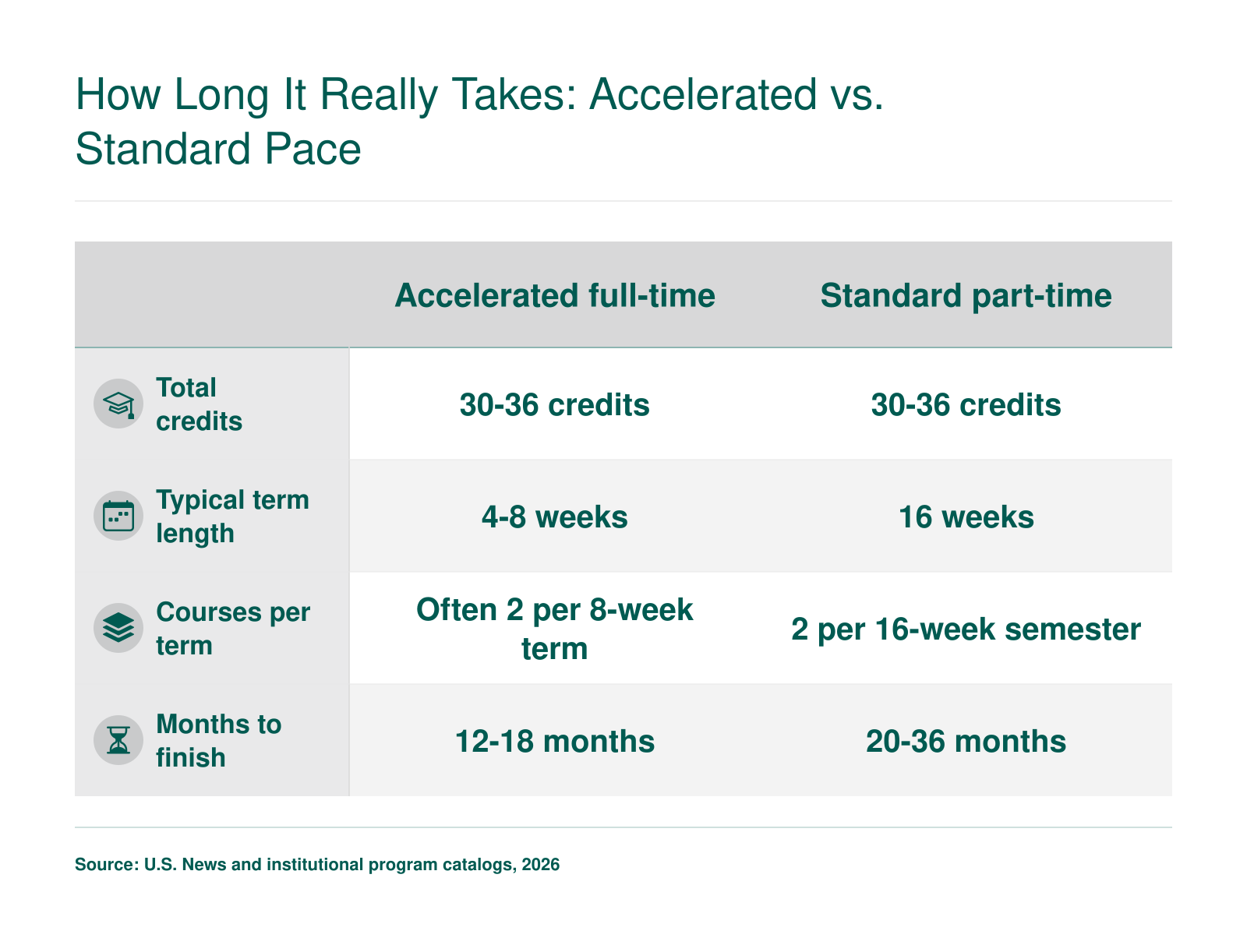
Most homeland security master's programs require 30-36 credits. A 12-month finish usually means two courses per 8-week term with no breaks, while a standard part-time pace often takes two 3-credit courses per 16-week semester. Accelerated tracks land around 12-18 months; part-time tracks can stretch from about 20 to 36 months.
Lowest-Cost Accelerated Homeland Security Master's Options
The lowest net price estimates in this comparison come from Purdue Global, Austin Peay State University, and East Texas A&M University. Net price is an institution-wide figure after financial aid, so it can be far lower than published tuition. Published per-credit tuition and total program cost are not reported for every program here; Purdue Global lists a $420 per-credit rate and a military tuition reduction of 17 to 30 percent. Military savings also appear at Liberty University ($310 per credit) and Columbia Southern University ($250 per credit for active-duty students).
| School | Published per-credit tuition | Estimated total program cost | Net price after aid |
|---|---|---|---|
| Purdue University Global | $420 | Not published | $7,770 |
| Austin Peay State University | Not published | Not published | $9,735 |
| East Texas A&M University | Not published | Not published | $11,841 |
Related Articles
Can You Work Full Time? Online Format, Term Length, and Start Dates
Seven-week terms at Tiffin University and Texas A&M International University are a scheduling advantage for working professionals: you take one or two courses at a time instead of four, and each commitment ends in under two months.12
Delivery format matters more than total credits in online master's in homeland security programs. Asynchronous coursework, offered at Tiffin, Liberty University, and the University of Maine at Fort Kent, has no required login times, so night-shift officers and service members overseas can work around duty schedules.13
Start dates vary widely. Columbia Southern University reports 11 per year; Tiffin and TAMIU each offer six.412 Penn State World Campus and George Washington University run on three, with longer 12- to 15-week semesters.5
Accreditation, Credit Transfer, and Bachelor's-to-Master's Pathways
Use this checklist to verify accreditation and transfer details for accredited homeland security master's programs, including online master's in homeland security. Published details on accreditation and transfer vary by school, so confirm each one yourself before you apply.
Accreditation
Look up each school's institutional accreditor in the U.S. Department of Education's DAPIP database or through CHEA. Then check the program page and latest catalog for any programmatic accreditation claim. Liberty University, for example, lists SACSCOC as its accreditor.
Credit transfer and 4+1 pathways
Ask the registrar, graduate admissions office, or program director for transfer limits in writing: maximum credits, minimum grades, residency rules, and time limits. Liberty states that up to 50% of a graduate degree may transfer, but confirm the finer rules directly.
For any 4+1 pathway, ask how many credits are shared, which courses count, what GPA and prerequisites apply, when to apply, and whether admission is guaranteed or conditional. Check the program handbook and talk with an academic advisor.
Source checklist
- School and program websites, plus the catalog
- Registrar and graduate admissions pages
- DAPIP or CHEA for accreditation
- BLS.gov for career and wage context (it does not accredit programs)
- ASIS International or IAEM for certification context
Admission Requirements for Accelerated Homeland Security Tracks
- RequirementsTypical materials include an accredited bachelor's degree, official transcripts, a résumé, a personal statement, and two to three recommendations.
- GPA and GREMinimum GPAs usually fall between 2.5 and 3.0; some schools waive the GRE, while others request it for lower GPAs.
- ExperienceGeorge Washington requires two years of homeland-security experience. Penn State's accelerated geospatial route waives experience but requires a résumé and professional statement after the third course.
- DeadlinesDeadlines follow multiple start dates, Penn State lists Jan. 4 and May 1, Angelo State lists five 2026 dates, and Sam Houston State and Kansas use rolling or ongoing review.
Homeland Security programs by state
Frequently Asked Questions
Quick answers for students weighing time, cost, accreditation, and careers.
How long does an accelerated homeland security master's take?
Which accelerated homeland security master's programs are cheapest?
Do accelerated homeland security master's programs have the same accreditation?
What jobs can I get with a master's in homeland security?
Compare Homeland Security programs on the data that matters
Explore more Criminal Justice & Law specializations or browse every graduate field.
All Criminal Justice & Law programs