Best Master's in Public Policy Programs
Compare 200+ accredited Public Policy programs at 140+ schools, with graduate earnings, cost, debt, and completion data from IPEDS and the U.S. College Scorecard.

Harvard lists $128,680 in total tuition for its four-semester MPP. UC San Diego lists $33,278 for a two-year MPP of its own. Between those figures sit dozens of master of public policy programs, and most rankings never show the math that places one above another.
This page ranks 13 programs on federal cost and outcome data rather than reputation surveys. Along the way it covers MPP vs. MPA, true cost, earnings and debt, online and part-time formats, GRE policies, and accreditation.
One caution applies throughout: program-level earnings for policy graduates are still thin in federal data, so price is often the clearer signal.
Key Points
- The ranking covers 13 programs scored on federal tuition, net price, and graduation data.
- Program-level MPP earnings are not yet published, so no salary claim here is verified.
- Of the 13 ranked schools, 11 are campus-based; only two offer flexible formats.
Best Master's in Public Policy Schools: 13 Top-Ranked Programs
The programs below pair strong federal outcomes with distinctive strengths, from Princeton's senior-leadership cohort to Georgia Tech's technology policy focus. We list them in ranked order based on verifiable federal data, with each card showing cost, format, and concentration details. Use the program bullets to compare what actually differs between these schools.
Princeton University
#1Princeton, NJ · ~$66,000/yr (est.)
Best for: Mid-career professionals targeting senior public service roles
Princeton's one-year residential MPP is designed for mid-career professionals with at least seven years of public or nonprofit experience. Students choose from four fields: International Relations, International Development, Domestic Policy, and Economics and Public Policy. A required summer session and a cohort of roughly 20 support close mentorship and rigorous quantitative training for senior public service roles.
- 1-Year program
- Starts with a six-week summer session
- Cohort of approximately 20 students
- Requires at least 7 years of work experience
- Four concentration options: International Relations, International Development, Domestic Policy, Economics and Public Policy
- Residential program at Princeton
Harvard University
#2Cambridge, MA · $55,000 – $60,000/yr (est.)
Best for: Evidence-driven leaders pursuing cross-sector policy careers
Harvard Kennedy School's two-year, campus-based MPP builds a social science core in economics, ethics, negotiation, quantitative analysis, and politics. Students then choose a Policy Area of Concentration and finish with an applied Policy Analysis Exercise for a real organization. Joint MBA or JD degrees are available, and the school's graduation rate is 98%.
- Two-year, full-time campus program
- Core covers economics, ethics, negotiation, quantitative analysis, politics
- Five Policy Area Concentrations, including Democracy, Politics, and Institutions and International and Global Affairs
- Policy Analysis Exercise capstone for a real client
- Joint MBA or JD degree options available
- Two-week Spring Exercise simulation in year one
Georgia Institute of Technology
#3Atlanta, GA · ~$16,000/yr (est.)
Best for: Technology-focused analysts shaping science and data policy
Georgia Tech's M.S. in Public Policy pairs technical training in data science and analytics with policy writing and implementation. Concentrations include energy and environmental policy, information and communications policy, and science and technology policy. The 46-credit campus program culminates in a research project or thesis, often with partners such as the EPA, and graduates move into roles at the CDC, FCC, and consulting firms.
- Two-year campus program
- 46 total credit hours
- Concentrations in energy and environmental, information and communications, and science and technology policy
- Thesis or capstone option
- Real-world research with partners such as the EPA
- STEM skills in coding, data science, and analytics
University of California-Berkeley
#4Berkeley, CA · ~$16,000/yr (est.)
UC Berkeley's Goldman School offers a two-year, full-time campus MPP that combines social science methods, political institutions, and economic analysis. A summer internship, a second-year policy analysis project, and electives across the university provide hands-on learning. The program typically enrolls students averaging three to four years of work experience.
- Two-year full-time program
- Campus-based delivery format
- Summer internship after first year
- Second-year policy analysis project
- Class size of about 102 students
- Average 3-4 years of work experience
University of California-Los Angeles
#5Los Angeles, CA · ~$14,000/yr (est.)
UCLA Luskin's two-year MPP emphasizes quantitative and analytical skills with a flexible curriculum and access to joint degrees in Law, Management, Public Health, Medicine, and Social Welfare. Certificate options include Global Public Affairs and Leaders in Sustainability. The program is competitive and draws students from varied undergraduate backgrounds.
- Two-year campus program
- GRE recommended for domestic applicants, required for international applicants
- 3.0 GPA minimum in upper-division courses
- Joint degrees with Law, Management, Public Health, Medicine, and Social Welfare
- Interdisciplinary certificate option
- Certificate in Global Public Affairs
- Leadership and sustainability certificate
- Certificate in Leaders in Sustainability
Duke University
#6Durham, NC · ~$67,000/yr (est.)
Duke's Sanford School offers a 24-month Master of Public Policy for early-career professionals, with eight policy-area concentrations and dual degree options. The residential program includes a summer internship and capstone or consulting project. NASPAA accreditation is in place through 2028, and the school's graduation rate is 97%.
- Two-year residential program
- 51 credit hours required
- Eight policy-area concentrations
- Core curriculum includes policy analysis, statistics, microeconomic analysis, political analysis, ethics, management
- Master's capstone project required
- Internship required
- Energy and Environment Policy concentration
- Spring consulting projects available
University of Virginia
#7Charlottesville, VA · ~$24,000/yr (est.)
UVA's Batten School MPP is a two-year, full-time program built on rigorous data analysis, hands-on policy experience, and leadership concepts. Students complete an Applied Policy Project with a real-world client. The school's graduation rate is 96%, and admissions use multiple fall deadline rounds.
- Two-year full-time program
- Rigorous data analysis curriculum
- Applied Policy Project with real-world clients
- Value-based leadership training
- Multiple application deadline rounds
University of Chicago
#8Chicago, IL · ~$69,000/yr (est.)
The University of Chicago Harris MPP is a two-year, STEM-designated program focused on economics, statistics, and political economy. Students use R for quantitative analysis and complete a practical experience requirement. The program offers cross-university electives and a 24-month STEM OPT extension for eligible international students.
- Two-year STEM-designated program
- Six core courses in economics, statistics, and political economy
- Practical experience requirement
- Analyze data using R
- 24-month STEM OPT extension available
- Cross-university course registration
Georgetown University
#9Washington, DC · $60,000 – $65,000/yr (est.)
Georgetown's McCourt School MPP is a two-year, STEM-designated campus degree with full-time and part-time evening options. The 48-credit program includes a required internship and capstone or thesis, and its Washington, DC location supports placements in federal agencies, think tanks, and consulting. The school's graduation rate is 95%.
- Two-year campus program
- 48 total credit hours
- Full-time and part-time evening options
- Required internship and capstone or thesis
- STEM-designated, with international OPT extension
- Located in Washington, DC
Cost & outcomes by school
Federal data for the highest-earning Public Policy programs, independent of the ranking above. Earnings are this field's master's graduates four years after completing, where the Scorecard reports them.
| School | Earnings | Tuition / yr | Debt | Grads/yr | Format |
|---|---|---|---|---|---|
| Harvard University MA | $129,978 | $57,248 | $70,447 | 159 | Campus |
| Princeton University NJ | $120,163 | $65,936 | — | 92 | Campus |
| Johns Hopkins University MD | $107,692 | $64,730 | $32,114 | 62 | Hybrid |
| University of California-Los Angeles CA | $100,925 | $14,476 | $41,000 | 63 | Campus |
| University of Virginia VA | $99,110 | $23,526 | $37,240 | 91 | Campus |
| American University DC | $98,588 | $36,754 | $54,986 | 97 | Campus |
| George Mason University VA | $97,926 | $17,964 | $37,996 | 81 | Hybrid |
| University of Maryland-College Park MD | $96,792 | $18,276 | $30,821 | 98 | Campus |
| Temple University PA | $91,832 | $22,818 | $35,400 | 61 | Hybrid |
| The University of Texas at Austin TX | $84,618 | $12,006 | $40,156 | 113 | Campus |
| University of California-San Diego CA | — | $15,097 | $33,242 | 67 | Campus |
| University of California-Berkeley CA | — | $15,866 | — | 119 | Campus |
Sources: U.S. Department of Education. Tuition and graduates: IPEDS. Earnings and debt: College Scorecard, this field's master's graduates; a dash means no figure is reported.
Cost, debt & payoff
Median earnings of this field's master's graduates (4 yrs after completing) vs. their median federal loan debt · U.S. College Scorecard
Across these programs the median graduate earns about $87,730 and finishes with roughly $41,000 in debt — a ratio that clears a common rule of thumb (keep debt below first-year salary). Tuition and debt vary widely school to school, so check the per-school figures in the table above before you shortlist.
Our Scoring Method: Federal Outcomes Over Reputation
Thirteen Criminal Justice, Law & Public Policy Master's Programs made this list, and every one earned its spot through numbers you can verify yourself. We looked at graduate tuition from IPEDS, net price from College Scorecard, institution-wide graduation rate, and whether a program is campus-based, online, or hybrid. Where program-level earnings and debt figures are published, we weighed those too. For many master's programs, those figures are not yet available, and we treat that gap as missing information rather than guessing.
What the Numbers Can and Can't Tell You
Two of our inputs describe the whole university, not the MPP itself. Both figures are institution-wide, so a school's 97 percent completion rate reflects its undergraduates as much as its policy students. Treat them as signals of institutional stability and typical cost, then check the program's own tuition page before you budget.
Earnings come with a caveat as well. Schools report them at different points after completion, anywhere from one to five years out, so two figures that look comparable may not be. Read the window before you compare.
Why Not Just Follow the Prestige Rankings?
Many well-known rankings lean heavily on peer-reputation surveys, in which academics and administrators rate one another. That tells you about brand recognition, not about what a graduate earns or owes. If you're self-funding, the cost-to-outcome relationship matters more than a school's name. Sometimes a lower-priced public program is the better value, and we say so.
MPP or MPA? How the Two Policy Degrees Split
Rule of thumb: choose an MPP if you want to design and evaluate policy, and an MPA if you want to run the agencies and nonprofits that carry it out. These differences are typical, not absolute. Some schools offer both degrees, and others make an MPA highly quantitative or an MPP management-heavy, so compare the actual curriculum rather than relying on the degree name.
| Dimension | MPP (Master of Public Policy) | MPA (Master of Public Administration) |
|---|---|---|
| Core focus | Policy analysis, research, and evaluation | Management and implementation of programs |
| Quantitative coursework | Heavier load: policy analysis methods, economics, and statistics | Moderate load: managerial economics, with budgeting and finance |
| Core curriculum | Defined first-year core in economics and statistics | Leadership, budgeting, and organizational management, often with a more flexible structure |
| Typical capstone | Policy Analysis Exercise, an applied, client-driven project often done in teams | Hands-on capstone, with the format varying by school |
| Common job titles | Policy Analyst, Data Scientist | Program Manager, Executive Director |
| Typical employers | Government agencies and think tanks | Government agencies and nonprofits |
| Typical work products | Policy analyses and program evaluations | Operating plans and budgets |
| Accrediting body | NASPAA, which accredits both degrees and sets no single required-course list | NASPAA, which accredits both degrees and sets no single required-course list |
Related Articles
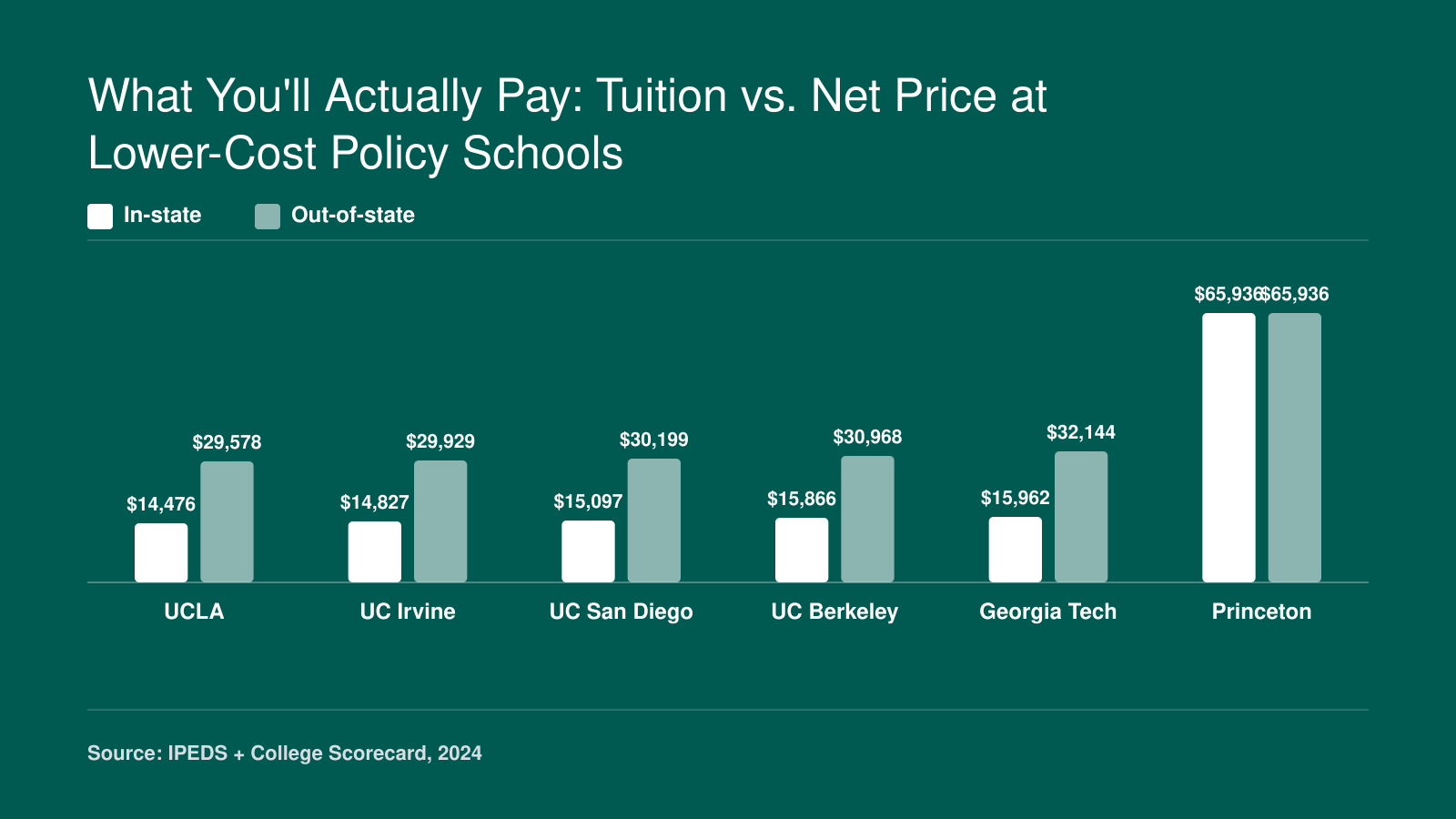
What You'll Actually Pay: Tuition vs. Net Price at Lower-Cost Policy Schools
At public universities, the in-state discount is often the single biggest cost lever, while a private school like Princeton charges one rate to everyone. For shoppers searching for affordable master of public policy programs, the cheapest option in this data is UCLA's Master of Public Policy at $14,476 in-state and $29,578 out-of-state. Net price after aid is an institution-wide average, so treat it as approximate rather than a quote for any individual MPP student.
Public Policy Master's Salary: Earnings, Debt, and Sector Pay
What does a master's in public policy actually pay, and does it cover the loans? The honest answer starts with a gap. The MPP programs we reviewed do not yet have published federal program-level earnings, median graduate debt, or 10-year monthly payment figures, so we can't give you a clean earnings-to-debt ratio for any single school. Institution-wide numbers exist, but they blend every degree level and shouldn't be read as an MPP result.
What Earnings Data Does Exist
Georgetown's McCourt School reports a median of $92,000 for recent MPP graduates in its most recent employment report, with 94% of the Class of 2025 employed or holding offers within six months. That is a school-reported figure, not a federal one; read it as a strong signal rather than a guarantee. Nationally, NASPAA's 2023-24 alumni data shows roughly half of graduates from MPP and MPA programs, three years out, earning between $45,000 and $75,000. The distance between those two numbers shows how much program, location, and prior experience matter.
Sector Pay: What We Can and Can't Say
Neither Harvard Kennedy School, Georgetown, Michigan Ford, nor Duke Sanford publishes salary ranges by sector, so any precise sector comparison would be invented. What is documented is where graduates land:
- Harvard Kennedy School (Class of 2025): about 36% in public service or intergovernmental roles (23% federal, 5% state, 5% local), 24% nonprofit, and 39% private sector. A separate HKS summary shows slightly different shares, so read these as approximate.
- NASPAA (2023-24): about 55% of alumni in the public sector and 22% in nonprofits.
- Federal entry: NASPAA guidance says graduates typically enter at GS-9, or GS-11 with relevant experience. Pay on the GS scale is published and adjusts annually, so check the current table for your target locality.
As a general pattern, not a measured result, private consulting and research roles tend to start higher than nonprofit work, while government pay starts more modestly but grows predictably.
A Practical Test for Your Own Numbers
A program whose graduate debt stays below one year of early-career earnings is generally a manageable bet. Apply that to sticker prices. Harvard's MPP lists $128,680 in total program tuition, so borrowing the full amount would exceed even Georgetown's $92,000 median. Programs with lower in-state tuition, such as Georgia Tech or UC Berkeley, or generous fellowship aid, leave far more room.
Before you commit, request each school's median debt at graduation and its employment report by sector. If a school can't provide them, weigh that in your decision.
Online, Hybrid, and Part-Time Options at Top Policy Schools
Public policy has been slower to move online than business, education, or nursing, and the programs ranked here show it.
Who Actually Offers Remote Study
The overwhelming majority of the programs on this list are campus-based. Brown's Watson School is the clear exception: a fully online MPP built for experienced professionals and structured to finish in 16 months. Duke's Sanford School is classified as hybrid, though its MPP is still described as a full-time residential degree, a useful reminder that "hybrid" sometimes means a few online components bolted onto an on-campus program. Beyond this list, George Mason's Schar School is one of the more genuinely flexible options in the Washington area, offering its 36 to 39 credit MPP on campus, online, or in some combination.2
Are Online Policy Degrees Respected?
Generally, yes. The credential carries the same name, the courses are usually taught by the same faculty, and accreditation attaches to the institution and the program rather than the delivery format. What you give up is incidental contact: the hallway conversation, the agency recruiter who visits campus, the classmate who forwards your resume. In a field where Capitol Hill and state-capital internships drive early hiring, that gap is real. Online students should budget time and money for conferences, alumni outreach, and in-person informational meetings.
Timelines and the Fine Print
Two years full-time is the default at Berkeley, UCLA, UVA, USC, Georgia Tech, Chicago, and Georgetown1. Harvard runs four semesters and 72 credit hours. Part-time study typically adds a year: Georgetown spreads its 48 credits across three years at 18, 18, and 12 credits.1 George Mason's part-time track runs 30 to 36 months, with a 12-month accelerated hybrid option for students who can move fast.2 Princeton's one-year MPP is a different animal entirely, aimed at mid-career applicants with substantial work experience and anchored by a six-week residential summer program.
Before you commit, confirm what "flexible" actually means. Georgetown's part-time route is evening classes in Washington, not remote study, and several nominally online programs require short on-campus residencies.
An online MPP from an accredited program earns the same degree as the on-campus version. What changes is the logistics: check whether the program requires short campus residencies before you assume fully remote.
GRE Policies, Deadlines, and What Top MPP Programs Ask For
Admissions rules for Fall 2027 vary by school, and not every policy could be verified as of October 2026. Treat the details below as a starting point and confirm them on each program's admissions page.
- Degree and prerequisitesExpect to need a bachelor's degree from an accredited institution. Quantitative preparation matters: Harvard Kennedy's waiver criteria look at grades in statistics and/or calculus and intermediate economics, so take microeconomics and statistics before applying if you haven't.
- GRE statusThe picture is mixed, not uniformly test-optional. Harvard Kennedy's MPP requires the GRE or GMAT unless a waiver was approved, and the August 31, 2026 waiver request deadline has passed. Princeton's MPA requires the GRE General Test. Harvard's Mid-Career MPA makes GRE/GMAT optional. We could not verify Fall 2027 policies for Berkeley Goldman, Michigan Ford, Georgetown McCourt, or UChicago Harris, so check those directly.
- DeadlinesHarvard's MPP deadline is December 1, 2026 at 12 p.m. ET. Princeton's is December 1, 2026 at 11:59 p.m. ET, with decisions on March 15, 2027 and a reply due April 15, 2027. We could not verify deadlines for the other four schools.
- Application materialsPlan on a statement of purpose, resume, and recommendation letters, the standard components for policy programs. Confirm exact requirements and letter counts on each school's page.
- Professional experienceExperience expectations differ by track. Mid-career programs like Harvard's MC/MPA are separate from the two-year MPP and are built for working professionals, so review their experience guidelines before choosing between them.
Public Policy programs by state
Compare Public Policy programs on the data that matters
Explore more Criminal Justice & Law specializations or browse every graduate field.
All Criminal Justice & Law programs