Best Master's in Public Policy Programs in Pennsylvania
Compare 17 accredited Public Policy programs in Pennsylvania at 11 schools, with graduate earnings, cost, debt, and completion data from IPEDS and the U.S. College Scorecard.
A Pennsylvania public policy master's is a financial commitment as much as a curriculum choice. Listed graduate tuition ranges from $8,340 at York College of Pennsylvania to $66,246 at Carnegie Mellon University, a spread that will follow graduates into loan payments for years.
Campus, online, and hybrid options are compared side by side here, because format determines who can enroll. Salary data shows the range is equally wide: median earnings run from $54,910 one year out at Temple University to $114,079 five years out at Carnegie Mellon University.
Key Points
- Drexel's online MPP costs $755 per credit, half its standard $1,510 rate.
- Earnings span $54,910 (Temple, year one) to $114,079 (Carnegie Mellon, year five).
- Pitt is among the Pennsylvania programs NASPAA accredits; confirm status before applying.
The 10 Best Master's in Public Policy Programs in Pennsylvania
Graduate tuition for a public policy master's in Pennsylvania runs from about $8,340 at York College to nearly $65,000 at Carnegie Mellon, so sticker price alone rarely settles the decision. The cards below pair each school's listed tuition with approximate net price, institution-wide graduation rates, and program-level earnings where they exist. Each also notes the internship, capstone, or employer detail that sets the program apart.
Carnegie Mellon University
#1Pittsburgh, PA · ~$51,000/yr (est.)
Best for: Data-minded students seeking a Washington fellowship
Carnegie Mellon's Heinz College in Pittsburgh offers an in-person Master of Science in Public Policy and Management with a listed graduate tuition of $49,999. The university graduates about 94% of its students, and the approximate average net price after aid is $31,944. Program graduates earned a median of $68,342 one year after finishing and $103,268 four years after finishing. Capstone teams solve problems for real clients. One Koppers team built a railcar-loading planning tool that cut planning time by about 85% and halved average truck usage over two semesters. A Washington, DC fellowship track is also available.
- Four tracks: Flagship, Data Analytics, Washington DC fellowship, and Fast Track
- Standard path runs four semesters; Fast Track finishes in three for experienced students
- Capstone projects solve a problem for a real client
- Internship required for students without prior work experience
- STEM-designated degree
- Three application deadline rounds, from December 2026 to February 2027
- Nearly 95% of public policy students receive a scholarship
Lehigh University
#2Bethlehem, PA · ~$29,000/yr (est.)
Best for: Career changers wanting a compact campus degree
Lehigh's Master of Public Policy in Bethlehem is a campus-based program with a listed graduate tuition of $28,620. The university graduates about 88% of its students, and the approximate average net price after aid is $36,931. The 30-credit degree can be finished in one calendar year, and students build a personal plan that can include directed research, internships, or a thesis. A community fellowship involves local agency projects, which gives students a practical route toward state and local government work.
- 30 credits with five required core courses
- Core includes Methods of Policy Analysis and Mapping Data for Policymaking
- 15 credits of electives
- Personalized graduation plan built with the director of graduate studies
- Optional internships, directed research, or thesis credits
- Community Fellowship with local agency projects
- Fall, spring, and summer terms
Saint Joseph's University - Philadelphia
#3Philadelphia, PA · ~$20,000/yr (est.)
Best for: Philadelphia undergraduates seeking an accelerated path
Saint Joseph's University in Philadelphia offers a campus-based MS in Public Policy built as an accelerated 4+1 path, with a listed graduate tuition of $20,048. The university graduates about 79% of its students, and the approximate average net price after aid is $29,689. It suits undergraduates who want both degrees in about five years within a Jesuit setting that emphasizes ethical leadership and service. It is less suited to mid-career applicants.
- 4+1 accelerated format for undergraduates
- Part of the College of Arts and Sciences, alongside the public policy major and minor
- Campus-based in Philadelphia
- Jesuit institution with a service and ethics focus
Drexel University
#4Philadelphia, PA · ~$39,000/yr (est.)
Drexel's Master of Public Policy in Philadelphia is offered in both campus and online formats, with a listed graduate tuition of $38,421. The university graduates about 78% of its students, and the approximate average net price after aid is $38,509. Full-time and part-time plans, year-round applications, and three start terms make it practical for working professionals. The curriculum draws on courses from several Drexel schools, and students can add certificates or graduate minors.
- Offered in person and online, full-time or part-time
- Complete in 18 to 24 months
- Case study research culminating in an oral defense
- Applications accepted year-round, with decisions typically within a month
- Start in fall, winter, or spring
- Courses from multiple Drexel schools
- Add a certificate to customize the degree
- Data analysis, statistics, economics, and research methods coursework
- Evening class options for working professionals
- Add a graduate minor to the policy core
- Philadelphia-based program with specialization tracks
- Can be completed in as few as 18 months
University of Pittsburgh-Pittsburgh
#5Pittsburgh, PA · ~$28,000/yr (est.)
The University of Pittsburgh's Master of Public Policy and Management is offered on campus in the evening and fully online, with listed graduate tuition of $26,350 in-state and $45,556 out-of-state. Online students pay the same tuition regardless of residency. The university graduates about 85% of its students, and the approximate average net price after aid is $30,434. It is designed for professionals with at least five years of experience, and specified government employees receive a 20% tuition discount. It sits in Pitt's School of Public and International Affairs, with joint-degree arrangements available with other Pitt professional schools.
- 30 credits over ten courses: four core and six electives
- On-campus evening classes
- Five years of professional experience expected
- Application needs a resume, personal statement, two recommendations, and transcripts
- Fall start
- Online completion in 20 months
- Same tuition for in-state and out-of-state online students
- 20% tuition discount for government employees
- Open to students in states covered by SARA participation
- TOEFL or IELTS required for international applicants
Temple University
#6Philadelphia, PA · $23,000 – $30,000/yr (est.)
Temple's Master of Public Policy in Philadelphia is a hybrid, 36-credit program with evening classes at its Center City campus plus synchronous and asynchronous online coursework. Listed graduate tuition is $21,802 in-state and $28,908 out-of-state. The university graduates about 75% of its students, and the approximate average net price after aid is $28,198. Program graduates earned a median of $54,910 one year after finishing and $91,832 four years after finishing. Students complete an internship course and a capstone, and faculty include practicing policymakers and nonprofit and budget leaders, which helps connect students to Philadelphia public service.
- 36 credits, full-time or part-time
- Hybrid: Center City evening classes plus online coursework
- Internship in Public Policy course included
- Capstone required
- Dual MPP/Master of Public Health option
- Core covers policy analysis, program evaluation, statistics, and budgeting
- Competitive partial scholarships available
Elizabethtown College
#7Elizabethtown, PA · ~$37,000/yr (est.)
Elizabethtown College's Master of Public Policy is a campus-based, combined bachelor's/master's pathway that lets undergraduates finish in five years. Listed graduate tuition is $37,250. The college graduates about 76% of its students, and the approximate average net price after aid is $26,598. The curriculum pairs policy research, statistics, administration, and ethics with a summer internship and a master's thesis. It fits current undergraduates with strong grades, not outside applicants.
- Combined bachelor's/master's pathway completed in five years
- Minimum 3.0 GPA
- Applications due in the fall of junior year
- Summer internship and master's thesis
- Graduate coursework in the fifth year
- Advanced research and data analysis
York College of Pennsylvania
#8York, PA · $5,000 – $10,000/yr (est.)
York College of Pennsylvania's Master of Public Policy and Administration is delivered fully online, with a listed graduate tuition of $8,340, the lowest of the ten programs. The college graduates about 64% of its students, and the approximate average net price after aid is $18,556. The 36-credit degree can be completed in two years, full-time or part-time, with a thesis project and a Scholar-in-Residence program for applied research. Concentrations include Urban Planning, Nonprofit Leadership, and Local Government.
- Fully online delivery
- 36 credits, completable in two years
- Full-time and part-time enrollment
- Concentrations in Urban Planning and Nonprofit Leadership
- Thesis project required
- 4+1 option for undergraduates
- Tuition discount partners and employee benefits available
- 30 core credits plus 6 elective credits
- Applied research setting with experiential learning
- Scholar-in-Residence program offered
- Full tuition remission available
East Stroudsburg University of Pennsylvania
#9East Stroudsburg, PA · ~$12,000/yr (est.)
East Stroudsburg University offers a campus-based Master of Science in Management and Leadership with a Public Administration and Policy concentration in East Stroudsburg. Listed graduate tuition is $10,062 in-state and $14,706 out-of-state. The university graduates about 43% of its students, and the approximate average net price after aid is $18,134. The 33-credit degree combines business management and political science coursework in budgeting, personnel management, and policy analysis, for those aiming at government and nonprofit careers. It is a management degree, not a pure MPP.
- 33-credit program
- Blends business management and political science
- Covers public budgeting and personnel management
- Includes public policy and research methods
- Campus-based, run by the Department of Political Science and Economics
- Admission requires a bachelor's degree with strong analytical and writing skills
Pennsylvania State University
#10University Park, PA · ~$25,000/yr (est.)
Penn State's Master of Public Policy is a 43-credit, two-year program based at University Park, with listed graduate tuition of $24,650 and an approximate average net price after aid of $19,550. Students complete an internship (required for most) and a capstone with a client project. They can choose from 11 specializations or design their own. Penn State reported that its School of Public Policy master's program earned NASPAA accreditation in September 2026. Its proximity to state government is useful for Harrisburg-area networking.
- 43 credits over two years at University Park
- 11 specializations, plus a customizable option
- Thesis or capstone option
- Internship and capstone experience
- Professional development and leadership training
- Capstone client project required
- 43-credit curriculum with internship
- Interdisciplinary courses across departments
- Applied capstone experience
- Internship required for most students
- Data analytics and global policy focus
Cost & outcomes by school
Federal data for the highest-earning Public Policy programs, independent of the ranking above. Earnings are this field's master's graduates four years after completing, where the Scorecard reports them.
| School | Earnings | Tuition / yr | Debt | Grads/yr | Format |
|---|---|---|---|---|---|
| Carnegie Mellon University PA | $103,268 | $50,975 | $41,000 | — | Campus |
| Temple University PA | $91,832 | $22,818 | $35,400 | 61 | Hybrid |
| East Stroudsburg University of Pennsylvania PA | — | $11,790 | — | — | Campus |
| Pennsylvania State University PA | — | $24,650 | — | — | Hybrid |
| York College of Pennsylvania PA | — | $8,340 | — | 7 | Online |
| Pennsylvania State University PA | — | $26,034 | — | 25 | Campus |
| Saint Joseph's University - Philadelphia PA | — | $20,048 | — | 5 | Campus |
| University of Pittsburgh-Pittsburgh PA | — | $27,580 | — | 18 | Campus |
| Lehigh University PA | — | $28,840 | — | 10 | Campus |
| Drexel University PA | — | $39,261 | — | 10 | Hybrid |
| Elizabethtown College PA | — | $37,250 | — | 3 | Campus |
Sources: U.S. Department of Education. Tuition and graduates: IPEDS. Earnings and debt: College Scorecard, this field's master's graduates; a dash means no figure is reported.
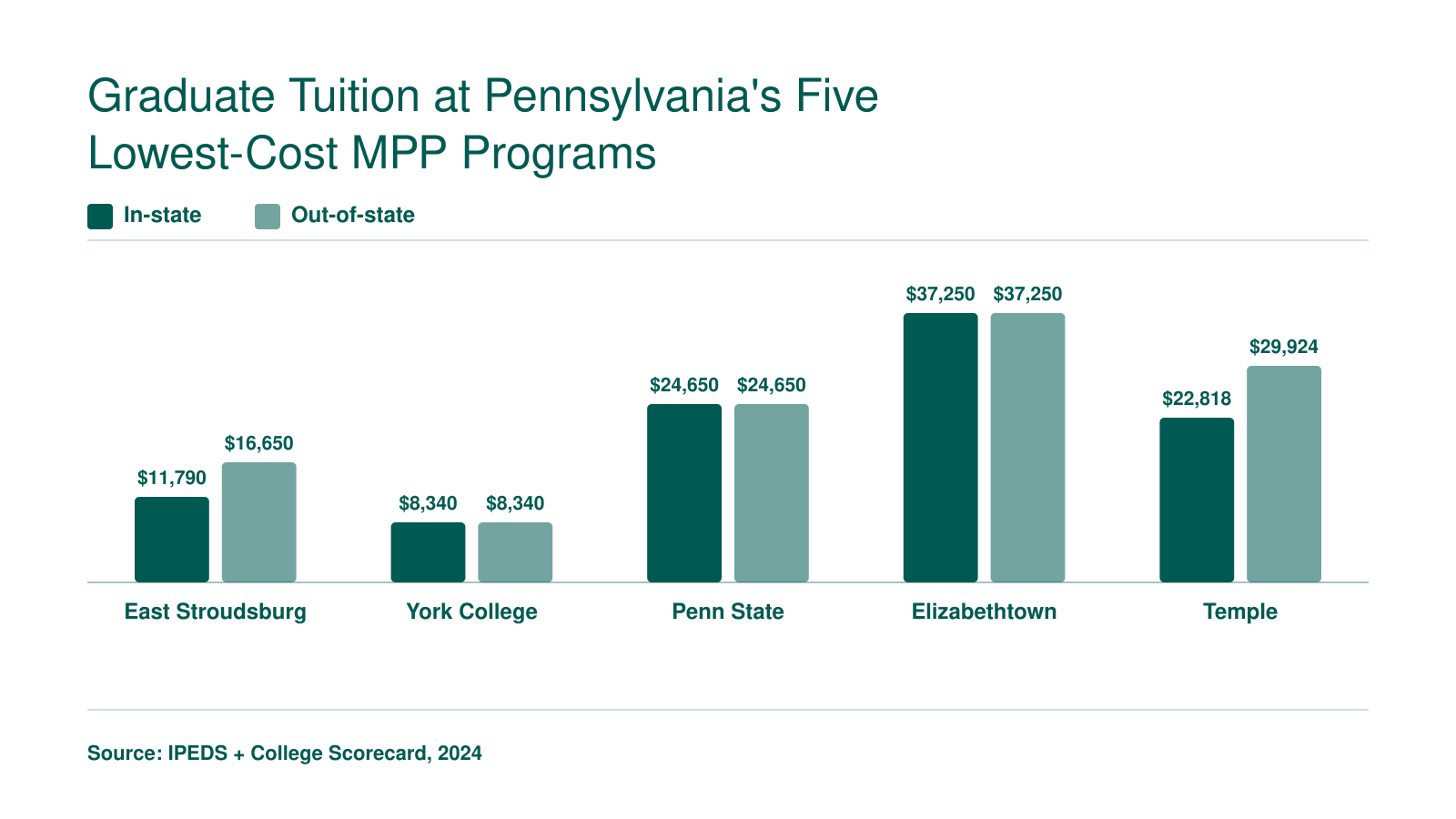
Graduate Tuition at Pennsylvania's Five Lowest-Cost MPP Programs
Annual graduate tuition and fees range from $8,340 at York College of Pennsylvania to $37,250 at Elizabethtown College, a gap of $28,910 between the lowest-cost and highest-cost options here. Published tuition is not net price, and graduate assistantships and employer or partner discounts can cut the bill substantially, so confirm what each school actually offers.
Earning a Master's in Public Policy Online or Hybrid in Pennsylvania
Most of the master of public policy programs below are campus-based; the real format choice is between campus evenings and a laptop at home. Flexible options come from York College of Pennsylvania (fully online), plus Drexel, Temple, and Penn State, which offer online or hybrid routes. Pitt's program page also lists an online option, with in-state tuition for online students, no online price difference, and a 20% government discount.
How the formats differ
Temple's online MPP uses the same curriculum and faculty as its Center City version, with synchronous weekday evening classes. Penn State's World Campus offering is a 100% online MPA of 36 to 39 credits and one of the online masters programs in pennsylvania. Confirm with each school whether any in-person residency applies.
Online versus campus pricing
- Penn State: For Fall 2026 through Summer 2027, the online rate is $1,048 per credit at 11 or fewer credits, or $12,572 per semester at 12 or more. No separate on-campus MPA rate was published for comparison.
- Drexel: The online MPP costs $755 per quarter credit, half of the regular $1,510 rate, plus a $125 annual online fee. The program is 45 quarter credits, roughly $34,000 before the fee.
- Temple: Online MPP students qualify for in-state tuition regardless of residence. A current per-credit figure was not available, so check the bursar.
Employer benefits
If you work for state or local government, ask HR whether tuition benefits cover online formats, and whether they apply per credit or per semester. York lists employee tuition benefits, and Pitt's government discount is worth raising too.
Related Articles
Salary and Debt Outcomes for Pennsylvania MPP Graduates
What does a public policy master's graduate earn in Pennsylvania? Among the schools ranked here that publish program-level figures, median earnings run from $54,910 one year after completion (Temple University) to $114,079 five years after completion (Carnegie Mellon University). Temple is also the value signal: its median debt of $35,400 is about 39 percent of its $91,832 four-year earnings, the lowest debt in the table. Lehigh, Saint Joseph's, and Drexel do not report program-level earnings or debt in the federal data (IPEDS and College Scorecard, 2024), so they are left out rather than filled with institution-wide numbers.
| School | Median earnings, 1 year after completion | Median earnings, 4 years after completion | Median earnings, 5 years after completion | Median debt at completion | Median monthly payment (10-year plan) |
|---|---|---|---|---|---|
| Carnegie Mellon University | $68,342 | $103,268 | $114,079 | $41,000 | $466 |
| Temple University | $54,910 | $91,832 | N/A | $35,400 | $403 |
According to the NASPAA roster of accredited programs, Penn State's University Park MPP is accredited through the 2032-2033 cycle. Penn State Harrisburg's public affairs master's is listed through 2028-2029. Always confirm a program's current status on the roster before applying.
GRE-Optional and GRE-Free Master's in Public Policy Admissions in Pennsylvania
Standardized-test policy is one of the first things to check, because No-GRE master's programs and test-required options vary sharply from one Pennsylvania program to the next and change often. Here is where the main programs stand.
GRE Policy, School by School
- Penn State School of Public Policy: The admissions FAQ states the GRE and GMAT are not required.1 Some older graduate materials mention test scores for applicants with a GPA below 3.00, so confirm the current rule with the program before you apply.
- Carnegie Mellon (Heinz): The MSPPM program requires the GRE or GMAT but offers a waiver when you submit qualifying materials.2
- Temple, Drexel, and Pitt (GSPIA): Their admissions pages do not currently publish a clear GRE policy we can confirm, so contact each program directly rather than assume.
Standard Requirements and Deadlines
Most applications ask for the same core documents: a bachelor's degree, official transcripts, a statement of purpose, two or three letters of recommendation, and a resume. Programs with quantitative coursework may expect prior statistics or economics.
Heinz lists Fall 2027 rounds of December 1, 2026, January 10, 2027, and February 1, 2027.2 Penn State encourages funding-seeking applicants to submit by March 1, with March 15 still eligible for funding consideration.1
Cost, Funding, and Certification Considerations for Pennsylvania Public Policy Careers
Temple lists graduate per-credit tuition from $446 to $2,266 for 2026-2027, but the MPP-specific rate is not published separately. Drexel's online MPP is $755 per credit, a published 50% discount from the $1,510 standard rate, plus a $125 annual program fee. At its 30-credit length, that works out to roughly $22,650 before fees, though delivery-specific charges are not fully published. Penn State does not publish a single MPP number; its graduate tuition varies by campus, program, and residency, so compare per-credit offers directly.
Paying for the degree
Penn State graduate assistantships include a stipend, tuition remission at a reduced assistantship rate, and a health-insurance subsidy; not every MPP student receives one. Separate Penn State graduate fellowships carry a stipend, tuition remission, and medical-insurance subsidy with no required work commitment for full-time students. For any qualifying government or nonprofit job, Public Service Loan Forgiveness remains a federal route to erase remaining debt after 120 on-time payments.
License and credential check
Pennsylvania does not require a state license to work as a policy analyst. An optional Pennsylvania Certified Public Manager program is offered in the state, costing $3,600 across seven courses and three retreats; it can carry up to nine credits toward some Pennsylvania MPA programs.
Before committing, ask each school for a net cost estimate that accounts for any assistantship stipend and tuition remission, not just the sticker price.
Compare Public Policy programs on the data that matters
Explore more Criminal Justice & Law specializations or browse every graduate field.
All Criminal Justice & Law programs