Best MPA Programs in Pennsylvania
Compare 21 accredited Public Administration (MPA) programs in Pennsylvania at 15 schools, with graduate earnings, cost, debt, and completion data from IPEDS and the U.S. College Scorecard.

Pennsylvania MPA program tuition runs from about $11,000 to more than $50,000, and the cheaper programs are not lesser credentials for most government jobs. Harrisburg, Philadelphia, and Pittsburgh anchor one of the Northeast's densest clusters of public-sector employers.
Campus, hybrid, and online master's in public administration programs are ranked together here on tuition, net price, and graduate earnings.
Format, accreditation, and price fit usually matter more than the name on the diploma.
Key Points
- NASPAA accredits Penn State Harrisburg, Pittsburgh, Villanova, and West Chester.
- Widener's online MPA costs about $29,580 across 34 credits.
- Most lowest-cost picks are PASSHE universities, including Kutztown and East Stroudsburg.
Ranking the 10 Best MPA Programs in Pennsylvania
Which Pennsylvania MPA delivers the strongest mix of affordability, completion, and graduate pay? The cards below put campus, hybrid, and online options side by side. Graduation rates cited are each university's institution-wide figure, not the MPA's own completion rate, and net price is an approximate average after aid, so use both as context rather than a program guarantee.
University of Pennsylvania
#1Philadelphia, PA · ~$48,000/yr (est.)
Best for: Early-career professionals wanting campus immersion
Penn's Fels Institute of Government in Philadelphia offers the state's most varied MPA lineup: a campus MPA, an online Global MPA, and a hybrid Executive MPA. Listed tuition and fees run about $68,686 for in-state and out-of-state students alike, and the university's institution-wide graduation rate is about 97%. Eligible Commonwealth of Pennsylvania, City of Philadelphia, and Attorney General employees receive a 25% tuition reduction, a real cost advantage for Pennsylvania public servants.
- Nine course units with a capstone project
- Summer internship required
- Core courses in statistics, public economics, and finance
- Optional concentrations such as nonprofit management and political advocacy
- Electives across Penn schools
- Small cohorts with faculty and practitioner guidance
- Online program with 10 course units
- Asynchronous courses plus weekly synchronous advising
- Optional in-person sessions
- Full-time in one year or part-time within three years
- Proficiency in English and another language required
- Hybrid format, 10 courses in under two years
- Monthly on-campus Executive Weekends
- Weekly synchronous online class meetings
- At least five years of professional experience required
Carnegie Mellon University
#2Pittsburgh, PA · ~$51,000/yr (est.)
Best for: Quantitative policy analysts seeking STEM training
Carnegie Mellon's Heinz College in Pittsburgh offers a Master of Science in Public Policy and Management rather than a traditional MPA, with a strong analytics emphasis. Listed tuition and fees are about $66,246 for all students, and the institution-wide graduation rate is about 94%. Students can choose a Data Analytics track or a Washington, D.C. option, and the program is STEM-designated.
- Two years across four semesters
- Three-semester fast track for some students
- Internship required except on the fast track
- Capstone projects with real clients
- Heinz College Fellowships and scholarships available
- Data Analytics track
- Curriculum in statistics, economics, and finance
- Application deadlines in December, January, and February
- Washington D.C. option
- Policy concentrations available
- Flagship, Data Analytics, and Fast Track paths also offered
Villanova University
#3Villanova, PA · $20,000 – $25,000/yr (est.)
Best for: Working professionals needing hybrid part-time flexibility
Villanova's NASPAA-accredited MPA is a 39-credit hybrid program in Villanova, built for working professionals who mostly study part time. Listed tuition and fees are about $67,776, and the institution-wide graduation rate is about 92%. Graduate certificates in nonprofit or city management add a specialization without a second degree.
- NASPAA accredited, next review in 2029
- 39 credit hours, full-time or part-time
- Synchronous online classes in 8-week terms
- Starts fall, spring, or summer
- Graduate certificates in nonprofit or city management
- Internship for students with limited public service experience
- February 15 deadline for funding consideration
University of Pittsburgh-Pittsburgh
#4Pittsburgh, PA · ~$28,000/yr (est.)
Pitt's NASPAA-accredited MPA in Pittsburgh is the strongest public-university option here for specialization. Listed tuition and fees are about $21,926 in-state and $41,430 out-of-state, and the institution-wide graduation rate is about 85%. Six concentrations and joint degrees in law, public health, and social work give students unusual range.
- NASPAA accredited, next review in 2028
- 48 credits with core courses in quantitative methods and microeconomics
- 300-hour internship, waivable with relevant experience
- Capstone seminar or thesis
- Five-year bachelor's/master's option
- Governance & International Public Management concentration
- Joint degree options with law (JD) and public health (MPH)
- Joint degree options with social work (MSW) and information science (MSIS)
- Urban Affairs & Planning concentration
- Focus on neighborhood development
- Skills in data interpretation and ethical leadership
West Chester University of Pennsylvania
#5West Chester, PA · $10,000 – $15,000/yr (est.)
West Chester University, in West Chester, runs a fully online, NASPAA-accredited MPA at a public-school price. Listed tuition and fees are about $10,775 in-state and $22,599 out-of-state, and the institution-wide graduation rate is about 71%. Internship ties to the City of Philadelphia and a flexible transfer-credit policy suit working professionals.
- NASPAA accredited, next review in 2027
- Fully online with synchronous and asynchronous options
- Complete in 24 to 36 months
- Three concentration options including General MPA
- 3 to 12 transfer credits possible with approval
- Capstone required, internship waived for experienced professionals
- Concurrent graduate certificates available
Widener University
#6Chester, PA · ~$28,000/yr (est.)
Widener University, in Chester, offers a 100% online MPA priced at $870 per credit, or $29,580 for the 34-credit degree. The institution-wide graduation rate is about 68%. No GRE is required, and specializations in nonprofit leadership, local government, and criminal justice let students tailor the degree.
- 100% online, synchronous seminar-style courses
- 34 credits, typically two years
- No GRE required
- 3.0 GPA, two recommendations, and a personal statement
- Specializations: criminal justice, local government, nonprofit leadership, human sexuality studies
- Rolling admissions and transfer credits allowed
Marywood University
#7Scranton, PA · $10,000 – $15,000/yr (est.)
Marywood University in Scranton offers a one-year Executive MPA delivered entirely online and asynchronously. Listed tuition and fees are about $41,420, and the institution-wide graduation rate is about 72%. It suits mid-career professionals who can meet the five-year experience expectation.
- One-year program, 18 credits across six courses
- Asynchronous online classes, fall start
- At least five years of work experience
- Capstone project applying concepts to a real challenge
- Covers policy analysis, budgeting, and human resource management
Shippensburg University of Pennsylvania
#8Shippensburg, PA · $12,000 – $17,000/yr (est.)
Shippensburg University offers a 36-credit MPA that can be taken fully online or in person, with rolling admissions. Listed tuition and fees are about $13,720 in-state and $15,974 out-of-state, and the institution-wide graduation rate is about 56%. No entrance exam is required, and Commonwealth employees can earn Professional Experience Credits.
- 36 credits, completed in one to two years
- No entrance exam required, 2.8 GPA minimum
- Online or in-person, with rolling admissions
- Internship waiver for veterans and public-sector employees
- Dual MSW/MPA and a 4+1 bachelor's-to-MPA path
- Alumni network in nearby Harrisburg
Indiana University of Pennsylvania
#9Indiana, PA · $13,000 – $18,000/yr (est.)
Indiana University of Pennsylvania, in Indiana, awards a Master of Arts in Public Affairs with a public administration core. Listed tuition and fees are about $11,380 in-state and $16,297 out-of-state, and the institution-wide graduation rate is about 56%. Six field specializations make it a good fit for local government and human services careers.
- 36 to 39 credits, full-time or part-time
- Six specializations including Local Government Management and Criminal Justice Administration
- Thesis or practicum option
- Internship option for employed students
- 2.8 GPA minimum, TOEFL for international applicants
Kutztown University of Pennsylvania
#10Kutztown, PA · ~$11,000/yr (est.)
Kutztown University offers a 36-credit hybrid MPA split evenly between online and in-person study, mostly in the evening. Listed tuition and fees are about $11,314 in-state and $16,068 out-of-state, and the institution-wide graduation rate is about 54%. Internships have included congressional offices and the PA Department of Transportation.
- 36 credits, as little as two years
- 50% online and 50% in-person hybrid format
- Mostly evening courses for working adults
- Data analysis with SPSS and Excel
- Criminal Justice concentration also offered
- Three letters of recommendation minimum
Cost & outcomes by school
Federal data for the highest-earning Public Administration (MPA) programs, independent of the ranking above. Earnings are this field's master's graduates four years after completing, where the Scorecard reports them.
| School | Earnings | Tuition / yr | Debt | Grads/yr | Format |
|---|---|---|---|---|---|
| York College of Pennsylvania PA | — | $8,340 | — | 250 | Campus |
| West Chester University of Pennsylvania PA | — | $12,652 | — | 1,942 | Online |
| Kutztown University of Pennsylvania PA | — | $11,185 | — | 570 | Hybrid |
| Indiana University of Pennsylvania PA | — | $12,672 | — | 1,058 | Campus |
| East Stroudsburg University of Pennsylvania PA | — | $11,790 | — | 510 | Campus |
| Shippensburg University of Pennsylvania PA | — | $12,330 | — | 548 | Online |
| Marywood University PA | — | $12,951 | — | 726 | Online |
| Strayer University-Pennsylvania PA | — | $15,135 | — | 100 | Online |
| Pennsylvania State University PA | — | $24,650 | — | 3,498 | Online |
| Villanova University PA | — | $22,335 | — | 2,008 | Hybrid |
| University of Pittsburgh-Pittsburgh PA | — | $27,580 | — | 3,662 | Campus |
| University of Pennsylvania PA | — | $47,844 | — | 12,210 | Campus |
Sources: U.S. Department of Education. Tuition and graduates: IPEDS. Earnings and debt: College Scorecard, this field's master's graduates; a dash means no figure is reported.
NASPAA Accreditation: Which Pennsylvania MPA Programs Have Earned It
NASPAA accreditation is the field's quality benchmark, and some federal and municipal employers, along with doctoral programs, prefer or expect it from applicants.
Four MPA programs here appear on NASPAA's current roster: Penn State Harrisburg, the University of Pittsburgh, Villanova University, and West Chester University. Penn State Harrisburg and Pitt (through its Graduate School of Public and International Affairs) both list 2028-2029 as their next scheduled review year. I could not confirm review years for Villanova or West Chester.
The other schools on this list of master's programs in Pennsylvania, including Marywood, Kutztown, and Shippensburg, are not on that roster. That says nothing about teaching quality. It only means they have not gone through NASPAA review.
Status changes each review cycle, so check NASPAA's own program search before you apply.
Online and Hybrid MPA Options Across Pennsylvania
Widener's online MPA runs 34 credits at $870 per credit, about $29,580 in total, and its classes are synchronous: small, seminar-style sessions held live. That builds a tight cohort but assumes you can log in at set times, which is hard for shift workers.
Penn State World Campus is the asynchronous counterpart. Its 100% online, self-paced MPA suits public employees with unpredictable hours. Tuition is $1,048 per credit for 2026-27, the same regardless of delivery mode or Pennsylvania residency, so online students get no discount. Residency or orientation requirements are not confirmed, so ask the program directly.
West Chester rotates synchronous and asynchronous courses. Fall 2026 lists PPA 500, 503, 515 and 533 as synchronous, with PPA 501, 506, 512, 513 and 600 asynchronous. Marywood's Executive MPA is asynchronous, Shippensburg offers in-person or fully online study, and Kutztown is a 50/50 hybrid with mostly evening classes. Villanova's hybrid program uses synchronous online classes in 8-week terms.
Penn, Carnegie Mellon, and Indiana University of Pennsylvania are campus-based, and Pitt offers an online option. Villanova and Marywood do not publish a clear online tuition rate here, so confirm it before comparing costs.
Which Pennsylvania MPA Programs Waive or Make the GRE Optional?
Since 2020, many MPA and MPP programs in Pennsylvania have dropped or softened standardized testing, and the rules keep shifting. Here is how the schools sit based on what their admissions pages state.
- No GRE required: Widener's online MPA states that no GRE is required, making it one of the No-GRE master's programs, and Shippensburg lists no entrance exam requirement.
- Optional or waivable: Penn's Fels MPA makes GRE, LSAT, or GMAT scores optional for fall 2026. The Fels Executive MPA is also optional, though the committee recommends a GRE or LSAT if possible and expects five years of professional experience. Penn State World Campus asks for GRE or GMAT scores only when the junior/senior (last two years) undergraduate GPA is below 3.0, and it lists no work-experience waiver.
- GRE required: No program here clearly requires it of every applicant.
Pitt is test-optional; Carnegie Mellon, Villanova, West Chester, Marywood, Kutztown, and Penn State Harrisburg publish no GRE policy we could confirm, so ask their admissions offices directly. Confirm the policy for the 2026-2027 cycle before you apply.
What Pennsylvania MPA Admissions Committees Typically Want
Requirements vary by school, so confirm details on each admissions page before applying.
- Degree and GPAA bachelor's degree from an accredited institution is standard. Pitt's current materials cite a 3.0 GPA, though older catalog language said 3.2, so confirm with the program.
- Application materialsExpect a statement of purpose, a résumé, and transcripts. Villanova asks for two recommendation letters and a statement of up to two pages. Pitt also requires letters.
- ExperienceExperience is rarely a hard cutoff for standard MPA tracks. Executive and mid-career formats usually expect several years of work, so check each program.
- DeadlinesVillanova: Aug 1 (fall), Dec 1 (Spring I), with rolling admission. Pitt: Feb 1 priority, Nov 1 for spring. Penn Fels: Dec 1, 2026 priority (fee waived), Jan 15, 2027 regular.
- PrerequisitesVillanova lists no separate prerequisite courses. Where statistics or economics is expected, confirm it directly with the school.
Related Articles
Where Pennsylvania MPA Graduates Report the Highest Earnings
These are median earnings five years after finishing, reported at the program level. Carnegie Mellon's figure is for its Master of Science in Public Policy & Management, and Penn State's two entries share one MPA program offered in residence and online. Weigh these against tuition, which ranges from about $22,000 to about $51,000 across these schools: a higher earnings figure matters most when the sticker price is also reasonable.
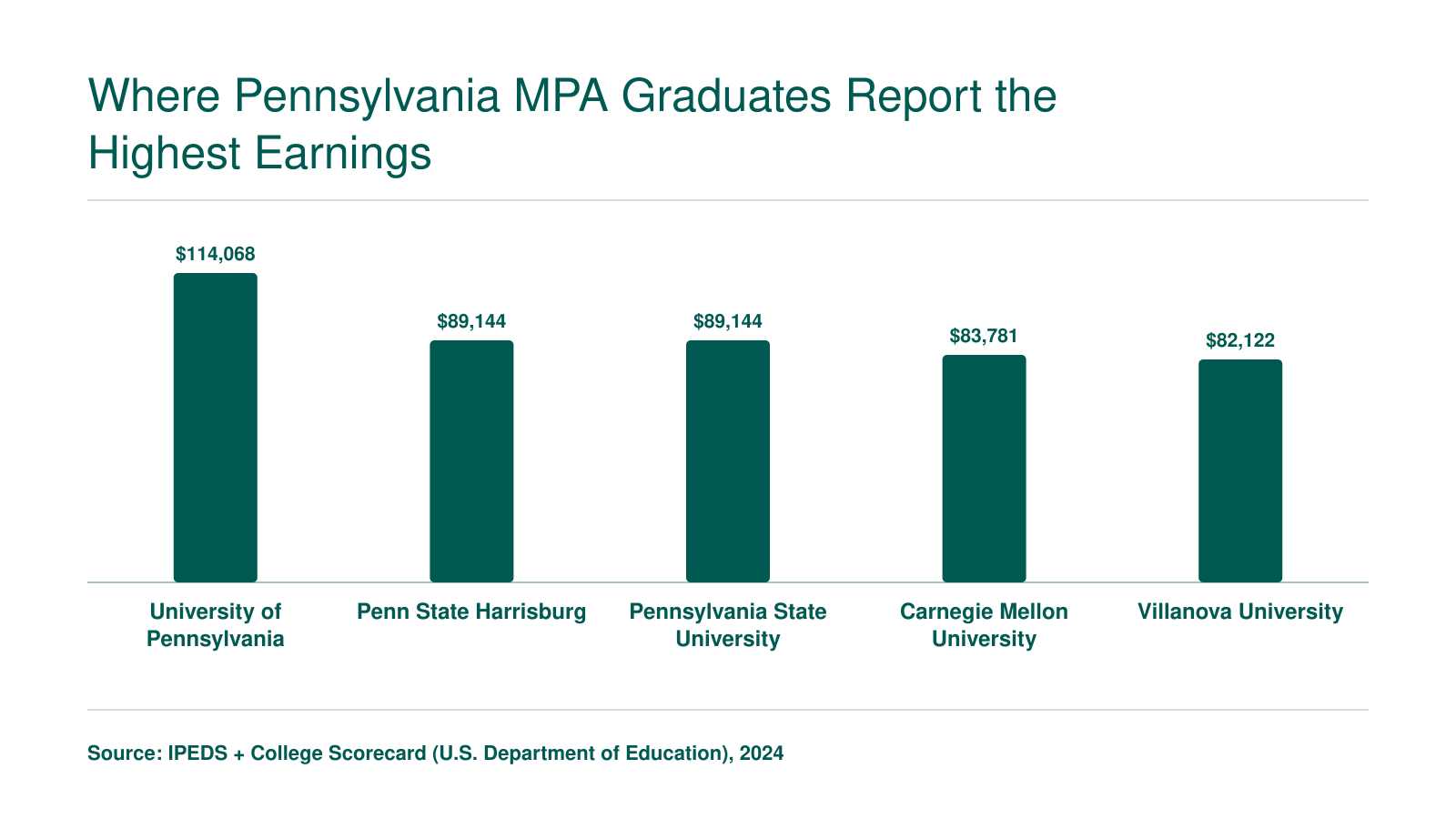
Pennsylvania state government employed about 151,100 people in September 2026 (not seasonally adjusted), according to the U.S. Bureau of Labor Statistics. That figure covers state government only, so local government jobs, another major source of public administration roles, are not included.
How Much Does an MPA Cost in Pennsylvania? Tuition, Lowest-Cost Picks, and Certifications
The lowest-cost options here are mostly PASSHE universities (Indiana University of Pennsylvania, East Stroudsburg, Kutztown, West Chester), with Penn State Harrisburg a state-related step up and the University of Pennsylvania at the top of the range as a private school. Tuition figures for the first five rows come from federal data and should be confirmed with each bursar, since billing basis and fees vary. Pennsylvania has no state MPA license, but the Pennsylvania Certified Public Manager program (confirm current availability, cost, and administering agency directly) and ICMA's Credentialed Manager designation for local government managers pair well with the degree. ICMA lists a $50 application fee, a $75 assessment fee, and 40 professional development hours each year to maintain the credential.
| Program | Delivery | In-state graduate tuition | Out-of-state graduate tuition | Approx. net price (institution-wide) | Credits | Per-unit rate and estimated total |
|---|---|---|---|---|---|---|
| Indiana University of Pennsylvania MPA | Campus | $12,672 | $18,261 | $16,804 | 36 | Not published in our data |
| East Stroudsburg University MS in Management and Leadership, Public Administration & Policy | Campus | $11,790 | $16,650 | $18,134 | 33 | Not published in our data |
| Kutztown University MPA | Hybrid | $11,185 | $16,742 | $21,331 | 36 | Not published in our data |
| Penn State Harrisburg MPA | Hybrid, online option | $25,356 | $33,698 | $23,330 | 39 | Not published in our data |
| West Chester University MPA | Online | $12,652 | $17,512 | $23,331 | N/A | Not published in our data |
| Penn State World Campus Online MPA | Online | $1,048 per credit (no residency split published) | Same rate | N/A | 36 to 39 | About $37,728 to $40,872 in tuition (per-credit rate applies at 11 or fewer credits per semester) |
| University of Pennsylvania Fels MPA | In-person | $7,322 per course unit (no residency split published) | Same rate | N/A | 11.5 course units | About $65,898 tuition; about $70,696 with general fees |
Quick Answers for Pennsylvania MPA Applicants
What is the best MPA program in Pennsylvania?
Can you earn a master's in public administration in Pennsylvania without going to campus?
What can you do with an MPA in Pennsylvania?
Can Pennsylvania state employees finish an MPA part-time while working full-time?
Compare Public Administration (MPA) programs on the data that matters
Explore more MPA specializations or browse every graduate field.
All MPA programs