Best Master's in Public Policy Programs in Maryland
Compare 7 accredited Public Policy programs in Maryland at 6 schools, with graduate earnings, cost, debt, and completion data from IPEDS and the U.S. College Scorecard.

Annapolis seats the state legislature, and Washington, D.C. is a commute from most Maryland campuses. A policy student can intern with a statehouse committee one term and a federal agency the next.
Institution-wide net prices for the ranked schools run from $15,678 to $21,916 a year, a narrow band despite very different formats and sticker rates.
Proximity helps, but degree titles differ: several programs are public administration degrees, not MPPs, and that shapes curriculum and career fit.
Key Points
- UMD-College Park graduates report median earnings near $102,700 five years after finishing the MPP.
- Only Bowie State, University of Baltimore, and UMD hold NASPAA accreditation in Maryland.
- Maryland requires no state license, though the Certified Public Manager credential is optional.
Ranked: Maryland's Top Master's in Public Policy Programs for 2027
Each program earned its spot on graduate earnings, what students actually pay after aid, and the debt they carry out the door. Tuition figures below are federal annual graduate rates, net price is institution-wide, and graduation rates describe the whole school, not the policy program. NASPAA accreditation is noted for each program where the roster confirms it.
University of Maryland-College Park
#1College Park, MD · ~$18,000/yr (est.)
Best for: Aspiring analysts targeting the D.C. corridor
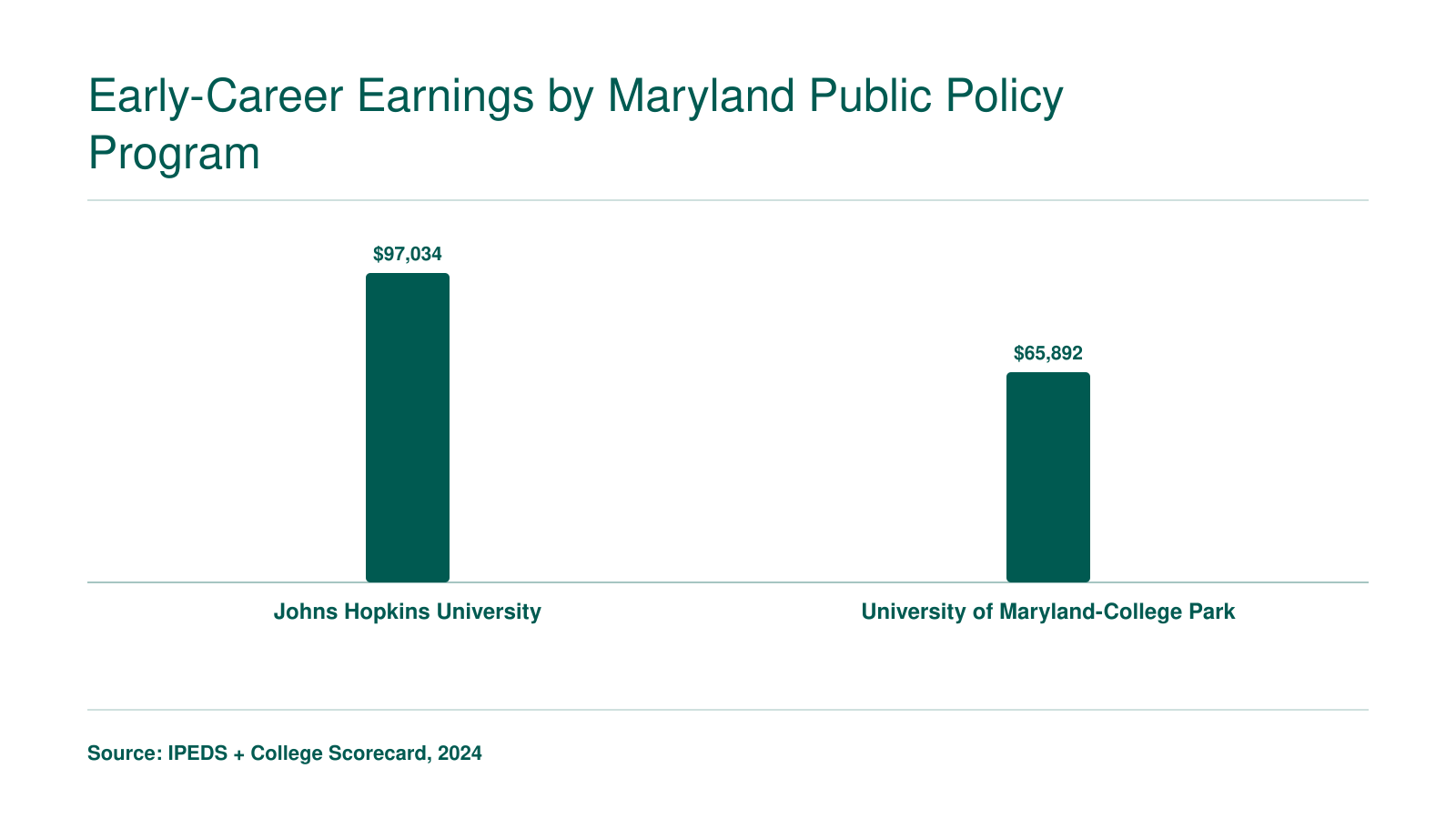
This is an on-campus, NASPAA-accredited Master of Public Policy in the Washington, D.C. policy corridor. Federal data lists graduate tuition at $16,891 for Maryland residents and $36,822 for out-of-state students, with an institution-wide net price after aid of $15,678. The school graduates 89% of its students. Policy graduates report median earnings of $65,892 one year out and $96,792 four years out, against median debt of $30,821.
- NASPAA accredited; next review 2030
- 48 credits: 27 core plus 21 elective
- Optional specializations; one or two can be completed
- Campus delivery, full-time or part-time (up to four years)
- 32% of 2025 graduates work in nonprofits, 14% in federal government
- In-state $1,055 vs out-of-state $2,095 per credit (FY2026 schedule)
Johns Hopkins University
#2Baltimore, MD · ~$65,000/yr (est.)
Best for: Seasoned professionals moving into global policy
Johns Hopkins SAIS offers the Master of International Public Policy, a hybrid, one-year program built for experienced professionals with global career goals. Graduate tuition is $64,730 for all students, and the institution-wide net price after aid is $18,809. The school graduates 94% of its students. Policy graduates report median earnings of $97,034 one year out and $107,692 four years out, with median debt of $32,114. We could not confirm NASPAA accreditation for this program, so verify it with the school if it matters to you.
- Requires 7+ years of professional work experience
- 32 credits; one year full-time or 2 to 3 years part-time
- 12 concentration options, including International Economics and Finance
- Public Service Scholars can receive a 50% tuition scholarship
- 94% employed or in fellowships within six months
- Practicum projects, internships, and treks
University of Maryland-Baltimore County
#3Baltimore, MD · $15,000 – $20,000/yr (est.)
Best for: Health or urban policy specialists
UMBC runs an in-person Master of Public Policy with six specialization options, including health, urban, and educational policy. Federal data lists graduate tuition at $13,356 for residents and $22,932 for nonresidents, with an institution-wide net price after aid of $16,467. The school graduates 70% of its students. We could not confirm NASPAA accreditation for this program.
- 37 credits; in-person classes on campus
- Concentrations: health, urban, public management, evaluation methods, educational, environmental
- Environmental Policy specialization currently paused
- 200-hour internship, waivable for experienced professionals
- Thesis or capstone option; policy analysis paper required
- Fall and spring admission
McDaniel College
#4Westminster, MD · ~$10,000/yr (est.)
McDaniel College offers a fully online Master of Science in Public Administration and Policy, the most affordable-per-credit private option here at $647 per credit. Federal data lists graduate tuition at $9,936, and the institution-wide net price after aid is $21,916. The college graduates 63% of its students. We could not confirm NASPAA accreditation.
- Online; 33 credits in eight-week course segments
- About two years to complete
- Minimum 3.0 GPA, resume, and goal statement required
- Capstone project or public service internship option
- Professional portfolio and presentation required
- B.A./M.S. pathway available
Bowie State University
#5Bowie, MD · ~$11,000/yr (est.)
Bowie State University offers an on-campus Master of Public Administration with a Public Policy and Management concentration, and NASPAA lists the MPA as accredited with its current period running through 2026-2027. Federal data lists graduate tuition at $8,226 for Maryland residents and $13,140 for nonresidents, with an institution-wide net price after aid of $19,298. The school graduates 38% of its students, so weigh completion support carefully.
- NASPAA accredited; current period through 2026-2027
- Campus-based, in-person classes
- Policy analysis and public management coursework
- 36 to 42 credits depending on background
- Housed in the College of Business
- General MPA option without a concentration
- Human Resource Management concentration also available
- Certificates in public management, management, and HR development
Strayer University-Maryland
#6Baltimore, MD · ~$15,000/yr (est.)
Strayer University's Maryland campus offers an online Master of Public Administration aimed at working public servants and career changers. Graduate tuition is listed at $14,940 for all students, and courses run 11 weeks each. The university graduates 38% of its students. We could not confirm NASPAA accreditation for this program; the university holds institutional accreditation from MSCHE.
- Fully online; 45 credits across 10 courses
- $2,040 per course; 11-week courses
- 2.5 GPA minimum; fall start
- Transfer up to three eligible classes
- 25% tuition discount for civic roles
- Covers state and local government, grants, budgeting, and policy analysis
Cost & outcomes by school
Federal data for the highest-earning Public Policy programs, independent of the ranking above. Earnings are this field's master's graduates four years after completing, where the Scorecard reports them.
| School | Earnings | Tuition / yr | Debt | Grads/yr | Format |
|---|---|---|---|---|---|
| Johns Hopkins University MD | $107,692 | $64,730 | $32,114 | 62 | Hybrid |
| University of Maryland-College Park MD | $96,792 | $18,276 | $30,821 | 98 | Campus |
| McDaniel College MD | — | $10,044 | — | — | Online |
| Bowie State University MD | — | $10,854 | — | — | Campus |
| Strayer University-Maryland MD | — | $15,135 | — | — | Online |
| University of Maryland-Baltimore County MD | — | $16,524 | — | 10 | Campus |
Sources: U.S. Department of Education. Tuition and graduates: IPEDS. Earnings and debt: College Scorecard, this field's master's graduates; a dash means no figure is reported.
Online, Hybrid, and Evening Master's in Public Policy Options in Maryland
Can you finish one of the master of public policy programs in Maryland while holding down a full-time government job? Yes, but the fully online path leads away from the MPP label specifically.
The MPP degrees here are campus-based. UMD's Master of Public Policy in College Park runs on campus with full-time and part-time tracks, and part-time students can stretch the program across as much as four years. UMBC's MPP meets in person in Catonsville, once a week, with classes starting at either 4:30 or 7:10 p.m., which is about as friendly a schedule as a state or federal employee in the Baltimore corridor will find. Johns Hopkins lists its MA in Public Management as hybrid, with campuses in Washington, D.C., and Europe, plus a part-time route of two to three years.
For a fully online degree, look to public administration: McDaniel College runs an online M.S. in Public Administration and Policy in eight-week terms, and Strayer offers a fully online MPA in 11-week courses. Confirm synchronous versus asynchronous expectations directly with each program before enrolling.
Which Maryland Master's in Public Policy Programs Waive or Drop the GRE
Test-optional and test-blind sound alike, but they treat your score very differently. Among Master's in Public Policy Programs With No GRE Required, one school lets you submit it if it helps, and another will not look at it at all.
- University of Maryland-College Park: GRE/GMAT optional, so there are no waiver criteria, putting it among No-GRE master's programs. Send scores only if they strengthen your file (ETS code 5814). Fall 2027 deadlines: Jan. 15, 2027 for best funding consideration, Mar. 12 for international applicants, May 14 for domestic applicants.
- University of Maryland-Baltimore County: Not required and not reviewed, even if submitted. No waiver criteria apply. Fall deadline is Feb. 15 for all applicants.
- Johns Hopkins University: No published policy.
- McDaniel College: No published policy.
- Bowie State University: No published policy.
- Strayer University-Maryland: No published policy.
UMD does not publish a program-level MPP acceptance rate, so treat any figure you see elsewhere with caution. For the schools with no published policy, email admissions and get the answer in writing before you pay an application fee or sit for the exam.
Maryland MPP Programs Tuition Comparison: Sticker Price, Net Price, and Debt
Published graduate rates are uneven across Maryland, so this table includes only the figures we could confirm. UMD lists 2026-27 rates, while an earlier FY2026 schedule shows lower ones ($1,055 in-state and $2,095 out-of-state per credit), so confirm current rates with the bursar. Johns Hopkins is private and does not publish a single in-state rate for this program. We could not confirm per-credit rates for the other programs here, so check those with each school before you budget.
| School and program | In-state per credit | Out-of-state per credit | Published cost estimate | Median debt, program completers |
|---|---|---|---|---|
| University of Maryland-College Park, Master of Public Policy | $1,087 | $2,158 | $27,564 in-state or $53,268 out-of-state for 24 credits plus full-time fees (annual, not the full degree) | $30,821 |
| Johns Hopkins University, Master of International Public Policy | N/A | N/A | N/A (32 credit program; per-credit tuition not confirmed) | $32,114 |
| McDaniel College, M.S. in Public Administration and Policy (online) | $647 | $647 | About $21,351 in tuition alone for 33 credits, before fees | N/A |
Early-Career Earnings by Maryland Public Policy Program
Program-level earnings show how graduates of specific public policy master's degrees fare right after finishing. Only programs with a published program-level figure appear here, so the comparison is limited to Johns Hopkins and the University of Maryland-College Park. Hopkins' figure reflects a program that requires several years of prior work experience, so part of the gap comes from who enrolls.
Related Articles
Maryland Licensure and Certification for Public Policy Careers
Where Maryland Public Policy Graduates Work and What They Earn
Earnings and sectors
Graduates of the Master of Public Policy at the University of Maryland-College Park report median earnings of about $102,700 five years after finishing, and roughly $65,900 one year out. Johns Hopkins public policy master's graduates report a median near $107,700 four years after completion. Those are program-level figures, not university-wide averages, and the gap between the one-year and five-year numbers at College Park shows how much the early climb matters.
UMD reported that among its 2025 School of Public Policy graduating cohort of 63, 32 percent went into nonprofits, 22 percent into the private sector, 14 percent into federal government and another 14 percent into state or local government, with 5 percent joining international organizations. UMBC lists its top alumni employers from 2011 through 2026 as including CMS, the Maryland Department of Health, the state of Maryland, the City of Baltimore and the Maryland General Assembly, and describes federal government as the largest employer of its graduates.
Internships
UMBC requires a 200-hour internship before graduation for students without relevant work experience, with a waiver for experienced professionals. UMD runs a competitive, year-round internship fund through its Do Good Institute Masters Programs that supports unpaid placements in nonprofit, community and government organizations.
Match the employer list to your target: Baltimore and state agency work points one way, D.C. federal and international work another.
Quick Answers on Maryland Public Policy Graduate Programs
Which Maryland school has the best master's in public policy program?
Can you earn a master's in public policy online in Maryland?
How does an MPP differ from a Master of Public Management (MPM)?
What do public policy graduates in Maryland typically earn?
Compare Public Policy programs on the data that matters
Explore more Criminal Justice & Law specializations or browse every graduate field.
All Criminal Justice & Law programs