Best Online Master's in Public Policy Programs
Compare 80+ accredited online Public Policy programs, with graduate earnings, cost, debt, and completion data from IPEDS and the U.S. College Scorecard.

Online has become an elastic label among public policy graduate programs. Many "online" MPP listings still require campus residencies or in-person immersions, which matters if you work full-time or live far from the school. Every program here is delivered fully online.
Four factors separate the strong options from the rest: true online delivery, online master's programs cost, program-level graduate earnings and debt, and accreditation. Published tuition runs from $8,340 at York College of Pennsylvania to $69,948 at Brown University.
A spread that wide means the price tag, more than the brand name, is often the first thing to scrutinize.
Key Points
- Only programs you can finish fully online were scored, hybrids excluded.
- Annual online MPP tuition spans $6,118 to $25,588 for in-state students.
- Five-year median earnings range from $45,199 to $99,422 across programs.
Top 10 Fully Online Master's in Public Policy Schools for 2027
The programs below are ordered by a mixed quality composite, not by a single metric. We prioritized schools that deliver the MPP fully online, and we flag any required in-person component. Each entry highlights delivery format, live-session expectations, tuition, and concentration options.
Brown University
#1Providence, RI · $65,000 – $70,000/yr (est.)
Best for: Mid-career policy professionals seeking senior leadership
Brown University's online Master of Public Policy is a rigorous 16-month program designed for experienced professionals seeking senior policy leadership roles. The program integrates leadership development, data-driven policy analysis, and interdisciplinary frameworks from economics, political science, and sociology. It is delivered fully online, with the first cohort beginning in January 2027. The school reports a 96% graduation rate, and in-state and out-of-state graduate tuition is $68,612.
- 16-month program for experienced professionals
- Fully online delivery
- Leadership threaded throughout curriculum
- Global lens on social and economic policy
- Interdisciplinary policy frameworks
- Data-driven policy analysis
- Careers in government, nonprofits, and industry
- First cohort begins January 2027
Binghamton University
#2Vestal, NY · $10,000 – $15,000/yr (est.)
Best for: Budget-conscious SUNY applicants wanting asynchronous flexibility
Binghamton University's Master of Public Policy is completed entirely online asynchronously, allowing working professionals to study on their own schedule. The program can be finished in one year full-time and emphasizes data analysis, policy modeling, and global perspectives. It is the only program of its kind offered by a New York institution. The school reports an 82% graduation rate. In-state graduate tuition is $7,070; out-of-state graduate tuition is $26,950.
- Completed entirely online
- Asynchronous delivery format
- One year full-time completion
- Focus on data analysis and policy modeling
- Global perspective emphasis
- Policy laboratory for applied projects
- No GRE required for admission
- Fall entry with February 1 priority deadline
University of Rhode Island
#3Kingston, RI · ~$18,000/yr (est.)
Best for: STEM professionals pivoting to ocean policy
The University of Rhode Island's Blue MPA is a 36-credit Master of Public Administration delivered fully online. Students choose between two tracks: Blue Public Management or Blue Policy Analysis, merging the online MPA with ocean science certificates. The program is designed for applicants with a STEM background and does not require the GRE. The school reports a 73% graduation rate. In-state graduate tuition is $14,630; out-of-state graduate tuition is $34,834.
- 36 credit hours
- Fully online option
- Two tracks: Blue Public Management or Blue Policy Analysis
- No entrance exam required
- Apply by November 24, 2026
- Spring classes start January 5, 2027
- Merges MPA with ocean science certificates
- STEM bachelor's degree preferred
The University of Tennessee-Knoxville
#4Knoxville, TN · ~$16,000/yr (est.)
The University of Tennessee-Knoxville's Baker School offers a 36-credit online Master of Public Policy with no thesis requirement. The program includes an internship and a master class, and students complete a nine-credit concentration in fields such as Agricultural and Environmental Policy, Energy Policy, Health Policy, or National Security. The school reports a 74% graduation rate. In-state graduate tuition is $11,560; out-of-state graduate tuition is $30,704.
- 36 graduate credit hours
- Internship required
- Master class capstone
- No thesis required
- 9-credit concentration required
- Agricultural and Environmental Policy concentration
- Energy, Health, and National Security options
- 3.00 GPA required for graduation
Southern Methodist University
#5Dallas, TX · ~$37,000/yr (est.)
Southern Methodist University's online Master of Public Policy is a part-time program for working professionals, but it is not fully online because it requires two Dallas immersions. The program splits coursework between asynchronous lessons and live Zoom sessions, with the live-session time zone unstated. The school reports an 84% graduation rate. In-state and out-of-state graduate tuition is $59,500.
- Online part-time format
- Two on-campus immersions required
- Half asynchronous, half synchronous via Zoom
- Focus on policy analysis and research methods
- Coursework in statistics
- Real-world capstone projects
- Prepares for policy analyst and economist roles
- Moody School of Graduate and Advanced Studies
American Public University System
#6Charles Town, WV · $5,000 – $10,000/yr (est.)
American Public University's online Master of Public Policy is delivered fully online with six concentration options, including Environmental Policy, Health Policy, National Security Policy, and Cybersecurity Policy. The 36-credit program uses rolling start dates and does not require an entrance exam. The school reports a 57% graduation rate. In-state and out-of-state graduate tuition is $8,400.
- 36 total credit hours
- $470 per credit
- No entrance exam required
- 12 start dates per year
- Six concentration options
- Capstone policy project
- Transfer up to 15 credits
- 8 to 16 week course sessions
University of Pittsburgh-Pittsburgh
#7Pittsburgh, PA · ~$28,000/yr (est.)
The University of Pittsburgh's Master of Public Policy and Management is a 30-credit program designed for professionals with at least five years of experience. It offers online, on-campus, or hybrid formats, so it is not a 100% online program, but online students pay in-state tuition regardless of residency. The school reports an 85% graduation rate. In-state graduate tuition is $20,556; out-of-state graduate tuition is $40,060.
- 30 credit hours, ten courses
- Five years experience required
- Online, on-campus, or hybrid options
- Online students pay in-state tuition
- 20% tuition discount for government employees
- No out-of-state tuition for online students
- 20 months online completion
- $50 application fee
University of Northern Iowa
#8Cedar Falls, IA · $12,000 – $23,000/yr (est.)
University of Northern Iowa's Master of Public Policy is a 36-credit online program with synchronous Zoom sessions on Tuesday evenings and two asynchronous courses in the first summer. It uses a cohort model and is accredited by NASPAA. The school reports a 68% graduation rate. In-state graduate tuition is $8,564; out-of-state graduate tuition is $20,340.
- 36 credit hours
- Synchronous Zoom Tuesday evenings
- Cohort model, two-year completion
- Annual fall admission
- Internship and capstone practicum required
- NASPAA accredited
- $586 per graduate credit
- Provisional admission option
Colorado State University-Fort Collins
#9Fort Collins, CO · ~$14,000/yr (est.)
Colorado State University's Master of Public Policy and Administration is an interdisciplinary program offered online and on-campus, with three areas of study: Public Management, Public Policy, and International Policy and Management. It includes an accelerated master's option and Western Regional Graduate Program eligibility. The school reports a 67% graduation rate. In-state graduate tuition is $10,610; out-of-state graduate tuition is $32,298.
- Online and on-campus formats
- Public Management area of study
- Interdisciplinary curriculum
- Prepares for public service leadership
- Western Regional Graduate Program eligible
- Accelerated master's option
- Public Policy area of study
- Leadership-focused curriculum
- Real-world policy experience
- Multiple career sector opportunities
- International Policy and Management area of study
- Interdisciplinary approach
- Accelerated master's program option
- Focuses on public service leadership
York College of Pennsylvania
#10York, PA · $5,000 – $10,000/yr (est.)
York College of Pennsylvania's Master of Public Policy and Administration is delivered fully online and can be completed in as few as two years. Students can choose concentrations in Urban Planning, Nonprofit Leadership, or Local Government, and a 4+1 degree option is available. The school reports a 64% graduation rate. In-state and out-of-state graduate tuition is $23,000.
- 36 credits total
- Fully online delivery
- Urban Planning concentration available
- Nonprofit Leadership concentration available
- Full-time or part-time options
- Two-year completion
- Thesis project required
- 4+1 degree option
- Local Government concentration
- 30 core course credits, 6 electives
- Can complete in 2 years
- Hands-on learning opportunities
- Scholar-in-Residence program
- Full tuition remission available
Cost & outcomes by school
Federal data for the highest-earning Public Policy programs, independent of the ranking above. Earnings are this field's master's graduates four years after completing, where the Scorecard reports them.
| School | Earnings | Tuition / yr | Debt | Grads/yr | Format |
|---|---|---|---|---|---|
| Johns Hopkins University MD | $107,692 | $64,730 | $32,114 | 62 | Hybrid |
| George Mason University VA | $97,926 | $17,964 | $37,996 | 81 | Hybrid |
| Temple University PA | $91,832 | $22,818 | $35,400 | 61 | Hybrid |
| Texas A&M University-Central Texas TX | — | $6,242 | — | — | Hybrid |
| The University of Texas at El Paso TX | — | $7,166 | — | — | Online |
| The University of Texas Rio Grande Valley TX | — | $8,589 | — | — | Online or campus |
| Florida Gulf Coast University FL | — | $8,961 | — | — | Online |
| California State University-Sacramento CA | — | $9,542 | — | — | Hybrid |
| McDaniel College MD | — | $10,044 | — | — | Online |
| Grand Canyon University AZ | — | $10,015 | — | — | Online |
| Murray State University KY | — | $10,683 | — | — | Online |
| Boise State University ID | — | $10,803 | — | — | Online or campus |
Sources: U.S. Department of Education. Tuition and graduates: IPEDS. Earnings and debt: College Scorecard, this field's master's graduates; a dash means no figure is reported.
Cost, debt & payoff
Median earnings of this field's master's graduates (4 yrs after completing) vs. their median federal loan debt · U.S. College Scorecard
Across these programs the median graduate earns about $87,730 and finishes with roughly $41,000 in debt — a ratio that clears a common rule of thumb (keep debt below first-year salary). Tuition and debt vary widely school to school, so check the per-school figures in the table above before you shortlist.
Our Scoring Approach: 100% Online Delivery First, Outcomes Second
Every program below passed one gate before it was scored: you can finish it online. Hybrid formats were excluded entirely, however strong their outcomes looked, because a degree that requires regular campus time is a different purchase for a working professional pursuing a Public Policy degree.
What Goes Into the Order
Programs that cleared the gate were ordered by a mixed quality composite built on federal IPEDS and College Scorecard data. The inputs are:
- Price: published tuition and the average net price students pay after aid.
- Completion: the institution-wide graduation rate.
- Outcomes: program-level earnings and debt, used only where the Scorecard publishes them.
Prestige and advertising spend played no part. A well-known name can sit below a state university when the lower price and stronger completion record justify it.
Limits Worth Knowing
The data has real gaps, and you should read the rank with them in mind. Graduation rates and net price describe the whole institution, not the MPP students alone. They are useful signals, but an online master's cohort may behave differently from a campus undergraduate population. Program-level earnings and debt exist only for schools where the Scorecard reports them, so a missing figure usually reflects reporting, not poor results.
How to Use the Rank
Treat the order as a starting shortlist, not a verdict. Before you apply, confirm the details with each school:
- Whether any residency, immersion, or live-session requirement applies.
- The current per-credit rate and every mandatory fee.
- Start dates, application deadlines, and whether your state is eligible for online enrollment.
Programs revise formats and pricing often, and the school's own admissions office has the final word on all three.
What an Online MPP Really Costs: Per-Credit Rates, Fees, and Net Price
The cost of an online master's in public policy varies widely, from about $6,118 to $25,588 per year in tuition for in-state students, with out-of-state public university rates often higher. Some online programs, including American Public University and York College of Pennsylvania, charge one flat rate for all students regardless of residency. The net price figures are institution-wide averages after financial aid, not exact program quotes, so your actual cost may differ. For a program-level estimate, University of Northern Iowa charges $604 per credit for 36 credits plus a $48 per-course technology fee, and William Paterson University charges $597 per credit for 30 credits with fees included in the $17,910 total.
| School | In-state tuition (annual) | Out-of-state tuition (annual) | Average net price (after aid) |
|---|---|---|---|
| Murray State University | $9,900 | $19,836 | $9,096 |
| The University of Texas at El Paso | $9,744 | $25,502 | $9,403 |
| American Public University System | $8,400 | $8,400 | $9,597 |
| Florida Gulf Coast University | $6,118 | $25,162 | $12,568 |
| Tennessee State University | $8,616 | $22,416 | $15,796 |
| University of Northern Iowa | $9,936 | $21,712 | $15,901 |
| Mississippi State University | $10,202 | $27,637 | $17,595 |
| York College of Pennsylvania | $25,588 | $25,588 | $18,556 |
| The University of Tennessee-Knoxville | $13,812 | $33,256 | $18,976 |
| University of Massachusetts-Dartmouth | $15,612 | $32,567 | $20,927 |
Related Articles
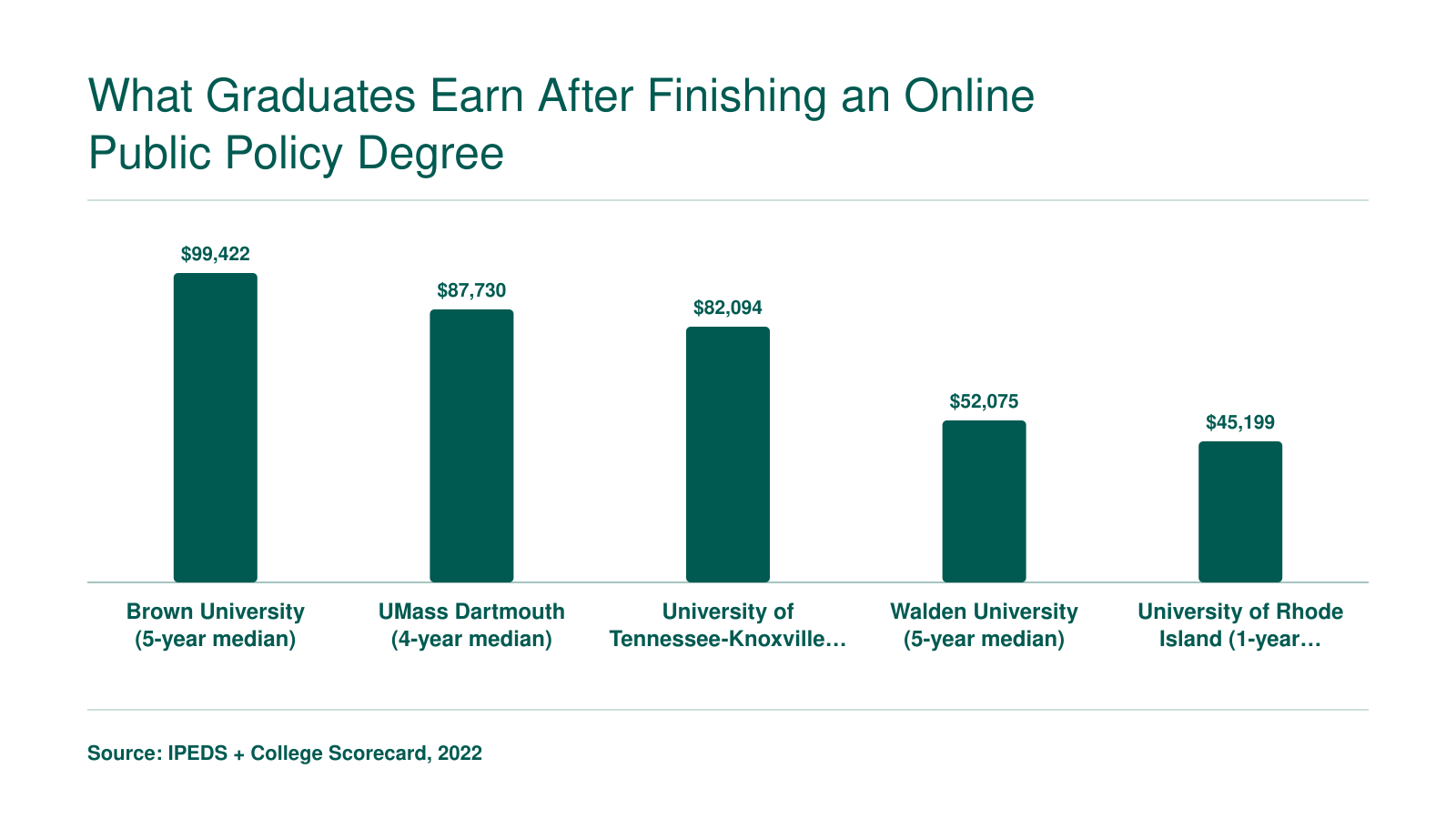
What Graduates Earn After Finishing an Online Public Policy Degree
Median earnings reported for these program-level outcomes vary by measurement window, from 1 year to 5 years after completion. The highest reported figure is $99,422 (Brown University, 5 years after completion) and the lowest is $45,199 (University of Rhode Island, 1 year after completion), a spread of $54,223. These figures reflect all completers in the public policy CIP code, not only online students.
Graduate Debt and Monthly Payments: Weighing the Return
Graduate debt is the amount students borrow specifically for a master's in public policy online degree, and the 10-year monthly payment is what that federal loan balance costs each month under a standard repayment plan. For online MPP programs, this is the clearest way to see the financial commitment before salary growth arrives.
What Borrowing Looks Like in This Ranking
Brown University is the school in this group with a published program-level median federal debt. The figure is $47,500, which converts to a 10-year monthly payment of $540. When a program does not publish its own median debt, avoid substituting a university-wide number, because debt varies widely by field and degree level. Request the program's own median federal debt before enrolling.
Debt vs. First-Year Salary
A practical rule of thumb is to keep total federal debt below first-year salary. Brown's $47,500 median debt sits below the $61,564 first-year median earnings shown for that program, which is a healthy ratio. A monthly payment near $540 is manageable only if the expected salary is around $60,000 or more, which Brown's figure is. If a program's debt approaches its starting salary, the monthly payment starts to crowd out rent, retirement savings, and other goals.
Employment After Finishing
Where employment data is published, it strengthens the return picture. Brown reports 92.9% of graduates employed one year after completion. That high placement rate, combined with the debt figure, suggests graduates are moving into income quickly enough to service the loan without waiting on long job searches. Prospective students should weigh this employment share alongside any earnings figure before comparing programs.
Highest Early-Career Pay Among Ranked Online MPPs
Early-career pay varies sharply among the online public policy programs ranked here.
Getting in: GRE Waivers, Deadlines, and Time to Finish
- Bachelor's degree and GPAMost programs expect an accredited bachelor's degree. Northern Iowa lists a 2.75 minimum (lower may be provisional); Binghamton has no general minimum but guarantees admission for graduates of seven named SUNY schools with a 3.5 GPA.
- GRE policyBinghamton and SMU do not require the GRE/GMAT. UMass Dartmouth requires GRE, LSAT, JD-Next, or GMAT (generally 50th percentile; no minimum) and waives it after its online Public Policy certificate. Brown, Drexel, George Mason, and Indiana do not publish a single GRE requirement.
- Application materialsA statement of purpose, résumé, and recommendation letters are common. Brown is designed for experienced professionals but has no mandatory work-experience threshold. Statistics or economics prerequisites are not uniformly listed.
- Deadlines and start termsDrexel: Fall 2026 Sept. 1 (early Aug. 1). SMU: Jan. 11, 2027 start; priority Oct. 1, final Dec. 1. Indiana: Fall final July 15. Binghamton: rolling, fall only, Jan. 1 recommended for funding. Canberra: multiple 2026 start blocks including Mar. 16, May 11, July 6, Aug. 31, Oct. 26.
- Program length and creditsOnline MPPs range from 36 to 48 credits. Binghamton's 36-credit program can be one year full-time or two to three years part-time. SMU is two years part-time; UMass Amherst two years part-time with flexible pacing; Indiana requires 48 credits; Canberra lists two years.
Concentrations and Where They Lead: Government, Nonprofit, and Private-Sector Paths
Public policy work has become more specialized by subject matter and more reliant on data fluency than it was a decade ago. The online programs below show how directly the concentration you choose shapes the jobs you can realistically pursue after graduation.
What the ranked programs actually offer
- Tennessee: In the online Master of Public Policy, concentrations include Agricultural and Environmental Policy, Economic and Community Development, Energy Policy, Health Policy, National Security, Nuclear Security, and Public Management.
- York College of Pennsylvania: Offers Urban Planning, Nonprofit Leadership, and Local Government.
- Colorado State University: The Master of Public Policy and Administration allows Public Management and International Policy as areas of study.
- University of Rhode Island: Blue Policy Analysis merges an MPA with ocean science certificates for coastal and marine policy work.
- American Public University System: Offers six concentration options within the online MPP, giving working students a broad menu.
What can you do with a master's in public policy?
Across these concentrations, the consistent first destinations are policy analyst, legislative staffer, program evaluator, nonprofit research director, and government relations or consulting analyst. The concentration determines which version of those roles you are most competitive for. - Energy, environmental, or agricultural policy: Policy analyst at a state environmental agency, legislative staffer on an energy or natural resources committee, or consulting analyst for utilities and clean-energy firms. - Health policy: Program evaluator in a public health department or nonprofit research director at a health foundation. - National security or nuclear security: Federal policy analyst, legislative staffer for defense or homeland security committees, and private-sector consulting roles. - Local government, nonprofit leadership, or urban planning: Policy analyst in a city manager's office, program evaluator for a community development organization, or government relations analyst for a regional planning body.
The core skills employers hire for
No matter the label, employers hire MPPs for the same core skills: quantitative analysis, program evaluation, and policy writing. A policy analyst who can turn a messy administrative dataset into a clear cost-benefit memo is more valuable than one with a generalist degree. Southern Methodist University's online MPP keeps the focus on policy analysis, research, statistics, and evaluation, a useful signal if you want a generalist analyst role.
Match the concentration to the market
Before falling for a course list, look at the employers in the city or agency you want to work for. A candidate targeting a coastal state capital may get more from the University of Rhode Island's Blue Policy Analysis concentration, while someone aiming for a county health department or nonprofit foundation will get more immediate interviews with a health policy or nonprofit leadership track. If the goal is a federal agency, programs with security, energy, or economic development concentrations align better with the job announcements those agencies actually post.
Public Policy programs by state
Compare Public Policy programs on the data that matters
Explore more Criminal Justice & Law specializations or browse every graduate field.
All Criminal Justice & Law programs