Best Master's in Public Policy Programs in Texas
Compare 12 accredited Public Policy programs in Texas at 11 schools, with graduate earnings, cost, debt, and completion data from IPEDS and the U.S. College Scorecard.

Texas concentrates state-level policy work in Austin: the Capitol, the governor's office, and major state agencies sit there, while Houston, Dallas, San Antonio, and El Paso run large city governments alongside active nonprofit and think-tank sectors.
The programs ranked here place campus, online, and hybrid MPP options side by side. Admissions pages differ on GRE requirements and deadlines, and the real comparison runs through cost, MPP versus MPA fit, and graduate earnings rather than degree title alone.
Key Points
- UT Austin's LBJ School offers no MPP; its Master of Public Affairs is the closest match.
- UTEP's online track costs about $17,300 in tuition for Texas residents, among the lowest here.
- UT Austin graduates report median earnings near $84,600 four years out, the clearest published signal.
Best Master's in Public Policy Programs in Texas, Ranked
This list weighs what students pay against what each school delivers, using federal IPEDS and College Scorecard data on net price, completion, debt, and graduate earnings. Graduation rates below describe the whole university, not the policy program. Program-level earnings appear only where the federal data publishes them.
The University of Texas at Austin
#1Austin, TX · ~$12,000/yr (est.)
Best for: Aspiring federal policymakers seeking Washington experience
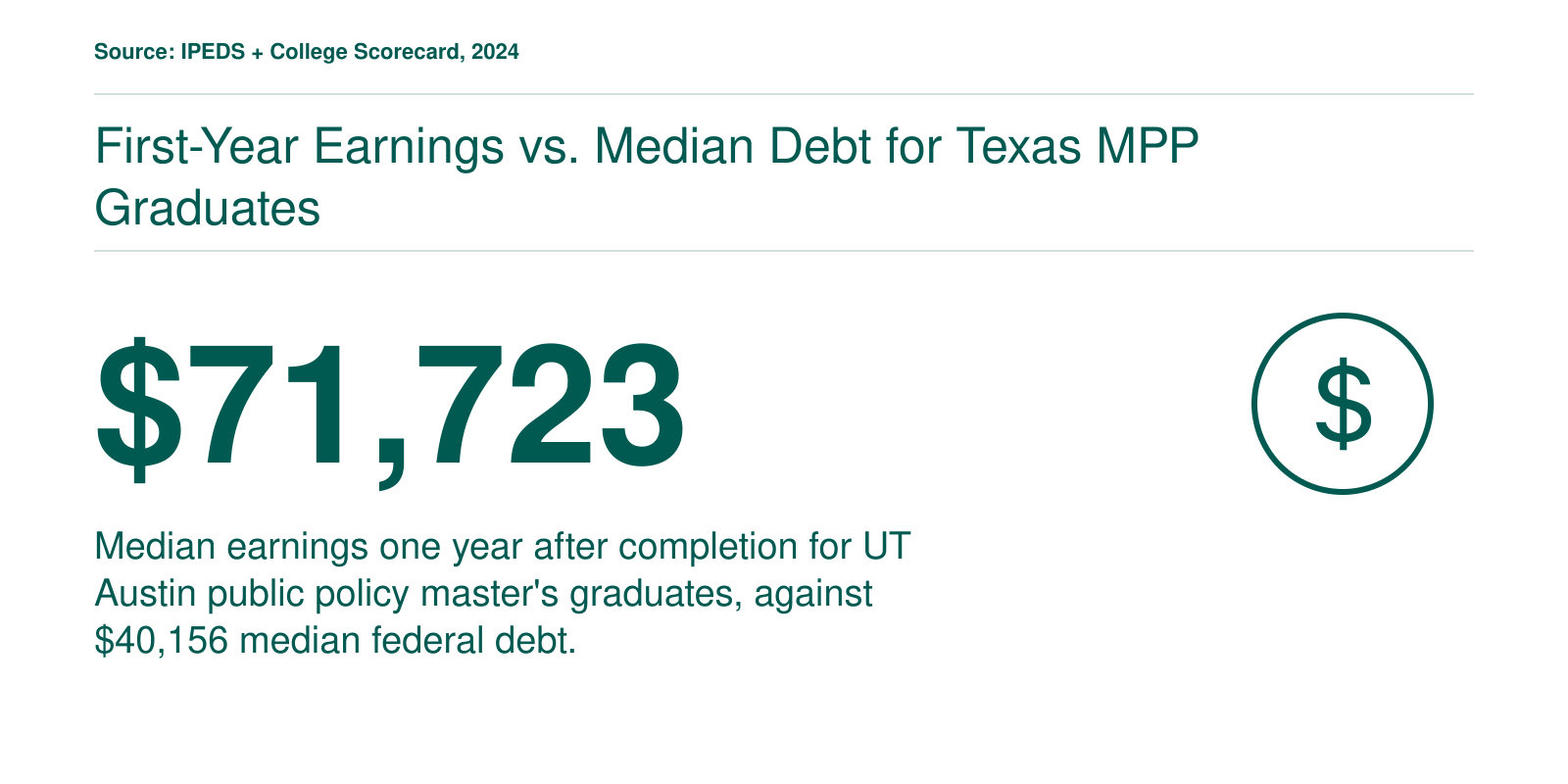
The LBJ School at The University of Texas at Austin offers the Master of Public Affairs on the Austin campus, with an optional 15-month track that ends in Washington, D.C. The university graduates 89% of its students, and graduate tuition is $12,006 in-state and $22,954 out-of-state. Federal data shows program-level median earnings of about $71,700 one year after graduation and about $84,600 four years out.
- Cohort-based, starts each fall
- Two-year full-time option or 15-month accelerated option
- DC Concentration with a semester in Washington, focused on federal policy
- Applications open in September; early funding deadline December 1
- Final application deadline March 1
- One of four master's programs at the LBJ School
Southern Methodist University
#2Dallas, TX · ~$37,000/yr (est.)
Best for: Working professionals needing online flexibility
Southern Methodist University in Dallas runs an online, part-time Master of Public Policy built for working professionals. Listed tuition is about $36,000 for 36 credits before fees, with no residency split, and the program does not require the GRE or GMAT. The university graduates 84% of its students. Program-level earnings are not yet published.
- Online, part-time format with virtual live lectures
- Two on-campus immersions, at the start and end of the program
- Coursework in policy analysis, research methods, and statistics
- Real-world capstone project
- Advertised January 2027 start; final deadline December 1, 2026
- Dallas location near the George W. Bush Institute
The University of Texas at Dallas
#3Richardson, TX · ~$15,000/yr (est.)
Best for: Texas residents focused on policy analysis
The University of Texas at Dallas offers a campus-based Master of Public Policy in Richardson, covering policy analysis, implementation, and evaluation. Graduate tuition is $11,856 in-state and $26,236 out-of-state, and the university graduates 76% of its students. The program does not require the GRE. Program-level earnings are not yet published.
- Campus-based delivery in Richardson
- Curriculum in policy analysis, implementation, and evaluation
- Required courses and electives, ending in a capstone or thesis
- Holistic review; typical entrants have a 3.0 GPA or higher
- Two recommendation letters and a one-page statement
- International applicants generally need a TOEFL iBT score of 80
University of Houston
#4Houston, TX · $10,000 – $19,000/yr (est.)
The University of Houston's Hobby School of Public Affairs delivers a 39-hour Master of Public Policy in a hybrid format in Houston. Graduate tuition is $9,019 in-state and $18,199 out-of-state, and the university graduates 65% of its students. The program is NASPAA-accredited, and federal data shows program-level median earnings of about $72,400 four years after graduation.
- 39-hour degree with core, internship, and capstone
- NASPAA accredited; next review in 2028
- Hybrid delivery
- Electives allow specialization
- Coursework in economics, politics, ethics, and quantitative analysis
- Priority and final deadlines for domestic and international applicants
University of St Thomas
#5Houston, TX · ~$22,000/yr (est.)
The University of St. Thomas in Houston offers a campus-based, 30-credit Master of Public Policy and Administration grounded in ethics and Catholic social teaching. Graduate tuition is $20,934 regardless of residency, and the university graduates 69% of its students. Program-level earnings are not yet published.
- 30 credit hours with a required capstone
- Concentration in State, County, and City Policy & Administration
- Concentration in Ethical Leadership
- Housed in the International Studies department
- Designed for working professionals
Texas A&M University-Central Texas
#6Killeen, TX · $5,000 – $10,000/yr (est.)
Texas A&M University-Central Texas in Killeen offers a hybrid, 36-credit Master of Public Administration with policy analysis, budgeting, and ethics coursework. It is the lowest-cost option here, with graduate tuition of $5,558 in-state and $12,902 out-of-state. Program-level earnings are not yet published, and this is an MPA rather than an MPP.
- 36-credit program
- Hybrid delivery
- Coursework in policy analysis, organizational theory, and budgeting
- Focus on ethical decision-making
- Prepares students for government and nonprofit leadership
Baylor University
#7Waco, TX · ~$44,000/yr (est.)
Baylor University in Waco offers a campus-based, 36-hour Master of Public Policy and Administration through political science. Students finish with an internship, professional paper, or thesis. Graduate tuition is $43,578 regardless of residency, the highest on this list, and the university graduates 80% of its students. Program-level earnings are not yet published.
- 36 credit hours
- Core courses from political science
- Thesis, professional paper, or internship options
- Elective options in cognate fields
- Transfer credit allowed
The University of Texas at El Paso
#8El Paso, TX · $5,000 – $10,000/yr (est.)
The University of Texas at El Paso delivers a 100% online, NASPAA-accredited Master of Public Administration with a public policy concentration. Program tuition is $480.90 per credit in-state and $590.53 out-of-state. Graduate tuition is $5,865 in-state and $15,320 out-of-state, and the university graduates 50% of its students. Program-level earnings are not yet published.
- 36 credit hours, fully online
- $480.90 per credit in-state, $590.53 out-of-state
- NASPAA accredited
- Optional internship for credit and a capstone
- Courses in policy analysis, public budgeting, and emergency management
- Designed for working professionals
- Fully online MPA offered through the College of Liberal Arts
- Public policy concentration option
- Serves pre-service students and in-career professionals
- Degree plan and course descriptions published online
The University of Texas at Arlington
#9Arlington, TX · ~$11,000/yr (est.)
The University of Texas at Arlington offers a campus-based Master of Public Policy through its Department of Public Affairs, with a focus on sustainable, healthy, and engaged communities. Graduate tuition is $9,189 in-state and $24,013 out-of-state, and the university graduates 54% of its students. Confirm current admission status with the department, and note that program-level earnings are not yet published.
- Campus-based program in Arlington
- Offered by the Department of Public Affairs
- Emphasis on professional engagement in communities
- Department also offers an MPA and a Ph.D. in Public Administration and Public Policy
Cost & outcomes by school
Federal data for the highest-earning Public Policy programs, independent of the ranking above. Earnings are this field's master's graduates four years after completing, where the Scorecard reports them.
| School | Earnings | Tuition / yr | Debt | Grads/yr | Format |
|---|---|---|---|---|---|
| The University of Texas at Austin TX | $84,618 | $12,006 | $40,156 | 113 | Campus |
| University of Houston TX | $72,392 | $10,051 | — | 14 | Hybrid |
| Texas A&M University-Central Texas TX | — | $6,242 | — | — | Hybrid |
| The University of Texas at El Paso TX | — | $7,166 | — | — | Online |
| The University of Texas Rio Grande Valley TX | — | $8,589 | — | — | Online or campus |
| Texas A&M University-College Station TX | — | $11,748 | — | 19 | Campus |
| The University of Texas at Arlington TX | — | $11,249 | — | — | Campus |
| The University of Texas at Dallas TX | — | $15,168 | — | 9 | Campus |
| Baylor University TX | — | $43,578 | — | — | Campus |
| University of St Thomas TX | — | $21,634 | — | 7 | Campus |
| Southern Methodist University TX | — | $37,278 | — | — | Online |
Sources: U.S. Department of Education. Tuition and graduates: IPEDS. Earnings and debt: College Scorecard, this field's master's graduates; a dash means no figure is reported.
Online and Hybrid Master's in Public Policy Options in Texas
Most of the master of public policy programs here are campus-based. Only a handful offer a way to study while working full time.
- Southern Methodist University: An online, part-time Master of Public Policy with virtual live lectures, a capstone project, and two on-campus immersions.
- The University of Texas at El Paso: A fully online Master of Public Administration with a public policy and management concentration. It is NASPAA-accredited and includes a capstone.
- University of Houston: A hybrid, 39-hour Master of Public Policy with an internship component and a capstone.
- Texas A&M University-Central Texas: A hybrid Master of Public Administration aimed at public sector careers.
For staff in state agencies or local government, a hybrid format usually means evening or blended coursework that fits around a full-time job. You keep your salary and your seniority while you study.
Even for online masters programs in Texas, remote does not always mean fully remote. Capstones, client projects, and residencies can still require campus time, as SMU's immersions show. Ask each program how those requirements work before you apply.
Texas MPP Programs That Waive or Make the GRE Optional
The LBJ School at The University of Texas at Austin is one of the No-GRE master's programs; it does not require the GRE for its Master of Public Affairs, Master of Global Policy Studies, or Washington, DC concentration, so no waiver criteria exist.123 Applicants pursuing a dual degree may still need scores if the partner program asks for them. The DC concentration carries a December 1, 2026 priority funding deadline and a March 1, 2027 final deadline.3
- GRE waivable with conditions: The University of Houston's Hobby School drops the requirement for applicants with a 3.3 undergraduate GPA or a completed master's or doctoral degree; everyone else tests. Scores must be under five years old, and Houston encourages eligible applicants to test anyway because scores factor into funding decisions.4 The University of Texas at Arlington waives the exam for a 3.25 GPA over the last 60 hours plus three years of public-service work, a completed related graduate degree, or a GMAT or LSAT taken within two years.
Several other programs here do not publish a GRE policy on their admissions pages. Confirm directly before applying, since these rules shift by cycle.
Related Articles
What Texas Policy Schools Ask for in an Application
Requirements vary by school, so confirm details on each admissions page before you apply.
- Bachelor's degree and GPAUT Dallas lists a 3.0 minimum. UT Arlington looks at a 3.0 on the last 60 undergraduate hours. UT Austin's LBJ School publishes no minimum.
- Statement of purposeUT Dallas asks for an admissions essay. UT Arlington asks for an essay of about 250 words. St. Thomas asks for a 250–300-word goal statement.
- Recommendation lettersUT Austin requires three letters, St. Thomas two, and UT Dallas one.
- RésuméUT Austin, UT Dallas, and St. Thomas all require one.
- Quantitative preparationUT Austin expects you to know descriptive statistics, probability, and algebra before coursework starts. UT Dallas lists no specific prerequisites.
- Deadlines and fundingUT Austin's funding priority date is December 1, 2026, with a final deadline of March 1, 2027, both for fall 2027. UT Dallas guarantees consideration for complete files by July 1. St. Thomas's priority deadline is July 15. UT Arlington's fall 2026 session deadlines are July 17 and September 11, with supporting documents due a week later.
Master's in Public Policy Costs in Texas and the Credentials That Matter
UTEP's online public policy and management track lists $480.90 per credit for Texas residents and $590.53 for non-residents across 36 credit hours, roughly $17,300 versus $21,300 in tuition. It is one of the most affordable options here.
Public vs. private pricing
Listed annual tuition at Texas A&M University-Central Texas runs $6,242 in-state and $13,586 out-of-state. The University of Houston lists $10,051 and $19,231. UT Dallas sits at $15,168 and $29,548, so residency there saves more than $14,000 a year. The private schools cost far more: University of St Thomas at $21,634, Southern Methodist University at $37,278, and Baylor University at $43,578, with no resident discount. Each school's average net price after aid is an institution-wide figure, not a quote for this program, so request a program-specific estimate.
Licensure and accreditation
Texas requires no state license or certification for public policy analysts or government policy professionals. Employers may still ask for a relevant master's degree or public-sector experience.
NASPAA accreditation is the field's quality marker, though it is voluntary and not a hiring requirement. The UTEP MPA accreditation page lists current accreditation through 2025-2026, and NASPAA's roster also includes UT Austin, UT Dallas, UT Arlington, and the University of Houston. The others do not.
First-Year Earnings vs. Median Debt for Texas MPP Graduates
Program-level earnings and federal debt are published for only one of the schools here, so a side-by-side chart would not be honest. The University of Texas at Austin reports both figures for its public policy master's graduates. We do not substitute institution-wide numbers for the others, so there is no basis yet for naming which programs pair the lowest debt with the strongest early earnings.
MPP, MPA, or Master of Public Affairs: Which Texas Degree Fits
Texas naming is inconsistent. The University of Texas at Austin offers no MPP, and its Master of Public Affairs (MPAff) at the LBJ School is the closest match. Titles do not guarantee curricula, so read the course list before you apply. Rule of thumb: choose the MPP to decide what policy should be, the MPA to run the program, and the MPAff to do both.
| Factor | MPP | MPA | Master of Public Affairs |
|---|---|---|---|
| Core focus | Policy analysis and policy choice | Organizational management and program implementation | Policy and management blended, with a public service leadership emphasis |
| Signature coursework | Microeconomics, statistics, cost-benefit analysis | Budgeting, human resources, leadership | Policy, finance, leadership, communication |
| Typical first jobs | Policy analyst, research analyst, program evaluator | Administrator, budget manager, nonprofit manager | Policy, management, and leadership roles, including directors and nonprofit leaders |
| Quantitative intensity | Highest of the three | Moderate, centered on budgets and operations | Varies by school, usually a mix of analysis and finance |
| Capstone style | Typically a research or analytic policy project | Typically an applied management project | Typically an applied project or internship, with one UT Austin track ending in a Washington, DC semester |
| Texas examples | Southern Methodist University and University of Houston | Southern Methodist University and The University of Texas at El Paso | UT Austin (48 credits, about two years full-time) |
Pick the degree that matches the job you want, not the school with the bigger name, because Texas policy salaries reward skills, not prestige.
Is a Master's in Public Policy Worth It in Texas? Earnings and Career Paths
What the earnings data show
Program-level earnings are still sparse for many Texas MPP tracks, but the clearest published signal comes from UT Austin's LBJ School Career Outcomes Report. Its Master of Public Affairs graduates report median earnings near $84,600 four years after finishing, and about 98% were employed one year after finishing. The typical 10-year loan payment runs about $457 a month, a manageable share of that income. University of Houston MPP completers show median earnings near $72,400 four years after finishing, although comparable debt and employment rates are not yet published for that program. For most other schools on this list, program-level outcomes are not yet available, so any blanket claim that every MPP pays for itself deserves caution.
Where the degree pays
The strongest return goes to students with low debt who land analyst roles in state agencies, Texas legislative offices such as the Texas Legislative Council, Texas House offices, and the Texas Senate, city and county governments, health and education nonprofits, or consulting firms. If you borrow moderately and stay flexible on location, the Texas public-sector route can make the degree worth it.
Compare Public Policy programs on the data that matters
Explore more Criminal Justice & Law specializations or browse every graduate field.
All Criminal Justice & Law programs