Best Master's in Public Policy Programs in Virginia
Compare 4 accredited Public Policy programs in Virginia, with graduate earnings, cost, debt, and completion data from IPEDS and the U.S. College Scorecard.
A Virginia policy master's is priced against two job markets: state government in Richmond and the federal agencies, contractors, and think tanks of Washington, D.C. The programs ranked here mix campus, hybrid, and online delivery.
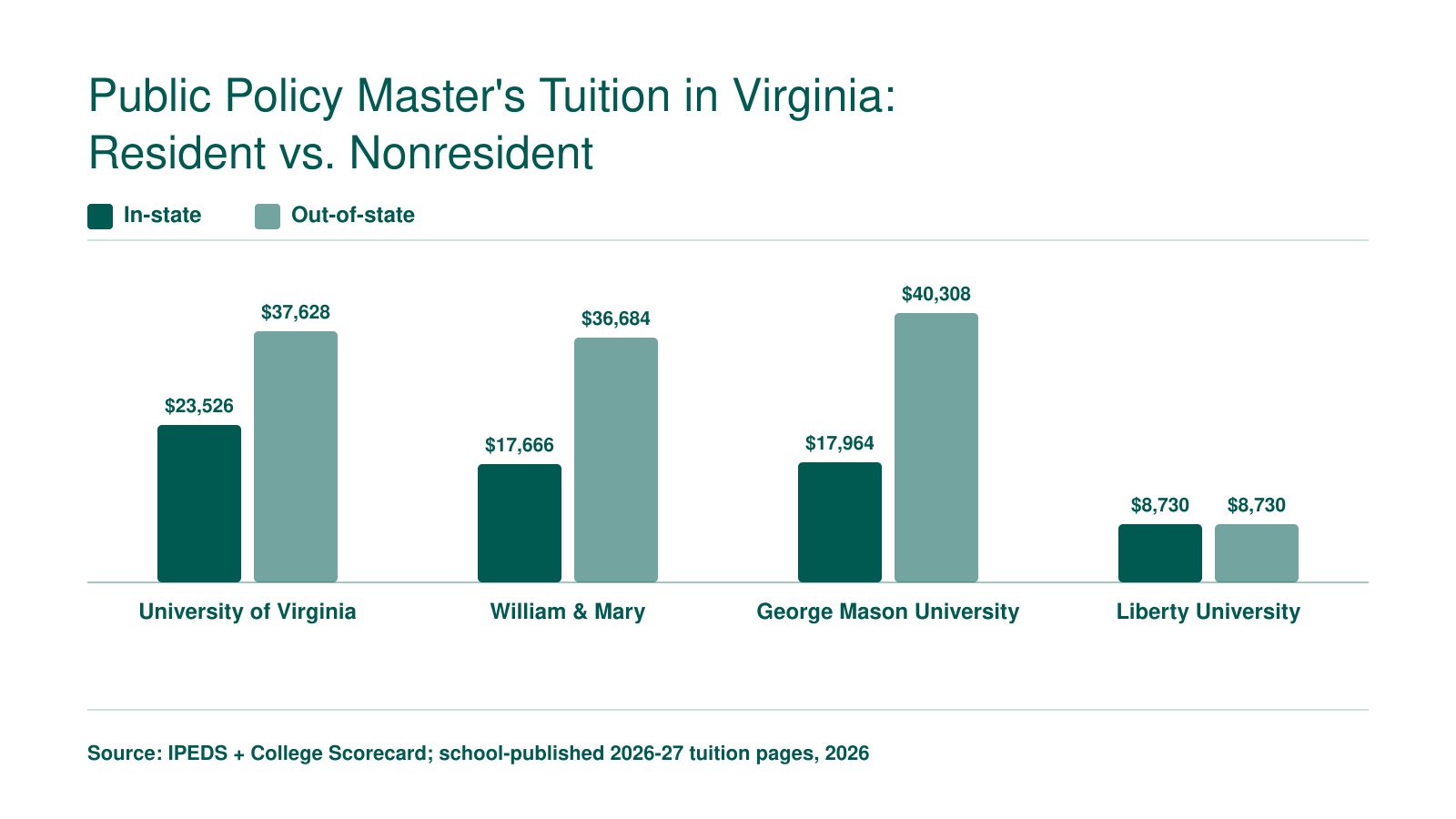
Annual tuition runs from about $8,700 at Liberty University to just over $40,000 for nonresidents at George Mason University, with the University of Virginia and William & Mary in between.
At the public schools, residency status often moves the bill more than the choice of school does.
Key Points
- UVA Batten's 2026-27 tuition runs $34,958 for residents and $61,170 for nonresidents.
- Liberty's 36-credit online M.A.P.P. offers eight start dates and eight-week courses.
- George Mason is the only school here with NASPAA accreditation.
Best Master's in Public Policy Programs in Virginia, Ranked
Virginia's four ranked programs differ sharply in format, length, and price. Two are selective, two-year residential programs with required internships. The others offer evening hybrid or online study, or a one-year pace. Use the cards below to compare credits, internship and capstone requirements, and fit.
University of Virginia
#1Charlottesville, VA · ~$24,000/yr (est.)
Best for: Analysts seeking a client-based capstone
The University of Virginia's Batten School runs a two-year, full-time Master of Public Policy on its Charlottesville campus. It pairs rigorous data analysis with leadership training and hands-on policy work. The Class of 2026 drew 446 applicants for 98 seats, so admission is competitive. The school's published income-based tuition guarantees cover in-state undergraduates, not MPP students.
- Two-year, full-time program on the Charlottesville campus
- 49 total credits required
- 400-hour policy internship required between first and second years
- Internships must be pre-approved and can be domestic or international
- Applied Policy Project for a real-world client, ending in a bound report of about 50 pages
- Median earnings of $71,078 one year after completion and $99,110 four years out (federal data)
- Median graduate debt of $37,240 among program completers
William & Mary
#2Williamsburg, VA · $15,000 – $20,000/yr (est.)
Best for: Health policy students with a Virginia focus
William & Mary's Master's in Public Policy is a small, two-year, full-time program in Williamsburg. It builds core training in economics, law, politics, and quantitative analysis before moving into electives. Students engage with practitioners through visits to Washington, D.C. and Richmond. The Schroeder Center for Health Policy gives the program a distinct Virginia health-policy research thread.
- Two-year, full-time program in Williamsburg
- 46 total credits required
- Summer internship after year one, at least 10 weeks full-time
- Second-year Policy Research Seminar serves as the capstone experience
- Requires applied methods in year one and applied law courses in year two
- Schroeder Center student research has covered Virginia's medical-debt crisis
- Policy Dialogues and trips to Washington, D.C. and Richmond connect students with practitioners
George Mason University
#3Fairfax, VA · $15,000 – $20,000/yr (est.)
Best for: Working professionals needing evening classes
George Mason's Master of Public Policy, offered through the Schar School of Policy and Government, is delivered in a hybrid or fully online format. Courses meet in late afternoons and evenings for working professionals. The Fairfax location places students in Virginia's densest policy and federal-affairs job market, close to Washington, D.C. Merit scholarships and military tuition assistance are available.
- Hybrid or fully online format with evening courses
- Fairfax location near Washington, D.C.
- Curriculum covers policy development, technology and analytic modeling, and global perspectives
- Two letters of recommendation minimum
- Military tuition assistance accepted; merit scholarships available
- Median earnings of $74,616 one year after completion and $97,926 four years out (federal data)
- Median graduate debt of $37,996 among program completers
Liberty University
#4Lynchburg, VA · ~$9,000/yr (est.)
Liberty University's Master of Arts in Public Policy is a 36-credit degree that can be finished in as little as one year, online or on campus. It takes a Christ-centered approach and emphasizes statesmanship, leadership, and the policy-making process. It is the lowest-priced and most flexible option on this list, with a different academic emphasis from the others.
- 36 total credit hours, finishable in as little as one year
- Online or residential study; starts in fall, spring, or summer
- Four concentration options, plus online cognates such as campaigns and elections
- No thesis or capstone required; optional thesis track available
- Internship opportunities in Washington, D.C. and New York City
- Median earnings of $58,353 one year after completion and $78,054 four years out (federal data)
- Median graduate debt of $27,994 among program completers
Cost & outcomes by school
Federal data for the highest-earning Public Policy programs, independent of the ranking above. Earnings are this field's master's graduates four years after completing, where the Scorecard reports them.
| School | Earnings | Tuition / yr | Debt | Grads/yr | Format |
|---|---|---|---|---|---|
| University of Virginia VA | $99,110 | $23,526 | $37,240 | 91 | Campus |
| George Mason University VA | $97,926 | $17,964 | $37,996 | 81 | Hybrid |
| William & Mary VA | $80,402 | $17,666 | — | 6 | Campus |
| Liberty University VA | $78,054 | $8,730 | $27,994 | 46 | Hybrid |
Sources: U.S. Department of Education. Tuition and graduates: IPEDS. Earnings and debt: College Scorecard, this field's master's graduates; a dash means no figure is reported.
Cost, debt & payoff
Median earnings of this field's master's graduates (4 yrs after completing) vs. their median federal loan debt · U.S. College Scorecard
Across these programs the median graduate earns about $89,164 and finishes with roughly $37,240 in debt — a ratio that clears a common rule of thumb (keep debt below first-year salary). Tuition and debt vary widely school to school, so check the per-school figures in the table above before you shortlist.
How We Scored Virginia's Master's in Public Policy Programs
Prospective students are increasingly asking what a policy degree returns rather than whose name sits on the diploma, and this list is built around that question. It rewards programs whose graduates come out ahead on pay and debt, not just schools with famous names.
The inputs are program-level earnings and median debt from College Scorecard, net price after aid, graduation rate, and format flexibility (campus, online, or both). One caveat: both the graduation rate and net price are school-wide averages, not policy-program figures, for the ranked Master's Programs in Virginia.
Scope matters too. We looked at Master of Public Policy programs and MA or MS public policy degrees, not MPA programs. An MPP trains analysts to design and evaluate policy, while an MPA focuses on managing public organizations and carrying out programs. If your goal is to run an agency, an MPA may fit better, but that is a different search.
Online and Hybrid Master's in Public Policy Options From Ranked Virginia Schools
Liberty University's online M.A. in Public Policy (M.A.P.P.) is built around asynchronous convenience, while the University of Virginia's data-focused online master's centers on required live evening sessions. Liberty's 36-credit program is 100% online with 8-week courses and eight start dates a year. Most work is asynchronous, though practicums or field experiences can require scheduled meetings. Part-time enrollment is supported, and the published sequence runs about four semesters, up to a five-year maximum. No routine in-person residency is required, but optional residential intensives are available.
UVA's data-focused online master's runs five terms in a flipped format: lectures and readings are asynchronous, but graded weekly live sessions are required, typically weekday evenings Eastern Time. Expect roughly 10 to 12 hours of asynchronous work per course weekly. No standard in-person residency is listed.
Yes, you can earn a public policy master's online through a ranked Virginia school, chiefly Liberty. The trade-off is real: online formats suit working professionals, while campus MPPs in Charlottesville or Williamsburg and George Mason's hybrid evening program offer more in-person internship and networking access to D.C. and Richmond.
GRE Policies and Admissions Odds at Ranked Virginia Schools
How competitive is the UVA Batten MPP, and do you actually need a GRE score to get into a Virginia policy master's? At UVA Batten, the MPP is among the master's programs with no GRE required: standardized tests are not required. Applicants who took the GRE may submit scores as an optional data point, and combination-degree applicants may also submit GMAT or LSAT scores. The MPP page does not publish an acceptance rate or admitted GPA range. The widely quoted University of Virginia acceptance rate reflects undergraduate admissions, not the Batten MPP.
William & Mary makes the GRE optional and states that skipping it will not hurt your application; submitted scores may add context. Its graduate admission page does not list an admission rate or minimum GPA. Liberty University's M.A.P.P. requires no standardized test. Admission in good standing requires a 3.0 GPA, though applicants with a cumulative GPA from 2.00 to 2.99 may be admitted on Academic Caution. George Mason University does not publish a GRE policy on its MPP program page.
Where the GRE is optional, your statement of purpose, quantitative coursework, and policy-related work experience carry more weight than a test score.
Related Articles
Public Policy Master's Tuition in Virginia: Resident vs. Nonresident
Residency matters at the public schools here: the gap runs from about $14,000 to over $22,000 a year in the chart, while Liberty charges one flat rate. Current 2026-27 published rates run higher at UVA Batten ($34,958 resident, $61,170 nonresident, with fees) and slightly higher at William & Mary ($18,142 and $37,160). A two-year MPP at those rates would be roughly $69,900 resident or $122,300 nonresident at Batten, and $36,300 or $74,300 at William & Mary. These are our estimates, not official totals, and exclude living costs. Liberty bills per credit ($600 full-time) and publishes no program total.
Paying for Your Degree: Aid, Tuition Breaks, and Licensure Questions
Paying for a master's in public policy in Virginia comes down to three levers: the tuition rate you qualify for, the aid a program offers, and federal programs that ease debt after graduation.
In-state rates at Virginia's public universities require domicile, meaning a permanent Virginia home you intend to keep, held for at least 12 months before classes begin.1 Schools look for clear and convincing evidence, such as Virginia tax filings, a driver's license, voter registration, and local employment.2 Moving here mainly to enroll doesn't qualify. Military dependents and Tuition Equity students have separate routes.34 No regional reciprocity agreement reduces graduate policy tuition, so out-of-state applicants should budget for nonresident rates.1
Ask each program about merit fellowships and graduate assistantships, since amounts and terms can change from year to year. Graduates working in government or qualifying nonprofits may also pursue federal Public Service Loan Forgiveness.
Virginia has no state license for policy work.1 Many graduates add data analytics or project management certifications, or aim for federal entry through the Presidential Management Fellows program.
Net price here is a school-wide average after aid, not a quote for any individual student.
Early-Career Earnings Snapshot for Virginia Policy Graduates
Highest program-level median earnings among the ranked programs
Compare Public Policy programs on the data that matters
Explore more Criminal Justice & Law specializations or browse every graduate field.
All Criminal Justice & Law programs