Best Master's in Public Policy Programs in Illinois
Compare 8 accredited Public Policy programs in Illinois, with graduate earnings, cost, debt, and completion data from IPEDS and the U.S. College Scorecard.

Price spread, not program scarcity, is the hard part in Illinois: published graduate tuition runs from about $6,408 to $6,917 a year in state at the University of Illinois Springfield to about $68,700 at the University of Chicago.
Geography sharpens the choice. Springfield puts students inside state agencies and legislative offices, while Chicago concentrates city and county government, foundations, and research shops. NASPAA accreditation reaches only some of these Illinois MPA programs, among them UIC, UIS, and DePaul, and the formats split across campus, hybrid, and fully online delivery.
Key Points
- University of Chicago MPP graduates report $118,011 median earnings five years out, against $78,854 median federal debt.
- DePaul, UIC and University of Illinois Springfield are NASPAA accredited, so check that status before you enroll.
- Illinois requires no state license for policy analysts, though UIC runs an optional Certified Public Manager program.
Top Master's in Public Policy Programs in Illinois for 2027
Every program below had to prove its value on price, completion, and what graduates actually earn, not on name recognition alone. Each card notes the format, city, in-state and out-of-state graduate tuition, any concentration, and NASPAA status. Accreditation attaches to a specific degree, so an MPA listing does not mean the same school's MPP is accredited. Graduation rates describe the whole university, not the policy program.
University of Chicago
#1Chicago, IL · ~$69,000/yr (est.)
Best for: Quant-minded analysts wanting a STEM track
The Harris School's Master of Public Policy is a two-year campus program in Chicago built for quantitative analysts. Graduate tuition is listed at about $67,200 for in-state and out-of-state students alike, and the university graduates 96% of its students. Program graduates reported median earnings of $79,721 one year out and $112,727 four years out, though that comes with the highest sticker price on this page. The MPP is not listed in the NASPAA directory.
- Two-year, 18-course program in Chicago
- STEM-designated, with a possible 24-month OPT extension
- Six core courses in economics, statistics, and political economy
- Policy modeling with R
- Practical experience requirement plus internships and independent research
- Cross-university course registration
- 2.7 GPA minimum listed
Northwestern University
#2Evanston, IL · ~$55,000/yr (est.)
Best for: Working professionals needing part-time flexibility
Northwestern offers a Master of Arts in Public Policy and Administration in a hybrid format, with a one-year full-time cohort at its Chicago location and a part-time route through its School of Professional Studies. Graduate tuition is listed at about $53,452 for in-state and out-of-state students, and the university graduates 95% of its students. Its MPPA is listed as NASPAA accredited, so confirm the accreditation covers the exact degree you apply to. The part-time option suits working professionals but does not satisfy visa requirements.
- Public Policy concentration, with five specializations in the part-time option
- Full-time option: one-year cohort model at the Chicago location
- Part-time students finish within five years and pay per course
- Part-time option is not visa eligible
- Starts fall, spring, summer, or winter
- Guaranteed networking events for full-time students
University of Illinois Chicago
#3Chicago, IL · ~$18,000/yr (est.)
Best for: Illinois residents on a tight budget
UIC's Master of Public Policy is the budget pick among Chicago campus programs, at about $14,390 in-state and $24,588 out-of-state graduate tuition. The university graduates 62% of its students. It offers four policy specializations (health, education, environment and urban planning, housing and community development) and no entrance exam. UIC's MPA holds NASPAA accreditation through 2027-2028, but the MPP is not listed as accredited.
- 53 total credit hours, coursework-only with no thesis
- Four specializations: health, education, environment, housing
- No entrance exam required
- Capstone and portfolio required for graduation
- Three letters of recommendation, optional writing sample
- Open to any undergraduate field
- Minimum 3.0 GPA required to graduate
DePaul University
#4Chicago, IL · ~$23,000/yr (est.)
DePaul is the one Illinois school here whose MPP itself is NASPAA accredited, with accreditation running through 2030-2031. Graduate tuition is listed at about $22,959 for in-state and out-of-state students, and the university graduates 68% of its students. Classes run evenings on the Loop Campus or fully online, with rolling admissions and fall, winter, and spring starts. It fits students who want an accredited MPP with a focus on urban and community policy.
- NASPAA accredited through 2030-2031
- 13 courses: 10 core plus three electives
- Evening classes in the Loop or fully online
- Rolling admissions, fall, winter, and spring starts
- Full-time and part-time options
- Scholarships, assistantships, and fellowships available
- No thesis or capstone required
University of Illinois Springfield
#5Springfield, IL · ~$12,000/yr (est.)
The University of Illinois Springfield offers an MPP online or on campus, with graduate tuition of about $8,838 in-state and $16,415 out-of-state, the lowest of the MPP programs listed. The university graduates 53% of its students. Its Graduate Public Service Internship places students with government agencies in Springfield or Chicago, which suits anyone aiming at state government work. UIS's MPA is NASPAA accredited through 2029-2030, but the MPP is not listed.
- Online and on-campus options, full-time or part-time
- Graduate Public Service Internship with paid placements
- Tuition waiver available for interns
- Government agency placements in Springfield and Chicago
- Completion in two years or less
- Coursework in economics for policy analysis and stakeholder engagement
Roosevelt University
#6Chicago, IL · ~$21,000/yr (est.)
Roosevelt's Chicago offering is a Master of Public Administration, not an MPP, available in Chicago and online. Graduate tuition is listed at about $20,620 for in-state and out-of-state students, and the university graduates 35% of its students. The featured route is an accelerated path in which political science undergraduates take three graduate courses toward the MPA. It is not listed in the NASPAA directory, so it suits Roosevelt undergraduates more than outside applicants.
- Concentration in Public Administration
- Offered in Chicago and online
- Accelerated path for Political Science BA students
- Three graduate courses count toward the MPA
- Requires 3.0 GPA, 60 undergraduate credits, and director permission
- Coursework in public service, management practices, and budgeting
Adler University
#7Chicago, IL · ~$47,000/yr (est.)
Adler University's Master of Public Policy has a Community Health concentration aimed at working professionals focused on urban health, housing, and social justice. Graduate tuition is listed at about $45,471 for in-state and out-of-state students. It can be finished in one year full-time or two years part-time, with evening courses. The program is not listed in the NASPAA directory.
- 36 total credit hours
- One year full-time or two years part-time
- 200-hour social justice practicum
- Capstone project required
- Evening courses for working students
- 3.0 GPA minimum and a personal interview for admission
National Louis University
#8Chicago, IL · ~$13,000/yr (est.)
National Louis University offers a 36-credit Master of Public Administration with a Public Policy concentration, in Chicago, fully online or blended. Graduate tuition is listed at about $12,928 for in-state and out-of-state students, and the program cites $16,830 in total tuition. The university graduates 30% of its students, the lowest rate on this page. It is not listed in the NASPAA directory, so it fits budget-conscious students who value speed and flexibility over accreditation.
- 36 credit hours, completed in 19 months
- Fully online or blended format, with meetings every other week
- Five concentration options including Public Policy and Nonprofit Management
- Total program tuition of $16,830
- Two six-week courses per quarter
- Credit for prior learning by portfolio
Cost & outcomes by school
Federal data for the highest-earning Public Policy programs, independent of the ranking above. Earnings are this field's master's graduates four years after completing, where the Scorecard reports them.
| School | Earnings | Tuition / yr | Debt | Grads/yr | Format |
|---|---|---|---|---|---|
| University of Chicago IL | $112,727 | $68,652 | $78,854 | 3 | Campus |
| Roosevelt University IL | — | $20,935 | — | — | Campus |
| University of Illinois Springfield IL | — | $11,938 | — | 2 | Hybrid |
| National Louis University IL | — | $13,453 | — | — | Hybrid |
| University of Illinois Chicago IL | — | $17,550 | — | 10 | Campus |
| DePaul University IL | — | $23,358 | — | 18 | Hybrid |
| Adler University IL | — | $47,179 | — | 27 | Hybrid |
| Northwestern University IL | — | $54,655 | — | — | Hybrid |
Sources: U.S. Department of Education. Tuition and graduates: IPEDS. Earnings and debt: College Scorecard, this field's master's graduates; a dash means no figure is reported.
Online and Hybrid Public Policy Master's Options in Illinois
The University of Illinois Chicago's online MPA can be finished in as little as 16 months, using accelerated 8-week terms with no set meeting times. Several other schools here also offer flexible formats: University of Illinois Springfield, DePaul, Northwestern, Adler, and National Louis list hybrid delivery, and Roosevelt's accelerated BA/MPA is offered in Chicago and online.
Online coursework is mostly asynchronous. At Springfield, online classes are asynchronous and on-campus sections start after 6 p.m., so students can go fully online or mix the two. National Louis runs a blended track that meets every other week, and DePaul holds evening classes in the Loop. No required campus residency is listed for the Springfield or UIC online programs.
Pacing varies. Springfield's MPP finishes in two years or less, full-time or part-time, and Southern Illinois' online MPA lists 14 months.1 National Louis lists 19 months. Adler's full-time degree takes one year, and Northwestern's full-time track also takes one year, with part-time students finishing within five.
If you work for state government in Springfield or the city in Chicago, ask HR about tuition benefits and compare evening hybrid schedules across public policy programs before choosing.
Related Articles
Which Illinois Master's in Public Policy Programs Make the GRE Optional?
The standardized test has lost its grip on Illinois policy admissions. Across the state, standalone public policy master's programs have moved away from mandatory GRE scores, following a broader shift toward No-GRE master's programs, and the exceptions now cluster in joint degrees with law. Policies also shift from one application cycle to the next, so confirm in writing with an admissions office before you pay for a test date.
- University of Illinois Springfield, Master of Public Policy: GRE scores are not required for admission to the School of Public Management and Policy's graduate programs. You may submit scores as supplementary material, and because the test isn't required, the page states no separate GPA or work-experience waiver criteria.
- University of Illinois Chicago, Master of Public Policy: The UIC Public Policy admissions page publishes neither a GRE requirement nor a test-optional policy. It lists qualifying applicant categories but no waiver criteria, which makes a direct question to admissions worth the email.
- University of Illinois Chicago, joint JD/Master of Public Policy: Applicants must submit either the LSAT or the GRE. The UIC Law Joint Juris Doctor/Master of Public Policy page publishes no waiver tied to GPA or years of work experience.
Cost of a Master's in Public Policy in Illinois, Plus Licensure and Certification Facts
The schools below are ordered from lowest to highest cost. Tuition and fees are institution-wide graduate figures. Net price is an average after aid for the whole institution, not a quote for MPP students. Public pricing sits far below private pricing: UIS publishes about $12,816 to $13,834 in tuition for its 36-credit MPP, excluding fees, while Northwestern's online MPPA runs $53,040 in tuition for 13 courses, or $54,795 with technology fees. We found no Illinois state license required for policy analysts. The certification box that follows covers optional credentials.
| School and program | In-state tuition and fees | Out-of-state tuition and fees | Net price after aid (institution-wide) | Published degree cost |
|---|---|---|---|---|
| University of Illinois Springfield, Master of Public Policy | $11,938 | $19,515 | $9,833 | 36 credits; $12,816 to $13,834 tuition over 2 years, fees excluded |
| University of Illinois Chicago, Master of Public Policy | $17,550 | $27,748 | $10,974 | N/A (no verified 2026 total) |
| National Louis University, Master of Public Administration | $13,453 | $13,453 | $12,641 | 36 credits; $16,830 total program tuition |
| University of Chicago, Master of Public Policy | $68,652 | $68,652 | $14,860 | 18 courses; total cost N/A |
| Roosevelt University, Master of Public Administration | $20,935 | $20,935 | $20,194 | N/A |
Illinois Licensure and Certification for Policy Professionals
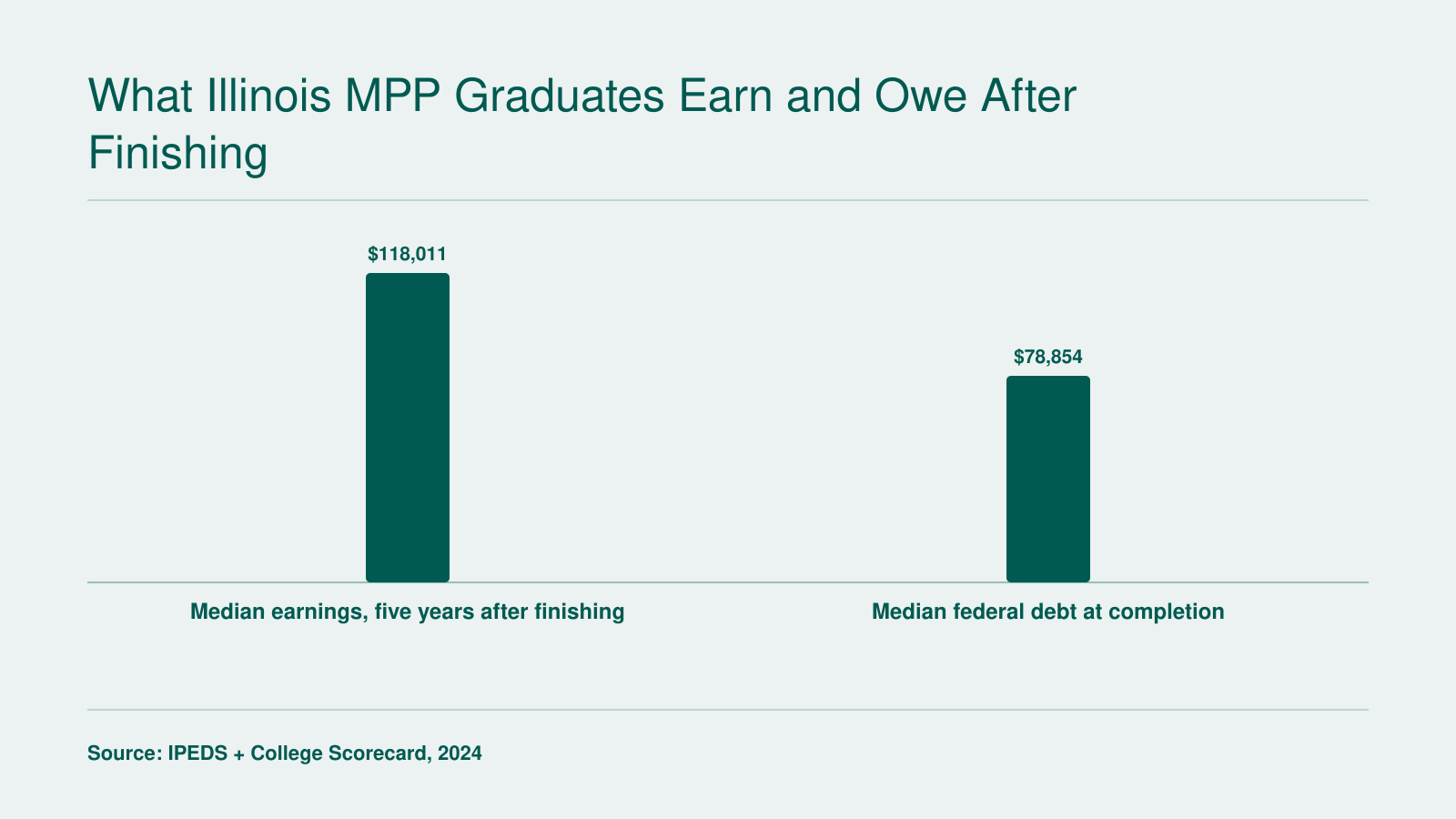
What Illinois MPP Graduates Earn and Owe After Finishing
University of Chicago's Master of Public Policy graduates report median earnings of $118,011 five years after finishing, against median federal debt of $78,854 at completion. That is roughly $1.50 earned per year for every $1 borrowed, with a median 10-year federal loan payment of $897 a month. For most graduates, the earnings outweigh the debt.
MPP or MPA? Matching the Degree to Your Public Service Goals
The two degrees overlap heavily, and an employer survey from Texas A&M found most employers reported no preference between them. What you study and who you become matters more than the title. Some Illinois schools offer only one of the two, so check the ranking cards before you commit to a specific degree.
| Comparison point | Master's in Public Policy (MPP) | Master's in Public Administration (MPA) |
|---|---|---|
| Core focus | Policy analysis, design, and evaluation | Public management and program administration |
| Typical coursework | Econometrics, statistics, cost-benefit analysis, program evaluation | Budgeting and finance, human resources, organizational leadership, public operations |
| Common Illinois employers | Legislative offices, state agencies, research organizations, consulting firms | City and county agencies, nonprofits, service-delivery organizations |
| Ideal candidate | Analytical thinker who wants to research problems and shape policy | Aspiring manager who wants to lead teams, budgets, and programs |
| NASPAA accreditation | Applies to MPP programs too; DePaul, UIC, and UIS are among the ranked schools with accreditation | Applies to MPA programs; the same three schools hold accreditation |
| Decision rule | Choose the MPP to analyze and design policy | Choose the MPA to run agencies and programs |
Quick Answers About Illinois Public Policy Master's Degrees
These short answers cover the questions applicants ask most about Illinois public policy master's programs. Details on cost, online formats and the GRE are in the sections that follow.
Which Illinois MPP program is best for a career in state government?
How does an MPP differ from an MPA?
Can you earn a public policy master's in Illinois entirely online?
Is the GRE still required for Illinois public policy master's admissions?
What does a master's in public policy cost in Illinois?
Is a master's in public policy worth the investment?
When are application deadlines for Illinois MPP programs?
What undergraduate coursework do Illinois MPP programs expect before you enroll?
Compare Public Policy programs on the data that matters
Explore more Criminal Justice & Law specializations or browse every graduate field.
All Criminal Justice & Law programs