Best Master's in Public Policy Programs in Arizona
Compare 4 accredited Public Policy programs in Arizona, with graduate earnings, cost, debt, and completion data from IPEDS and the U.S. College Scorecard.

Arizona State University's Master of Public Policy graduates earn a median of about $52,400 one year out. Arizona's MPP options are few, so the choice turns on format, cost, and career fit, not a long shortlist.
Campus and online programs share one ranking. The University of Arizona and ASU both require 42 credits in evening formats, and ASU requires no entrance exam, which makes it a Master's in Public Policy Programs With No GRE Required candidate. Grand Canyon University's online policy MPA costs $610 per credit.
Residency matters: University of Arizona tuition more than doubles for nonresidents.
Key Points
- NASPAA accredits Arizona State University and the University of Arizona at the master's level.
- Arizona requires no state license to work as a policy analyst.
- Arizona State graduates report median earnings of about $52,400 one year after finishing.
Ranked: Arizona's Top Master's in Public Policy Schools
These are the Arizona programs that give policy-minded students the strongest mix of affordability, completion, and graduate outcomes. The University of Arizona leads because its evening-format MPP pairs a higher institution-wide completion rate than the other schools listed with a structure built for people who keep working. Note that no Arizona MPP appears on the current NASPAA roster, so accreditation claims below are kept to what is documented.
University of Arizona
#1Tucson, AZ · ~$15,000/yr (est.)
Best for: Working professionals needing evening classes
The University of Arizona's School of Government and Public Policy in Tucson runs a 42-unit MPP with evening classes, an internship, and a capstone. Schools offering this program graduate about 68% of students institution-wide, the strongest completion figure on this list. Accreditation: the university's regional accreditor is the Higher Learning Commission (confirm current status with the school). The School's MPA is NASPAA-accredited, but no sources establish NASPAA status for the MPP itself.
- 42 unit hours across 14 classes
- Evening classes, 5:30pm to 8pm, Monday through Thursday
- Core courses, electives, internship, and capstone project
- Two-year completion possible
- Faculty strengths in public management and environmental policy
- Emphasis on quantitative analysis and policy evaluation
Arizona State University
#2Scottsdale, AZ · ~$11,000/yr (est.)
Best for: Specialization-minded students targeting niche policy fields
Arizona State University's MPP is based at the Downtown Phoenix campus and stands out for specialization, with four concentration options including Science and Technology Policy, Policy Informatics, and Environmental Policy. U.S. News (2024) ranked its public affairs offerings #13 nationally. No institution-wide graduation rate is available in the data used here. Accreditation: ASU's regional accreditor is the Higher Learning Commission (verify current status). Its MPA is NASPAA-accredited through 2030-2031, but the school publishes no NASPAA status for the MPP.
- 42 credit hours with a required capstone
- No entrance exam required
- Four concentration options
- Full-time and part-time options
- Classes meet one evening per week in person
- Six years allowed to complete the degree
- Marvin Andrews and Jane Morris Fellowship available
Grand Canyon University
#3Phoenix, AZ · ~$10,000/yr (est.)
Best for: Fully online public administration seekers
Grand Canyon University in Phoenix offers an online Master of Public Administration with a Government and Policy emphasis, not an MPP, so treat it as a policy-adjacent alternative. Schools offering this program graduate about 43% of students institution-wide, the lowest rate here. Accreditation: the university is regionally accredited through the Higher Learning Commission (verify current status). It does not appear on the NASPAA roster of accredited Arizona programs.
- 38 credits at $610 per credit
- 8-week online courses
- Transfer up to 12 credits
- 2.8 GPA minimum, or lower GPA with GMAT or GRE scores
- Coursework in policy analysis, budgeting, and public governance
- Fully online option available
Cost & outcomes by school
Federal data for the highest-earning Public Policy programs, independent of the ranking above. Earnings are this field's master's graduates four years after completing, where the Scorecard reports them.
| School | Earnings | Tuition / yr | Debt | Grads/yr | Format |
|---|---|---|---|---|---|
| Grand Canyon University AZ | — | $10,015 | — | — | Online |
| Arizona State University AZ | — | $10,843 | — | 39 | Campus |
| Arizona State University AZ | — | $13,587 | — | 13 | Campus |
| University of Arizona AZ | — | $14,856 | — | 4 | Campus |
Sources: U.S. Department of Education. Tuition and graduates: IPEDS. Earnings and debt: College Scorecard, this field's master's graduates; a dash means no figure is reported.
ASU vs. University of Arizona: How the Two MPP Programs Differ
How do Arizona's two master of public policy programs actually differ once you look past the brochures? On paper, masters programs in Arizona land in similar territory: both require 42 credits (Arizona counts them as units), both cap the degree with a 3-credit capstone, and both are generally built to finish in roughly two years. The split shows up in structure and emphasis.
Structure and location
Arizona State University weights its curriculum toward a 27-credit core1, leaving room for concentration and restricted-elective work, with coursework at Downtown Phoenix and Tempe.2 The University of Arizona runs a leaner 24-credit core followed by a larger 15 units of electives, delivered from Tucson.
Policy focus
ASU's documented strengths lean urban and include an Environmental Policy concentration plus a science and technology track. Arizona's identity is regional: border security, water, and natural-resource policy, reflected in its Environmental Management and Water Policy option. Choose based on which policy world you want to work in.
Online and Hybrid Master's in Public Policy Options in Arizona
Choosing a public policy master's in Arizona means weighing the networking of an evening classroom against the flexibility of fully online study, the same trade-off reflected in the Best Online Master's in Public Policy Programs.
The University of Arizona's MPP is a Tucson campus program. Classes run Monday through Thursday from 5:30 to 8:00 p.m., with some online electives. Fall 2026 costs come to $9,061 per semester, including a $1,250 program fee, a figure worth comparing with the Most Affordable Master's in Public Policy Programs.
Arizona State University's MPP is based at the Downtown Phoenix campus, where classes meet one evening per week in person. ASU also lists an online format through ASU Online, whose 2026-2027 graduate rate is $605 per credit plus program fees. Arizona residents pay less online than in person for their first 11 credits.
Grand Canyon University's Master of Public Administration in Government and Policy is fully online, with 8-week courses at $610 per credit.
If you hold a full-time state or city job, ASU's single weekly evening or GCU's online format disrupts the workday least. UA's evening schedule fits best if you live within reach of Tucson.
Related Articles
Which Arizona MPP Programs Waive the GRE or Make It Optional
GRE policies below come from each school's admissions materials. Confirm them before you apply.
- University of Arizona GRENot required. Scores are optional if you already have them, but not recommended solely for admission.
- Arizona State University GREThe current admissions page publishes no policy. A 2021–22 information session called it test optional, so verify with the program.
- Grand Canyon University GRENo GRE policy was confirmed for its online public administration degree. Ask admissions.
- ASU prerequisites3.00 GPA, two recommendation letters, a 1–2 page statement, transcripts, English proficiency, and an application fee. Applied statistics (PAF 301) and American government (POS 310) are due within one semester.
- UA other materialsIts page lists no GPA minimum, letters, statement, or prerequisites. That does not mean none are required, so confirm.
- UA deadlinesFall 2026: March 15 funding priority, August 1 domestic final. Spring 2027 dates are listed (international October 1, domestic December 1), but the program handbook says admission is fall only.
- ASU deadlinesThe current page lists no fall 2026 or spring 2027 dates.
What a Master's in Public Policy Costs in Arizona
How much does a master's in public policy actually cost in Arizona, and where can you find the lowest tuition?
Published graduate tuition among the schools here splits by residency. Grand Canyon University lists the same $10,015 rate for all students, making it the most affordable published option. University of Arizona lists $14,856 for in-state students and $34,110 for out-of-state students. Arizona State University's 2025-2026 base tuition is $13,327 before required fees such as a $350 surcharge, $807 in student-initiated fees, and a $300 graduate support fee.1
UA's Fall 2026 main-campus 9-unit semester total is $9,061 for residents and $19,211 for nonresidents, including a $1,250 per-term program fee. Online costs vary: GCU's government and policy track is $610 per credit across 38 credits. After aid, average net price is $16,674 at UA and $22,472 at GCU, though these are institution-wide averages, not program quotes. Public policy has no Arizona state license, so optional certificates in nonprofit management or GIS add cost but aren't required.
Arizona MPP Graduate Earnings: Year One vs. Later Career
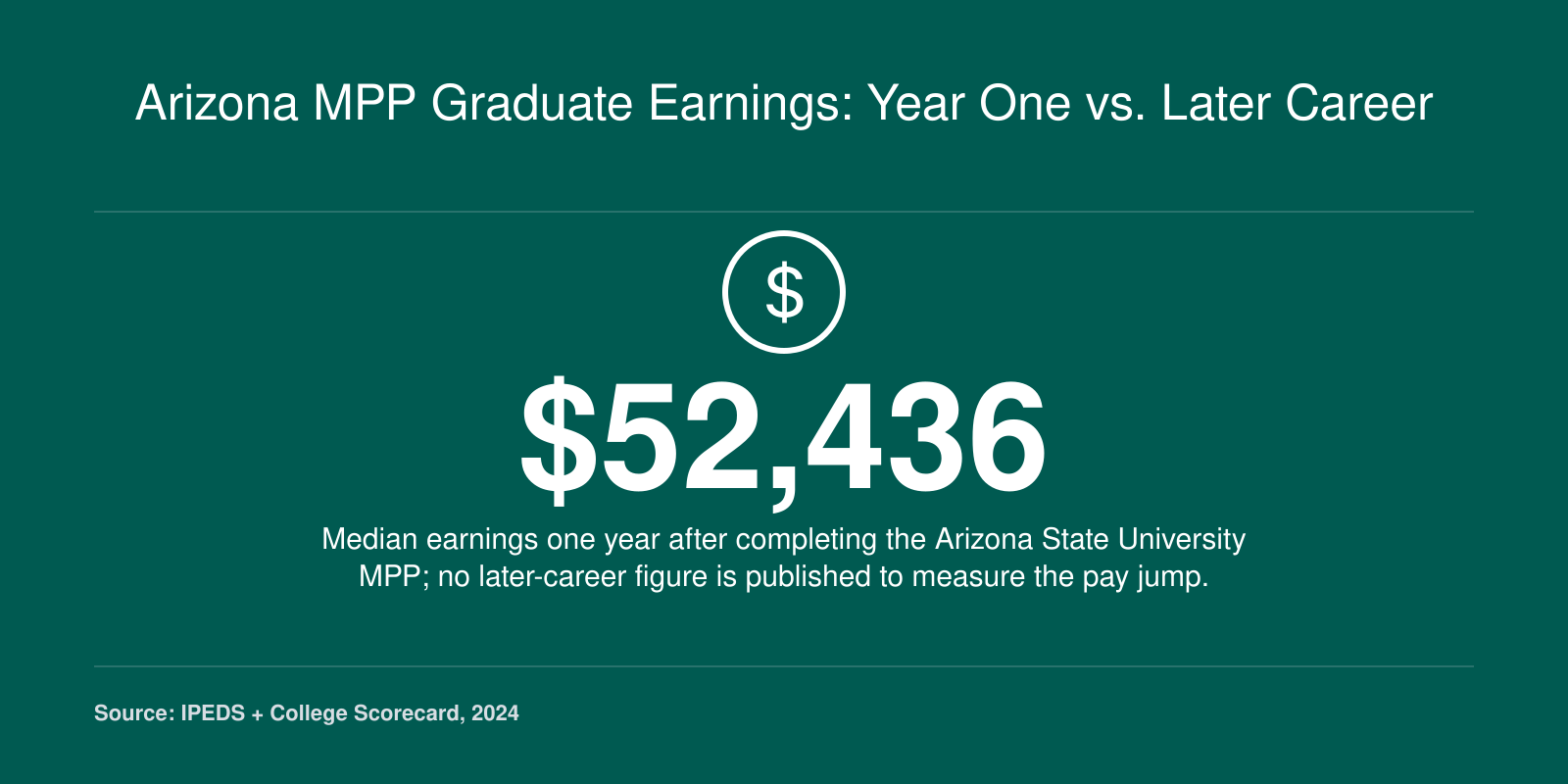
Federal data gives a program-level earnings figure only for Arizona State University's Master of Public Policy, and only for one year after completion. Neither University of Arizona nor Grand Canyon University has a published program-level figure, and no later-career window is reported for any school here. A year-one versus later-career comparison would be guesswork, so the chart shows the one verified number.
Career Outcomes and Salaries for Arizona Public Policy Graduates
What do Arizona MPP graduates actually earn, and does the debt pay off? Start with Arizona State University, which reports graduates earning a median of about $52,400 one year after completing the public policy master's. Weigh that against program-level borrowing: ASU graduates carry a median debt around $12,100, with a typical 10-year repayment near $135 a month. University of Arizona does not publish one-year earnings for its public policy master's, but its typical debt load runs lower, roughly $11,400, with a comparable monthly payment. Early earnings comfortably clear those payments at both schools.
Graduates land across state agencies, Phoenix and Tucson city governments, tribal governments, nonprofits, and policy research centers. The competitive Arizona Legislative Internship, open to graduate students at both universities, places about 50 paid interns each spring with the Legislature, Governor's Office, a state agency, or the Supreme Court,1 with a $6,000 stipend, full tuition waiver, and 9 credits. ASU also flags a Governor's Office budget analyst internship on its ASU School of Public Affairs internship page.
On verifiable value for public-sector careers, ASU edges ahead: documented early earnings.
Arizona MPP Questions Prospective Students Ask Most
These are the questions readers raise most often about Arizona public policy master's programs. Where schools publish no firm figure or policy, we say so and point you to the official page.
Which Arizona university has the top-ranked master's in public policy program?
How much does a master's in public policy cost in Arizona?
When are fall and spring application deadlines for Arizona MPP programs?
Can veterans use GI Bill or Yellow Ribbon benefits toward an Arizona MPP?
Do Arizona MPP programs offer graduate assistantships that reduce tuition?
Can out-of-state students get reduced tuition through WICHE's Western Regional Graduate Program?
How long does a full-time public policy master's take at Arizona schools?
Compare Public Policy programs on the data that matters
Explore more Criminal Justice & Law specializations or browse every graduate field.
All Criminal Justice & Law programs