Accelerated Master's in Public Policy Programs
Compare 200+ accredited fastest Public Policy programs at 140+ schools, with graduate earnings, cost, debt, and completion data from IPEDS and the U.S. College Scorecard.

A traditional MPP takes two years and two years of tuition. A fast-track version compresses that, either by letting undergraduates start graduate coursework early or by packing the degree into twelve months, so the policy master's arrives a year or more sooner and often at a lower total bill.
Three routes dominate: the 4+1 combined BA/MPP, the one-year MPP or MA, and accelerated MPA tracks. The savings are real only when credits double-count and aid carries over, which varies sharply by school.
Key Points
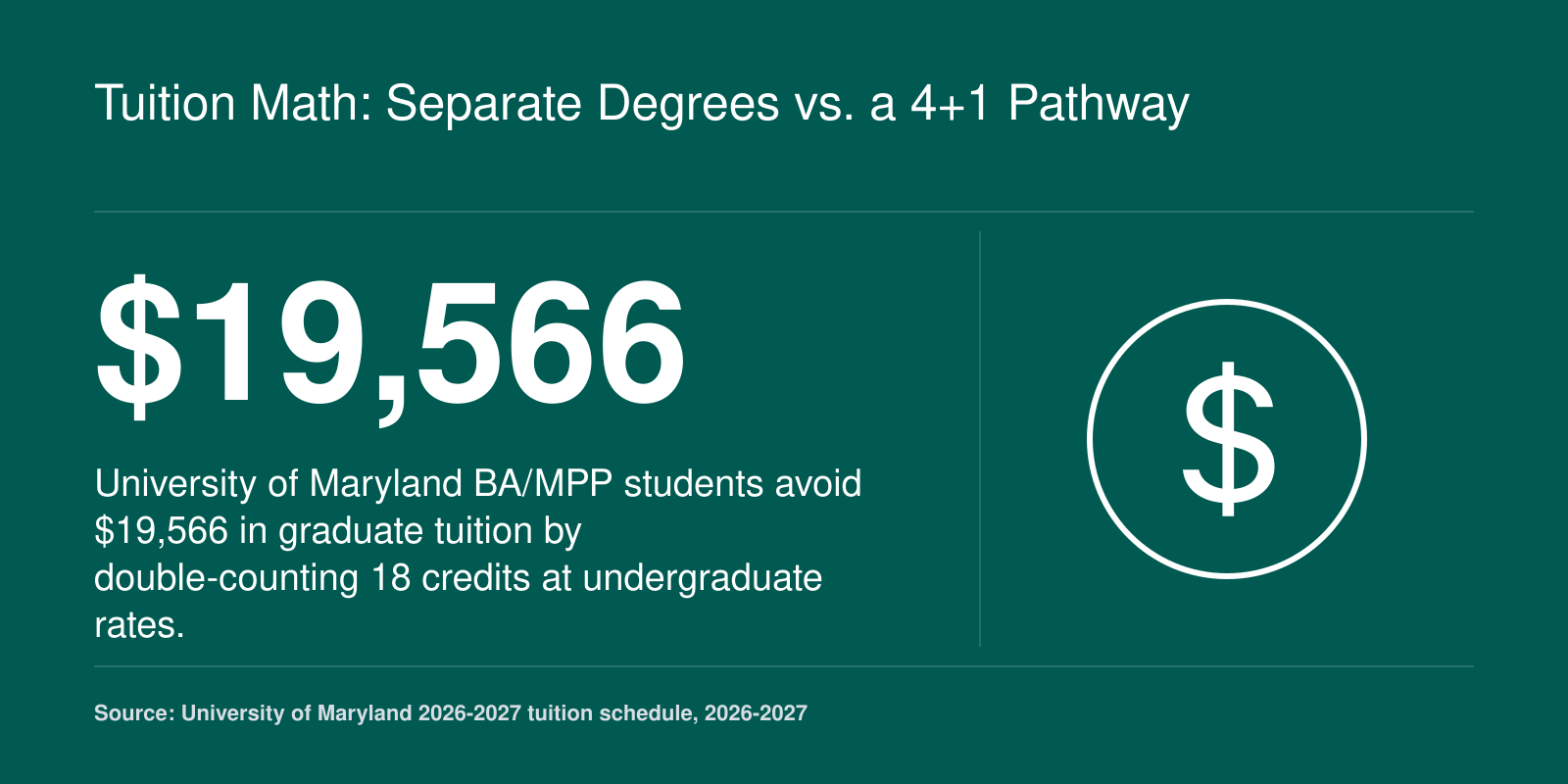
- University of Maryland's 4+1 path saves $19,566 by double-counting 18 credits.
- Princeton MPP graduates report median earnings of $120,163 four years later.
- Some schools bill the entire fifth year at full graduate rates.
Accelerated MPP Program Rankings: 10 Fast-Track Policy Schools
Speed only matters if the degree pays off, so this list weighs how quickly you finish against what graduates earn, what they owe, and what the school costs after aid. Ten policy schools stand out for clear accelerated options, from 4+1 shared credits to one-year cohorts.
Duke University
#1Durham, NC · ~$67,000/yr (est.)
Best for: Duke undergraduates finishing in five years
Duke offers a residential two-year MPP plus a 4+1 for current undergraduates, who still complete the same 51 graduate credits. The program is strong on concentrations and policy analysis, and recent graduates reported median earnings of $85,125 one year after finishing.
- Two-year residential program with 51 graduate credits
- Eight policy concentrations including Energy and Environment Policy
- 4+1 accelerated track for current Duke undergraduates
- Requires microeconomics and statistics prerequisites
- Optional GRE scores accepted
- Summer internship and capstone project required
- NASPAA-accredited with next review in 2028
- Base tuition $61,610 per academic year
University of North Carolina at Chapel Hill
#2Chapel Hill, NC · ~$13,000/yr (est.)
Best for: UNC undergrads using shared graduate credits
UNC's Department of Public Policy offers a 4+1 MPP for current UNC undergraduates, with up to 12 graduate credits counting toward the bachelor's degree. The standard two-year MPP has a December 1 deadline and no GRE requirement, with prerequisites in microeconomics, research design, and statistics.
- Accelerated MPP for current UNC undergraduates
- Up to 12 credits can count toward both degrees
- Apply by December 1 for standard two-year MPP
- Three prerequisites: microeconomics, research design, statistics
- No GRE scores required
- Separate accelerated application deadline September 25
- First and only MPP in the UNC System
Lehigh University
#3Bethlehem, PA · ~$29,000/yr (est.)
Best for: Lehigh students completing one calendar year
Lehigh offers a 30-credit Master of Public Policy that can be completed in a single calendar year, including a dedicated 4+1 path for current Lehigh students. The 4+1 allows graduate coursework in junior and senior years and requires a 3.5 GPA.
- 30-credit graduate program
- Five core courses including policy analysis and public administration
- Can be completed in one calendar year
- Dedicated 4+1 MPP for current Lehigh students
- Requires junior standing and 3.5 overall GPA for 4+1
- Graduate coursework during junior and senior years
- Community Fellowship program with 20 hours weekly work
Northwestern University
#4Evanston, IL · ~$55,000/yr (est.)
Northwestern's School of Professional Studies offers a full-time one-year accelerated MPP and Administration cohort at its Chicago campus, with two on-campus and one to two online courses per term. Separate part-time and full-time tuition structures let students choose pace and format.
- Full-time accelerated option completes in one year
- Part-time option finishes within five years
- Five specializations including Public Policy and Data Analytics
- Full-time courses at Chicago campus with hybrid delivery
- Full-time tuition charged quarterly
- Part-time option not visa eligible
Princeton University
#5Princeton, NJ · ~$66,000/yr (est.)
Princeton's School of Public and International Affairs runs a one-year residential MPP for mid-career professionals with seven or more years of experience. The small cohort focuses on quantitative and policy analysis, and graduates reported median earnings of $85,111 one year after finishing.
- One-year residential program for mid-career professionals
- Requires at least seven years of public or nonprofit experience
- Four fields: International Relations, International Development, Domestic Policy, Economics and Public Policy
- Six-week summer session before fall start
- Cohort of about 20 students
Johns Hopkins University
#6Baltimore, MD · ~$65,000/yr (est.)
Johns Hopkins SAIS offers a one-year, 32-credit Master of International Public Policy for experienced professionals with seven or more years of work experience. The program reports 94% employment or fellowship within six months and median earnings of $97,034 one year after finishing.
- One-year full-time or two to three years part-time
- 32 total credit hours
- Requires at least seven years of professional work experience
- 12 concentration options
- 94% employed within six months of graduation
- Campuses in Washington DC and SAIS Europe
Stanford University
#7Stanford, CA · $60,000 – $65,000/yr (est.)
Stanford's one-year MA in Public Policy is open mainly to current Stanford students, recent alumni, and joint-degree applicants. The 45-unit degree includes policy subplans, a thesis for most paths, and a two-week math and economics bootcamp.
- One-year, 45-unit graduate degree
- Ten concentration options through subplans
- Admission limited to current Stanford students, recent alums, joint-degree applicants
- Requires calculus and economics equivalents
- Two quarters of Public Policy Colloquium
- No-credit math and economics bootcamp
- 3.0 GPA minimum
Carnegie Mellon University
#8Pittsburgh, PA · ~$51,000/yr (est.)
Carnegie Mellon's Heinz College offers a STEM-designated MS in Public Policy and Management with a standard two-year path or a one-year Fast Track for students with prior work experience. The program includes a capstone for a real client and reports median earnings of $68,342 one year after finishing.
- Standard two-year path or accelerated Fast Track for experienced professionals
- Fast Track finishes in three semesters for students with prior work experience
- Four tracks: Flagship Pittsburgh, Data Analytics Pittsburgh, Washington DC, Fast Track
- STEM-designated degree program
- Nearly 95% of public policy students receive a scholarship
- Capstone project solves a client problem
- Applications close December 1, January 10, and February 1
Washington University in St Louis
#9St. Louis, MO · ~$65,000/yr (est.)
Washington University's Brown School offers a one-year, 31-credit Master of Social Policy with a substantial 360-hour internship. It is in person only and emphasizes policy analysis, management, statistics, and specialized policy.
- One-year, 31-credit graduate degree
- 22 core credits plus 6 elective credits
- 360-hour internship May through August
- Placements with nonprofits, government agencies, think tanks
- In-person only; no online degree option
- Policy areas include health, housing, education
Binghamton University
#10Vestal, NY · $10,000 – $15,000/yr (est.)
Binghamton's Master of Public Policy is delivered entirely online asynchronously and can be completed in one year full-time. It focuses on data analysis, policy modeling, and applied projects in a policy laboratory.
- Entirely online asynchronous delivery
- Can be completed in one year full-time
- Focus on data analysis and policy modeling
- Applied projects in policy laboratory
- Affordable online tuition
- Prepares for government, private sector, nonprofit roles
Cost & outcomes by school
Federal data for the highest-earning Public Policy programs, independent of the ranking above. Earnings are this field's master's graduates four years after completing, where the Scorecard reports them.
| School | Earnings | Tuition / yr | Debt | Grads/yr | Format |
|---|---|---|---|---|---|
| Princeton University NJ | $120,163 | $65,936 | — | 92 | Campus |
| Johns Hopkins University MD | $107,692 | $64,730 | $32,114 | 62 | Hybrid |
| Boise State University ID | — | $10,803 | — | — | Online or campus |
| University of Oregon OR | — | $19,474 | — | — | Campus |
Sources: U.S. Department of Education. Tuition and graduates: IPEDS. Earnings and debt: College Scorecard, this field's master's graduates; a dash means no figure is reported.
Cost, debt & payoff
Median earnings of this field's master's graduates (4 yrs after completing) vs. their median federal loan debt · U.S. College Scorecard
Across these programs the median graduate earns about $87,730 and finishes with roughly $41,000 in debt — a ratio that clears a common rule of thumb (keep debt below first-year salary). Tuition and debt vary widely school to school, so check the per-school figures in the table above before you shortlist.
What Is an Accelerated MPP Program?
An accelerated MPP is a Master of Public Policy degree that shortens the usual two years of study, most often by letting undergraduates begin graduate coursework before they finish their bachelor's. In a 4+1 pathway, students take graduate-level policy courses during senior year that count toward both the undergraduate degree and the MPP, cutting total time and master's in public policy cost compared with completing the two degrees separately.
A 4+1 program differs from a one-year MPP or MA, which usually serves mid-career professionals who already hold a bachelor's and work experience and compress the same graduate curriculum into one intensive year. Accelerated MPA tracks use a similar credit-sharing structure but sit on the management side of the public policy and administration field.
The practical distinction for applicants is that an MPP trains policy analysts in economics, statistics, and program evaluation, while an MPA emphasizes budgeting, human resources, and organizational leadership. If your goal is to design and evaluate policy, the MPP is the closer fit; if you want to lead public agencies and programs, the MPA typically aligns better.
What Admissions Committees Expect From Accelerated MPP Applicants
- Home-campus enrollment and standingDuke, UVA, and UNC 4+1 tracks are limited to their own undergraduates; Temple opens the pathway to juniors or seniors from any major.
- Minimum GPADuke and Temple ask for a 3.5 cumulative GPA, while UVA states no GPA cutoff.
- Prerequisite courseworkDuke requires statistics, microeconomics, and ethics; UVA requires microeconomics and calculus; UNC expects microeconomics, research methods, and statistics. Temple lists no prerequisites.
- Application timing and eligible majorsDuke sets an April 20 junior-year deadline, UNC accepts applications in summer or fall of senior year, and UVA and Temple do not restrict majors.
- GRE or test policyDuke lists the GRE as optional for the MPP overall and strongly encouraged without stats/micro; UVA, UNC, and Temple do not publish a separate accelerated-pathway GRE rule.
- Letters and statement of purposeTemple requires two faculty letters and a 500–1000-word goals statement; check each school’s written requirements before applying.
Related Articles
Tuition Math: Separate Degrees vs. a 4+1 Pathway
The savings in a 4+1 pathway come from fewer billed graduate credits and one less year of living costs and lost income. At the University of Maryland, 18 graduate credits double-counted at the undergraduate rate avoid $19,566 in graduate tuition under the 2026-2027 per-credit rate.
Online, Hybrid, or On-Campus: How Accelerated MPPs Are Delivered
Accelerated MPPs are delivered in three main ways: fully on-campus, fully online, or a hybrid that mixes required residencies with online coursework. On-campus and hybrid formats are the most common among these programs. Binghamton's MPP is fully online; Duke, Johns Hopkins, Northwestern, and Carnegie Mellon use hybrid models; Princeton, UNC, Stanford, WashU, and Lehigh are campus-based.
Most 4+1 pathways are residential because they extend an undergraduate program already taking place on campus. Fully online accelerated options, such as William Paterson's 12-month MPP, tend to be one-year professional formats. Hybrid models vary: Northwestern's one-year MPPA combines two on-campus courses with one to two online courses per term, and some programs use weekend residencies or synchronous evening classes.
International students on F-1 visas generally need substantial on-campus enrollment, which makes fully online accelerated tracks less viable for them.
Career Outcomes for Accelerated MPP Graduates
Two programs can post nearly identical earnings and still deliver very different returns once debt enters the picture. Princeton's MPP reports median earnings of $120,163 four years after completion, and Carnegie Mellon's public policy master's reports $114,079 five years after completion. Duke's MPP shows $109,274 four years after completion, with median debt of $66,331 and a 10-year payment of $755 a month. Johns Hopkins' international public policy master's reports $107,692 four years after completion against $32,114 in debt and $365 a month. About 95 percent of Duke's graduates were employed one year after completion. Across the best public policy graduate programs, these are program-wide figures, not accelerated-track outcomes.
Same internships and capstones?
Mostly yes, though no source gives completion or placement data by track. Georgetown's BA/MPP requires an internship and offers the same client-consulting or thesis capstone as the regular MPP. UNC's MPP curriculum lets accelerated students complete the internship in summer, fall, or spring. UMass Amherst's 4+1 includes a summer internship and lists career advising, seminars, and alumni networking, but doesn't expressly confirm equal access. Ask each career office directly.
Public Policy programs by state
Quick Answers on Fast-Track Public Policy Degrees
How much does an accelerated MPP cost from start to finish?
Can I complete an accelerated MPP online?
Do accelerated MPP programs require work experience?
How does an MPA differ from an MPP when both are offered on an accelerated timeline?
Can international students enroll in a 4+1 or one-year MPP?
How selective is UVA's accelerated BA/MPP pathway?
Compare Public Policy programs on the data that matters
Explore more Criminal Justice & Law specializations or browse every graduate field.
All Criminal Justice & Law programs