Best Master's in Public Policy Programs in New Jersey
Compare 11 accredited Public Policy programs in New Jersey at 5 schools, with graduate earnings, cost, debt, and completion data from IPEDS and the U.S. College Scorecard.

Published tuition in New Jersey public policy master's programs runs from $18,349 at The College of New Jersey to $65,936 at Princeton University, a $47,587 spread before financial aid. That gap frames the choice: an Ivy League research campus or public universities in New Brunswick, Ewing, Newark, and Glassboro, all within commuting distance of Trenton, Newark, and New York City.
State and city employers reward policy, budgeting, and quantitative analysis, not the name on the diploma.
Key Points
- Tuition ranges from $18,349 at TCNJ to $65,936 at Princeton.
- Princeton graduates earn a median of $85,111 one year after finishing.
- Policy jobs need no license, but Rutgers-Newark partners on Certified Public Manager training.
Top-Ranked Master's in Public Policy Programs in New Jersey
Five New Jersey institutions offer a master's in public policy, and several list more than one program option. Rutgers-New Brunswick, Rutgers-Newark and Rowan each have separate listings by concentration, so treat those as distinct options at the same school. Budget-conscious in-state students should start with Rutgers or Rowan, which carry the lowest in-state graduate tuition among these listings. Research-focused applicants with substantial work experience may find Princeton's one-year program the stronger fit.
Princeton University
#1Princeton, NJ · ~$66,000/yr (est.)
Best for: Mid-career leaders seeking one-year residency
Princeton's Master in Public Policy, offered through the School of Public and International Affairs, is a one-year residential program built for mid-career professionals with significant public or nonprofit experience. Students choose among four fields of study and train in rigorous quantitative and policy analysis alongside a cohort of about 20. It is the most selective and most expensive option in the state, aimed at people preparing for senior leadership.
- One-year residential program starting with a required six-week summer session
- Four fields: International Relations, International Development, Domestic Policy, Economics and Public Policy
- Designed for mid-career professionals; work experience required
- Cohort of approximately 20 students
- Rigorous quantitative and evidence-based policy analysis training
- Financial aid and scholarships available
Rutgers University
#2New Brunswick, NJ · ~$23,000/yr (est.)
Best for: Career changers wanting concentration variety
Rutgers-New Brunswick runs a NASPAA-accredited, 48-credit Master of Public Policy through the Bloustein School, with 14 concentrations or a self-designed option. The program combines economics, quantitative methods and a 300-hour internship with a group policy research practicum. Students can also cross-register at Princeton's School of Public and International Affairs, and the school's statewide policy infrastructure, including the New Jersey State Policy Lab, is a real advantage for those targeting state government.
- NASPAA accredited, next review in 2031
- 48 credits over two years; no thesis required
- 14 concentrations or design your own
- 300-hour internship and group policy research practicum
- Cross-registration with Princeton's School of Public and International Affairs
- 3.0 GPA minimum; in-person with some synchronous remote courses
- Budget and Finance concentration, a separate listing at the same school
- Three-course concentration requirement with B+ average needed
- Concentration courses from Bloustein or other Rutgers programs
- Applied Field Experience internship
- Health concentration, a separate listing at the same school
- Policy Research Practicum with an agency client
- Up to 12 credits from other Rutgers programs
- Hybrid format with synchronous remote courses
The College of New Jersey
#3Ewing, NJ · ~$18,000/yr (est.)
Best for: Working professionals studying part time near Trenton
The College of New Jersey offers a 36-credit, on-campus Master of Public Policy in Ewing, close to the State House and state agencies in Trenton. The curriculum covers budgeting, the policy process and program evaluation, with data-focused electives such as machine learning and geospatial analysis. Full-time and part-time paths make it practical for government and nonprofit staff who keep working while they study.
- 36 credits across 12 courses; thesis required
- Full time in 18 months to two years; part time in about three
- Tuition of $1,170 per credit regardless of residency
- Rolling admissions
- Core in public budgeting, microeconomics, policy process and quantitative methods
- Electives in health, environmental and data policy, including machine learning and geospatial analysis
- On campus in Ewing, near the New Jersey State House
Rowan University
#4Glassboro, NJ · ~$19,000/yr (est.)
Rowan's 39-credit Master of Public Policy meets face to face on the Glassboro campus, with evening classes for working adults. Students pick a policy field such as criminal justice, diversity and inclusion, or interdisciplinary study, and can finish with a thesis or internship. It offers one of the lowest in-state tuition rates among the listings and serves South Jersey's public-sector and social-policy employers.
- Criminal Justice policy field, a separate listing at the same school
- 39 graduate semester hours, face to face in Glassboro
- Evening classes; full-time or part-time
- Requires a 2.75 GPA, resume, statement of objectives and two recommendations
- Diversity and Inclusion policy field, a separate listing at the same school
- 21 semester hours of required courses plus 12 in elective fields
- Other fields include education, environmental, health and emergency management, and social change
- Thesis or internship option
- Interdisciplinary field, a separate listing at the same school
- Capstone course included
- Fall and spring entry; July 21 fall and November 1 spring deadlines
- May 1 scholarship deadline
Rutgers University-Newark
#5Newark, NJ · ~$23,000/yr (est.)
Rutgers-Newark delivers the Bloustein Master of Public Policy in person in New Jersey's largest city, with select synchronous remote courses. Students complete 48 credits, a 300-hour internship and a policy research practicum, with small classes and faculty mentorship. Newark's location suits students aiming at regional government, nonprofits and think tanks, and its ties to Rutgers' wider public-policy network add research connections.
- Budget and Finance concentration, a separate listing at the Newark campus
- Skills in public budgeting, financial management and economic analysis
- 48 credits over two years of full-time study
- Group research project required
- Economics concentration, a separate listing at the Newark campus
- Core courses in economics and quantitative methods
- Designed for policy analysis careers
- 300-hour internship required
- Environment concentration, a separate listing at the Newark campus
- Policy research practicum with real clients
- Cross-registration with Princeton's School of Public and International Affairs
- Option to design your own concentration
Cost & outcomes by school
Federal data for the highest-earning Public Policy programs, independent of the ranking above. Earnings are this field's master's graduates four years after completing, where the Scorecard reports them.
| School | Earnings | Tuition / yr | Debt | Grads/yr | Format |
|---|---|---|---|---|---|
| Princeton University NJ | $120,163 | $65,936 | — | 92 | Campus |
| Rutgers University NJ | $89,111 | $23,241 | $30,250 | 34 | Hybrid |
| Rowan University NJ | — | $18,607 | — | — | Campus |
| Rutgers University-Newark NJ | — | $23,221 | — | — | Campus |
| The College of New Jersey NJ | — | $18,349 | — | 2 | Campus |
Sources: U.S. Department of Education. Tuition and graduates: IPEDS. Earnings and debt: College Scorecard, this field's master's graduates; a dash means no figure is reported.
Cost, debt & payoff
Median earnings of this field's master's graduates (4 yrs after completing) vs. their median federal loan debt · U.S. College Scorecard
Across these programs the median graduate earns about $89,111 and finishes with roughly $30,250 in debt — a ratio that clears a common rule of thumb (keep debt below first-year salary). Tuition and debt vary widely school to school, so check the per-school figures in the table above before you shortlist.
What Shapes Our New Jersey Public Policy Master's Rankings
Which New Jersey public policy master's programs actually pay off for the money you put in? Every school below earned its place on cost, completion, and outcomes data rather than brand name. The inputs are graduate tuition, average net price, graduation rate, delivery format, and, where College Scorecard publishes them, program-level earnings and debt. Graduation rates cover each whole institution, not the policy program alone, so read them as a signal of overall student support.
Accreditation adds a second check for accredited master of public policy programs. The 2025-2026 NASPAA roster, updated January 2026, lists the Rutgers Bloustein School in New Brunswick and the School of Public Affairs and Administration at Rutgers University-Newark as accredited. Both are next up for review in 2031-2032. You can confirm each university's institutional standing in the Middle States Commission on Higher Education directory.
Online and Hybrid Master's in Public Policy Options in New Jersey
Rutgers University-Newark is the only school here that lists a fully online option, an Online Master of Public Administration.1 None of the ranked Master of Public Policy programs is fully online. Its published details do not say whether coursework is synchronous or asynchronous, so confirm that with the school before you apply.
Rutgers University's New Brunswick MPP is the closest to a mix of formats among master's programs in New Jersey. It is mainly in person, but some courses run remotely and synchronously on Zoom. Princeton's one-year MPP is residential. The College of New Jersey's MPP is on campus in Ewing. Rowan's MPP is face-to-face in Glassboro, with evening classes.
For a working professional in Trenton, TCNJ is the practical pick. It offers a part-time track of roughly 2.5 to 3 years, though it publishes no evening or hybrid schedule. In North Jersey, the Newark online MPA avoids relocation. Rowan's evening classes suit South Jersey commuters.
The trade-off is access. As with the best online master's in public policy programs, online study gives flexibility, but a campus near Trenton makes internships and capstone contacts with state agencies easier to arrange.
Related Articles
GRE Policies at New Jersey Public Policy Master's Programs: Required, Optional, or Waived
Policies below come from each school's admissions pages and can change, so confirm before you apply. Most of the programs in the table are effectively GRE-free, and Princeton's Master in Public Affairs is the clear exception. We did not find a published test policy for The College of New Jersey, Rowan University, or Rutgers University-Newark, so check those admissions pages directly.
| School | Program | GRE Policy | Waiver Conditions | Notes |
|---|---|---|---|---|
| Princeton University | Master in Public Affairs (MPA) | Required (GRE general test) | None. SPIA will not waive the GRE for MPA students. | The GRE is the only exam accepted for MPA applicants. |
| Princeton University | Master in Public Policy (MPP) | Optional, not required | None stated | Policy differs from the MPA at the same school. |
| Rutgers University (Bloustein School) | Master of Public Policy (MPP) | Not required | None needed | No standardized test scores are required for admission. |
| Rutgers University (Bloustein School) | Master of Public Affairs and Politics (MPAP) | Not required | None needed | No standardized test scores are required for admission. |
| Rutgers University (Bloustein School) | Bloustein master's programs, fall 2026 intake | Waived for all master's applications | Applies to applications seeking fall/September 2026 entry | School-wide statement, broader than the MPP and MPAP wording. |
What New Jersey Public Policy Graduates Earn After Finishing
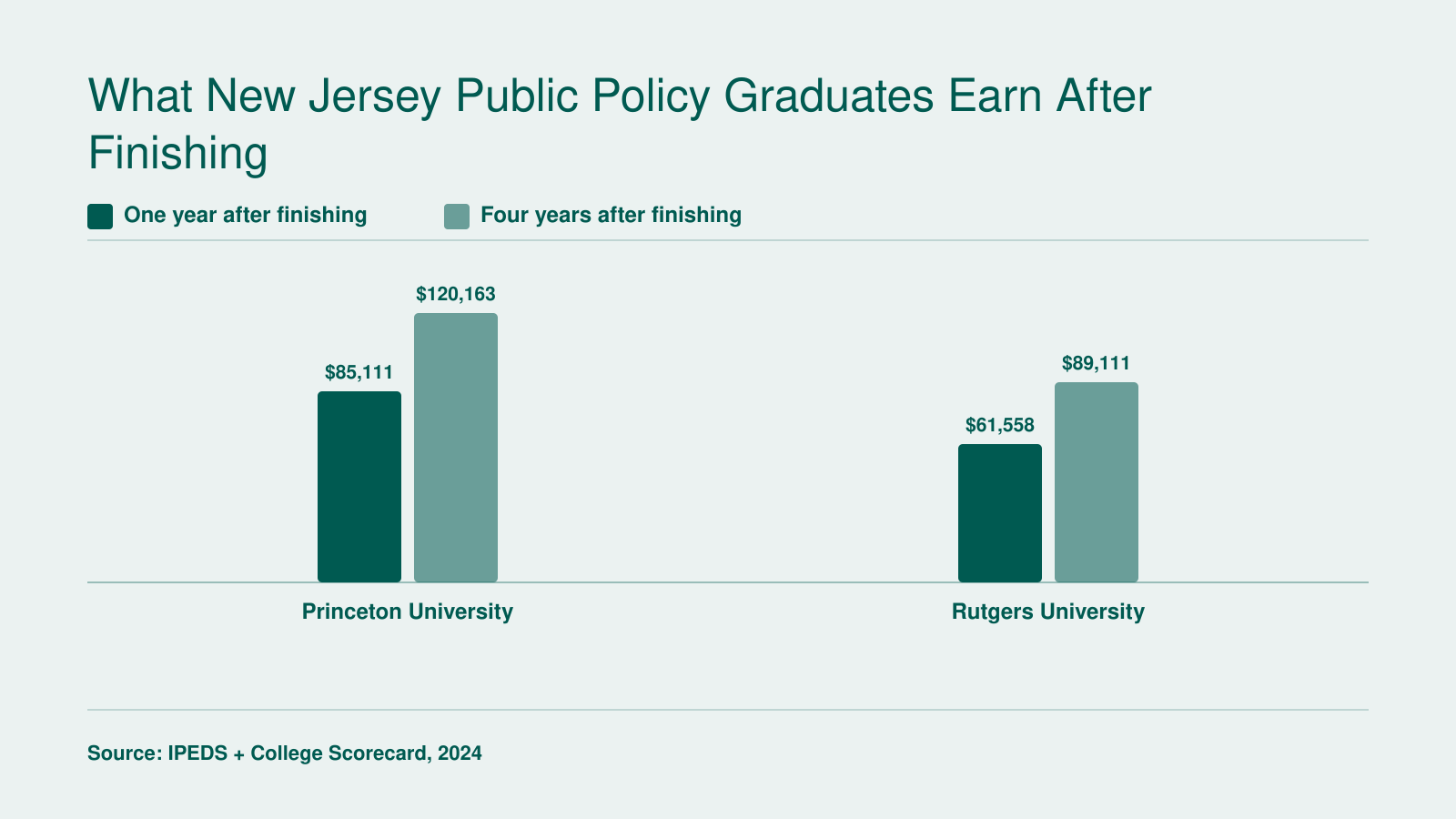
Only Princeton University and Rutgers University publish program-level College Scorecard earnings for their public policy master's programs, so the other schools here are left out rather than filled with institution-wide numbers. Princeton's graduates earn a median of $85,111 one year after finishing and $120,163 four years out. Rutgers graduates earn $61,558 and $89,111 at the same points, and the program's median borrowing is $30,250. Princeton publishes no program-level debt figure. For ROI, earnings at Rutgers grow by about $27,500 between year one and year four, which is close to the size of the median debt, so the cost-to-pay-back ratio looks manageable. Princeton's higher pay comes from a smaller, mid-career cohort, so it is not a like-for-like comparison.
New Jersey Certified Public Manager Program
Master's in Public Policy Costs in New Jersey and Certification Paths
How much does a public policy master's in New Jersey actually cost? Published program tuition runs from $18,349 at The College of New Jersey to $65,936 at Princeton University, a gap of $47,587. Rowan University sits just above TCNJ at $18,607, and both charge the same rate regardless of residency. Rutgers University-Newark charges $23,221 in-state and $37,669 out-of-state. Rutgers University in New Brunswick is nearly identical at $23,241 and $37,689.
Average net price is an approximate institution-wide figure, not a quote for the MPP itself. It runs from $6,128 at Princeton to $27,646 at TCNJ, with Rutgers-Newark at $19,703, Rowan at $22,408, and Rutgers New Brunswick at $24,406.
Weigh tuition against borrowing. Rutgers New Brunswick MPP graduates carry median debt of $30,250, which works out to about $344 a month over 10 years.
No New Jersey license is required for policy analyst roles. The Certified Public Manager credential and a NASPAA-accredited degree are the main signals of readiness for state and local government work. Among the schools here, Rutgers New Brunswick and Rutgers-Newark hold that accreditation.
Questions Applicants Ask About Public Policy Master's Programs in New Jersey
These answers cover the questions applicants raise most often. Deadlines and requirements change each cycle, so confirm details on each program's admissions page before you apply.
Which New Jersey public policy master's program ranks highest overall?
Are there 4+1 or accelerated bachelor's-to-master's public policy pathways in New Jersey?
When are application deadlines for New Jersey public policy master's programs, and do any offer spring starts?
What GPA, transcripts, or work experience do New Jersey MPP programs expect?
Can I transfer graduate credits into a New Jersey public policy master's program?
Can working professionals complete a public policy master's part-time in New Jersey?
Does an MPA with a policy concentration count as a public policy master's degree for employers?
Do New Jersey programs offer assistantships or fellowships for public policy students?
Compare Public Policy programs on the data that matters
Explore more Criminal Justice & Law specializations or browse every graduate field.
All Criminal Justice & Law programs